The U.S. Department of the Treasury reported Tuesday that millions of Americans claimed tax relief under President Donald Trump’s Working Families Tax Cuts during the most recent filing season. According to the analysis, low- and middle-income households received the largest share of the benefits.
According to a June 2 press release from the Treasury Department, taxpayers claimed approximately $82 billion in individual tax relief through the April filing deadline under provisions included in the Working Families Tax Cuts. Treasury officials said the total is expected to increase as taxpayers who requested filing extensions continue submitting returns.
Treasury Secretary Scott Bessent said the data demonstrates that the tax package delivered significant relief to working Americans and families.
“American families and workers overwhelmingly benefited from the Working Families Tax Cuts, receiving the largest share of the historic tax relief delivered this past filing season,” Bessent said. “This analysis confirms President Trump’s tax policies deliver substantial tax cuts to hardworking Americans and provide greater relief and financial certainty to low- and middle-income households.”
While Iran’s economy is in free fall, the regime has chosen to co-opt digital asset technologies for its own corrupt agenda, including evading sanctions and transferring wealth out of the country. Iran’s current economic chaos is proof that @POTUS’ maximum pressure campaign has… https://t.co/CJPNSgccqh
— Treasury Secretary Scott Bessent (@SecScottBessent) June 2, 2026
The Treasury Department stated that without the legislation, taxpayers would have faced the scheduled expiration of the 2017 Tax Cuts and Jobs Act, which officials said would have resulted in approximately $5 trillion in tax increases over time. According to the Treasury, 97% of filers who received a tax cut during the most recent filing season would have owed more in taxes absent the extension of the 2017 tax provisions.
The analysis found that tax relief was concentrated among households earning less than $200,000 annually. The Treasury reported that 96% of filers receiving a tax cut earned less than $200,000 per year, while nearly 70% earned less than $100,000.
Among taxpayers earning between $100,000 and $200,000 who claimed one of the tax provisions, the average tax reduction exceeded $1,250. Taxpayers earning between $50,000 and $100,000 who claimed one of the provisions received an average tax cut of more than $815.
The report highlighted several signature provisions included in the package. The Treasury reported that more than 7.5 million filers claimed the “No Tax on Tips” deduction, receiving an average deduction of more than $7,000. According to the department, 90% of taxpayers claiming the deduction earned less than $100,000 annually, while 99% earned less than $200,000.
More than 29 million filers claimed the “No Tax on Overtime” deduction, with an average deduction exceeding $3,100. The Treasury reported that 75% of taxpayers using the provision earned less than $100,000 annually, while 96% earned less than $200,000.
The department also reported that more than 35 million seniors claimed the Enhanced Deduction for Seniors, receiving an average deduction of more than $7,500. According to the Treasury, 68% of participating seniors earned less than $100,000 annually and 94% earned less than $200,000.
Other provisions cited in the report included the “No Tax on Car Loan Interest” deduction, which the Treasury said was claimed by more than 1.4 million taxpayers purchasing qualifying American-made vehicles. Those taxpayers received an average deduction of more than $1,800. The Treasury reported that 62% of claimants earned less than $100,000 annually and 98% earned less than $200,000.
The Treasury also reported that more than 5.5 million Trump Accounts have been opened since the program’s launch, with approximately 1.4 million qualifying for a $1,000 pilot contribution. According to the department, 86% of the accounts are linked to families earning less than $200,000 annually.
The report further found that nearly 40 million families claimed the enhanced Child Tax Credit, which the Treasury noted was permanently expanded under the legislation. Approximately 65% of participating families earned less than $100,000 annually, while 89% earned less than $200,000.
In addition, the Treasury reported that more than 127 million taxpayers—representing roughly 90% of all filers—claimed the permanently doubled standard deduction during the filing season. The department said the provision continues to simplify tax filing requirements for millions of Americans.
The Republican National Committee is targeting Sen. Ruben Gallego (D-AZ) following reports that Rep. Jimmy Gomez (D-CA) is facing a House Ethics Committee investigation into allegations of sexual misconduct.
The attack comes after Gomez publicly acknowledged an extramarital affair following reporting by the New York Post and amid reports that House investigators are reviewing allegations involving his conduct toward congressional staffers. Gomez has denied violating House rules and has maintained that any relationships were consensual.
In a statement distributed Wednesday, RNC Western Regional Communications Director Nick Poche sought to tie Gallego to Gomez and other congressional Democrats who have faced controversy.
“Ruben Gallego’s sick freak friends prey on women and employees. You are the company you keep, so Gallego needs to answer for what he’s seen, and the people around Gallego need to answer whether or not he is part of the problem as well,” Poche said.
According to the New York Post, Gomez admitted to an affair after initially denying reports concerning his personal conduct. The outlet also reported that allegations involving Gomez’s interactions with congressional staffers prompted a House Ethics Committee investigation. Gomez has disputed allegations that he engaged in misconduct and has stated that he did not violate House ethics rules.
As discussion of the allegations spread online, Brian Anderson of Saguaro Group and Arizona Capitol Oversight highlighted a resurfaced 2018 X exchange involving Gallego, Gomez, and Swalwell.
The RNC statement also referenced former Rep. Eric Swalwell (D-CA), another California Democrat who has faced scrutiny in recent years. Poche argued that Gallego’s political associations with Gomez and Swalwell warranted additional questions about the Arizona senator’s judgment and political alliances.
Gallego served alongside Gomez during his tenure in the U.S. House before winning election to the Senate in 2024. The RNC did not allege that Gallego engaged in any misconduct.
The new scrutiny also follows controversy surrounding Gallego’s comments on allegations of sexual conduct involving Democratic Maine Senate candidate Graham Platner raised by a Fox News report.
FIRST ON FOX: Democratic Maine Senate candidate Graham Platner's deleted Reddit account reveals graphic posts about masturbating in portable toilets and praising explicit military restroom graffiti — the latest in a growing trail of vulgar comments that could define his race… pic.twitter.com/oejepVCv9y
— Fox News Politics (@foxnewspolitics) May 19, 2026
In May, Gallego defended Platner, arguing in a post to X that some of the conduct being criticized reflected experiences and attitudes common in military culture. The remarks drew criticism from Republicans and became a point of contention in Arizona political circles.
As of publication, Gallego’s office had not publicly responded to the RNC statement.
The Arizona Auditor General found that Apache Elementary School District (AESD) improperly received state funding for out-of-state students and more than $27,500 in excess transportation funding, while raising concerns about employee benefits, technology controls, and the future viability of the eight-student district.
The Auditor General’s Office also reported that one audit finding was omitted from the public report because of its “sensitive nature” and was communicated directly to the district’s governing board and management.
According to the audit highlights, AESD, located on the Arizona-New Mexico state border, served just eight students during fiscal year 2024, with four of those students residing in neighboring New Mexico. Auditors found the district failed to comply with state requirements governing the admission and reporting of out-of-state students and improperly received state funding for those students. The report recommended that the district evaluate operational alternatives given the small number of Arizona students it serves.
The audit found that the district improperly claimed funding for out-of-state students and failed to charge tuition as required by state law. Auditors also concluded that the district improperly reported transportation miles associated with transporting out-of-state students to and from their homes in New Mexico, along with other reporting errors.
The report stated that the district “paid parents to transport students but did not ensure that all reported mileage and transported students were eligible for State funding and reported data was accurate.”
According to the report, those errors resulted in the district receiving more than $27,500 in excess transportation funding during fiscal year 2025 that it will likely be required to repay to the state.
The Auditor General recommended that the district work with the Arizona Department of Education to correct its student enrollment and transportation reporting errors and ensure future compliance with state requirements. Auditors also recommended that if the district continues admitting out-of-state students, it should charge tuition in accordance with state law.
In addition to the funding issues, auditors found that the district may have violated the Arizona Constitution’s Gift Clause by providing unauthorized fringe benefits to two employees. According to the report, the benefits were not included in employee contracts and were not approved by the district’s governing board prior to being provided. Auditors recommended that the district consult legal counsel to determine whether a Gift Clause violation occurred and, if so, report its determination to the Arizona Attorney General’s Office.
The audit also identified deficiencies in the district’s cash-handling procedures. Auditors reported that the district did not consistently prepare receipts when cash was collected and did not always make deposits in accordance with required timelines, increasing the risk of loss or theft.
The report further found weaknesses in the district’s information technology controls. According to auditors, employees and external users had excessive access to sensitive computerized data, while the district lacked comprehensive system monitoring, security awareness training, and an IT contingency plan. The Auditor General concluded that these deficiencies increased the risk of unauthorized access to sensitive information, data loss, errors, and fraud.
Auditors also recommended that the district work with the Cochise County School Superintendent’s Office to evaluate alternative operational structures. Potential options identified in the report include consolidating with another school district, operating as a transportation school district, or dissolving the district and requiring students to attend a nearby district.
The report noted that the majority of the district’s administrative spending was “for superintendent and business manager salaries and benefits.”
According to the Auditor General, the district’s governing board had three filled positions during fiscal year 2024, though one board member later resigned and only two of the three positions were filled when the report was issued in May 2026. The district’s small enrollment prevented the Arizona Department of Education from assigning a school letter grade or publicly reporting student achievement data in order to protect student privacy.
In its formal response to Arizona Auditor General Lindsey Perry, AESD agreed with the audit findings and stated it has already begun implementing corrective actions. Superintendent Loy Ann Guzman wrote, “While some recommendations already have been implemented, the district will continue to work diligently to complete administration of the remaining items and will work to improve the processes and procedures moving forward.”
The district reported that it has instituted procedures requiring proof of residency for enrolled students, worked with the Arizona Department of Education to correct enrollment reporting errors, and does not currently plan to admit out-of-state students. The district also agreed to evaluate operational alternatives with the Cochise County School Superintendent’s Office, review potential Gift Clause issues with legal counsel, improve cash-handling procedures, and implement additional information technology safeguards.
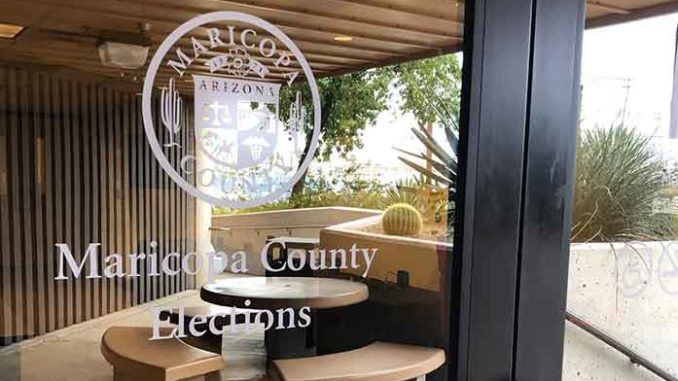
Maricopa County Supervisor Mark Stewart on Wednesday called for better communication and cooperation between county leadership and the Recorder’s Office after Maricopa County Recorder Justin Heap asked a court to hold county officials in contempt. The request is the latest development in an ongoing dispute over election administration authority.
Stewart said the Recorder’s request for contempt findings may reflect a broader breakdown in communication and trust between county officials and the Recorder’s Office.
My statement on the Recorder's recent contempt filing.
— Mark Stewart Maricopa County Supervisor District 1 (@MarkStewart_AZ) June 3, 2026
“The Recorder’s request for contempt findings may be more aggressive than necessary, but it is likely a symptom of the breakdown in communication and trust that has been building for some time,” Stewart said.
Heap argued in an Application for Order to Show Cause that the Board continues to exercise powers that the court determined belong to the Recorder’s Office and has refused to return critical election personnel, systems, and resources to the Recorder’s office.
“The Court settled these issues 43 days ago,” Heap said. “Since then, the Board has refused to comply, continued exercising powers the Court ruled it does not possess, and even interfered with Recorder personnel carrying out their lawful duties at Recorder-operated election sites.”
🚨 MARICOPA ELECTIONS UPDATE
43 days ago, the Court ruled the Board of Supervisors was acting in violation of the law.
43 days later, they still haven't returned the IT staff, systems, and resources the Court ordered restored. Instead, they continued interfering in election… pic.twitter.com/whIXbRzWh6
— Maricopa County Recorder Justin Heap (@azjustinheap) May 30, 2026
Stewart said county officials should accept the court’s ruling in the dispute and focus on implementing the decision ahead of Arizona’s upcoming primary election.
“My view is straightforward. We should accept the court’s ruling, implement it, and move forward,” Stewart said. “As we move forward with implementation, county leadership should carefully consider and prepare operational timelines to ensure a smooth transition ahead of the upcoming primary election.”
The statement follows continued legal disputes between the Maricopa County Recorder’s Office and the Maricopa County Board of Supervisors regarding election administration responsibilities. Stewart said his priority is supporting implementation of the court’s judgment and ensuring county staff have the guidance needed to administer elections effectively.
“The court has ruled. My priority is supporting the execution of the judgment and providing staff with the operational clarity they need to administer elections effectively,” Stewart said.
According to Stewart, he has previously encouraged direct discussions between county leadership and the Recorder’s Office in an effort to reach a negotiated resolution.
“I have worked to encourage direct discussions between county leadership and the Recorder to reach a negotiated solution,” Stewart said. “In my experience, most long-term solutions are achieved around a table, not in a courtroom.”
Stewart said those efforts did not result in a resolution and that the dispute has continued to escalate. While acknowledging the Recorder’s concerns, Stewart said he does not believe contempt proceedings are the best path forward.
“While I understand the Recorder’s frustration, I believe pursuing contempt findings is not helpful at this stage,” Stewart said. “The public is tired of litigation. Voters want their elected officials focused on administering elections, solving problems, and delivering results.”
Stewart reiterated his support for direct discussions between the parties and said long-term success will require rebuilding trust and improving communication between county officials.
“Litigation may resolve legal questions, but lasting solutions and successful operations require communication, trust, and a willingness to work together,” Stewart said.
The supervisor also expressed support for efforts by Supervisor Debbie Lesko to facilitate public discussions between county leadership and the Recorder’s Office.
“I am encouraged that my colleague, Debbie Lesko, is working to bring the parties together for direct public discussions,” Stewart said. “This is something I have been advocating for since early 2025.”
Lesko posted to X on May 29 criticizing Recorder Heap’s decision to request a contempt finding.
“I am once again disappointed that Recorder Heap turns to the court instead of meeting with the Board of Supervisors to resolve our differences in order to run the upcoming elections,” she wrote. “It’s been 9 days since our last invite to meet and we still haven’t heard back from him.”
Stewart concluded by stating that his focus remains on election administration and restoring working relationships between county officials.
“My responsibility is not to relitigate the past,” Stewart said. “My responsibility is to establish secure, transparent, and efficient elections while rebuilding the professional working relationships necessary for long-term success. The voters deserve nothing less.”
Legislation allowing courts to redesignate certain lower-level felony convictions as misdemeanors after successful completion of a sentence passed the Arizona Legislature unanimously. It now awaits action from Arizona Governor Katie Hobbs.
House Bill 2749, sponsored by State Rep. Tony Rivero (R-LD27), would establish a process allowing eligible individuals convicted of certain Class 4, 5, or 6 felonies to petition a court to have those convictions redesignated as Class 1 misdemeanors five years after completing all terms of their sentences.
According to the Arizona House Republican Caucus, the measure received unanimous support in both legislative chambers before being transmitted to the governor’s desk.
“HB 2749 is about accountability, redemption, and common sense,” Rivero said in a statement announcing the bill’s passage. “When someone commits a nonviolent, victimless offense, pays their debt, completes every requirement ordered by the court, and proves for years that they are living the right way, Arizona should not force that person to carry a felony label forever.”
Under the legislation, eligibility would be limited to individuals convicted of non-dangerous offenses that did not involve a victim and who have no prior felony convictions. Applicants must also successfully complete all terms of their sentence before petitioning the court for redesignation.
The bill would not apply to dangerous offenses, offenses involving victims, or individuals with prior felony convictions.
According to the Senate fact sheet, the legislation would permit a court to redesignate an eligible felony conviction as a Class 1 misdemeanor if the court determines the person meets the statutory requirements and redesignation is appropriate. The measure does not provide for automatic redesignation and leaves the final decision to the court.
Rivero said the legislation is intended to help individuals who have demonstrated rehabilitation overcome barriers that can remain long after completion of a sentence.
“This bill protects public safety, excludes victim crimes, and gives deserving people a fair chance to work, find housing, support their families, and fully rejoin their communities,” he said.
According to the legislative fact sheet, the bill applies only to a limited category of felony convictions and requires individuals to affirmatively petition the court for relief. Courts would retain discretion in determining whether redesignation is warranted in each case.