Republican gubernatorial candidate and U.S. Rep. Andy Biggs (R-AZ05) says Arizona’s affordability crisis cannot be solved by housing policy alone, arguing that water management, utility costs, state trust lands, natural resource development, and election integrity all require a new approach under the state’s next governor.
In an exclusive interview with AZ Free News, Biggs outlined what he described as the core priorities of a potential administration, saying Arizona’s long-term prosperity depends on responsible resource management while restoring confidence in state government.
“The affordability of housing” is the state’s biggest economic challenge, Biggs said.
“It gets attention, but it doesn’t encompass everything that’s related to it,” he continued. “The water issue is massive, and it goes hand in glove with housing.”
Biggs argued that utility costs, water availability, and management of Arizona’s natural resources all contribute to the state’s affordability challenges.
“But the one aspect to this all that’s not being addressed in this administration… is how do you manage the state’s natural resources, including state trust land?” Biggs said. “That is going to be critical going forward on affordability issues in the state and viability of long-term economic success.”
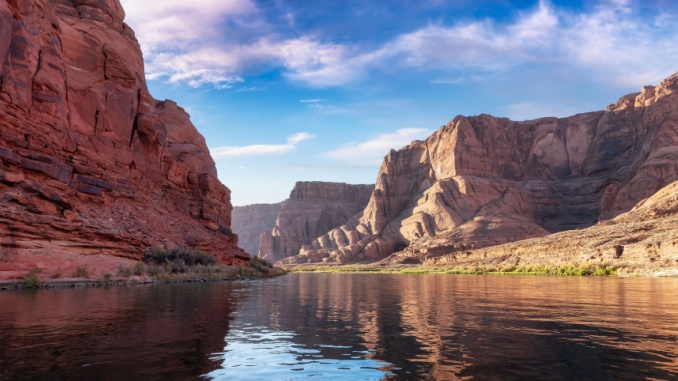
For Biggs, water policy remains central to that vision. Biggs said Arizona must play a far more active role in negotiations over the future of the Colorado River rather than allowing federal agencies to dictate the outcome.
“You have to be engaged,” Biggs said.
He said he has met with officials from the United States Bureau of Reclamation, the United States Department of the Interior, the United States Department of Agriculture, the United States Department of Commerce, and the United States Department of Defense, arguing Arizona’s water allocation should reflect the state’s importance to national food production, semiconductor manufacturing, commerce, and defense.
“I’m encouraging all of them… to redo the environmental impact statement so it actually considers the national food security issue… the national defense sector… and the microchips and the industry,” Biggs said.
He also credited bipartisan work with Democrat Rep. Greg Stanton (AZ-04) to secure additional conservation funding for Lower Basin states and said Arizona’s advocacy helped encourage releases from Flaming Gorge Reservoir to stabilize Lake Powell.
Biggs also called for expanded forest thinning, continued livestock grazing, removal of invasive salt cedar, and responsible development of Arizona’s mineral resources.
“We have 26 of the critical minerals necessary in this state,” Biggs said. “You’ve got to figure out a way to use that and allow for extraction and development in a very rational and sane way.”
Addressing another growing issue, Biggs said he supports data center development but opposes taxpayer incentives.
“I sat down with multiple brokers for data centers and said, ‘Look, here’s the deal. No special breaks. No special benefits,'” Biggs said.
Instead, he said developers should finance their own electrical generation and water infrastructure without reducing resources available to existing residential or commercial customers. “We’re going to allow you guys to develop your power… provided that you do not encroach on current and future commercial and residential users.”
A policy report released by the Goldwater Institute in February warned that Arizona’s growing role as a national hub for data centers could be undermined by municipal regulations driven by concerns over water use, electricity demand, and land use.
On elections, Biggs said restoring public confidence would be among his first priorities if elected governor.
He pointed to Gov. Katie Hobbs’ veto of a Florida-style election integrity bill earlier this year and pledged to sign similar legislation if elected.
“One of the first bills I will sign is that Florida-style election integrity bill in January of 2027,” Biggs said.
Asked about the legal dispute between the Maricopa County Recorder’s Office and the Maricopa County Board of Supervisors over election administration, Biggs declined to side with either party but said he has spoken with both.
“I think both sides truly want us to have a fair, transparent election,” Biggs said. “They need to get this thing sorted out quickly.”
Biggs said he believes Arizona can become “the leader on election integrity” by the end of a potential administration.
The congressman is facing fellow Congressman David Schweikert (R-AZ01), business owner Ken Miceli, and entrepreneur Scott Neely for the Republican gubernatorial nomination in the primary and has centered much of his campaign on affordability, border security, government reform, and economic growth.
A groundwater fee provision backed by Rep. Chris Lopez (R-LD16) has been included in Arizona’s FY2027 budget, extending Pinal County agricultural water fee relief through 2030 and giving irrigation districts additional time to use funds for groundwater and irrigation efficiency projects.
The provision is part of HB 4159, the environment budget reconciliation bill signed by Gov. Katie Hobbs on June 13 and enacted as Chapter 131 of the 2026 session laws. The law amended state groundwater statutes by extending the period during which no groundwater withdrawal fee is levied in the Pinal Active Management Area (AMA) for Arizona water banking purposes from 2026 to 2030. It also extends through 2030 the $ 2.50-per-acre-foot annual fee cap for groundwater and irrigation efficiency projects in the Pinal AMA.
Lopez introduced the policy earlier in the session as HB 2827. The introduced version listed Lopez as the primary sponsor, with Reps. Gail Griffin (R-LD19), Teresa Martinez (R-LD16), Michele Peña (R-LD23), and James Taylor (R-LD29) also listed as sponsors.
Pinal County farmers are getting needed relief and long-term certainty.
Thanks to Rep. Chris Lopez (@lopezforarizona), the FY2027 budget extends key pump tax relief through 2030, allowing farmers and irrigation districts in the Pinal Active Management Area to keep and reinvest… pic.twitter.com/bNKzMFxHpZ
— Arizona House Republicans (@AZHouseGOP) July 7, 2026
Lopez serves as vice chair of the House Natural Resources, Energy & Water Committee and represents Legislative District 16, which includes portions of Pinal and Pima counties.
The Temporary Groundwater and Irrigation Efficiency Projects Fund provides money for projects tied to construction and rehabilitation of wells and related infrastructure for qualified irrigation districts in the Phoenix AMA, Pinal AMA, and Harquahala Irrigation Non-Expansion Area. Under Chapter 131, groundwater withdrawal fees collected in the Pinal AMA for groundwater and irrigation efficiency projects are deposited into the fund and used solely to construct and rehabilitate wells and related infrastructure in the Pinal AMA.
The law also extends the distribution schedule for unencumbered fund money. The previous June 30, 2027, deadline for distributing remaining funds to contributors is moved to June 30, 2032, with proportional distribution by Dec. 31, 2032. The repeal date for the Temporary Groundwater and Irrigation Efficiency Projects Fund is extended from March 31, 2028, to March 31, 2033. HB 4159 also extends the repeal date for the Arizona System Conservation Fund from March 31, 2027, to March 31, 2031.
Lopez said that, with ongoing Colorado River negotiations, the extension was needed to “provide stability for irrigation districts” preparing for reduced Colorado River water. He also said the measure helps “keep Pinal money in Pinal” and allows irrigation districts to upgrade wells and switch from open canals to closed-pipe systems, which he said conserves water by reducing evaporative losses.
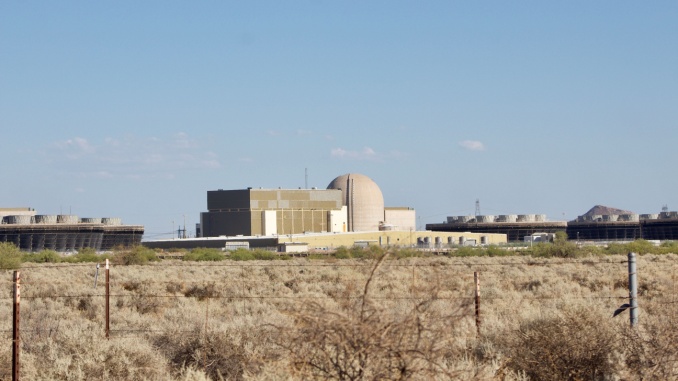
Republican gubernatorial candidate and U.S. Rep. Andy Biggs (R-AZ05) says Arizona should embrace an expanded nuclear future, backing additional reactors at Palo Verde Generating Station while positioning the state to become a national leader in small modular reactor technology.
In an exclsuive interview with AZ Free News, Biggs voiced unequivocal support for expanding Arizona’s nuclear generating capacity as electricity demand continues rising from population growth, advanced manufacturing, and data centers.
“I’m 100 percent behind it,” Biggs said when asked about expanding Palo Verde. “I think they need to be located there.”
His comments come as Arizona utilities continue to pursue license renewals that would allow Palo Verde’s three existing reactors to operate into the 2060s. Palo Verde was also originally envisioned with additional generating capacity, including Units 4 and 5, expansion plans first contemplated in the 1970s and revisited in 2006.
Separately, Arizona Public Service (APS), Salt River Project (SRP) and Tucson Electric Power (TEP) announced in February 2025 that they were working together to identify potential sites for an entirely new nuclear power plant to meet growing energy demands.
“New nuclear generation could provide Arizona with reliable, around-the-clock carbon-free energy to power economic growth while helping us make progress toward a clean energy future,” TEP President and CEO Susan Gray said in a news release at the time. “We know the development timeline would be long, so it makes sense for our state’s energy providers to begin this preliminary evaluation as soon as possible.”
Biggs also expressed strong support for small modular reactors, commonly known as SMRs.
“I’ve been supportive of the development of SMRs,” he said.
The Arizona legislature considered House Bill 2795 in February, which aimed to ease regulatory barriers for next-generation nuclear power projects in rural Arizona. However, the measure failed to pass in the State Senate.
While Biggs cautioned the technology is probably “not going to be scalable for five to 10 years,” he said Arizona should move aggressively to secure one of the first demonstration projects.
One location stands above the rest, according to Biggs. He said, “We’re advocating that Luke Air Force Base gets an SMR—one of the first nine or 10 that the administration is insisting needs to be there by the end of 2027.”
Biggs said he has been working alongside fellow Arizona Republican members of Congress, including Reps. Paul Gosar (R-AZ09), Eli Crane (R-AZ02), and Abe Hamadeh (R-AZ08), to encourage the effort.
“We want to be on the cutting edge of that. Because I think SMRs are the wave of the future,” Biggs said.
He also said recent meetings with energy-sector officials reinforced that view.
“I just talked to an energy group last week, and they agree SMRs are the wave of the future. And that’s where we need to be going.”
Biggs also tied nuclear development to Arizona’s broader economic future, saying reliable baseload power will be essential as advanced manufacturing, semiconductor production, artificial intelligence, and data centers continue expanding throughout the state.
Although he said he supports data center investment, Biggs argued such projects should proceed without taxpayer subsidies or preferential treatment.
“No special breaks. No special benefits,” he said.
Instead, Biggs said developers should be responsible for securing their own electrical generation—including SMRs where appropriate—while ensuring existing residential and commercial ratepayers are not displaced by new industrial demand.
His comments come as Arizona utilities and policymakers increasingly examine nuclear energy as part of the state’s long-term strategy to meet growing electricity demand while maintaining grid reliability.
Biggs is seeking the Republican nomination for governor, making energy development one of several major policy areas he says will shape Arizona’s long-term economic competitiveness.
The Goldwater Institute has filed a motion in Maricopa County Superior Court seeking to intervene on behalf of two Air Force veterans in a lawsuit challenging a proposed constitutional amendment that would protect certain scholarship funds for children of military families.
The motion was filed on behalf of Nickolas Kupper and Robert Figueroa, whom Goldwater identified as Air Force veterans whose children currently participate in Arizona’s Empowerment Scholarship Account (ESA) program. The proposed intervenors are seeking to defend House Concurrent Resolution 2048, the “Military Families College Savings and Scholarship Protection Act,” which the Legislature recently referred to the November 2026 ballot.
The lawsuit was filed by the Protect Education Accountability Now Committee, Save Our Schools Arizona, and voter Linda May Lyon against the State of Arizona and Secretary of State Adrian Fontes. According to Goldwater’s motion to intervene, the plaintiffs are asking the court to block HCR 2048 from appearing on the November ballot.
Arizona's military families don't deserve to have their children's educational opportunities ripped from their hands. That's why we're stepping up to defend them. https://t.co/ayRcX5JbBE
— Goldwater Institute (@GoldwaterInst) July 2, 2026
Goldwater said in a July 2 announcement that Kupper and Figueroa are seeking to defend the measure because their families have used ESA funds for years and have a direct interest in the outcome of the litigation.
“Proposed Intervenors seek to intervene as Defendants to defend the constitutionality of House Concurrent Resolution 2048 (‘HCR 2048’), the ‘Military Families College Savings and Scholarship Protection Act,’ which is a legislative referral passed to protect the educational stability of military families,” the motion states.
HCR 2048 proposes adding a new section to Article XI of the Arizona Constitution. Under the measure, the state could not confiscate funds from the scholarship account of a child of a military family if the account is maintained under a state program that designates such students as eligible and allows the funds to be used for tuition or fees at eligible postsecondary institutions.
The measure defines a “child of a military family” as a student who is the child of a person serving on active duty in the U.S. armed forces, who was serving on active duty when the student’s eligibility was initially determined, or who was killed in the line of duty.
The proposed amendment also contains a nonseverability provision. If a future law or voter-approved measure violates the military-family scholarship protection, the entire conflicting law or measure would be void, and a court could not sever only the offending portion.
The House passed HCR 2048 initially on March 2, the Senate passed it on June 12 by a 16-13-1 vote, and the House passed the final reading on June 13 by a 31-22-7 vote.
Goldwater’s motion argues that Kupper and Figueroa have a right to intervene because the lawsuit directly threatens their ability to secure long-term constitutional protections for their children’s education funding.
“By seeking to keep HCR 2048 off the ballot, Plaintiffs directly threaten to block Proposed Intervenors’ ability to secure long-term constitutional protections for their children’s educational funding,” the motion states.
The filing also argues that the existing government defendants cannot adequately represent the families’ specific interests. Goldwater said Fontes is defending the measure as a neutral election administrator, while Kupper and Figueroa are defending the substantive validity of the proposed amendment because their children rely on ESA funds.
In its July 2 statement, the Goldwater Institute said, “The Arizona Constitution is clear: Arizona voters have the right to amend the state constitution, and the Military Families Protection Act would trump the activists’ efforts to cripple the scholarship opportunities currently afforded to Arizona military families and others.”
The lawsuit comes as ESA opponents are also seeking to place the Protect Education Act on the ballot. Save Our Schools Arizona says the proposal is intended to “reform Arizona’s universal ESA voucher program” and increase transparency and accountability.
The Protect Education Campaign announced last week that it submitted 421,451 signatures to the Secretary of State’s Office.
The Protect Education Act proposal would require unused ESA money to revert to the state and be directed to public schools, and it would bar families making more than $150,000 annually from joining the program. It would also ban ESA spending on non-educational or luxury items and require the Arizona Department of Education to report how much voucher funding each school receives.
HCR 2048 could conflict with the Protect Education Act because the proposed constitutional amendment would block future laws or ballot measures from changing the protected scholarship-account funds for military families.
Goldwater argued in its motion that the litigation is directly tied to that conflict, saying an adverse ruling could remove HCR 2048 from the ballot and leave the families’ ESA accounts vulnerable to “regulatory and financial rollbacks” under the competing Protect Education Act.
“Without HCR 2048, Proposed Intervenors’ educational accounts will remain highly vulnerable to systemic legislative and political volatility, including the exact regulatory and financial rollbacks slated under Plaintiffs’ competing ‘Protect Education Act,’” the motion states.
Kupper and Figueroa are asking the court to allow them to enter the case as defendants, either as a matter of right or by permission. They also said they intend to file a motion to dismiss the plaintiffs’ claim rather than expand the litigation with counterclaims.
The case is assigned to Maricopa County Superior Court Judge Joseph Kreamer.
One year after President Donald Trump signed the Working Families Tax Cut Bill into law, U.S. Rep. Andy Biggs (R-AZ05) defended the legislation as a cornerstone of the nation’s economic recovery, arguing it prevented what he described as a massive tax increase while expanding tax relief for families, workers, and small businesses.
In an exclusive interview with AZ Free News earlier this week, Biggs, who is also running for Arizona Governor, said the legislation’s most immediate accomplishment was preserving tax relief that otherwise would have expired.
“I think what you’re seeing is, the biggest success, is you stopped a $4 trillion tax increase,” Biggs said. “That would have been economically really, really bad for the country—maybe the death knell.”
Biggs said extending the 20 percent deduction for qualifying small businesses and preserving immediate business expensing provisions were among the bill’s most significant accomplishments. He also pointed to Treasury Department estimates indicating many families could see larger tax savings.
“According to the Treasury Department, the average family is going to see somewhere north of $2,000,” Biggs said, adding that other estimates range between $1,500 and $2,000. “That provides money to the economy and stimulus to the economy and helps the working men and women of this country.”
The congressman said some provisions are only beginning to show their long-term effects, particularly expanded domestic energy and natural resource development.
“I think people are getting… that a lot more federal land is being opened up for oil, gas, coal, minerals, whatever those natural resources are,” Biggs said. “Years from now, looking back, people will say, ‘Man, that really was one of the most critical things that could have happened for us.'”
Biggs also cited provisions eliminating federal taxes on tips, reducing taxes on overtime income, and providing tax relief for seniors receiving Social Security benefits as measures designed to increase disposable income while stimulating economic activity.
Critics of the legislation, such as Arizona Senate Minority Leader Priya Sundareshan (D-LD18), have argued it disproportionately benefits higher-income Americans and could increase the federal deficit, as reported by The Center Square. Biggs rejected both claims.
“The problem that we have is not a revenue problem in Washington, D.C.,” Biggs said. “It is a spending problem.”
He argued that economic growth generated by lower taxes ultimately produces additional federal revenue.
“What you do get is more economic activity,” Biggs said. “More taxes ultimately get paid and go into the federal government.”
Looking ahead, Biggs said a future Republican Congress should consider additional tax reductions for businesses while encouraging domestic manufacturing and development of critical mineral resources.
“If you want to stimulate jobs,” he said, “you’d find a way to reduce some of the corporate tax policy… and pass those along to sole proprietors and small firms as well.”
Although Biggs described the legislation as comprehensive, he said one area he wished Congress had addressed more aggressively was healthcare policy.
“One thing that we didn’t take care of, in my opinion… is we did nothing really on healthcare costs in the One Big Beautiful Bill,” Biggs said.
He said he had introduced legislation to expand Health Savings Accounts and increase their portability, adding that Rep. Eric Burlison of Missouri had proposed similar but broader reforms.
“I would have liked to see us do more on tax policy related directly to healthcare as well,” Biggs said.
Speaking with KTAR’s Mike Broomhead Monday, Biggs also discussed fraud in Medicaid and the Indian Health Services program. In a post to X sharing a clip he wrote, “When we root this waste out, we’ll get taxpayer dollars back in the pockets of Arizonans so families and businesses can thrive.”
There’s still billions of fraud in Arizona, especially in Medicaid and our Indian Health Services program.
When we root this waste out, we’ll get taxpayer dollars back in the pockets of Arizonans so families and businesses can thrive.
Looking ahead to a possible Biggs administration, he said future state tax policy should continue focusing on healthcare affordability and higher education while complementing the broader economic approach established by the federal legislation.
“The affordability of housing” remains Arizona’s largest economic challenge, Biggs said, arguing that utility costs, water policy, and management of state trust lands all play significant roles in addressing long-term affordability.
Biggs, who declined to seek another term in Congress to run for Governor, said Arizona has already incorporated many of the federal tax provisions into state law, though he criticized Gov. Katie Hobbs for initially vetoing related legislation before later signing it.