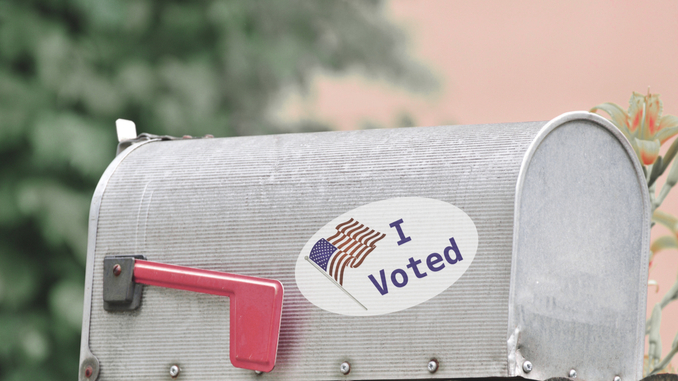
Protect the Vote Arizona will not submit signatures for its proposed Free, Fair and Secure Elections Act, ending the group’s effort to place a constitutional amendment that supporters said would preserve early voting and mail-in voting on Arizona’s November ballot.
The campaign said it collected 439,000 raw signatures with the help of more than 2,000 volunteers after filing the initiative in mid-March, but the measure needed 383,923 valid signatures by July 2 to qualify for the ballot.
Stacy Pearson, who led the campaign, said the raw signature total would have required nearly 88 percent of the signatures to be validated. She said the campaign made a “strategic decision” not to turn over the petitions, citing Maricopa County Recorder Justin Heap by name.
“Facing an impossible 88 percent validity requirement, the campaign made a strategic decision to not turn over the signatures of hundreds of thousands of mail-in voting supporters to the very election-denying politicians (i.e. Maricopa County Recorder Justin Heap) that this measure was designed to protect against,” the campaign said in a statement.
BREAKING: Protect the Vote Arizona's election initiative won't be on the ballot this year.
The group didn't collect enough signatures and decided not to give supporters' information to "the very election-denying politicians… that this measure was designed to protect against." pic.twitter.com/AMVKTZzPWH
“The Protect the Vote Arizona team is filled with gratitude for the encouragement, support and hard work across the state,” the group said.
The campaign said it will now focus on challenging HCR 2001 in court and supporting what it called “pro-democracy candidates” in November.
The Free, Fair and Secure Elections Act would have amended the Arizona Constitution to enshrine voting by mail, early in-person voting, Election Day voting at county voting centers, and the ability of voters to sign up to receive a ballot for every election.
The campaign also said the measure would have codified Arizona’s voter ID requirements, required election outcomes to be determined by votes cast by eligible U.S. citizen voters, and barred the Legislature from eliminating mail-in voting or reducing the early voting period.
Protect the Vote Arizona’s decision leaves HCR 2001, also known as the Arizona Secure Elections Act, as a major statewide election measure on the issue currently headed to voters.
The measure would require every voter to show valid government-issued proof of identity before casting a ballot “whether voting in person or by any other method,” require Arizona elections to be decided solely by the votes of eligible citizen voters, prohibit foreign nationals from contributing or spending money to influence Arizona elections, and give voters the option to have their ballot tabulated at their voting location on Election Day.
The measure would also allow Arizona voters and the Legislature to enact laws governing elections, including early voting and mail voting, if those laws are “rationally connected to a legitimate state interest,” including timely and accurate election results, efficient election administration, election security, and preserving public confidence in elections.
HCR 2001 would apply to elections taking place on or after Jan. 1, 2028, if approved by voters. The enrolled text designates the measure as the “Fast Accurate Secure Transparent Election Results Act” or “FAST Election Results Act.”
Rep. Alexander Kolodin (R-LD3), the Scottsdale Republican who sponsored HCR 2001, told lawmakers in March that there were “many potential options” for implementing the ID requirement for mail ballots, including a system in which county recorders would issue voters a unique identification number and require voters to write the last four digits on their ballot envelope.
Votebeat reported that if two Arizona ballot measures with conflicting provisions were to pass, the measure receiving more votes would take effect. With Protect the Vote Arizona no longer submitting signatures, that potential ballot conflict has been removed.
State Representatives Quang Nguyen and Selina Bliss (R-LD1) met Sunday with Pocket Fire incident command at the Sedona Airport air operations base as the wind-driven wildfire north of Sedona continued to grow and threaten nearby communities.
The Pocket Fire had burned 5,547 acres as of Sunday morning, with 871 personnel assigned to the incident. The fire was first reported June 19 about seven miles north of Sedona and is burning in steep, rugged terrain that limits where crews can safely attack it directly. By mid-Monday, the fire had grown to 11,192 acres with zero percent containment.
The fire more than doubled in size between Saturday evening and Sunday morning as strong winds pushed it northeast. Fire crews shifted resources toward threatened communities and continued using bulldozers and other heavy equipment to build defensive lines. By Monday, the blaze had roughly doubled again.
Coconino County’s Pocket Fire information page said the fire began on June 19 on the Coconino National Forest, is burning in difficult-to-access terrain, and is expected to remain active for several weeks. The county listed Oak Creek Canyon, Kachina Village, Forest Highlands and Pine Del under SET evacuation status and encouraged residents susceptible to smoke to take precautions.
As of Sunday afternoon, Oak Creek Canyon Zones 14 and 15, Kachina Village and Forest Highlands remained under SET status. State Route 89A remained closed to nonlocal traffic between Sedona and Interstate 17, and portions of the Coconino National Forest remained closed.
Nguyen and Bliss requested the briefing to hear directly from incident command, determine whether additional state assistance is needed, and provide residents with current information. Fire officials thanked Yavapai County, Coconino County, the Arizona Department of Transportation, the Arizona Department of Public Safety, and other agencies assisting with the response.
“This is our district, and we have a duty to know where the threat is moving, what crews need and whether the state can do more,” Nguyen said. “We came to hear directly from incident command and see the operation firsthand. The men and women fighting this fire are working in dangerous conditions, and we stand ready to help secure any state resources they need.”
Bliss urged residents in SET areas to prepare before conditions worsen.
“SET means prepare now, not later,” Bliss said. “Pack medications, important documents and supplies. Account for family members and pets. Know where you will go, monitor official alerts and leave immediately if ordered. Do not wait for GO status to start preparing.”
Coconino County Emergency Management ordered activation of the county Emergency Operations Center (EOC) on Friday due to critical fire weather in connection with the Pocket Fire and to assist with an APS Public Safety Power Shutoff. The county said the EOC provides support and coordination for multi-agency and multi-jurisdictional emergencies affecting residents, businesses, property, and infrastructure.
The U.S. Forest Service said earlier in the incident that resources assigned to the Pocket Fire included Hotshot crews, engines, helicopters, air attack, and other firefighting assets, with the Southwest Area Incident Management Team 2 ordered to assume command after initial response by a Northern Arizona Type 3 Incident Management Team.
Nguyen and Bliss also honored three federal firefighters killed Saturday in a burnover incident while assigned to the Knowles and Gore fires near the Colorado-Utah border. Two other firefighters were injured.
“The deaths of three firefighters this weekend are a painful reminder of the dangers wildland firefighters face to protect others,” Nguyen and Bliss said. “We mourn them, pray for the injured and remember the six lost in the Dude Fire and the 19 Granite Mountain Hotshots. At the height of fire season, the public must do its part: obey restrictions, prepare early and never interfere with crews on the line.”
Coconino County has activated a Pocket Fire call center for questions about the fire, shelters or evacuation stages at 928-679-8525. County officials also said areas of Coconino County within and adjacent to the Coconino National Forest moved to Stage 2 fire restrictions effective Tuesday, June 30, at 8 a.m..
Officials urged residents to monitor Coconino County Emergency Management, Coconino National Forest, InciWeb, and AZ511 for current fire, evacuation, closure, and road information. They also warned the public not to fly drones near the fire because unauthorized aircraft can ground firefighting planes and helicopters.
U.S. Rep. David Schweikert (R-AZ01), chairman of the Joint Economic Committee (JEC), warned that the United States faces growing fiscal risk unless Congress acts sooner to stabilize the federal debt-to-GDP ratio.
Schweikert sent the committee’s latest Views and Estimates letter to House Budget Committee Chairman Jodey Arrington in a letter earlier this month.
“There is great uncertainty about when and how the debt will switch from sustainable, business as-usual, to an unsustainable, market-unraveling nightmare,” Schweikert wrote. “Every year we wait to change course increases leverage, and the higher the debt-to-GDP ratio the easier it is for bad headwinds—such as crisis spending or interest rate fragility—to lock us into a debt spiral. In short, allowing the debt burden to increase is a levered bet, and the downside risks are already enormous.”
JEC Chairman @RepDavid sent @HouseBudgetGOP Chairman @RepArrington the latest Views & Estimates. “There is great uncertainty about when & how the debt will switch from sustainable, business as-usual, to an unsustainable, market-unraveling nightmare. https://t.co/pPMp4K17EP
— Joint Economic Committee Republicans (@JECRepublicans) June 8, 2026
The committee’s Republican staff found that rising federal debt is structurally unsustainable and that stabilizing the debt-to-GDP ratio will require large early policy changes. The letter states that delaying action materially increases the risk of severe economic and financial consequences.
According to the letter, federal debt has recently reached 100 percent of gross domestic product, meaning the federal debt is now roughly the size of the economy’s total annual output. The Congressional Budget Office projects debt held by the public will reach 118 percent of GDP by 2035, 142 percent by 2045, and 172 percent by 2055. Treasury projections cited in the letter are higher, estimating 129 percent by 2035, 183 percent by 2045, and 245 percent by 2055.
The JEC letter describes the current debt path as a “levered bet on stability” that depends on avoiding major crises requiring substantial fiscal headroom and on future interest rates remaining favorable relative to economic growth. The letter warns that the damage to the nation’s fiscal position and status as a world power could be “catastrophic and irreversible” if those conditions deteriorate.
The committee cited estimates from the Committee for a Responsible Federal Budget indicating that a fiscal adjustment of about $9.5 trillion over ten years would be needed to stabilize the debt-to-GDP ratio at about 100 percent. The JEC letter used a similar ballpark estimate of about $9.2 trillion to close the primary deficit over a ten-year window, while noting that the exact adjustment would depend on interest rates, economic growth, the timing of policy changes, and the path of the primary deficit.
“In any case, these are magnitudes of adjustment virtually absent from current policy debates,” the letter states.
The letter recommended reforms in Medicare, international taxation, and immigration that it estimated would produce about $3.6 trillion in deficit reduction over ten years, or roughly 40 percent of the adjustment identified as necessary to stabilize the debt-to-GDP ratio.
The largest proposed savings would come from Medicare Advantage reform. The letter states that Medicare Advantage now covers 55 percent of all Medicare beneficiaries and that flawed payment policies, excessive coding practices, insufficient enforcement, and federal inaction have driven up costs. According to the JEC, Medicare Advantage beneficiaries are now estimated to cost roughly 14 percent more than they would under traditional Medicare, amounting to an estimated $76 billion in excess federal spending in 2025.
The letter cites H.R. 3467, the Better Medicare Act, as a proposal to realign Medicare Advantage incentives. The JEC estimated the legislation would reduce federal spending by approximately $1.8 trillion over ten years.
In a Fox Business appearance posted to X by Schweikert’s office, Schweikert described what he called “institutional design fraud,” citing his team’s investigations into New York and California “where they’re exploiting part of the Medicaid system for billions and billions and billions of dollars.”
Federal prosecutors say a $30 million Medicaid scheme meant for children’s mental health services helped pay for a fleet of luxury vehicles. That is bad actor fraud.
But the real bleeding is coming from New York and California exploiting parts of Medicaid for billions and… pic.twitter.com/jFyGJr3JAC
“If New York actually had the same cost in their Medicaid system,” he continued, “it would be a $50 billion savings a year if they had the same costs as other states. That’s actually where the tremendous amount of money is, because remember, we’re borrowing about a million dollars every 15 seconds. So, the scale is what’s just so hard to get your head around.”
The committee also recommended a border adjustment tax policy, which would tax business income based on where products are sold rather than where they are produced. Under the proposal, export receipts would be excluded from the tax base and import deductions would be disallowed. The JEC estimated the policy could raise approximately $1.5 trillion over ten years.
On immigration, the committee recommended shifting employment-based admissions toward higher-producing applicants through a points-based, industry-targeted framework. The letter states that an aging population and a shrinking pool of younger workers are reducing the labor force needed to grow the economy and service the debt. The JEC estimated that such a reform could produce a net fiscal benefit of $335 billion over ten years and $1.34 trillion over twenty years, assuming annual immigration remains at current levels.
Schweikert has raised the alarm regarding demographic decline as a driver of fiscal collapse, citing three unassailable facts: “debt, deficits and demographics,” in March 2025.
The letter also credited H.R. 1, commonly known as the One Big Beautiful Bill Act, with pro-growth tax provisions. The JEC said policymakers should redirect their focus toward “transparently pro-growth reforms” and cited federal land sales, reforms of the Jones Act, and policy related to port automation as examples of areas that could support growth.
Schweikert’s letter concluded that growth alone should not be counted on to resolve the federal government’s fiscal problems.
“I have highlighted fiscal reforms that would bring us about 40 percent of the way to stability of the debt-to-GDP ratio,” Schweikert concluded in the letter. “While there is strong potential for increasing economic growth as a partial solution, we should not count on growth alone to address our fiscal problems.”
Congressman Juan Ciscomani (R-AZ-06) launched his first television ad of the 2026 campaign cycle last wek, highlighting his background as a legal immigrant, work history, and support for legislation restricting members of Congress from trading stocks.
The ad, titled “Work For You”, was released in both English and Spanish and is available to view on the campaign’s YouTube account. The spot centers on Ciscomani’s family story and his argument that public office should be focused on service rather than personal financial gain.
“Twenty years ago, I became an American citizen,” Ciscomani says in the ad. “We immigrated to the United States and started with nothing. Dad drove a bus. Mom cleaned houses. Five of us in a two-bedroom apartment.”
20 years ago, I became an American citizen 🇺🇸
My dad drove a bus. My mom cleaned houses. Like many, we've worked hard toward our American Dream.
That's why I stood up to both parties to ban insider trading by Members of Congress.
Ciscomani immigrated to the United States as a child and grew up in Tucson, according to his official biography, where his father worked as a bus driver. As a child, he attended Tucson public schools, then Pima Community College and the University of Arizona, while working maintenance and service jobs before becoming the first member of his family to graduate from college.
“The opportunity to pursue our American Dream changed my life, but it’s not just my story – it’s the story of countless families across the country who simply want an opportunity to build a better future,” Ciscomani said in a campaign statement. “Families are working too hard to watch Washington politicians put themselves first. Arizonans deserve leaders who never forget where they came from, why they’re there in the first place, and who they work for. I don’t work for Washington. I work for you.”
The ad points to Ciscomani’s support for legislation aimed at congressional stock trading as a highlight of his freshman term. In the spot, Ciscomani says he “stood up to both parties” to cosponsor legislation banning insider trading by members of Congress.
Federal records list Ciscomani among the cosponsors of H.R. 7008, the Stop Insider Trading Act, introduced in January by House Administration Committee Chairman Bryan Steil (R-WI). The bill’s full title states that it would amend federal law “to require certain restrictions on stocks for Members of Congress and their spouses and dependents.”
The House Administration Committee said the Stop Insider Trading Act would prohibit members of Congress, their spouses, and dependent children from purchasing publicly traded securities. The committee said the bill would also require members to file public notice at least seven days, and no more than 14 days, before selling covered investments.
The committee said the proposal would require the House Ethics Committee to impose a fee equal to $2,000 or 10 percent of the value of the covered investment, whichever is greater, along with any net gain realized from the sale.
H.R. 7008 is currently pending consideration on the House floor after passing the Committee on House Administration in February 2026.
Rep. Eli Crane’s bill to expand the U.S. Capitol Police’s authority to respond to drone threats near the Capitol complex advanced through the House Administration Committee on Wednesday.
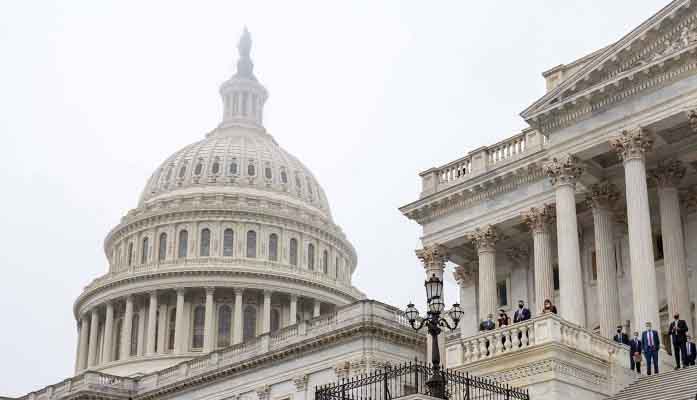
The U.S. Capitol Police Empowerment Act, sponsored by Crane (R-AZ-02), would authorize the Capitol Police Board and designated U.S. Capitol Police personnel to take action against unmanned aircraft systems that pose a credible threat to covered Capitol Police facilities or assets. The House Administration Committee unanimously advanced the measure during its June 24 markup.
Crane introduced the bill on May 13, 2025, with Reps. Scott Perry (R-PA) and Barry Moore (R-AL), as original cosponsors. Rep. Abe Hamadeh (R-AZ-08) later joined the measure as a cosponsor.
In a post to X, Crane wrote, “After meeting with the U.S. Capitol Police, I learned they lacked explicit authority to intercept drones on the complex.”
After meeting with the U.S. Capitol Police, I learned they lacked explicit authority to intercept drones on the complex.
My bill would allow the USCP to take decisive action to protect Members of Congress, staff, and constituents on Capitol Hill:https://t.co/IldB8bmEma
Under the bill text, the Capitol Police Board could authorize Capitol Police personnel assigned to protect people, facilities, or assets to mitigate a credible threat posed by an unmanned aircraft system. The bill would allow Capitol Police to detect, identify, monitor, and track a drone; warn its operator; disrupt control of the aircraft; seize or exercise control of it; confiscate it; or use reasonable force, if necessary, to disable, damage, or destroy it.
“The evolution of drone warfare has drastically changed both the battlefield and the threats to our national security,” Crane said. “My bill would grant the USCP the ability to take decisive action to protect Members of Congress, staff, and constituents on Capitol Hill.”
The legislation would require the Capitol Police Board to coordinate with the Secretary of Transportation and with the Federal Aviation Administration when an action could affect aviation safety, civilian aviation or aerospace operations, aircraft airworthiness, or the use of airspace.
The bill also includes privacy provisions. Regulations or guidance issued under the measure would have to ensure that interception or use of communications to or from a drone is conducted in a manner consistent with the First and Fourth Amendments and applicable federal law. The bill would limit the acquisition of communications to what is necessary to support authorized action and would generally bar retention of those records for more than 180 days unless one of several exceptions applies.
The measure would also require the chief of the Capitol Police, or another individual designated by the Capitol Police Board, to submit reports to Congress within six months of enactment and every six months thereafter. Those reports would have to cover actions taken under the authority, effects on the National Airspace System, privacy and civil liberties procedures, communications retained or shared outside Capitol Police, and any new technology or equipment deployed under the program.
The proposal comes as federal rules already restrict drone activity in Washington, D.C. The FAA says the National Capital Region is governed by a Special Flight Rules Area within a 30-mile radius of Ronald Reagan Washington National Airport, with unmanned aircraft flights prohibited inside the 15-mile inner ring without specific FAA authorization.
The U.S. Capitol Police also identifies Washington, D.C., and the U.S. Capitol Grounds as a “No Drone Zone.” Capitol Police regulations prohibit unmanned aircraft on Capitol Grounds, and violations can carry arrest, a $300 fine, 90 days imprisonment, and additional federal civil or criminal penalties.
Crane’s office said he drafted the bill with input from committees of jurisdiction, including House Administration, Transportation and Infrastructure, Judiciary, and Homeland Security. The bill was referred to the House Administration, Transportation and Infrastructure, and Judiciary committees after introduction.
Crane has also introduced the DEFEND Act, a separate piece of legislation aimed at broader civilian drone threats, and, alongside Rep. Ciscomani, targeted drone interference with wildfire response efforts with the Wildfire Aerial Response Safety Act of 2025.