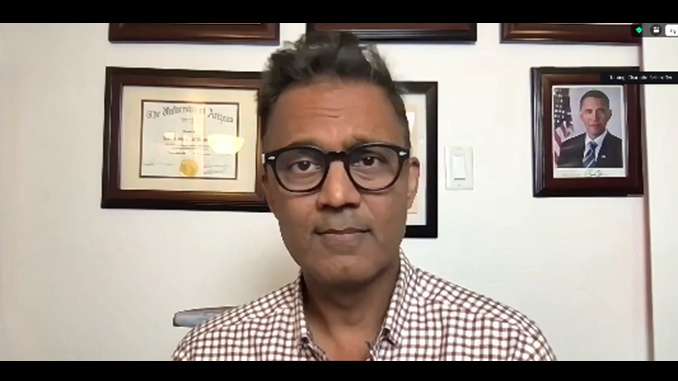
Goldwater Institute attorneys urged the Arizona Supreme Court on Tuesday to allow Arizona State University (ASU) professor Owen Anderson to pursue his lawsuit alleging that the school’s “Inclusive Communities” employee training violated state law.
During oral arguments in Arizona Board of Regents v. Anderson, Goldwater Institute Vice President for Litigation Jon Riches argued that the Arizona Court of Appeals applied the wrong legal analysis when it concluded that Anderson had no implied private right to enforce the statute in court.
If a legal right exists, so does the right to enforce it.
That's the case we made before the Arizona Supreme Court today on behalf of @dr_owenanderson, a professor at ASU who is fighting for his right NOT to be forced into discriminatory DEI training. pic.twitter.com/OoPngHtixm
“Where there is a legal right, there is a legal remedy, is one of the oldest maxims in Anglo-American law,” Riches told the justices. “For decades, this court has applied that principle to find implied causes of action where a statute does not expressly create them. Yet without citing a single one of this court’s cases, the lower court did exactly what this court commanded it not to; it treated legislative silence as dispositive as to whether a statute creates a cause of action. But as this court [has held], legislative silence begins rather than ends the inquiry.”
In a post to X on Tuesday, Anderson invoked the legal maxim in Latin, writing, “‘ubi jus ibi remedium’ if there is a right there is a remedy. A cornerstone principle of common law. Yet @ASU and @AZRegents are asking the @AZCourts to suspend this principle and keep me as an employee from holding them responsible for racist DEI training.”
Anderson also shared a clip from the hearing in which Justice Clint Bolick characterized the right-remedy maxim as “the indispensable common law principle” and invoked Chief Justice John Marshall’s discussion of the principle in the landmark 1803 decision Marbury v. Madison.
Following the hearing, Anderson posted a statement saying, “That was an excellent hearing today before the @AZCourts. Jonathan Riches for @GoldwaterInst presented a solid case. The Justices asked the @AZRegents lawyer questions that exposed the contradiction at the heart of their claims, with their lawyer at one point stumbling so badly as to say, ‘I forgot the question.’ Oops! Now we wait for a decision.”
That was an excellent hearing today before the @AZCourts Jonathan Riches for @GoldwaterInst presented a solid case. The Justices asked the @AZRegents lawyer questions that exposed the contradiction at the heart of their claims, with their lawyer at one point stumbling so badly…
The Supreme Court limited its review to whether the Court of Appeals failed to apply the factors established in the court’s 1988 Transamerica Financial Corp. v. Superior Courtdecision before finding that A.R.S. § 41-1494 provides no implied private right of action.
Those factors include the statute’s context and language, its subject matter, its effects and consequences, and the law’s overall purpose. Riches argued that the lower court improperly treated the Legislature’s silence about a private cause of action as conclusive instead of beginning the broader analysis required under Transamerica.
The Arizona Board of Regents asked the justices to uphold the appellate ruling. In its supplemental brief to the Supreme Court, the board argued that courts should begin with the statutory text and consider secondary factors such as legislative history, consequences, and purpose only when the text is ambiguous.
The board maintained that § 41-1494 regulates government conduct without creating a private right or remedy. It also pointed to the statute’s annual compliance-reporting requirement and argued that lawmakers left enforcement to elected officials. The board said nearly all surrounding statutes contain express private rights of action, indicating that the Legislature deliberately omitted one from § 41-1494.
The statute prohibits the state, its agencies, and political subdivisions from requiring employees to undergo training, orientation, or therapy that presents blame or judgment based on race, ethnicity, or sex. It also prohibits the use of public money for such training and directs the Arizona Department of Administration to submit an annual compliance report to the governor and legislative leaders.
Anderson’s case began after ASU informed employees in October 2022 that they were required to complete its “Inclusive Communities” training. Anderson, a philosophy and religious studies professor, filed suit against the Board of Regents in 2024, seeking declaratory and injunctive relief.
Anderson alleges that the training presented prohibited concepts involving race, sex, and identity. His court filings cite training materials discussing “whiteness,” white supremacy, heterosexual privilege, land acknowledgments, and efforts to “decolonize the university.” The accompanying examination identified designated answers concerning systemic bias, transformative justice, and the incorporation of diversity, equity, inclusion, and belonging throughout the university.
A Maricopa County Superior Court judge found that the statute contained no express private cause of action but concluded that it implied one for employees subjected to prohibited training. The Arizona Court of Appeals reversed that decision in December, finding that the statute “unambiguously does not create a private right of action.”
The Court of Appeals left Anderson’s underlying allegations about the training unresolved. The Supreme Court’s current review also concerns the enforcement question rather than whether the content of ASU’s training violated § 41-1494.
The Board of Regents has disputed that the training was mandatory. Anderson said the alleged injury arose from being required to undergo the training.
“Well, I think the hurt is in taking the training, and so I would ask them to consider it from their perspective if they were asked to sit through hours of training that involved racial discrimination against a group they identify with, they would be offended by that and feel hurt,” Anderson said. “So the hurt — the consequence — is just in the fact that I had to sit through that.”
Anderson previously asked the Supreme Court to accept the case after the appellate ruling, arguing that public employees would otherwise lack an effective way to enforce the training prohibition. Goldwater’s petition sought recognition of an implied private cause of action allowing employees to challenge alleged violations by government employers.
The Supreme Court took the case under advisement following Tuesday’s arguments. Anderson said that he intends to proceed toward trial if the justices recognize his right to bring the claim. The court has not announced a deadline for its decision.
Federal officers arrested a man identified as a person of interest in the fatal shooting of Tucson Police Department recruit Carlos Ramirez as he attempted to enter the United States through the Douglas Port of Entry.
Alexis Monter, 30, approached the port’s pedestrian lane at approximately 7:53 p.m. on Sunday. During the inspection process, a CBP officer checked Monter’s information and received an active National Crime Information Center (NCIC) warrant, according to a CBP announcement.
The warrant identified Monter as a person of interest in the shooting of a Tucson police recruit and advised officers to consider him armed and dangerous. CBP officers detained Monter and contacted the Douglas Police Department, which took custody of him at approximately 8:42 p.m.
“The vigilance of our officers at the Douglas Port of Entry is critical to the safety of our communities,” Douglas Area Port Director Martin Gomez said. “By identifying and apprehending this individual, our officers have ensured that a dangerous subject is removed from the streets and held accountable for his alleged actions.”
CBP described the underlying investigation as the shooting of a Tucson police recruit without identifying Ramirez by name. KVOA connected Monter’s arrest to the Ramirez case, and KOLD reported that Monter was arrested in connection with the Aug. 19 shooting.
ANOTHER ARREST IN TPD RECRUIT KILLING: We just received this release from CBP saying 30-year-old Alexis Monter was arrested in connection to the death of TPD recruit Carlos Ramirez. We've asked PCSD why we're just finding out, and how many suspects there actually are in this… pic.twitter.com/7Tr2ylkt4g
The CBP announcement did not specify Monter’s suspected role in the shooting, disclose the offense listed in the warrant, or identify any charges filed against him following his transfer to Douglas police.
Ramirez, 23, was found shot to death inside his home in the 7700 block of South Enchanted Spring Drive during the early morning hours of Aug. 19. His pregnant fiancée, a Pima County Sheriff’s Department corrections officer, was shot in the shoulder. She and her unborn child survived.
An interim complaint filed in the case states that Ramirez’s fiancée heard banging outside their bedroom before Ramirez told her to retrieve a gun from a safe because two masked men were inside the home. Ramirez fought with the masked men before shots were fired.
Investigators obtained surveillance footage showing a dark Acura SUV leaving the area. Additional footage showed Alex James Barnett and Santiago Jorge Rogers at a gas station near West Valencia Road shortly before the shooting.
Rogers, 39, was arrested on Aug. 22 at a hotel near South Palo Verde Road and charged with first-degree murder and aggravated assault. A judge ordered him held without bond. Barnett, 33, surrendered on Aug. 24 following a three-hour standoff at an apartment complex near Broadway Boulevard and Camino Seco. A judge set his bond at $2 million in the Ramirez case and ordered him held without bond for an alleged probation violation.
Ramirez had completed 23 weeks of training at the Southern Arizona Law Enforcement Training Center and was scheduled to graduate on Aug. 27 with Basic Recruit Class 26-1. His classmates honored him during the graduation ceremony, where his brother, an Arizona Department of Public Safety trooper, accepted Ramirez’s badge and presented it to his fiancée.
The investigation into Ramirez’s killing remains ongoing.
Democratic congressional nominee Amish Shah is facing fresh criticism from the National Republican Congressional Committee (NRCC) over his support for taxpayer-funded health care for illegal immigrants. The NRCC is pointing to Shah’s call for a “wholesale repeal” of the tax-and-spending law President Donald Trump signed in 2025.
During an April candidate forum, Shah was asked what he would do about the law commonly known as the One Big Beautiful Bill Act. The Trump administration and the U.S. Centers for Medicare & Medicaid Services (CMS) refer to Public Law 119-21 as the Working Families Tax Cut.
“So number one, repeal the tax cuts,” Shah said in a video released by the NRCC. “Yeah, I’ve called for a wholesale repeal of the One Big Beautiful Bill Act. … I think it’s abominable.”
The NRCC argues that repealing the entire law would also reverse its immigration-related healthcare restrictions and rescind billions of dollars provided for immigration enforcement and border security.
LEAKED: AZ Democrat @DrAmishShah said, "So #1, repeal the tax cuts! Yeah, I’ve called for a wholesale repeal" … "Yes!"
Socialist Shah would raise taxes on Valley families by OVER $4,000 and end No Tax on Tips/Overtime/Social Security. AZ can't afford Socialist Shah! pic.twitter.com/JOfaelDmtl
“If Socialist Amish Shah got his way, criminal illegal immigrants would be back on free healthcare while Arizona families foot the bill,” NRCC spokesman Ben Petersen said in a statement provided to AZ Free News. “Every step of the way, Amish Shah backed radical open borders policies that led to the worst border crisis in American history and he’d do it all over again.”
Shah did not mention immigration or Medicaid in the cited portion of the forum. His remarks called for repealing the broader law and its tax provisions.
The legislation became Public Law 119-21 when President Trump signed it on July 4, 2025. It combined tax provisions with changes to Medicaid, food assistance, energy policy, and immigration enforcement.
The law narrows the categories of noncitizens eligible for federally funded Medicaid and Children’s Health Insurance Program benefits beginning Oct. 1. Under guidance issued by the CMS, federal Medicaid and Children’s Health Insurance Program (CHIP) funding generally will be limited to U.S. citizens, U.S. nationals, lawful permanent residents, Cuban and Haitian entrants, and migrants covered by the Compact of Free Association.
The restrictions will affect some immigrants lawfully present in the United States, including refugees and people granted asylum. Across Medicaid, CHIP, Medicare, and Affordable Care Act marketplace coverage, the Congressional Budget Office (CBO) estimated that the law’s combined immigration-related provisions would leave approximately 1.4 million lawfully present immigrants uninsured by 2034.
Illegal immigrants were already ineligible for comprehensive federally funded Medicaid coverage before the 2025 law. Federal matching funds were, and remain, available when a patient requires emergency treatment and would otherwise qualify for Medicaid apart from immigration status.
CMS said the new law preserves federal matching funds for emergency treatment. It also preserves state options to cover lawfully residing children and pregnant women through Medicaid or CHIP.
A separate provision caps the federal reimbursement rate for emergency Medicaid at each state’s standard matching rate beginning Oct. 1, rather than the enhanced rate available for the Medicaid expansion population. Repealing that provision would restore the previous reimbursement formula for emergency care. It would not establish comprehensive Medicaid eligibility for people living in the country illegally.
The 1.4 million figure cited by the White House and Republican organizations during the bill’s 2025 debate came from a separate CBO analysis of the earlier House-passed version.
The Congressional Budget Office determined that approximately 1.4 million people whose immigration or citizenship status was unverified could lose coverage because states would face a reduced federal Medicaid matching rate if they continued operating state-funded health programs for illegal immigrants.
“Those 1.4 million people currently are covered under state-funded programs alone,” the CBO wrote. “Their health insurance coverage does not involve federal funding.”
Shah has focused his opposition to the law on its wider healthcare provisions. In a July 2025 guest commentary for the Arizona Capitol Times, the emergency room physician called the law “a logistical failure, professional betrayal, a moral outrage and a national disgrace.”
The law also contains major appropriations for border and immigration enforcement. It provides $4.1 billion to hire and train additional Customs and Border Protection personnel, including Border Patrol agents, Office of Field Operations officers, and Air and Marine agents. Another $2.05 billion is designated for retention, hiring, and performance bonuses.
The law appropriates $29.85 billion for Immigration and Customs Enforcement activities through fiscal year 2029, including hiring and training additional personnel. It also allocates billions for border barriers, detention capacity, transportation, and state reimbursement.
A wholesale repeal of the One Big Beautiful Bill, codified as Public Law 119-21, would require Congress to decide which tax, healthcare, immigration, and spending provisions to eliminate or replace. Shah has not released a detailed proposal for repeal legislation specifying how he would treat each provision.
Federal authorities arrested 95 commercial truck drivers identified as illegal aliens during a multi-agency enforcement operation in Arizona’s Yuma Sector, with more than three-quarters carrying commercial driver’s licenses (CDLs) issued by California.
The U.S. Border Patrol conducted the operation with local law enforcement partners from Aug. 10 through Aug. 14, resulting in 143 arrests involving individuals from 18 countries, according to U.S. Customs and Border Protection (CBP).
Of the 95 truck drivers arrested, 76 possessed California CDLs, while six held licenses issued by New York. CBP said the remaining licenses came from other states but did not identify them individually.
The operation also intercepted two human-smuggling attempts, resulting in the arrest of four alleged smugglers and 17 smuggled aliens. Agents seized a firearm, 74 pounds of methamphetamine, and 169 pounds of marijuana.
95 ILLEGAL ALIEN TRUCK DRIVERS ARRESTED.
Working alongside law enforcement partners, @CBP arrested the truckers in Arizona — 76 of whom had driver’s licenses issued by CALIFORNIA.
We won’t stop fighting to get illegal alien truckers OFF our nation’s roads.… https://t.co/OojGPH3lHC
Acting Chief Patrol Agent Dustin W. Caudle of the U.S. Border Patrol’s Yuma Sector said the agency is targeting threats involving improperly qualified commercial drivers as well as criminal organizations engaged in drug and human smuggling.
“We are committed to protecting our citizens from all international threats,” Caudle said, “whether that is from unlicensed or untrained drivers, or transnational criminal organizations engaged in human or drug trafficking.”
Fox News first reported the arrests Monday morning, before CBP publicly released the operation’s results.
The arrests come amid increased federal scrutiny of state commercial licensing programs for foreign nationals and follow an August report by the Federation for American Immigration Reform (FAIR) examining the issuance of non-domiciled CDLs nationwide.
FAIR reported that California issued more than 128,000 non-domiciled CDLs between January 2022 and September 2025, more than doubling the state’s annual issuance during that period, and that in 2025 at least 17 fatal crashes involving foreign national CDL holders cost more than 30 Americans their lives.
A non-domiciled CDL is a separate category of commercial license available under federal law to certain foreign nationals and is not synonymous with a license issued to an illegal alien. Under current federal regulations, foreign-domiciled applicants for a non-domiciled CDL must be lawfully present in the United States under specified employment-based nonimmigrant visa categories.
FAIR’s report found California allowed CDL knowledge examinations in Arabic, Chinese, Punjabi, Russian, and Spanish. According to data cited in the organization’s 31-page investigative report, first-attempt pass rates were 22 percent for applicants taking the test in Arabic and 26 percent for Punjabi, compared with 63 percent for applicants testing in English.
“Our investigation—powered by public records, litigation against New York’s stonewalling, and analysis of FMCSA’s own audits—lays bare systemic noncompliance on a massive scale,” Mateo Forero, FAIR’s director of investigations, said. “California’s 128,000-plus non-domiciled CDLs and abysmal foreign-language pass rates, the multi-state practice of issuing licenses beyond lawful presence, and the growing list of preventable deaths make clear that temporary executive fixes are not enough. Only permanent statutory reform can restore the integrity of the CDL program and protect every American driver.”
Federal regulators separately identified problems with California’s non-domiciled CDL program during a 2025 review.
The Federal Motor Carrier Safety Administration (FMCSA) found that approximately 25 percent of the California records sampled during its review failed to comply with federal requirements.
FMCSA found that California issued some commercial licenses with expiration dates extending beyond the expiration of drivers’ lawful-presence documents. Regulators also found licenses issued to Mexican nationals who were ineligible under the applicable federal rules and found that some temporary commercial credentials were issued without first validating lawful presence or reporting the licenses to the national Commercial Driver’s License Information System.
California informed federal regulators in late 2025 that it had begun proceedings to rescind approximately 17,000 noncompliant licenses. FMCSA subsequently determined California had failed to complete the corrective actions on the agreed schedule and withheld approximately $160 million in federal highway funding in January.
The California DMV later said that, effective March 6, the federal government required it to cancel approximately 13,000 non-domiciled CDLs. The state agency said all affected drivers had federal work authorization and were legally present when their licenses were originally issued. California DMV also said it had sought permission to issue corrected licenses to drivers who remained eligible.
New York has faced similar federal enforcement. An FMCSA audit found 107 of 200 sampled non-domiciled CDL records were issued in violation of federal requirements, a failure rate of more than 53 percent.
The agency found New York’s licensing system routinely issued eight-year non-REAL ID commercial licenses without limiting their expiration dates to the period during which the foreign driver was lawfully present in the United States. FMCSA withheld more than $73 million from New York in April after concluding the state had failed to complete required corrective actions.
Federal rules governing non-domiciled commercial licenses were tightened this year. An FMCSA final rule, effective March 16, limits eligibility to foreign nationals lawfully present in the United States under H-2A temporary agricultural worker, H-2B temporary non-agricultural worker, or E-2 treaty investor status.
The regulations also require states to verify an applicant’s immigration status and require states unable to comply with the new standards to halt issuance of non-domiciled commercial licenses until their systems meet federal requirements.
The Yuma Sector arrests are the latest enforcement action involving commercial drivers as federal transportation and immigration authorities increase scrutiny of the licensing and employment of foreign nationals operating commercial vehicles on U.S. highways.
Republican Rep. Abraham Hamadeh (AZ-08) said Arizona has a “captured government” after Democratic Attorney General Kris Mayes declined to prosecute Gov. Katie Hobbs over allegations involving political contributions connected to Sunshine Residential Homes and rate increases the company received from the Arizona Department of Child Safety (DCS).
Hamadeh made the remarks during an appearance on James T. Harris’ “The Conservative Circus,” calling Mayes’ two-year criminal investigation “a sham” that he said was intended to clear Hobbs before the November election.
“Arizona has a captured government right now,” Hamadeh said.
Congressman Hamadeh is not surprised that @KrisMayes dropped the investigation into crooked @KatieHobbs.
Mayes is the illegitimate attorney general BECAUSE Hobbs withheld evidence when she was Secretary of State. They are in cahoots. This was a sham released sixty days before… pic.twitter.com/OJwDggjUKw
— Office of Congressman Abe Hamadeh (@RepAbeHamadeh) August 25, 2026
“The most important thing we have to do this November is get rid of both Kris Mayes and Katie Hobbs.” Hamadeh said. Hamadeh accused Mayes and Hobbs of protecting one another and said the state’s news media had failed to hold either official accountable.
“The attorney general is not going to hold the governor accountable,” Hamadeh said. “This is what you call a captured government. So it is up to We the People to show them accountability by voting them out of office.”
The congressman also tied the decision to his continuing claim that Mayes is an “illegitimate attorney general,” arguing that Hobbs withheld evidence while serving as secretary of state during Hamadeh’s unsuccessful challenge to the 2022 attorney general election. Mayes defeated Hamadeh by 280 votes after a recount, a result later recounted in an Arizona Court of Appeals decision rejecting Hamadeh’s request for a new trial.
Mayes announced earlier this month that her office found no evidence of a quid pro quo connecting Sunshine’s political contributions to the company’s DCS rate increases.
“After two years of investigation, consisting of multiple interviews, reviews of campaign-finance records, procurement records, bank documents, and State emails and chats, totaling over one terabyte of data, including more than 100,000 documents, the investigation has not uncovered any evidence of the necessary quid pro quo to support a bribery charge,” Mayes said.
The attorney general’s seven-page legal memorandum said investigators conducted 12 interviews and reviewed campaign-finance records, procurement documents, bank records, and state communications. The memorandum concluded that prosecutors lacked evidence establishing a reasonable likelihood of conviction for bribery or related offenses.
Hobbs declined an in-person interview and submitted two written statements through her attorneys on Aug. 17, according to the memorandum. She stated that she had never discussed Sunshine’s rates or DCS contracting decisions with Sunshine founder and CEO Simon Kottoor or anyone affiliated with the company. Hobbs also denied directing anyone to intervene and said Sunshine’s political contributions did not influence state agency decisions.
Sunshine gave $200,000 to the Arizona Democratic Party before Hobbs’ 2022 election, $100,000 to her inaugural fund and another $100,000 to the state party in August 2023. Kottoor and his wife, Elizabeth, also made contributions to Hobbs’ gubernatorial campaigns.
The company received a mid-contract rate increase in May 2023 that raised its payment to $195 per bed, followed by an increase to $234 per bed during an April 2024 contract renewal. The AG memorandum said Sunshine’s rate increased 56% between 2019 and 2024. Two other providers received larger percentage increases over that period while retaining lower daily rates.
Mayes’ Investigation found that DCS officials knew about Sunshine’s political contributions as they considered its request. Then-DCS official Robert Navarro told colleagues during a February 2023 meeting that Sunshine was likely to seek an increase and was a donor to Hobbs, according to the memorandum. Navarro told investigators that the donations created perceived pressure. The Attorney General’s Office concluded that any perceived pressure resulted from Navarro’s own knowledge of the contributions and found no evidence that Hobbs or her office directed DCS to increase Sunshine’s rate.
The memorandum concluded that Sunshine’s rate increases resulted from its leverage as one of Arizona’s largest congregate-care providers. Sunshine accounted for approximately 20% to 25% of the state’s non-Division of Developmental Disabilities group-home beds. DCS officials told investigators that the company had threatened to move beds to the federal Office of Refugee Resettlement, which paid higher rates to house unaccompanied migrant children. Officials said losing Sunshine’s capacity would have strained the foster-care system and reduced beds available to keep siblings together.
Mayes called for legislation increasing transparency around political contributions from state contractors when she announced the decision. Hobbs previously vetoed two bills sponsored by Republican Senate President Pro Tempore T.J. Shope (R-LD16) that would have required certain companies seeking state contracts or grants to disclose political contributions and required agencies to retain procurement records.
Mayes’ criminal division recommended closing its pay-to-play investigation while keeping the matter open for the limited purpose of assisting the Arizona Auditor General. A separate review involving the Auditor General and Maricopa County Attorney Rachel Mitchell remains ongoing. The Arizona House has also commissioned an independent investigation.