The Protect Education Act is projected to fall more than 10,000 valid signatures short of the number required to qualify for Arizona’s November ballot after a court challenge removed thousands of petition signatures and county recorders completed their validity reviews.
The Arizona Free Enterprise Club (AFEC) announced Monday that applying the trial court’s rulings and county signature-validity rates leaves the initiative with approximately 245,000 valid signatures. Arizona law required the campaign to produce 255,949 valid signatures.
The calculation follows an expedited ruling Thursday from Maricopa County Superior Court Judge David McDowell in Clark v. Fontes, the lawsuit challenging the petitions submitted by Protect Education, Accountability Now, the political committee behind the initiative.
At the time of McDowell’s ruling, the final outcome remained unresolved because Maricopa and Apache counties had not yet completed their reviews. The Arizona Capitol Timesreported that the Secretary of State’s initial review had reduced the campaign’s submitted total to 389,376 signatures before the court considered challenges to individual circulators, petition sheets, and duplicate signatures.
🚨 BREAKING: “PROTECT EDUCATION ACT” FALLS SHORT
Based on the trial court’s ruling in Clark (@ClarkRimsza) v Fontes and county signature validity rates, the union-backed anti-ESA initiative does not have enough valid signatures to qualify for the November ballot.
McDowell’s ruling left 348,269 signatures presumptively valid before application of the counties’ random-sample validity rates. The court also addressed 24,369 duplicate signatures and challenges involving more than 110 petition circulators.
“The court agrees that it is conceivable that a double count could occur, but the court cannot make a decision based upon a hypothetical double counting of duplicate signatures,” McDowell wrote.
The initiative’s supporters submitted 421,451 signatures on July 2. Save Our Schools Arizona and the Arizona Education Association were among the organizations backing the campaign.
The Goldwater Institute filed its challenge July 20, alleging that tens of thousands of the submitted signatures should be rejected because of duplicate entries, defects in circulator registrations, and petitions collected by people who were legally ineligible to circulate them.
The amended complaint raised more than 73,300 objections. Those included allegations involving unregistered paid circulators, signatures collected before circulator registration, inaccurate addresses or contact information, identification problems, and circulators whose felony convictions or other legal circumstances allegedly made them ineligible.
McDowell ultimately invalidated signatures collected by several circulators. Four circulators were disqualified because of criminal histories. The judge also invalidated several thousand signatures collected by circulator Tyrone Crispell after finding his denial that he misrepresented the initiative to prospective signers was not credible.
AFEC said Monday that nearly 70,000 signatures were disqualified through the challenge, including duplicates and signatures gathered by legally ineligible circulators.
“This is a major victory for Arizona parents, students, and the integrity of our elections,” AFEC President Scot Mussi said. “This anti-school choice initiative and its union backers spent more than $7 million dollars trying to dismantle school choice in our state, but they still could not collect enough lawful, valid signatures to qualify for the ballot.”
Campaign-finance figures compiled by Transparency USA from Arizona disclosure records show the Protect Education, Accountability Now committee had reported more than $7.5 million in total expenditures through July 30. The National Education Association accounted for approximately $6.57 million in cash and in-kind contributions, while the Arizona Education Association contributed another $810,000.
The Protect Education Act, designated Proposition 212 during the ballot-review process, would make several changes to Arizona’s Empowerment Scholarship Account (ESA) program. The measure would generally limit eligibility to families earning $150,000 or less, with exceptions including students with disabilities, certain military families, and students assigned to poorly performing public schools.
The proposal would also establish additional requirements for participating private schools and tutors, restrict certain ESA expenditures, and generally require unused annual ESA funds to be returned to the state.
The signature dispute is separate from litigation over how Proposition 212 would be described to voters. Last week, Maricopa County Superior Court Judge Julie Ann Mata ordered Secretary of State Adrian Fontes to rewrite portions of the proposition’s descriptive title and “yes” and “no” statements after finding that the existing language omitted significant provisions of the measure. Judge Daniel Martin separately ordered revisions to the Arizona Legislative Council’s publicity-pamphlet analysis.
The National Republican Congressional Committee (NRCC) is targeting Democratic congressional nominee Amish Shah over his documented support for admitting Washington, D.C., as the 51st state. The criticism comes as Arizona’s competitive First Congressional District race moves into the general election.
The NRCC said Thursday that Shah supported the proposal on multiple occasions while serving in the Arizona House of Representatives and characterized statehood as an effort to expand Democratic power in Congress. The committee cited a 2021 letter signed by Shah and a 2023 concurrent resolution listing him among its sponsors.
The D.C. Statehood Compact, an organization supporting admission, lists Shah among 33 Democratic Arizona lawmakers who signed the 2021 letter. The lawmakers wrote that “the State of Arizona supports admitting Washington, D.C. into the Union” and urged the state’s congressional delegation to support federal statehood legislation.
Two years later, Shah joined more than two dozen Arizona House members and eight state senators sponsoring House Concurrent Resolution 2034. The measure, which died in committee without receiving a floor vote, would have proclaimed support for admitting Washington, D.C., as a state and enacting federal legislation granting statehood to its residents.
The resolution argued that District residents pay federal taxes, serve in the military, and remain without full voting representation in Congress. It also cited the 2016 districtwide referendum in which approximately 86 percent of voters supported statehood.
Federal statehood legislation would preserve a smaller federal district containing the White House, Capitol, Supreme Court and other federal buildings while admitting the residential and commercial portions of Washington as the State of Washington, Douglass Commonwealth. The proposed state would elect two senators and initially one voting member of the House. Delegate Eleanor Holmes Norton and Sen. Chris Van Hollen reintroduced companion measures in January 2025.
Republicans have argued that admission would produce two reliably Democratic Senate seats and an additional Democratic vote in the House. District voters have supported the Democratic presidential nominee in every election since they first participated in 1964. Former Vice President Kamala Harris received 90.28 percent of the District’s vote in 2024, while President Donald Trump received 6.47 percent.
NRCC spokesman Ben Petersen linked Shah’s statehood position to the committee’s broader criticism of his policy record.
ALERT: Arizona Democrat Socialist @DrAmishShah pushed for making Washington D.C. 🟦 the 51st state — a Democrat power grab
Uncovered docs revealed Socialist Shah wanted to create two new Democrat-held U.S. Senate seats and a Democrat U.S. House seat 🟦🟦🟦
In a post to X, Petersen wrote, “Arizona Democrat Socialist @DrAmishShah pushed for making Washington D.C. the 51st state — a Democrat power grab. Uncovered docs revealed Socialist Shah wanted to create two new Democrat-held U.S. Senate seats and a Democrat U.S. House seat.”
“Socialist Amish Shah demonstrated he’s a partisan Democrat obsessed with seizing power to force unpopular far-left tax hikes on Arizonans,” Petersen said, adding, “Arizona families can’t afford Socialist Shah rubber-stamping a radical left agenda in Congress.”
Shah’s campaign describes him as an independent voice who worked across party lines during his five years in the state Legislature. His campaign says his congressional priorities include lowering costs, protecting Social Security, Medicare and Medicaid, and defending abortion rights.
The new attack follows a contentious Democratic primary in which Shah openly criticized national party leaders. In May, Shah accused the Democratic Congressional Campaign Committee of interfering in the race after it endorsed former television journalist Marlene Galán-Woods. Shah said the committee had previously assured candidates that it would remain out of the primary and described its intervention as “hubris.”
Shah defeated Galán-Woods and two other candidates in July and will face Republican nominee Jay Feely in November. Feely, a former Arizona Cardinals kicker, received Trump’s endorsement during the Republican primary. The open district includes Scottsdale, northeast Phoenix, Fountain Hills, and Paradise Valley and is expected to help determine control of the U.S. House.
The NRCC has also focused on remarks Shah made about taxes and the Democratic Party’s progressive wing. During a Democratic forum this year, Shah called Trump’s tax cuts “abominable” and said he would use his platform to “prosecute” Trump and congressional Republicans “as vigorously as I can.”
During a 2018 appearance that resurfaced in the 2024 campaign, Shah said the country’s economic system was unfair, blamed Reagan-era tax reductions for contributing to inequality and welcomed what he called a “huge progressive movement” within the Democratic Party. Shah also said during the 2024 campaign that he opposed extending the Trump tax cuts because many of their beneficiaries were wealthy.
Shah previously won the district’s Democratic nomination in 2024 and lost to Republican Rep. David Schweikert by approximately four percentage points Schweikert left the seat open after forgoing reelection to run unsuccessfully for governor.
The Arizona Corporation Commission unanimously approved a new review process Wednesday designed to prevent existing electric cooperative customers from paying for transmission and infrastructure required by data centers, manufacturers, and other large electricity users.
The framework was jointly proposed by Arizona Electric Power Cooperative, which provides wholesale electricity, and five distribution cooperatives: Duncan Valley Electric Cooperative, Sulphur Springs Valley Electric Cooperative, Mohave Electric Cooperative, Graham County Electric Cooperative, and Trico Electric Cooperative.
The cooperatives sought the process as they hold discussions with several prospective large-load businesses considering facilities within their service territories. Commission Chairman Nick Myers said those customers are showing increasing interest in rural Arizona.
“Large load customers are becoming increasingly interested in rural areas of Arizona,” Myers said in the Commission’s announcement. “This new process allows rural Arizona to capture the economic growth responsibly without being subsidized by other customers of the utilities.”
The ACC held its August Open Meeting on August 12, 2026. The Commission voted on 29 agenda items. pic.twitter.com/HC3QtTQMvj
— Arizona Corporation Commission (@CorpCommAZ) August 12, 2026
Prospective projects would negotiate electric service agreements involving Arizona Electric Power Cooperative as the wholesale electricity provider, a distribution cooperative serving the project site and the large-load business as the retail customer.
Each proposed agreement would follow a common set of guidelines and application requirements before undergoing review by the Commission’s Utilities Division staff. Commissioners would retain authority to approve, deny, or amend each agreement, according to the approved framework (Docket No. E-01773A-26-0123).
Staff reviews must consider whether an agreement serves the public interest, whether its rates are reasonable, and whether it prevents other customer classes from subsidizing the large-load customer’s commercial operations. The Commission said large-load customers will be responsible for costs associated with serving their projects, including new transmission and infrastructure construction.
“This further protects ratepayers from potentially subsidizing costs attributed to serving ‘cost causers’ such as manufacturing facilities and data centers,” Commissioner Kevin Thompson said.
Commissioner Lea Márquez Peterson said the process accounts for differences among the cooperatives and the communities they serve.
Márquez Peterson said the cooperatives are structured differently and represent diverse communities across the state.
“It’s important that the process for onboarding large loads reflects this difference,” she said. “I was proud to support their effort to streamline their processes and to protect their members and ratepayers.”
The decision advances the Commission’s “Growth Pays for Growth” approach, under which the costs of infrastructure needed to serve new industrial-scale electricity demand are assigned to the customers creating that demand.
The Commission has been studying the effect of data centers and other large-load businesses on Arizona’s electric system since Thompson opened a statewide docket in 2025. The inquiry has examined utility tariffs, new customer classifications, energy service agreements, independent generation, and other mechanisms intended to protect residential and small business customers from cost shifts.
At an April workshop, the Commission reported that approximately 1,300 megawatts of data center development was under construction in Arizona and more than 4,000 megawatts was in the planning stages. Commissioners and utility representatives discussed the generation, transmission, and distribution investments that would be needed to serve that demand.
Commission officials said Arizona’s existing utility rates and regulatory mechanisms have required data center developers to pay their share of power-generation and infrastructure expansion. The Commission opened the broader proceeding to determine whether additional policies would be needed as the number and size of proposed facilities increase.
Participants in the April large-load workshop discussed combining utility-specific rates with individual energy service agreements. Those agreements can include longer contract terms, minimum billing requirements, collateral and credit requirements, termination provisions, and the direct assignment of generation, transmission, and distribution costs to the large customer.
The newly approved cooperative framework uses project-specific service agreements while establishing a common process for Commission review. It also allows individual cooperatives to negotiate terms reflecting their systems and service territories.
“This new large load process gives Arizona cooperative utilities a clear standardized framework for bringing data centers and large load users online while protecting existing ratepayers from bearing the costs,” Myers said.
A federal judge denied a request on Tuesday from two healthcare nonprofits seeking to block Phoenix from enforcing restrictions on food distribution and medical treatment in city parks. The court found that the organizations had not shown a likelihood of success on their argument that the activities constitute expressive conduct under the First Amendment.
U.S. District Judge Diane J. Humetewa denied the preliminary-injunction motion filed by Circle the City and Valle del Sol Community Health. Humetewa also canceled a hearing that had been scheduled for Wednesday.
“The Court disagrees that Plaintiffs’ provision of medical care or food to the unhoused is inherently expressive conduct under the First Amendment,” Humetewa wrote.
The order leaves Phoenix’s Medical Treatment and Food Distribution in Parks Ordinance enforceable against the two organizations while their underlying lawsuit continues. The organizations filed the case, Circle the City et al. v. City of Phoenix et al., in the U.S. District Court for the District of Arizona on June 15 and submitted their motion for preliminary injunction the following day.
Circle the City provides street medicine and other healthcare services to homeless residents, while Valle del Sol operates harm-reduction programs that include syringe services. Their lawsuit argues that the ordinance violates the First Amendment by restricting charitable food distribution and medical care while exempting other activities involving food or medical assistance.
The plaintiffs also contend that the city’s permit system operates as an unconstitutional prior restraint and that Arizona law authorizing harm-reduction programs preempts the ordinance’s restrictions on syringe services.
Humetewa found that the nonprofits had not demonstrated that observers would understand their provision of food and medical care as communicating their stated message that every person deserves dignity and access to basic services. Humetewa cited the absence of signs, literature, or other accompanying communications in the record.
Humetewa also wrote that the First Amendment gives governments greater latitude to regulate conduct than spoken or written expression.
Attorney Will Knight of the National Homelessness Law Center said the plaintiffs were disappointed with the ruling and were reviewing their legal options. Phoenix declined to comment on the decision, citing the pending litigation.
The Phoenix City Council approved the ordinance on May 6, and it took effect on June 7. Individuals and organizations must obtain a Parks Services Permit before conducting charitable food distributions or providing covered medical treatment in a city park.
Phoenix will issue no more than two per eligible park each month. The ordinance requires covered medical services to be provided under the supervision of a licensed professional inside an enclosed tent or mobile medical vehicle located on a parking lot or other approved hardscape area.
The ordinance also prohibits the sale, distribution, or exchange of syringes or needles, needle-exchange programs, and the distribution of needle or intramuscular naloxone in city parks. Violations constitute a Class 1 misdemeanor.
The ordinance contains exemptions, including those for first responders, assistance provided during emergencies, aid given to family members, water and electrolyte distribution, educational outreach, and private gatherings where food is served to participants.
Phoenix says the framework is intended to keep parks clean, safe, and accessible while connecting homeless residents with established service providers. The city encourages residents to support organizations participating in its Healthy Giving program.
The Humetewa ruling follows a different result in a parallel challenge brought by St. Herman’s Table, an Orthodox Christian ministry that distributes meals to homeless residents at Cave Creek Park.
U.S. District Judge Krissa Lanham granted St. Herman’s Table and its founder, Lance Brace, a temporary restraining order on June 10, finding that they were likely to succeed on their First Amendment Free Exercise claim. Lanham extended the order on June 16 until she rules on their preliminary injunction motion.
The temporary order prohibits Phoenix from enforcing the ordinance against St. Herman’s Table and Brace. It does not apply to other organizations.
AZ Free News reported in June that St. Herman’s Table distributes meals, water, Bibles, and hygiene supplies each week as part of its religious ministry.
The ordinance and Phoenix’s handling of homelessness have also drawn political criticism. In May, Arizona Republican Party Chairman Sergio Arellano joined radio host James T. Harris during a visit to the downtown area known as “The Zone.”
Arellano criticized city leadership and praised an unidentified faith-based nonprofit that the Arizona Republican Party said received no taxpayer funding. Harris regularly conducts homeless outreach through The Bridge for Community Services, where he serves as corporate vice president and executive director. The party’s post did not identify the organization accompanying Harris, and The Bridge is not a party to either federal lawsuit.
Humetewa’s ruling addresses the request for immediate relief filed by Circle the City and Valle del Sol. Their broader challenge to the ordinance remains pending before the federal court.
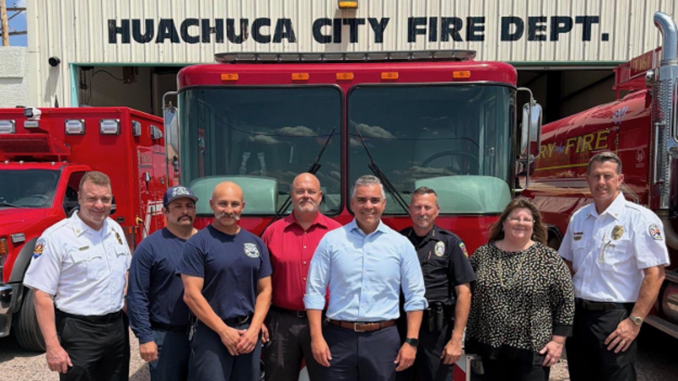
Congressman Juan Ciscomani (R-AZ-06) met with Huachuca City officials Tuesday to discuss a $1.3 million federal funding provision intended to replace the town fire department’s aging ladder-equipped fire engine.
The congressman visited Huachuca City this week and met with local leaders and fire personnel about the proposed purchase. The funding remains preliminary and has not been distributed to the town.
The provision appears in H.R. 8646, the Agriculture, Rural Development, Food and Drug Administration, and Related Agency Appropriations Act for fiscal year 2027. The House passed the bill 213-210 on June 4, and it was received by the Senate on June 8. Senate approval and enactment of the appropriations legislation are still required before the funding becomes available.
Grateful to see firsthand how the $1.3 million in federal funding I preliminarily secured will strengthen fire response in Huachuca City and across the region.
Proud to fight for this meaningful investment, which will bring a much-needed quint ladder truck and help keep #AZ06… pic.twitter.com/p5j5qGuHhg
— Congressman Juan Ciscomani (@RepCiscomani) August 12, 2026
Ciscomani’s Community Project Funding disclosure identifies Huachuca City as the intended recipient of $1.3 million for the “Community Fire Protection and Regional Mutual Aid Ladder Truck Acquisition Project.”
The money would replace an aging fire engine with a quint ladder truck equipped with a 78-foot Viper aerial. According to the disclosure, the apparatus would be used for fire suppression, rescue operations, and emergency response.
Huachuca City’s existing ladder-equipped engine dates to 2008 and is approaching the end of its service life. It is currently the department’s only apparatus equipped with a ladder. The town relies on grants and federal funding to finance large equipment purchases.
The proposed truck would be stationed in Huachuca City and made available for regional mutual-aid responses. Ciscomani’s disclosure states that the apparatus would also support emergency operations in Sierra Vista, Fort Huachuca, Whetstone, and unincorporated areas of Cochise County.
“This has different layers of purpose,” Ciscomani told KGUN while discussing the project’s regional role.
Huachuca City Mayor Johann Wallace said the purchase would give the department approximately 20 additional years of apparatus service and allow it to continue assisting other communities throughout Cochise County.
The Huachuca City proposal is among 20 fiscal year 2027 Community Project Funding requests supported by Ciscomani. His office announced in June that the fire-truck provision and two other projects in Arizona’s Sixth Congressional District had been included in the House-passed agriculture appropriations bill.
According to a press release from Ciscomani’s office, the proposed funding for Huachuca City is included among a total of $7.3 million in FY2027 funding for Cochise County.
“As Arizona’s sole appropriator in either the House or Senate, I have made it my mission to be a relentless advocate for Southern Arizona by listening to the needs of our communities and fighting to bring those priorities to Washington,” Ciscomani said.
“Every Community Project Funding request I champion is driven by local leaders and the people they serve, ensuring taxpayer dollars are invested where they will have the greatest impact. These meaningful investments in Cochise County will improve and strengthen public safety by equipping our first responders with the tools necessary to do their job effectively, such as replacing an aging fire engine with a new quint ladder truck, to ensure that across Cochise County they are prepared to meet the moment when it matters most.”
H.R. 8646 remains pending in the Senate. The Huachuca City allocation will depend on the project remaining in the final appropriations legislation approved by Congress and signed into law.