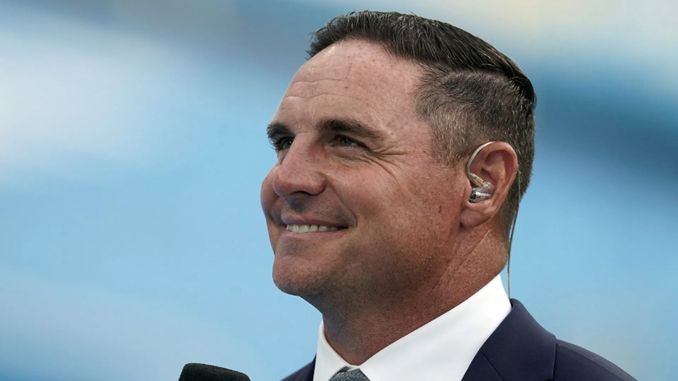
Democratic congressional nominee Amish Shah declined an invitation to participate in an Arizona PBS discussion with Republican nominee Jay Feely, leaving Feely as the only First Congressional District candidate on the program.
“As for the Democratic candidate, Amish Shah, he declined our invitation to participate in tonight’s discussion,” Arizona Horizon host Ted Simons said at the opening of the segment.
Arizona PBS presented the interview as part of its “Candidates in Conversation” series. The station described the district as Arizona’s wealthiest congressional district and identified northeast Phoenix, Scottsdale, Paradise Valley, and Fountain Hills among the communities it includes.
Feely greeted Simmons and asked, “Is it you or me they don’t like?”
“I haven’t figured it out,” Simons replied. “We’ll work that out later.”
Feely subsequently characterized the planned appearance as a debate and accused Shah of avoiding scrutiny.
“It’s disappointing that Amish Shah hid from tonight’s debate,” Feely wrote on X. “Arizonans deserve a representative willing to show up and stand by their convictions. Shah knows his socialist views & support for Bernie Sanders are deeply unpopular. He’s hoping you never learn who he really is.”
It's disappointing that Amish Shah hid from tonight's debate.
Arizonans deserve a representative willing to show up and stand by their convictions.
Shah knows his socialist views & support for Bernie Sanders are deeply unpopular. He's hoping you never learn who he really is. https://t.co/pQkXYL1Ffq
Shah’s campaign has not publicly explained his decision to decline the Arizona PBS invitation.
The interview began with the economy. Feely identified affordability as the most pressing issue facing district residents, citing conversations at doors and campaign events.
“People in general care about the economy,” Feely told Simons. “They care about the future for their children. You know, when you go to the grocery store, you look at prices. When you buy gas, obviously that’s a big one as well.”
The top issue for citizens across this district is affordability — groceries, gas, and improving the cost of living.
I’m running to lower your bills.
The policies Amish Shah endorses would take more money out of your pocket, raise your taxes and create hyperinflation again. pic.twitter.com/RINUFaGgix
Feely said reducing regulations could lower housing costs and argued that wage growth would help households absorb higher prices. He also defended President Donald Trump’s use of tariffs as leverage in trade negotiations.
Asked whether he would support a proposed tariff of 50 percent or more on Canadian goods, Feely said he did not expect the tariff to take effect.
“It’s not going to happen,” Feely said. “He uses it as leverage. Everything he does is about leverage to get the best deal for America.”
Feely later acknowledged that tariffs can raise prices in the short term. He said the policies should be evaluated according to whether they encourage domestic manufacturing and produce more favorable trade agreements.
Simons also questioned Feely about the national debt and federal entitlement spending. Feely said Congress would have to address mandatory spending and begin a discussion about the long-term finances of Social Security.
Shah’s current campaign platform calls for rolling back Trump’s tariffs, protecting Social Security and Medicare, and expanding access to health coverage. His campaign describes him as a supporter of universal health care and says he would work to reduce premiums and prescription drug prices.
The candidates’ differences over health care became part of Feely’s closing argument.
When Simons asked whether Feely wanted Trump to campaign in the district, Feely said he would remain consistent with the positions he took during the Republican primary. Trump endorsed Feely during that contest, and Feely said the two had known each other before either entered politics.
No tax on tips. No tax on overtime. No tax on Social Security for seniors.
90% of the people benefiting from these cuts earn less than $100,000 a year.
“I think it will come down to a choice of two things in this district in particular, two visions of where the country is going,” Feely said during the exchange. “You have common-sense measures of Republicans on the right, and you have socialist measures and a Bernie Sanders-type guy in Amish Shah, who has campaigned for him. He talked at some of the DSA rallies and believes in crazy policies that they want to implement.”
My opponent and I have completely different visions for America.
Amish Shah is Bernie Sanders Democrat.
He campaigned with Democratic Socialists of America, who support no borders, no prisons, and no private property rights.
Simons attempted to return Feely to the question about Trump.
“No borders, no prisons, no property rights,” Feely continued. “These are ideas that I don’t think resonate with the people in the First Congressional District or normal, average people around the country.”
“If he were here—” Simons began.
“He could have been here to defend himself,” Feely replied.
Shah appeared at an April 2019 Arizona for Bernie 2020 town hall in Phoenix. The video of his remarks identifies the event as paid for by Phoenix Democratic Socialists of America and states that it was not authorized by a candidate or candidate committee.
Shah spoke in support of Sanders and a universal, single-payer health care system during the event.
“We have a system that is based on the free market, and there are a lot of things that are wrong with that,” Shah said in the recorded remarks. “We need universal, single-payer Medicare for All throughout this country.”
Shah said during the appearance that health care policy was “one of the first things that drew me to Bernie as a candidate.” His current campaign platform continues to describe him as a supporter of universal health care, with an emphasis on expanding coverage, protecting Medicare, and lowering prescription drug prices.
Simons pressed Feely a second time on whether he wanted Trump to campaign in the district, citing its narrow Republican advantage, large population of independent voters, and Trump’s approval ratings.
Feely responded that he would continue knocking on doors, conducting town halls, and speaking with independent voters.
“I handle that by talking to people, by going door to door, town halls with independents, anyone that wants to talk to me and hear our story and why we care about people and how I want to do that in Congress and do it the right way,” Feely said. “That’s how you handle it. You have those conversations and you communicate with them.”
Shah was also the Democratic nominee in 2024, losing to Schweikert by approximately four percentage points. Shah and Feely will face each other in the general election.
The Arizona Supreme Court will hear arguments Sept. 1 in Arizona State University (ASU) professor Owen Anderson’s effort to pursue a lawsuit alleging the school’s mandatory employee training violated state law. The law bars public employers from requiring training that assigns blame or judgment based on race, ethnicity, or sex.
The justices agreed to review whether the Arizona Court of Appeals should have applied factors established in a 1988 state Supreme Court decision before concluding that the law gives employees no implied private right to sue. The court’s review is limited to that enforcement question.
Anderson’s allegation that ASU violated the law remains unresolved. The Court of Appeals also did not decide whether the training’s contents violated the statute.
As AZ Free News reported in February, Anderson asked the high court to take the case after the Court of Appeals held in December that the statute supplied no private cause of action. His attorneys at the Goldwater Institute argued in their petition that the ruling departed from the method Arizona courts have used to determine whether lawmakers intended an implied remedy.
ASU forced a professor to take DEI training as a condition of employment.
ASU required employees to complete its “Inclusive Communities” module, one of three employee-training modules described in the Court of Appeals’ memorandum decision. According to Goldwater’s case materials, employees were instructed to repeat the training every two years, and Anderson viewed but did not complete the module or its accompanying quiz. The philosophy professor brought his lawsuit against the Arizona Board of Regents in 2024, alleging that the training presented race- and sex-based concepts prohibited by state law.
The statute bars the state and its political subdivisions from requiring employee training that presents “blame or judgment” based on race, ethnicity, or sex. It also prohibits the use of public money for such training and directs the Arizona Department of Administration to submit an annual compliance report to the governor and legislative leaders. The law exempts sexual harassment training from its restrictions.
“Ultimately, the question now before the Arizona Supreme Court isn’t a left or right issue—and it’s not just about DEI—it’s about whether a state employee has the right to hold their employer accountable when it violates the law,” Anderson said in a statement released by the Goldwater Institute.
In a statement to AZ Free News, Dr. Anderson added, “This case is now an employment case. ABOR/ASU is arguing a state employee does not have standing to hold them accountable for breaking § 41-1494. That means this is not a conservative vs. liberal issue. It is an employment issue that will affect all state employees going forward.”
A Maricopa County Superior Court judge denied the Board of Regents’ motion to dismiss Anderson’s statutory claim. The judge found that the Legislature had created an implied right for affected public employees to enforce the prohibition, despite the absence of an express authorization to sue. The Board then filed a special-action petition with the Court of Appeals, which accepted jurisdiction and vacated that portion of the trial court’s ruling.
The appellate panel concluded that the statute’s text contains neither an express nor an implied private right of action. It pointed to the statutory compliance reporting system and said a mandamus action could compel officials to submit the required reports. The panel left the superior court free to consider a separate request for equitable or declaratory relief if a proper party raises that issue on remand, according to the December decision
Goldwater’s petition for review argues that the appellate court should have applied the factors set out in Transamerica Financial Corp. v. Superior Court. Those factors include the statute’s context, language, subject matter, effects, consequences, spirit, and purpose. Goldwater contends that the law protects an identifiable group of public employees and that the reporting requirement does not give an employee a remedy after an alleged violation.
In its supplemental brief, the Board of Regents argues that the Court of Appeals correctly began with the statutory text. The Board says the provision prohibits specified government conduct without granting individuals a cause of action, and that the Legislature’s inclusion of a reporting system shows the enforcement approach it selected. It also points to express private remedies in surrounding statutes and argues that the Legislature deliberately left them out of § 41-1494.
Goldwater Vice President for Litigation Jon Riches said that lawmakers intended state employees to be able to challenge alleged violations in court.
“There is no doubt that when Arizona lawmakers banned mandatory DEI trainings for state workers, they intended for those workers to have ability to challenge their employers in court,” Riches said. “We’re now asking for the Arizona Supreme Court to correct the lower court’s error and restore Arizonans’ right to hold government agencies accountable when they violate the law.”
The hearing comes as Arizona voters prepare to consider Proposition 142 on the November ballot. The separate proposed constitutional amendment would expand the state’s prohibition on preferential treatment and restrict compelled support for race- or ethnicity-based preferential treatment in public education and employment, according to the official ballot language.
Republican congressional nominee Jay Feely and Pro Football Hall of Famer Brian Urlacher joined the National Republican Congressional Committee (NRCC) on Saturday for the opening of a new campaign “Battlestation” in Scottsdale. The event took place as Republicans build out their ground operation in one of the country’s most competitive congressional races.
The NRCC said the Scottsdale office will serve as a hub for the grassroots operation supporting Feely, including volunteer recruitment, voter contact, and turnout efforts ahead of the general election.
The opening places another piece of the national Republican Party’s field organization directly inside Arizona. In July, Republican Rep. Juan Ciscomani and the NRCC opened a Battlestation in Sierra Vista for the competitive Sixth Congressional District race.
The NRCC has described its Battlestation program as a multimillion-dollar national investment designed to establish permanent field operations in competitive House districts. In a May strategy document, the committee said it already had more than 20 offices operating around the country.
Battlestation is live — Scottsdale showed up and we are not slowing down. 🌵☀️🇺🇸 pic.twitter.com/ullLTee059
By late June, NOTUS reported that the network had grown to more than 30 Battlestations in key congressional districts. The broader Republican strategy is focused heavily on identifying and turning out voters who supported President Donald Trump but are historically less likely to vote in midterm elections.
The Scottsdale opening comes as Republicans and Democrats prepare for a closely watched contest between Feely and Democratic nominee Amish Shah for the seat being vacated by Republican Rep. David Schweikert.
Feely, a former Arizona Cardinals kicker and longtime NFL broadcaster, won the Republican primary in July with approximately half of the GOP vote, defeating former state Rep. Joseph Chaplik and businessman John Trobough.
Shah, an emergency physician and former Arizona state representative, won a four-way Democratic primary after defeating former television journalist Marlene Galán-Woods, whom the Democratic Congressional Campaign Committee had backed. Shah previously challenged Schweikert in 2024 and lost by approximately four percentage points.
The open seat emerged after Schweikert gave up his congressional reelection bid to run for governor. He was subsequently defeated by Rep. Andy Biggs (R-AZ05) in the Republican gubernatorial primary.
The district, which includes much of Scottsdale, northeast Phoenix, Paradise Valley, and Fountain Hills, is regarded as one of the races that could help determine control of the House. The Cook Political Report rates CD1 a Toss Up, with a R+1 partisan voting index.
Feely has already received substantial support from national Republicans.
In March, the NRCC named him to its first group of candidates in the committee’s “MAGA Majority” program, the successor to its longtime Young Guns candidate program. The initiative provides targeted Republican candidates with strategic support, resources, and national exposure.
President Trump also endorsed Feely and reiterated that support shortly before the July primary.
“There’s an incredibly important election coming up in your state,” Trump said in a video endorsement, calling Feely a “true America First conservative” and saying he would support lower taxes, reduced regulation, border security, and law enforcement.
Urlacher’s participation in Saturday’s opening also reflects the unusual level of support Feely has received from figures in professional sports. Urlacher spent his entire 13-season NFL career with the Chicago Bears and was inducted into the Pro Football Hall of Fame in 2018. He is also among the sports figures who have financially backed Feely’s congressional campaign.
Campaign finance records show Urlacher contributed $7,000 to Feely.
Feely has also received contributions from NFL Commissioner Roger Goodell, former Phoenix Suns star Charles Barkley, New England Patriots owner Robert Kraft, former Denver Broncos quarterback John Elway, broadcaster Jim Nantz, and members of the Arizona Cardinals’ Bidwill family.
After Feely won the primary, the NRCC said after Feely won the primary that Republicans intend to campaign on affordability, economic policy, and public safety in the district.
“As a former NFL player, business leader and charity founder, Jay Feely understands the Valley needs fiscally conservative leadership so every Arizonan can prosper and live the American Dream,” NRCC spokesman Ben Petersen said. “That’s why Arizonans will send Jay Feely to fight the tax-and-spend politicians in Washington D.C., lower the cost of groceries, gas and housing and protect our public safety and quality of life.”
The committee has already begun spending against Shah as well, launching a paid digital advertising campaign following the Democratic primary.
With the Scottsdale Battlestation now open, the national Republican effort in Arizona’s First Congressional District is moving from the primary campaign into its general-election turnout operation with just over two months remaining before Election Day.
A new poll of Arizona’s Second Congressional District shows Republican Rep. Eli Crane leading Democratic challenger Jonathan Nez by 11 points in their rematch for the northeastern Arizona seat.
The Peak Insights survey, conducted August 17-20, found Crane supported by 53% of respondents and Nez by 42%, with 5% selecting neither candidate or saying they did not know.
The poll places Crane above 50% in the initial ballot test with just over two months remaining before the general election.
Per source, Freedom Caucus member Eli Crane up double digits in a competitive northern Arizona district pic.twitter.com/6Yp5Tp9djC
Peak Insights conducted 400 live telephone interviews with a representative sample of 2026 general election voters in the district using landlines and cell phones. The poll carries a margin of error of plus or minus 5 percentage points at the 95% confidence level.
The memo does not identify who commissioned or paid for the survey.
The poll’s ballot test listed Crane, Nez, and “Neither/don’t know.” It did not include Libertarian Curtis Goodwin, who advanced from the July 21 Libertarian primary and is also a candidate in the general election.
The Peak Insights memo also reported a positive job-approval rating for Crane. 41% of respondents approved of his performance in Congress, while 25% disapproved.
President Donald Trump was viewed favorably by 51% of respondents and unfavorably by 45%, according to the survey. Among voters who viewed Trump favorably, Crane led Nez 95% to 2%.
Peak Insights also examined the remaining undecided voters and reported that a majority are registered Republicans who supported Trump over former Vice President Kamala Harris in the 2024 presidential election.
The pollster characterized that group as favoring Crane based on its partisan composition and previous voting behavior.
Nez drew 42% in the ballot test, which Peak Insights noted matched Harris’ 2024 share of the presidential vote in the district. The memo reported that Nez received support from 2% of respondents who said they voted for Trump in 2024.
The candidates are meeting for a second consecutive general election after Crane defeated Nez in 2024. Alongside the release of his latest ad in early August, Crane said, “The same D.C. Democrats who look down on rural Arizonans because we don’t share their woke values want to pretend like they all of the sudden care about AZ-02. What they really care about is power.”
Crane won the 2024 contest with 54.5% of the vote to Nez’s 45.5%, a nine-point margin. The Cook Political Report notes that Nez ran ahead of Harris in the district, which Trump carried by approximately 15 points.
Cook currently rates the 2026 race “Likely Republican” and gives Arizona’s Second Congressional District a Republican-leaning R+7 Partisan Voting Index.
Crane, a former Navy SEAL first elected to Congress in 2022, is seeking a third term. Nez served as president of the Navajo Nation from 2019 to 2023.
Both advanced through the July 21 primary. The official state canvass recorded 89,205 votes for Crane in the Republican primary and 65,118 for Nez in the Democratic primary, with neither facing a listed opponent in his respective party contest.
The race has also drawn substantial campaign spending. Federal Election Commission (FEC) records through July 1 show Crane’s campaign with approximately $2.84 million in cash on hand, while Nez reported approximately $1.91 million.
Crane’s campaign had raised approximately $9.48 million during the 2025-26 election cycle through July 1, compared with approximately $3.52 million raised by Nez’s campaign, according to the FEC.
The Second Congressional District covers a large portion of northern and eastern Arizona, including Flagstaff, Prescott, and much of the Navajo Nation.
Arizona Senate President Warren Petersen (R-LD14) launched his first general election advertisement on Monday in his bid to unseat Democratic Attorney General Kris Mayes. The ad highlights tax cuts enacted during Petersen’s tenure as Senate president and endorsements from law enforcement organizations across the state.
The 30-second advertisement, focused around Petersen’s “common sense leadership” message, comes 71 days before Arizona voters head to the polls for the Nov. 3 general election.
“Arizona needs an Attorney General who solves problems,” the ad begins before highlighting Petersen’s legislative record and support from police organizations.
The spot says Petersen “worked with both parties to deliver historic tax relief for Arizona families,” specifically citing the elimination of taxes on residential rent and overtime income.
🚨 FIRST TV AD
As Senate President, I delivered real results for Arizona families, working across the aisle and delivering historic tax cuts. As Attorney General, I’ll bring that same problem-solving approach and actually stand with the officers who protect our communities. The…
Municipal transaction privilege taxes on residential rentals were eliminated through legislation enacted in 2023 during Petersen’s tenure as Senate president. Senate Bill 1184 banned municipal excise taxes on residential leases with the change taking effect on January 1, 2025, and the Arizona Department of Revenue says cities and towns can no longer impose transaction privilege taxes on long-term residential rentals.
The overtime provision came this year through the Fiscal Year 2027 budget agreement negotiated between Governor Hobbs and Republican legislative leaders. The agreement included full conformity with federal tax provisions eliminating state taxes on qualified tips and overtime while increasing the standard deduction and adding other tax deductions and credits.
Petersen, who has served as Senate president since 2023, said his legislative work would inform how he approaches the Attorney General’s Office.
“As Senate President, I’ve proven that I can work with both parties to deliver results for everyday Arizonans,” Petersen said. “I will continue that approach as Arizona’s next Attorney General.”
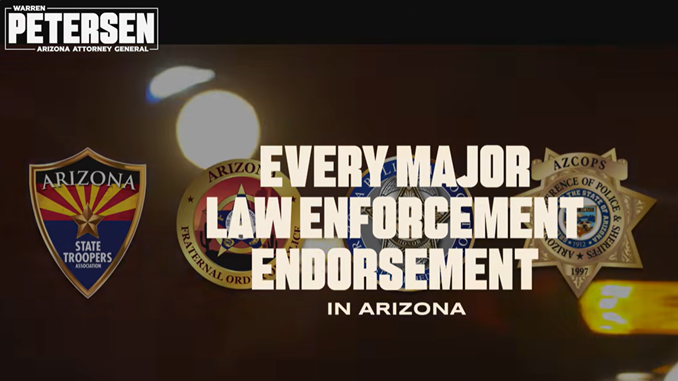
The ad also highlights Petersen’s backing from law enforcement groups, saying he is supported by “every major law enforcement organization in Arizona.”
Petersen has accumulated endorsements from organizations including the Arizona Fraternal Order of Police, Arizona Police Association, Arizona State Troopers Association, Arizona Conference of Police & Sheriffs, Combined Law Enforcement Associations of Arizona, Maricopa County Colleges Police Officers Association, and Phoenix Police Sergeants and Lieutenants Association.
The campaign also lists endorsements from Maricopa County Sheriff Jerry Sheridan, Maricopa County Attorney Rachel Mitchell, Pinal County Sheriff Ross Teeple, Yavapai County Sheriff David Rhodes, and several county attorneys. Republican attorneys general Raúl Labrador of Idaho, Todd Rokita of Indiana, Mike Hilgers of Nebraska, Derek Brown of Utah, and J.B. McCuskey of West Virginia have also endorsed Petersen.
The Republican nominee also used Monday’s announcement to renew his criticism of Mayes following her decision last week against bringing criminal charges against Hobbs in the Sunshine Residential Homes investigation.
“For four years, we’ve had a chief law enforcement officer who has been more interested in politicizing her office than supporting the brave men and women who protect our communities,” Petersen said. He accused Mayes of failing to hold Hobbs accountable over a “pay-to-play scheme.”
Mayes announced last Friday that her office would not pursue charges after a two-year criminal investigation into allegations involving political contributions connected to Sunshine Residential Homes and substantial increases in the rates the Department of Child Safety paid the foster care provider.
Petersen rejected the conclusion and has argued that Mayes’ handling of the case demonstrates the need for a change in leadership at the Attorney General’s Office.
“Mayes’ destructive brand of leadership will end January 2027,” Petersen said.
The campaign ad itself makes a broader criticism of Mayes without referring specifically to the Sunshine investigation, saying Petersen “delivers for Arizona, while his opponent wastes tax dollars on her political agenda.”
Mayes has also begun advertising in the general election. Her campaign launched a television spot titled “Not Finished” on August 13.
Petersen secured the Republican nomination in the primary against Rodney Glassman, while Mayes advanced unopposed on the Democratic side.