U.S. Rep. Juan Ciscomani’s (R-AZ-06) reelection campaign released a new advertisement last week featuring an injured combat veteran who identifies himself as a registered Democrat and credits the congressman with speaking up on his behalf.
In the advertisement, the veteran describes seeking assistance from Ciscomani.
“I’m an injured combat veteran. I wish you could hear my desperation, my frustration, what’s happened to me,” he says. “I am a registered Democrat, but I chose to reach out to him because I was at the end of my rope.”
Chris is an injured combat veteran. He’s also a registered Democrat.
When he had nowhere else to turn, he called my office. We answered. And we delivered.
“He has spoken out for me, spoken up for me. He definitely put me as a person over politics,” he says.
The campaign identifies Chris as a resident of the Sixth District. The advertisement does not specify the underlying case or describe a particular benefits decision or other outcome.
“This is what public service is supposed to look like,” Ciscomani said. “It doesn’t matter if you’re a Republican, a Democrat, or an independent. If you’re a resident of AZ-06, especially a veteran who served this country and needs help, my office will show up for you.”
Ciscomani is seeking reelection against Democrat JoAnna Mendoza in Arizona’s Sixth Congressional District, which includes portions of Pima, Pinal, Cochise, and Graham counties and all of Greenlee County.
In an endorsement announcement in July, the campaign listed 11 current and former county supervisors supporting Ciscomani. The Democratic endorsers included former Pima County Supervisor Sharon Bronson, Graham County Supervisor Paul David, and Greenlee County Supervisor David Gomez. Greenlee County Supervisor Will Wearne was identified as an independent.
The new advertisement’s focus on veterans follows legislative efforts involving education benefits, health care, and homeownership. Ciscomani’s congressional office says nearly 80,000 veterans live in the district and that four veteran-focused bills he led passed the House during the current Congress.
Among those measures is the Veterans Education and Technical Skills Opportunity Act, H.R. 1458, which the House passed Feb. 2, 2026. The legislation would expand access to qualifying certificate and technical training programs through the GI Bill, including certain programs offered in a hybrid format.
The measure also addresses protections for National Guard and Reserve students called to active duty during a semester. Ciscomani’s office said it would allow eligible students to receive grades for substantially completed coursework rather than having to repeat it.
Ciscomani also co-led the VA Home Loan Affordability Act, H.R. 8532, with Rep. Derrick Van Orden (R-WI). An announcement from Ciscomani’s office in May described the proposal as an effort to remove barriers in the Department of Veterans Affairs’ home loan process, particularly for veterans in rural communities.
Beyond legislation, Ciscomani’s office reported in May that it worked with the VA to reopen a Vet Center Outstation in Sierra Vista, providing mental health care and other resources at no cost to veterans. During that district work period, Ciscomani also visited the Northwest VA Clinic with VA Secretary Doug Collins and met with veterans and service organizations.
“I am here to serve everyone in the district, regardless of party,” Ciscomani said.
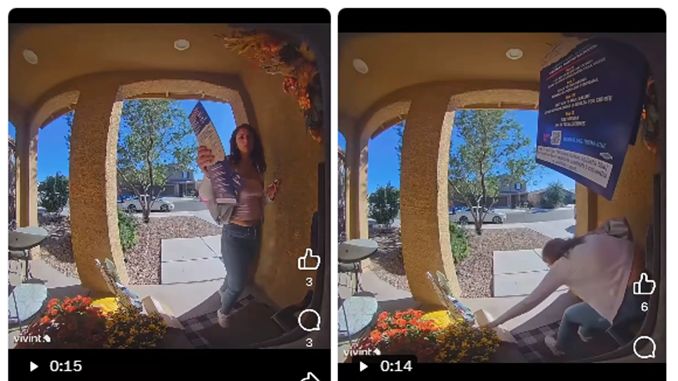
The Arizona Republican Party is circulating an allegation that a person identified online as a volunteer for Democratic Gov. Katie Hobbs took a package from a residential porch while canvassing. Screenshots from the posted footage show the person carrying a LUCHA Blue voter information flyer.
Robert Contreras, whose X bio identifies him with Turning Point Action’s Chase the Vote effort in the Gila River Region and as co-chair of the Pima County Young Republicans, shared the doorbell-camera video, writing, “Katie Hobbs volunteer steals package off someone’s porch while knocking.”
The Arizona Republican Party amplified the accusation, writing, “This is who supports Governor Katie Hobbs.” The party also questioned whether Attorney General Kris Mayes would give the person a pass if she declined an interview with investigators.
This is who supports Governor Katie Hobbs.
If they catch this thief, will AZ AG Kris Mayes giver her a pass if she refuses to sit for an interview with investigators?
The party’s reference to an investigative interview appears to invoke the Sunshine Residential Homes investigation. Hobbs declined an in-person interview but submitted two written statements through her attorneys denying wrongdoing. Mayes declined to prosecute Hobbs following the investigation into political contributions and state decisions benefiting the group-home provider.
One video posted by Contreras shows a person holding a flyer toward a Vivint doorbell camera. Another video shows the person bending down and reaching toward an item on the porch. In that video, the person leaves with a package that was already on the porch and takes it to their car.
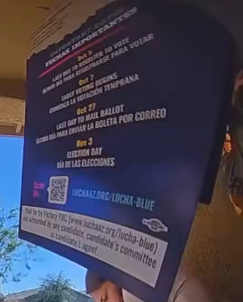
Close-up images reviewed by AZ Free News identify the flyer as LUCHA Blue material, displaying election dates and directing readers to the organization’s website. A disclaimer states that the communication was not authorized by any candidate or candidate’s committee.
Contreras described the person as a Hobbs volunteer. The posts supplied for this report do not explain how that affiliation was established. The flyer identifies the political material being distributed, while the person’s employment or volunteer relationship remains unconfirmed.
The quoted posts do not identify the person accused, specify the incident’s date or location, or provide a police report number. The materials reviewed do not establish whether the homeowner reported a theft or whether law enforcement has opened an investigation.
Democratic congressional nominee Amish Shah’s campaign reported financial support from the Human Rights Campaign (HRC) PAC. HRC opposed the same restrictions on gender transition surgeries for minors and girls’ sports participation in Arizona that Shah voted against as a state lawmaker.
Shah’s campaign disclosed two in-kind contributions totaling $152.66. The entries list a $50 press release contribution dated Aug. 21 and $102.66 in signage dated Sept. 18. The contributions provided campaign materials and services.
The press release entry coincided with HRC PAC’s endorsement of Shah for Arizona’s First Congressional District. In announcing its endorsement, the organization described the race as important to securing a congressional majority supporting its policy priorities.
“The Human Rights Campaign is proud to endorse [Amish Shah’s] candidacy and to work to get him elected this November,” HRC President Kelley Robinson said.
Arizonans, you deserve a champion who will address the real issues — let’s send Dr. Amish Shah to Congress and help secure a pro-equality majority!
— Human Rights Campaign Rapid Response (@HRC) August 21, 2026
The endorsement announcement’s disclaimer identifies Human Rights Campaign PAC as paying for the communication and states that Amish for Arizona authorized it.
Shah responded to the endorsement in a statement describing himself as “a longtime ally of Arizona’s LGBTQ+ community” and saying he was “proud to fight for the community in my time in the State House.”
The endorsement and reported contributions have drawn criticism from the National Republican Congressional Committee (NRCC), which pointed to Shah’s votes on legislation involving minors’ surgeries, school athletics, and restroom access.
“Arizona families don’t agree with Socialist Amish Shah’s extreme views like backing child transgender sex change surgeries or men in women’s sports. But that’s exactly the far-left agenda Socialist Shah would pursue in Washington if elected,” NRCC spokesman Ben Petersen said.
Shah voted against Senate Bill 1138, which prohibited physicians from providing specified irreversible gender reassignment surgeries to patients younger than 18. The House passed the measure 31–26 on March 24, 2022, and then-Gov. Doug Ducey signed it March 30.
The law’s definition includes mastectomies, breast augmentation, and specified genital procedures performed for gender transition. It preserves exceptions involving certain disorders of sex development, treatment of complications from previous procedures, and physical conditions requiring surgery to prevent imminent death or impairment of a major bodily function. Its prohibition addresses surgical procedures.
HRC urged Ducey to veto SB 1138, arguing that lawmakers were interfering with healthcare decisions involving transgender children and their families.
“It is simply not the job of legislators to make healthcare decisions for the families who this legislation will directly impact,” HRC Arizona State Director Bridget Sharpe said.
The same statement opposed Senate Bill 1165, the Save Women’s Sports Act, which Shah also voted against. That legislation required covered school athletic teams to be designated according to biological sex and prohibited students of the male sex from participating on teams designated for females, women, or girls.
The sports measure covered public schools and private schools competing against them, including institutions of higher education. It permitted female students to participate on teams designated for males and preserved coeducational competition. The House approved it 31–24, with five members not voting, on March 24, 2022.
After Ducey signed both bills March 30, HRC issued a statement condemning his decision, expressly identifying the surgery and sports restrictions.
Shah had previously opposed House Bill 2706, a 2020 proposal restricting participation on female school athletic teams based on biological sex. The House passed that bill 31–29, with all Democrats voting against it. The measure subsequently stalled in the Senate Rules Committee and never received a Senate floor vote.
His voting record also includes opposition to Senate Bill 1040, a 2023 proposal governing public school restrooms, changing facilities, and sleeping accommodations.
The bill would have required reasonable accommodations for people unwilling or unable to use facilities designated for their sex. Possible accommodations included single-occupancy or employee facilities. The proposal excluded accommodations allowing access to opposite-sex restrooms or changing facilities when others were or could be present. It also would have authorized lawsuits under specified circumstances involving access to facilities designated for the opposite sex.
Shah voted against the measure when the House passed it 31–27 on May 15, 2023. Gov. Katie Hobbs vetoed it June 8.
Shah faces Republican nominee Jay Feely in Arizona’s First Congressional District.
Republican attorney general nominee and Arizona Senate President Warren Petersen is targeting Democratic incumbent Kris Mayes’ utility-regulation record in a new campaign advertisement, contrasting her votes on the Arizona Corporation Commission with his support for tax reductions in the Legislature.
The ad accuses Mayes of voting to increase utility rates six times and attributes higher gas, water, and electricity costs to her decisions.
“I’m Senate President Warren Petersen. I helped pass one of the largest tax cuts in state history, eliminating tax on tips, rent, and overtime,” Petersen says. “But my opponent voted to raise your utility rates six times.”
Petersen’s campaign also criticized Mayes’ role in establishing renewable energy surcharges during her tenure on the Arizona Corporation Commission. The commission adopted the Renewable Energy Standard and Tariff (REST) rules in November 2006, establishing renewable energy requirements and procedures for utilities to recover program costs through customer surcharges. The rules became effective in August 2007.
Mayes’ office has described her as instrumental in adopting the rules. She has defended the renewable energy standards, arguing that repealing them would threaten electricity affordability and reliability.
The commission reported in March 2026 that APS, Tucson Electric Power, and UNS Electric had collected more than $2.3 billion in REST surcharges from customers. That figure measures collections under the program and does not establish its net economic impact after accounting for benefits or avoided costs.
“While we’ve fought to make life more affordable for hardworking Arizona families, Mayes has supported higher utility rates that squeeze household budgets and punish the very people she was elected to protect,” Petersen said.
Petersen’s tax message references changes enacted at different times. The Arizona Department of Revenue states that cities stopped collecting transaction privilege tax on residential rentals beginning January 1, 2025. The change applies specifically to municipal taxes on residential rentals.
In June 2026, Gov. Katie Hobbs signed the fiscal year 2027 budget after vetoing nearly all bills sent to her desk from April 13 until May 14, including a proposed Republican budget containing over $1 billion in tax relief. The package, spearheaded by Repbulican lawmakers, incorporated full conformity with the tax cuts of the One, Big, Beautiful Bill Act and included $1.4 billion in tax cuts, with relief involving tips and overtime, a higher standard deduction, and an additional deduction for seniors.
The advertisement follows another dispute between the candidates over Mayes’ past statements about utility pricing.
Petersen recently criticized a resurfaced 2009 Arizona PBS interview in which Mayes, then chair of the Corporation Commission, discussed higher water prices as a means of reducing consumption and the energy required to pump water.
The discussion also included Mayes calling for utilities to provide conservation tools and participate in a statewide conversation about resource use. The interview did not identify a particular rate increase she approved.
Petersen’s new release also criticizes Mayes for challenging utility costs as attorney general after supporting increases during her commission service.
Petersen said affordability would remain a priority if he wins the attorney general’s office.
“As Attorney General, I will fight from day one to protect Arizona families, challenge policies that drive up costs, and help restore the financial breathing room Arizonans desperately need and deserve,” he said.
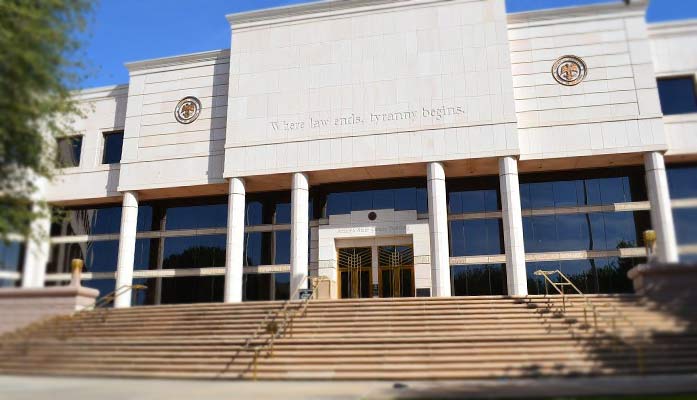
The Arizona Supreme Court agreed Thursday to review whether the Citizens Clean Elections Commission can determine that the secretary of state incorrectly certified candidates’ qualifying contributions and order repayment of public campaign funds on that basis.
In the order, the justices granted review of two questions in Lombardo v. Arizona Citizens Clean Elections Commission. The court ordered the parties to submit simultaneous briefs by Monday, Oct. 19, at 4 p.m., and will consider the case on an expedited basis without oral argument.
Risa Lombardo and Duwayne Collier, the Green Party nominees for governor and secretary of state, are challenging the commission’s authority to demand repayment amid an investigation into whether they properly qualified for public campaign financing.
In September, Lombardo and Collier alleged that the threat of repayment obligations had effectively halted their campaigns and burdened their free speech rights. Their lawsuit also challenged the commission’s authority to revisit their qualification for public funding after certification by the secretary of state. At that point, the commission had directed Executive Director Thomas Collins to investigate further without issuing a repayment order.
The Supreme Court’s first question asks: “Does the Citizens Clean Elections Commission possess legal authority to determine that the Secretary of State’s certification of qualifying contributions was incorrect?”
The second asks: “If yes, does the Commission have the authority to order repayment of funds on that basis?”
Chief Justice Ann Scott Timmer signed the two-page order. It limits review to those questions and contains no ruling on the underlying allegations or express directive halting the commission’s investigation.
The candidates contend that the secretary of state and county recorders have authority to determine whether they collected sufficient qualifying $5 contributions. Their attorney, Timothy La Sota, has argued that the threat of repayment interfered with their campaigns and that relief after the election would come too late.
The litigation reached the state Supreme Court after Maricopa County Superior Court Judge Melissa Iyer Julian dismissed the candidates’ lawsuit. Julian concluded in her ruling that the challenge was premature because the commission had not completed its investigation or issued a repayment order.
“Plaintiffs’ challenge is to the basis for a repayment order that has not and may never be issued,” Julian wrote. “That claim is not ripe for this Court’s review.”
The judge said the administrative process could establish the facts and allow the commission to determine whether enforcement was warranted before judicial review.
The Court of Appeals declined special action jurisdiction on Oct. 6. Lombardo and Collier then sought Supreme Court review through a special action petition that the clerk docketed as a petition for review.
The Supreme Court considered the petition and responses from the commission and its executive director, Thomas Collins, before granting limited review.
The underlying investigation includes allegations that qualifying-contribution records were falsified. La Sota has disputed the accusations, characterizing them as conspiracy theories.