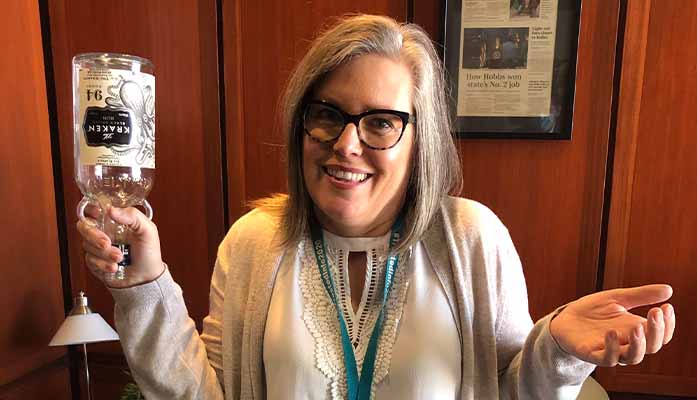
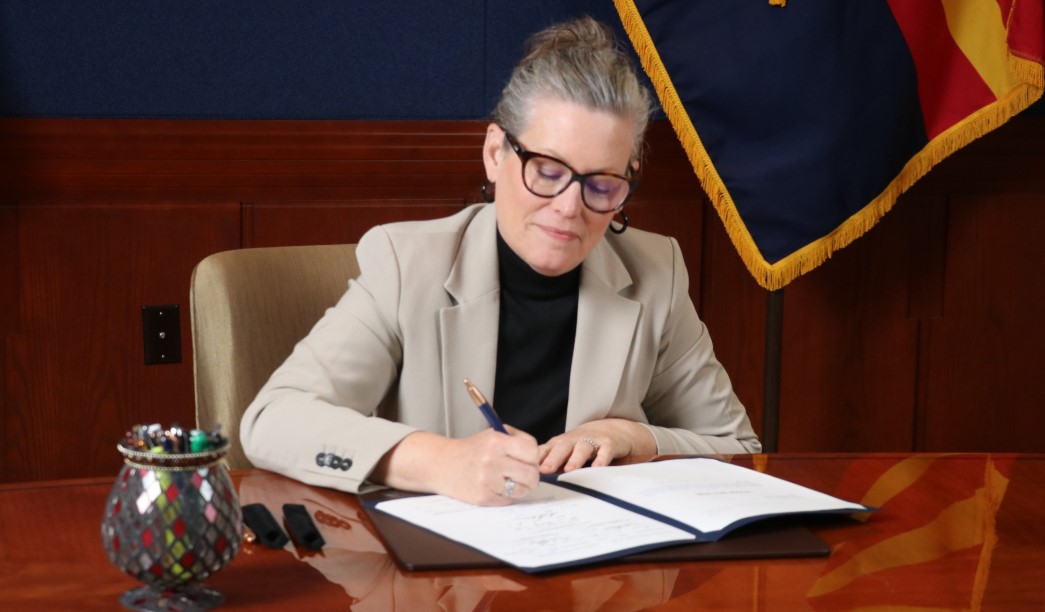
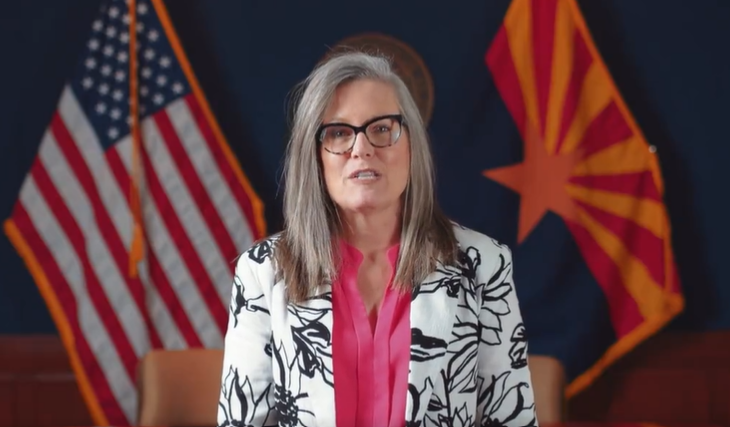
On Monday, Arizona House Republicans revealed that the Department of Child Safety’s (DCS) Congregate Care program is bound for bankruptcy in a week’s time and announced the creation of a House Ad Hoc Committee to investigate the responsibility of Democrat Governor Katie Hobbs for a series of fiscal failures.
Arizona House Speaker Steve Montenegro, joined by Majority Leader Michael Carbone, Majority Whip Julie Willoughby, Speaker Pro Tempore Neal Carter, and members of the House Republican Majority called out the governor directly. “This is not a simple oversight—it is gross financial mismanagement at the highest level,” said Speaker Montenegro. “Governor Hobbs has made a habit of overspending, ignoring reality, and then sounding the alarm only when disaster strikes. The difference here is that Arizona’s children will be the ones to suffer for her failures. That’s why I’m taking immediate action.”
The Speaker continued, “This is a pattern. Congregate Care is set to go bankrupt next week. The Governor’s mismanaged Developmental Disabilities program will collapse by the end of April. Her administration failed to budget for formula growth in AHCCCS for two years straight—racking up hundreds of millions in unaccounted costs. The list goes on. This is not leadership. This is incompetence.”
“The people of Arizona didn’t elect us to stand by while the Governor manufactures crisis after crisis. House Republicans will ensure accountability and enforce responsible budgeting, but we expect the Governor to take ownership of her failures. That starts with making her staff available to the Legislature so we can fully understand the depth of this mismanagement and pursue the right solutions. Governor Hobbs may be comfortable with chaos, but we are not.”
As reported by AZ Free News in February, Treasurer Kimberly Yee reported on the allegations against the Hobbs administration in a letter to Chairman of the Arizona House Appropriations Committee, Rep. David Livingston.
In a statement at the time, Livingston said, “I appreciate Treasurer Yee’s clarity in addressing the financial mess Governor Hobbs has created. The issue isn’t ‘missing money’—it’s blatant mismanagement.”
“Under the Governor’s feckless leadership, state agencies are making massive spending decisions with zero legislative oversight, ballooning costs, and expecting taxpayers to foot the bill. This kind of incompetence cannot stand.”
The release from Montenegro detailed that the House Ad Hoc Committee on Executive Budget Mismanagement will examine “how the Governor has consistently mismanaged the budget, ignored financial reality, and allowed critical services to reach the brink of collapse before taking action.”
The Speaker also directed the Chairman of the Joint Legislative Budget Committee to summon the Committee to order and instruct Governor Hobbs to redirect existing funds to handle the crisis and prevent harm to the children in DCS custody noting, “The Governor’s administration failed to spend wisely, and it is their responsibility to fix this situation—not the Legislature’s job to bail them out.”
Arizona’s ongoing housing crisis is taking center stage as state lawmakers, led by House Majority Leader Michael Carbone, voice strong opposition to Governor Katie Hobbs’ water policies, accusing them of exacerbating the state’s housing shortage. In a statement released last week, Carbone applauded House Speaker Steve Montenegro for authorizing a lawsuit against the Arizona Department of Water Resources (ADWR) over its adoption of a controversial 33.3% groundwater tax. Carbone claims that this policy is driving up the cost of housing and ultimately harming Arizonans who are already grappling with soaring housing prices.
At the center of the dispute is a policy known as the housing moratorium, which has been criticized for preventing the development of large swathes of land that could otherwise be used to build affordable homes. According to Carbone and other critics, the moratorium was adopted illegally, and it has led to a situation where hundreds of thousands of acres of land remain undeveloped. This, in turn, limits the amount of available space for new homes, driving demand to already crowded urban areas and increasing housing costs.
Carbone explained that “water policy is land use policy, and land use policy is housing policy,” suggesting that the restrictions on land development, while related to water conservation, are having broader economic consequences.
As a result of the moratorium, many Arizonans are facing higher costs when it comes to purchasing new homes. The housing moratorium is expected to increase home prices by $19,600 to $23,700 per house. Additionally, the proposed 33.3% groundwater tax has been predicted to add an extra $5,100 to $7,900 to the cost of new homes. These measures have raised concerns about the affordability of housing, especially in a state already struggling with rapid population growth and a housing shortage.
The Arizona House of Representatives, alongside the Home Builders Association of Central Arizona (HBACA) and members of the Arizona Senate, have joined forces in a legal battle against the ADWR’s actions. The lawsuit seeks to halt the 33.3% groundwater tax, which lawmakers argue is not only illegal but also harmful to Arizona’s housing market. Carbone criticized the governor’s policies, stating that they are not about ensuring water security but rather a means of “government control.”
“The Governor wants to dictate where and how Arizona families live, limiting all future growth to cities and driving up home prices,” Carbone said. “Affordable housing is central to the American Dream, and we are committed to fighting these illegal policies that will only make the housing crisis worse.”
The legal battle focuses on the ADWR’s authority to implement such a tax and whether it complies with state law. Proponents of the lawsuit argue that homebuilders have long demonstrated a commitment to responsible water management, having replenished 100% of the groundwater they use annually since 1995. Therefore, they contend, penalizing the homebuilding industry with additional taxes is unfair and counterproductive.
Jonathan Eberle is a reporter for AZ Free News. You can send him news tips using this link.
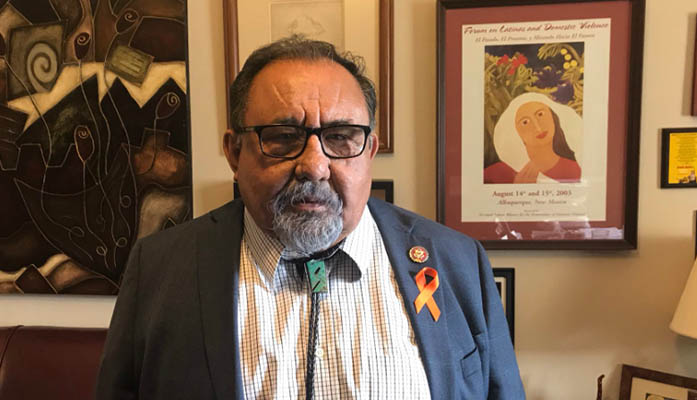
Democratic Congressman Raúl Grijalva passed away from complications with cancer on Thursday morning.
Grijalva was 77 years old at the time of his passing. The representative took up his congressional seat in 2003. This term was promised to be Grijalva’s last, per the congressman.
It appears staff didn’t get the memo about Grijalva’s passing. Hours before Grijalva’s office issued an official statement on X about his passing, Grijalva’s staff published a post criticizing the Trump administration.
The last post on Grijalva’s account prior to the announcement of his passing concerned the mass layoffs essentially halving the Department of Education (ED) workforce. Grijalva’s staff criticized President Donald Trump’s ED cleanup as “reckless,” “selfish,” and “illegal,” claiming students’ aid programs, civil rights protections, and disability supports were jeopardized.
Grijalva’s staff claimed, specifically, the ED firings would deprive 26 million students of critical funding, 12 million students of career and technical education resources, 10 million low-income students of higher education assistance, and 7.5 million Individualized Education Plan (IEP) students of special education services.
These estimates were pulled directly from the American Federation of Teachers (AFT), the affiliated international union of the American Federation of Labor and Congress of Industrial Organization (AFL-CIO). The AFT consists of over 1.3 million members and 3,000 local affiliates nationwide. However, these estimates were not based on ED layoffs but rather a complete abolition of ED — something that has not yet taken place.
The posting raises concerns over who was representing Grijalva’s constituents during his last few years in office after his announced lung cancer diagnosis in 2023 — especially due to the fact Grijalva missed a vast majority of major votes since then.
President Trump’s latest reckless decision to fire thousands of employees at the Department of Education jeopardizes critical student aid programs, weakens protections for students’ civil rights, and undermines essential support for students with disabilities. This move severely…
Not only did Grijalva step down from key leadership positions — he remained absent from Congress for most of this last legislative session and was absent for this session with the exception of the first day (69 out of 71 roll call votes, or about 97 percent of votes). Grijalva didn’t cast a vote on legislation this session, save for his vote for Democratic Rep. Hakeem Jeffries for House Speaker at the start.
Grijalva previously defended his lack of voting in remarks to the press because “Republicans are in charge” and his vote wouldn’t matter anyway.
“They’re inconsequential because the Republicans are in charge and it’s the worst performing Congress in decades, if not a hundred years,” said Grijalva.
Although Grijalva’s health was in decline amid his ongoing cancer treatments last summer, Grijalva was among the early few Democratic leaders to call on former President Joe Biden to step down from his reelection bid last year. Grijalva said it was a duty for those unfit to serve to preserve the seat for their party by dropping out of the race.
“If he’s the candidate, I’m going to support him, but I think that this is an opportunity to look elsewhere,” said Grijalva to the press. “What he needs to do is shoulder the responsibility for keeping that seat — and part of that responsibility is to get out of the race.”
These remarks to the media were reported at the time to be a sharp and inexplicable departure from Grijalva’s messaging on social media supporting Biden and criticizing naysayers of Biden’s candidacy just the week prior.
In light of the fact that Grijalva’s staff posted on X under his name hours after he died on Thursday, it seems Grijalva’s staff may have been more in charge of the office for longer than most constituents were aware.
Following the passing of Grijalva, Governor Katie Hobbs issued a proclamation calling for a special primary election to fill the vacancy for Congressional District 7 on Tuesday, July 15, 2025, and a special general election on Tuesday, September 23, 2025.
Federal law (2 U.S.C. § 8) provides that special elections to fill vacancies in the U.S. House of Representatives are held under applicable state laws.
Under A.R.S. § 16-222(B), if the next regular general election is not to be held within six months from the date of the occurrence of the vacancy, the Governor shall call a special primary election to be held 120 to 133 days after the vacancy and a special general election to be held 70 to 80 days after the special primary election.
AZ Free News is your #1 source for Arizona news and politics. You can send us news tips using this link.
Democratic Arizona Gov. Katie Hobbs vetoed a commonsense bill that would have allowed our state to provide voters with same-day election results, moving us further away from the disastrous reporting system that is found when California voters go to their polls. Rather than our current operation of keeping Arizona voters in the dark about certain results of critical election races every two years, this legislation closely mirrored policies and procedures found in the state of Florida, which has largely perfected its vote counting over recent election cycles.
Additionally, my colleagues and I worked closely with a broad coalition of Arizona stakeholders, including most of the state’s county recorders and the Maricopa County Board of Supervisors – one of the largest jurisdictions in the entire nation.
This bill was sorely needed in our state. Yet, instead of working with Republicans in good-faith to provide much-needed reforms to our elections processes, Hobbs impeded all efforts to ensure Arizona can report the vast majority of votes on election night. Her veto was a huge mistake – not just politically, but for the future of our state’s elections.
Over the past decade, Arizona has seen a seemingly increasing share of razor-thin election results, which have proved the urgent need for this kind of legislation. In 2016, my good friend Andy Biggs won his primary election for the U.S. House of Representatives by just 27 votes. Outstanding votes were not counted until days after election night concluded, leaving supporters of the top two contenders in suspense. In 2022, current Arizona Attorney General Kris Mayes defeated her Republican challenger, Abraham Hamadeh, by fewer than 300 votes. Again, the votes were being processed and tabulated long after election night had come and gone.
In 2024, President Donald Trump was not officially declared the winner of Arizona until days after the election thanks to the myriad of un-tabulated votes after election night. There are many more examples of these kind of delayed calls on critical election races, where voters were left in the dark about the eventual outcomes.
Arizona’s delayed results have embodied more of the nature of California’s failed system in the past decade. Many around the nation shake their heads in disgust at California’s persistent inability to count most votes by the end of election night. Oftentimes, the results for several critical races for different levels of government remain outstanding for weeks, let alone days, following the election. Compare California’s delays with Florida’s successful system, which allows it to report the results of most of its races within hours of all polls closing. There’s no question which system I want my state to emulate.
These delays in our election results lead to massive distrust in our system and officials. Voters deserve and expect maximum transparency when it comes to the elections systems that select the men and women who govern us. However, by making voters wait days after the election has finished, government officials contribute to the rising fear about the integrity of our system. There is a better way.
As a long-time public servant, I was unwilling to stand by and allow the people of Arizona to live in perpetual anxiety every two years when elections rolled around. These voters deserve certainty and transparency in one of the fundamental pillars of our constitutional republic: our sacred votes. That’s why I introduced this bill – SB 1011 / HB 2703 – to speed up vote counting in our state, improve voter confidence and end the frustration felt by many waiting way too long for results on Election Day.
This bill should not have been politicized. I am baffled why, even after a broad coalition around Arizona endorsed these policies, legislative Democrats and Hobbs dug their heels into the ground and opposed our efforts to make reasonable and necessary fixes to the state’s elections system. The Democrats’ partisanship on this bill is not what Arizonans want from their state’s leaders. Republicans and Democrats should be able to work together to solve these issues in a bipartisan manner without resorting to political talking points. Sadly, that is not what happened in this case.
I promised the people of Arizona that this Legislature would be committed to making commonsense and proven changes to our state’s election processes, and my colleagues and I remain wholly resolved to achieve that goal. The status quo for our elections is not an option. Voters deserve more respect than to see their government officials content to leave their state as the laughingstock of the nation for its woefully slow election reporting.
To that end, Republicans in the Arizona Legislature will soon be pursuing a bill to send the question of same-day election results to voters in the next General Election. If Hobbs and Arizona Democrats do not want to be a part of the solution, we will let the voters decide. One way or another, it’s time to bring same-day election results to our great state.
If the Hobbs administration has proven itself to be uniquely skilled at anything over the past two years, it’s incompetence and negligence. But now, Arizona’s governor has taken the next step toward outright fraud.
As a part of her recent budget proposal, Hobbs has asked for a supplemental appropriation to the Arizona Department of Economic Security (DES) to cover a shortfall in the Division of Developmental Disabilities (DDD). Without the additional funding, the DDD could run out of money by May, affecting many people under a program that provides services to Arizonans with disabilities.
The problem stems from a COVID-era program funded entirely by the federal government that would pay parents who operate as caregivers for their children with disabilities—the Parents as Paid Caregivers program. The program was intended to be temporary, but Hobbs received approval from the federal government in February 2024 to make it permanent.
That approval came with a catch. Beginning on April 1, the State of Arizona would have to cover 32% of the costs, which Hobbs attempted to get funding for in last year’s budget. Her proposal was not approved by the legislature, which she mutually agreed to as part of the budget process. But she continued funding the program anyway—likely believing that she would be able to flip the legislature in November’s election or bully lawmakers into giving her the money. She failed on both counts and now has created a shortfall in the DDD program that has exceeded $100 million…