by Jonathan Eberle | Apr 20, 2025 | Education, News
By Jonathan Eberle |
Arizona students will soon face new limits on cellphone and social media use during the school day under a law signed Monday by Governor Katie Hobbs. The bill, HB 2484, passed with bipartisan support and aims to reduce digital distractions in public and charter school classrooms across the state.
The legislation, sponsored by Representative Beverly Pingerelli (R-LD28), requires school districts and charter schools to adopt policies that restrict student access to personal wireless devices and social media platforms during instructional hours. Exceptions are provided for emergency communication, medical needs, and teacher-approved academic use.
“Education requires attention, and attention is exactly what today’s students are being robbed of by addictive devices and endless scrolling,” Pingerelli said in a statement. “Arizona classrooms are for learning, not TikTok. Teachers can finally reclaim their classrooms.”
The new law mandates that Arizona schools develop and enforce policies that limit or prohibit non-educational cellphone use during school hours; restrict access to social media platforms while on school premises; and provide exemptions for emergencies, health-related needs, or educational tools as determined by teachers.
Districts will have flexibility in crafting the specific guidelines, but they must meet the state’s minimum requirements. Supporters say the law empowers teachers, supports student focus, and responds to growing concerns among parents and educators about the impact of screen time on learning.
Arizona is the latest in a growing number of states considering restrictions on student cellphone use. Educators across the country have increasingly voiced concerns that smartphones, social media, and digital distractions are interfering with learning, fueling anxiety, and making classroom management more difficult.
Research has shown that heavy cellphone use in school correlates with lower academic performance, increased mental health concerns, and reduced attention spans. In response, some districts nationwide have independently instituted bans or restrictions—though results and enforcement vary.
Critics of such policies have occasionally raised concerns about student safety, parental access, and equitable enforcement. However, HB 2484 includes exceptions to ensure students can still reach caregivers in emergencies and access necessary medical technology.
The law aligns with the Arizona House Republican Majority Plan’s emphasis on academic focus, teacher support, and increased parental involvement in education. While the issue drew support across party lines, it also sparked debate about how best to balance technology in modern classrooms.
“Teachers shouldn’t have to compete with YouTube and Instagram to be heard,” Pingerelli said. “This law puts students’ education first.”
Arizona schools are expected to begin implementing the new policies in the upcoming academic year.
Jonathan Eberle is a reporter for AZ Free News. You can send him news tips using this link.
by Staff Reporter | Apr 19, 2025 | News
By Staff Reporter |
The Arizona Republican House Whip sided with Democratic lawmakers and Governor Katie Hobbs against the codification of a key emergency funding bill for disability services in the state.
Most House and Senate Republicans support removing over $100 million in emergency funding from the Housing Trust Fund and the Prescription Drug Rebate Fund and giving it to the Division of Developmental Disabilities (DD). Several Republican lawmakers along with their Democratic counterparts and Hobbs reject the legislation (House Bill 2945 and Senate Bill 1734). Democrats want to pull funding from the general fund instead.
Governor Hobbs issued a moratorium on all legislation until Republicans agreed to find another avenue for funding DD. Hobbs expressed gratitude for the existence of “bipartisan opposition” enabling Democrats to retain a negotiations foothold.
Hobbs called Republicans “extreme” and accused them of “political theater.”
Hobbs would be alluding to House Majority Whip Julie Willoughby. Willoughby joined Reps. Justin Olson and Jeff Weninger as the sole “no” votes on House Bill 2945 against majority Republican support within the House Appropriations Committee.
Willoughby introduced an amendment to House Bill 2945 that drew Democratic support. Willoughby said in her presentation of the amendment that she worked with Democrats to craft it.
Willougby’s amendment would have dropped the original bill’s requirement for the Arizona Healthcare Cost Containment System Administration (“Administration”) to obtain legislative approval via statute for any Centers for Medicare and Medicaid Services (CMS) renewal request or termination request for any waiver or waiver amendment. Willoughby said the legislative approval was overly burdensome and would require the legislature to convene for every waiver request, even for simple extensions.
It would have also eliminated the original intent to have the Administration submit a waiver amendment request to CMS to reduce parents as paid caregivers program care services per week per child limit to 20 hours. It would have limited the new federal money reporting requirements to only the Department of Economic Security (DES) and Access rather than all state agencies. Additionally, it would have not pulled $10 million from the Arizona Competes Fund but instead increased by $10 million the funding pulled from the Prescription Drug Rebate Fund.
House Appropriations Chair Steve Livingston said he liked some aspects of Willoughby’s amendment, but suggested it would be better suited for consideration in a Committee of the Whole (COW) amendment.
In Willoughby’s closing explanation of her “no” vote on House Bill 2945, Willoughby said she would continue to fight for the Democrat-supported changes in her amendment and apologized extensively for the bill.
“People have continuously asked me to not move this amendment. What hill do you die on? And I choose you as my hill to die on,” said Willoughby. “I’m sorry this is happening to you. With my whole heart I’m sorry.”
Willoughby said she opposed the bill as against her pro-life beliefs as a Republican.
“I’m pro-life, and I’m pro-life through the entire spectrum of life, from the moment of conception until the last breath you take, and this is my moment to help support you in a way I haven’t had to before,” said Willoughby.
The House Appropriations Committee rejected Willougby’s amendment during its hearing on Tuesday.
Supporters of Willoughby’s olive branch to Democrats sent flowers to the lawmaker.
Where Willoughby sought compromise, other Arizona House Republican leaders took Hobbs to task for her administration’s management of DD that ultimately led to its budget shortfall. House Speaker Steve Montenegro said Hobbs’ desired funding pathway would ensure “no oversight, no reforms, and no accountability” for DD administration.
“Governor Hobbs’ decision to hold every bill hostage because she didn’t get her way on a blank check is not leadership—it’s political blackmail,” said Montenegro. “She created this crisis by foolishly expanding the DD program without legislative approval or funding in place, and now she’s throwing a tantrum because the Legislature is doing the responsible thing: funding services while putting guardrails in place to keep the program from collapsing.”
Without approval of emergency funding by the end of this month, DD won’t be able to pay caregivers and services will cease.
AZ Free News is your #1 source for Arizona news and politics. You can send us news tips using this link.
by AZ Free Enterprise Club | Apr 18, 2025 | Opinion
By the Arizona Free Enterprise Club |
This past November was a good time to be a Republican, especially here in Arizona. Not only did President Donald Trump win our state in a landslide victory, but Republicans expanded their majorities in both the Arizona House and Senate—despite being outspent in every single race.
While this turn of events shocked many in the corporate media who were convinced that Arizona was on its way from being a purple state to a blue state, we knew that voter registration trends told a different story.
Over the last couple of years, the gap between registered Republicans and Democrats in Arizona widened from 3.04% in 2020 to 4.03% in 2022. By April of last year, it had increased to 5.77%. And by November, it had expanded to 6.77%, a registration increase that proved decisive in President Trump’s overwhelming victory.
Now, 5 months removed from their electoral wipeout in November, there has been a lot of discussion about whether the Democrats’ political fortunes in Arizona would be reversing after their blowout loss to Trump.
Unfortunately for them, the latest voter registration numbers poured plenty of cold water on those dreams…
>>> CONTINUE READING >>>
by Christy Narsi | Apr 16, 2025 | Opinion
By Christy Narsi |
March was Women’s History Month, but a quick perusal through Governor Katie Hobbs’ social media shows no mention of it.
Crickets.
I can only assume she was avoiding the backlash because she knows how the majority of Arizona voters feel about matters such as Women’s History Month.
It’s for women.
So much for being the party of women’s rights. Gov. Hobbs, a female governor, made it clear this week that she refuses to stand with women and, in doing so, she refuses to stand with Arizona voters.
Gov. Hobbs had a second chance to preserve women’s rights this year, but she vetoed HB2062, Arizona’s Stand With Women Act, an act that would have codified the original meaning of basic sex-based words like ‘woman’ and ‘female’ in order to ensure that women’s rights aren’t compromised by judicial activism and bureaucrats. It would have given power back to our elected representatives to decide how, and in which contexts, it is appropriate to separate citizens by sex.
Words matter. We can’t protect women if we can’t define ‘woman.’ I have a vested interest in making sure we do. I am a mother. I have two daughters. My first granddaughter is on the way. I am president of a public K-8 charter school where young girls come to learn.
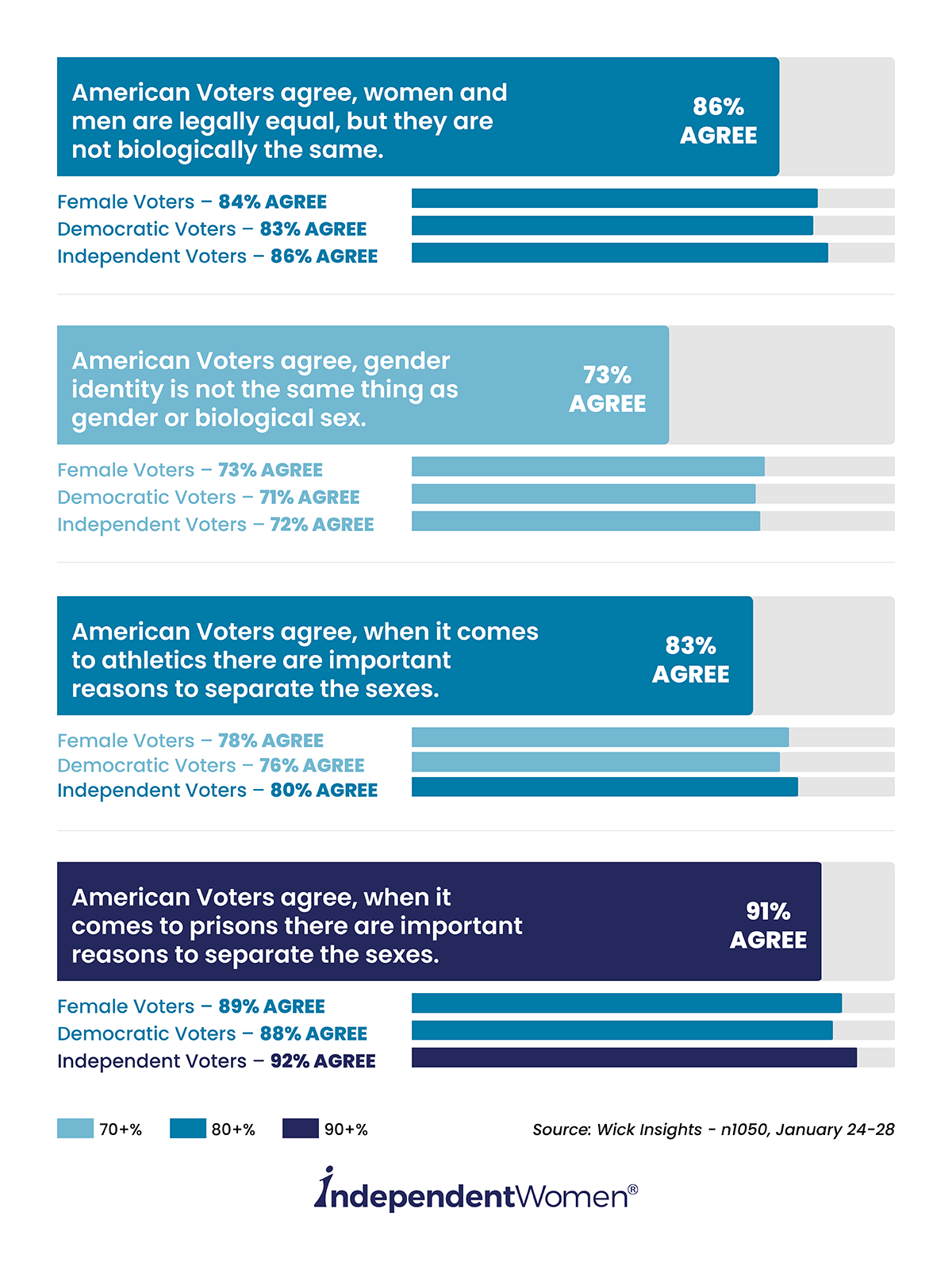
Mother, daughter, granddaughter, grandmother, aunt, sister, girls … all words that will become meaningless if we don’t fight to stop our erasure. Activists say these words lack objective meaning. They say these words are defined by subjective feelings, rather than objective reality. The efforts of these activists to legally eradicate the difference between the sexes fundamentally erase women by depriving them of their dignity, safety, and well-being. Men and women are legally equal, but biologically different and as such should have a legal right to single-sex spaces. 86% of Americans (and even 83% of Democrats) agree. Gov. Hobbs is out of touch with the public and even those of her own party.
What about publicly collected data regarding males and females? Shouldn’t vital statistics—including statistics about matters such as violence against women—reflect biological truth? Imagine a world where all data used to promote public health, prevent crime, enforce civil rights laws, and ensure economic and social policy was subjective!
Most of the public focus on this issue has been on fairness in women’s sports, but this goes far beyond sports. Only two states—and not Arizona—ensure women’s prisons are only for women. In many states, men identifying as women, many of whom are violent sexual predators, have been transferred into women’s prisons. Unfortunately, many female inmates have already suffered physical and psychological damage as a result. This is why 91% of Americans, even 88% of Democrats, support single-sex prisons.
Women, including sexual assault survivors, are being told not to complain about having men undress next to them in their private spaces such as locker rooms. Men are invading female sororities, domestic violence shelters, and educational training programs that were created specifically to encourage women’s engagement.
What kind of a world are we setting up for the next generation if we close our eyes to this? My challenge to all Arizonans is this: make some serious noise and do not let up! Educate everyone you meet on what Gov. Hobbs has done to disadvantage women and take away our right to equal opportunity. Talk about this at church, at the gym, and yes, even in the workplace. I am convinced that once Arizonans understand the dangerous impact of this veto, they will have found their line in the sand and have the courage to do something about it.
Christy Narsi lives in Surprise, AZ. She is the national chapter director for Independent Women’s Network. Christy is passionate about developing and empowering women who make an impact in their communities.
by Jonathan Eberle | Apr 16, 2025 | Education, News
By Jonathan Eberle |
Arizona has officially become the first state in the nation to ban ultra-processed foods in public schools. Governor Katie Hobbs signed HB 2164, also known as the Arizona Healthy Schools Act, into law this week after it passed both chambers of the legislature with overwhelming bipartisan support.
The law will take effect in the 2026–2027 school year and applies to all schools that participate in federally funded or assisted meal programs. It prohibits schools from serving, selling, or allowing third-party vendors to offer ultra-processed foods during the normal school day.
Ultra-processed foods are defined under the law as any food or beverage containing one or more of 11 specific additives, including potassium bromate, titanium dioxide, propylparaben, brominated vegetable oil, and synthetic dyes such as red dye 40, yellow dye 5, and blue dye 1. These ingredients have faced mounting scrutiny due to potential links to behavioral issues, allergic reactions, and even cancer risks.
Importantly, the law does not restrict what parents or guardians may provide for their own children. However, it places full responsibility on schools to eliminate the sale or provision of these additives through lunches, vending machines, snack bars, and school stores during the school day.
State Representative Leo Biasiucci (R-LD30), a leading sponsor of the bill, celebrated the signing in a post on X: “My bill, HB2164: banning of ultra processed foods in school meals, was just signed into law in Arizona!”
Under the new law, the Arizona Department of Education (ADE) is tasked with implementing a compliance system. This includes publishing a standardized form for schools to certify adherence and posting a public list of compliant schools on the ADE website.
Arizona schools are already required to meet federal guidelines on school meals through the National School Lunch and School Breakfast Programs. These standards limit calories, sodium, unhealthy fats, and mandate the inclusion of fruits, vegetables, and whole grains. HB 2164 builds on those efforts by targeting a set of food additives that are not currently prohibited by federal rules.
The Joint Legislative Budget Committee noted that the administrative impact of the law on ADE would be minimal and can be handled by existing staff. With the law now on the books, Arizona is poised to become a national leader in school nutrition policy—placing children’s health and safety at the center of its education system.
Jonathan Eberle is a reporter for AZ Free News. You can send him news tips using this link.