by Matthew Holloway | Feb 28, 2025 | News
By Matthew Holloway |
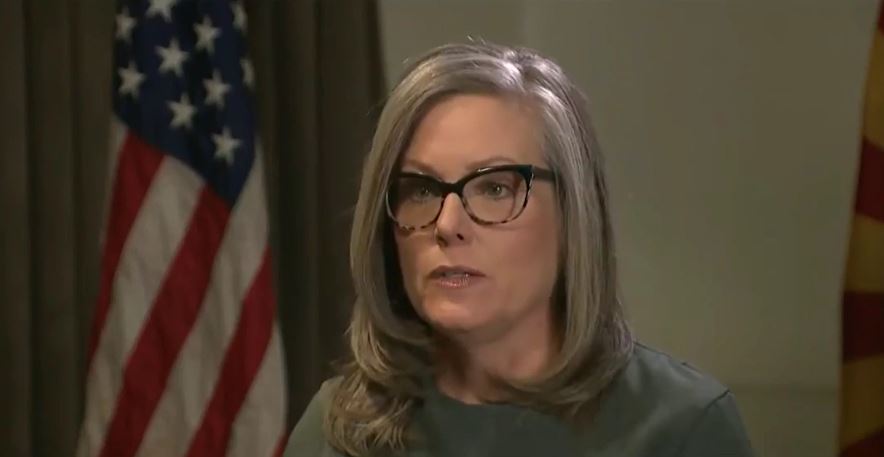
Rep. David Livingston, Chairman of the Arizona House Appropriations Committee, issued a letter to Governor Katie Hobbs this week calling on her to publicly acknowledge her responsibility for a $122 million shortfall in the Arizona State Developmental Disabilities (DDD) program and work with the Republican-controlled legislature to correct the problem. Livingston noted that “Despite repeated requests for meaningful discussions, the Governor and her staff have refused to engage.”
Hobbs has faced sustained criticism from Livingston, the Goldwater Institute, and Arizona State Treasurer Kimberly Yee who described the situation as “unfortunate gross financial mismanagement by the Hobbs Administration.”
In his letter to Hobbs, Livingston wrote, “For the past seven weeks, I have held seven Appropriations Committee hearings, laying out in clear detail how your administration’s budget mismanagement is creating serious financial risks for the state. At every turn, I have asked for serious, responsible discussions to address this situation, yet your office continues to say you ‘aren’t ready.’ Meanwhile, rather than engaging with the Legislature in good faith, you and your staff have chosen to issue public statements, assign blame, and demand more taxpayer dollars—without addressing the broken system that led us here. Here’s the reality:
- The $122 million shortfall in the Developmental Disabilities (DDD) program stems entirely from unilateral decisions made by your administration. The Legislature was never consulted before these funds were spent, yet now taxpayers are being asked to cover the consequences.
- Last week, Democrats attempted to force through $122 million in additional spending without any structural reforms or accountability measures—a short-term band-aid that does nothing to prevent future financial shortfalls. Republicans rejected this reckless approach because real solutions require responsible budgeting, not knee-jerk political stunts.
- Your budget proposal is grossly unbalanced, leaving out over $800 million in expenses. Yet, your office suggested to reporters that lawmakers should simply “pass it” and trust the same administration that created this crisis to handle the details. That is not how responsible government works.”
Livingston emphasized that while Hobbs has opted “instead for public statements and political posturing,” Arizona families have suffered the consequences and “remain uncertain about critical services.”
In his letter, he implored the Governor, “You have a choice: You can work with us to fix this problem responsibly, or you can continue making public statements while Arizona families and service providers face uncertainty.” He added, “What we need is real accountability, long-term planning, and meaningful reforms to ensure this program is funded properly—not just for today, but for the future.”
The Appropriations Chairman closed his letter on an affirmation that “The Republican Majority in the House and Senate is committed to responsible budgeting and ensuring that Arizona families have the services they need—without reckless overspending.” He offered Hobbs a final recommendation: “It is time for you to step up, take responsibility, and come to the table.”
Matthew Holloway is a senior reporter for AZ Free News. Follow him on X for his latest stories, or email tips to Matthew@azfreenews.com.
by Staff Reporter | Feb 27, 2025 | News
By Staff Reporter |
With the 2026 election just around the corner, Governor Katie Hobbs is adopting right-leaning policies and stances.
On Tuesday, Hobbs announced the creation of a border task force, Operation Desert Guardian (ODG), to enhance border security. The task force strongly resembles the Border Strike Force (BSF) of Hobbs’ Republican predecessor, Doug Ducey.
This renewed focus on border security and support for a task force marks a significant departure from Hobbs’ initial stance as governor.
Early on in her first months in office in 2023, Hobbs began ending Ducey’s BSF, which included removing shipping containers intended to close off unsealed sections of the southern border. On the campaign trail in the summer of 2022, Hobbs promised to not end the BSF. By November, Hobbs indicated her intent to leave border security and immigration enforcement to the federal government.
Hobbs’ spokesman, Christian Slater, insisted in statements to the media that Hobbs’ task force differed greatly from Ducey’s strike force. However, the two share nearly identical structures and duties.
The BSF launched as an enforcement bureau within the Department of Public Safety’s Criminal Investigations Division. The strike force focused on improvements to addressing border-related crimes (for example: drug trafficking, weapon smuggling, vehicle theft recovery, and violent criminal apprehension) while evaluating and analyzing criminal intelligence and enhancing response capabilities along the border. The BSF combined federal, state, county, tribal, and local law enforcement agencies in the border region to carry out these duties, especially for disruption of transnational criminal organizations (TCOs).
By comparison, ODG also partners with local law enforcement within the border-inclusive counties to disrupt TCO operations and border-related crimes.
Hobbs reversed course on her support for Proposition 123. While still a state senator in 2015, Hobbs opposed the proposition’s arrangement increasing state land trust dollars to fund schools. Last month, Hobbs advocated for the proposition’s renewal as an “essential” means of providing “critical funding” for the state’s public schools and educators.
Hobbs also reversed course on a significant agency pick, Angie Rogers, opting instead to restore Michael Wisehart as director of the Department of Economic Security (DES); her predecessor, Doug Ducey, installed Wisehart.
Last month, Hobbs appointed another Ducey administration veteran, Kathryn “Katie” Ptak, to lead the Department of Child Services.
Some efforts undertaken by the current administration, often seen as red meat right-wing priorities, have backfired recently for the governor. Hobbs created a new six-figure role within DES (chief, or “senior executive consultant,” of the newly-created Office of Veteran & Military Affairs) that mirrors the work already undertaken by the Department of Veterans’ Services (DVS). The position went to Dana Allmond at Hobbs’ behest, the unsuccessful Democratic 2022 legislative candidate and failed gubernatorial nominee. Republican legislative leaders questioned the apparent duplicity of the new DES position and DVS responsibilities.
Per the secretary of state’s office, 11 individuals have filed statements of interest in the governor’s race: Republican candidates Alan White, Karrin Taylor Robinson, George Nicholson, Scott Neely, Donald Mucheck, Christian “Maverick” Grey, Andy Biggs, and Christopher Ames; Green Party candidates William Pounds IV and Lisa Castillo; and Libertarian candidate Barry Hess.
AZ Free News is your #1 source for Arizona news and politics. You can send us news tips using this link.
by Staff Reporter | Feb 26, 2025 | Education, News
By Staff Reporter |
A majority of the Arizona State Board of Education (ASBE) members are serving on expired terms. Governor Katie Hobbs’ office has yet to replace them, but now she’s targeting one member in particular with an historically strong advocacy for school choice.
Board members serve a four-year term under gubernatorial appointment with State Senate consent.
Six of the 11 members on the board are serving on expired terms. The board also has one vacancy, making it six of 10 existing members to be serving on expired terms.
The terms for Jason Catanese and Vice President Dr. Scott Hagerman expired last January. The terms for President Katherine Haley, Jenny Clark, Dr. Daniel Corr, and Julia Meyerson expired last month.
It appears that Clark and her expired term came on Hobbs’ radar with the signing of the Phoenix Declaration: An American Vision for Education from the conservative think tank, Heritage Foundation, last week during its Conservative Vision of Education Conference in Phoenix. The declaration advocates for school choice, curriculum transparency, ideology-free classrooms, Western and Judeo-Christian education, character-based learning models, merit-based academic standards, and a greater emphasis on civics education.
10 educational and public interest groups, along with over 50 scholars and education policy experts, signed onto the declaration. Clark signed on with the organization she founded, Love Your School.
Following this development, Hobbs’ office called on Clark to resign last Wednesday. When Clark refused, Hobbs’ staff allegedly advised of a letter to arrive last Friday confirming Clark’s term ending. Clark claimed she had received no such letter as of Monday.
“Honestly, I’m surprised @GovernorHobbs didn’t remove me when she took office (which was fully within her abilities as Governor). Clearly, the 9th floor has been struggling the last couple of years!” said Clark. “I’ve enjoyed advocating for all students (including Arizona ESA families) while on the board, and I know the current board has a significant task ahead with the absolute CRISIS in math and reading AZ public schools are facing with the latest NAEP scores. I look forward to seeing the timely, aggressive, and student-centered approach they will take regarding this crisis.”
One of Hobbs’ main campaign promises was to eradicate the universality of the school choice program implemented by her predecessor, Republican Doug Ducey, in 2022.
Over the course of her two-year-long fight with the Republican-controlled legislature, Hobbs scaled back her original goal of undoing the universality of the state’s school choice model.
This year, Hobbs is vying for a budget proposal slashing funds to the states Empowerment Scholarship Accounts (ESA) Program. Hobbs proposed graduated income limits, with a restriction to household incomes at or above $200,000.
House Speaker Steve Montenegro indicated in statements to the press that this budget was a nonstarter for Republicans.
“While we share a commitment to improving the lives of Arizonans, the Governor’s budget proposal as presented raises concerns about parental choice, fiscal responsibility, public safety, economic growth, and the undue burdens it places on the backs of taxpayers,” said Montenegro.
Nearly 86,500 students have entered the ESA Program as of Monday.
AZ Free News is your #1 source for Arizona news and politics. You can send us news tips using this link.
by Matthew Holloway | Feb 19, 2025 | News
By Matthew Holloway |
Last week, the Chairman of the Arizona House Appropriations Committee, Rep. David Livingston, praised Treasurer Kimberly Yee for her recent letter reporting on allegations of “missing money,” somehow “misplaced” by Democrat Governor Katie Hobbs. Yee explained that the “missing money…appears to be unfortunate gross financial mismanagement by the Hobbs Administration.”
Chairman Livingston said in a statement, “I appreciate Treasurer Yee’s clarity in addressing the financial mess Governor Hobbs has created. The issue isn’t ‘missing money’—it’s blatant mismanagement.”
“Under the Governor’s feckless leadership, state agencies are making massive spending decisions with zero legislative oversight, ballooning costs, and expecting taxpayers to foot the bill. This kind of incompetence cannot stand.”
Livingston has been among the legislators expressing increasing alarm over the State of Arizona’s Developmental Disabilities Program (DDD). The program is presently staring down insolvency in a matter of months due to decisions made by Hobbs’ Office.
“This Governor is running Arizona’s budget into the ground,” Livingston added. “She’s refusing to control spending, and instead of making responsible choices, she’s leaving families on the hook for her failures. The Republican Majority Legislature won’t stand by while she bankrupts the state.”
According to Matt Beienburg of the Goldwater Institute, the budget proposed by Hobbs in late January is “mismanagement at its worst.” He explained, “Her recently released budget plan seeks to tear down Arizona’s Empowerment Scholarship Account program (ESA), the most successful school choice program in the country, even as it fails to account for more than $800 million in statutorily required spending on the state’s Medicaid program.”
In a letter to Hobbs in early February, Livingston called the Governor out for “fiscal mismanagement and lack of legislative consultation.” He claimed that the Hobbs administration has failed to control costs, noting that the program’s supplemental funding needs have ballooned from $109 million to $122 million in just weeks. He observed that in the case of the DDD, “Under Governor Hobbs’ watch, the cost of this program has exploded from $750 million to $1.5 billion.” He added, “The Legislature was blindsided by these numbers, and we need immediate answers on how the administration plans to rein in spending before Arizona families are left with nothing.”
“The state must act now to fix this before families pay the price for this administration’s failure,” Livingston said, according to the Arizona Daily Independent. “We can’t afford more of the governor’s last-minute budget negotiations while programs Arizonans depend on collapse.”
Matthew Holloway is a senior reporter for AZ Free News. Follow him on X for his latest stories, or email tips to Matthew@azfreenews.com.
by Staff Reporter | Feb 19, 2025 | News
By Staff Reporter |
Governor Katie Hobbs vetoed a key bill aimed to speed up election results on Tuesday.
Hobbs rejected HB 2703 (SB 1011). The legislation proposed modifying the deadlines and methods by which a voter could return their voted early ballot in person, restricting early ballot drop-offs to vote collection locations on the Friday preceding Election Day. The bill also allowed for on-site tabulation during the period of early voting, including on the weekends and on the Monday before Election Day.
The legislation also required voters in larger counties such as Maricopa County (the fourth most populous county in the nation) to confirm their address every election cycle in order to be eligible to receive ballots by mail. Voters in smaller counties would also have to confirm their addresses to receive mail ballots, but only every four years.
In a statement on the veto, House Speaker Steve Montenegro lamented Hobbs’ continued refusal to approve reforms speeding up elections while making them more transparent.
The speaker alluded to a planned attempt by the GOP to get the legislation passed without Hobbs’ approval: by putting the changes on the ballot for voters to decide.
“Governor Hobbs and Democrat legislators continue to block reforms aimed at ensuring timely and transparent election results,” said Montenegro. “If they won’t act, we will—letting Arizona voters have the final say.”
Governor Hobbs claimed the changes made by HB 2703 created partisan benefits for Republicans. Hobbs cited aspects of the legislation that reformed the Active Early Voting List and late-early ballot drop-offs.
“After adding partisan policies that do nothing to speed up election results and refusing to compromise to protect voting access, it’s clear to me the focus of this bill is disenfranchising voters for partisan gain, not speeding up election results,” said Hobbs.
The public policy organization Arizona Free Enterprise Club (AFEC) released a statement calling Hobbs’ decision a “foolish, stubborn, and politically minded” fodder for keeping Arizona “the laughingstock of the country” in the next election.
“Governor Hobbs is more interested in catering to a fringe minority of her party than the vast majority of Arizonans who were calling for this necessary and reasonable election reform,” said Scot Mussi, AFEC president. “This action from the Governor’s Office is not what our state expects from our leaders when there are clear procedural problems to address on issues that are central to the government’s purview.”
House Minority Leader Oscar De Los Santos claimed the rejection of HB 2703 crossed party lines, citing polling results from Noble Predictive Insights as proof.
The Republican Governors Association (RGA) issued a statement criticizing Hobbs’ veto as a rejection of “common sense” policymaking.
“Katie Hobbs is failing to sign even the most common sense bills being placed on her desk,” said the RGA. “Arizona lags the nation in the time it takes to count ballots and report results. The insane wait in reporting results is bad for governance, and causes chaos and uncertainty for voters, elected officials, and the country.”
AZ Free News is your #1 source for Arizona news and politics. You can send us news tips using this link.