With the new year here and the 2025 legislative session officially underway, Democrats are already proving they can’t learn a lesson. Led by Governor Katie Hobbs, one of their primary targets is once again…you guessed it…Arizona’s Empowerment Scholarship Account (ESA) program. Stop us if you’ve heard this before.
You would think that Democrats would find a different target after getting trounced in an election where teachers’ unions and other anti-school choice groups made it a referendum on school choice. But no. After 2 ½ years and multiplefailures trying to overturn school choice, they’d rather double down on their same tired and out-of-touch policies.
This time, Hobbs and the Dems say they want to roll back ESAs because of all the supposed “fraud” in the program. Never mind the fact that the rate of waste, fraud, and abuse in the ESA program is extremely low. Never mind the fact that ESAs have proven to be far more financially accountable than other government programs. Democrats don’t care about facts. Instead, they want to regulate this popular program while Arizona’s Democrat Attorney General Kris Mayes asks for more funding to investigate ESA fraud.
But here’s a message for Hobbs, Mayes, and the rest of the Democrats:
If you care so much about fraud, why not investigate Arizona’s public school districts?
They could start with Isaac Elementary School District (IESD)…
As another legislative session begins in Arizona, Republicans and Democrats are again bringing the all-important issue of school choice to the forefront of the public debate.
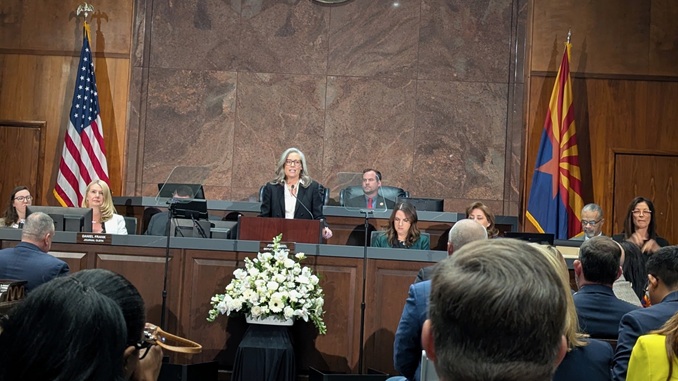
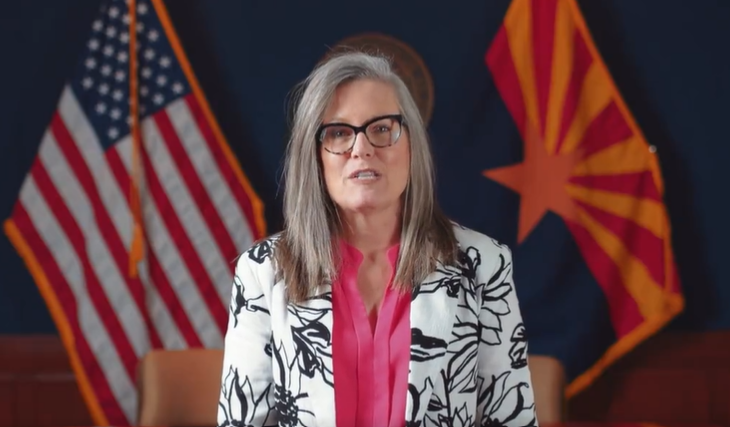
On Monday, Governor Katie Hobbs ushered in the start of the 57th Regular Session of the Arizona Legislature with her State of the State address, where she took time to criticize the Empowerment Scholarship Accounts (ESA) program. In her speech, Hobbs said, “The current program is unchecked, flawed, and rife with exploitation. Three years ago, it went far beyond its original purpose, which was to support kids with special needs and military families. Today, it has ballooned into a billion-dollar boondoggle increasingly scamming Arizonans. Other entitlements funded by taxpayers have strict oversight and income requirements. Yet the ESA program has the privilege of virtually no safeguards.”
Other entitlements funded by taxpayers have strict oversight and income requirements. Yet the ESA program has the privilege of virtually no safeguards. My executive budget offers a balanced solution that supports families and finally brings real and effective guardrails to ESAs.
Hobbs proposed changes to the ESA program for a “balanced solution that supports families and finally brings real and effective guardrails to ESAs.” Her solution was to “institute responsible income caps, ensure taxpayers know where their money is going, and create real accountability for taxpayer dollars.”
The governor’s remarks were met with immediate criticism from Republicans and others who support the expanded ESA program. Superintendent of Public Instruction Tom Horne said, “Under my leadership, the department has done a full-court press against waste and fraud. I hired both a program auditor and an investigator, which had not been done before. I require that every expenditure be for a valid educational purpose and have been attacked for doing that. The Governor needs to pay more attention to what is going on. She gets an ‘F’.”
Senate President Pro Tempore T.J. Shope added, “We will also protect parental choice, so that every child in the state has the ability to succeed in the classroom, no matter their zip code or financial status.”
Common Sense Institute Arizona wrote, “In her State of the State address, Governor Hobbs asked lawmakers to compare Arizona’s ESA program to other government entitlement programs with respect to accountability and transparency. Luckily, we already did! And it turns out that improper payment rates in the Arizona ESA program are a fraction of those in other government programs like Medicaid, Unemployment Insurance, and SNAP.”
In her State of the State address, @GovernorHobbs asked lawmakers to compare Arizona's ESA program to other government entitlement programs with respect to accountability and transparency.
Luckily, we already did! And it turns out that improper payment rates in the Arizona ESA… pic.twitter.com/XAfMKzaPmS
— Common Sense Institute Arizona (@CSInstituteAZ) January 13, 2025
Jason Bedrick said, “The voters made their will clear by re-electing those who supported ESAs and expanding their legislative majority. The legislature should reject Gov. Hobbs’ attempts to undermine ESA families.”
Once again, AZ Gov. @KatieHobbs is attacking families who use Empowerment Scholarship Accounts.
In her State of the State address, she called for income caps that would kick thousands of families out. Is she going to impose income caps on district schools too?
On the flip side, Governor Hobbs’ comments received support from her allies, who have long attempted to shrink, regulate, or eliminate the historic ESA expansion program in Arizona. Save Our Schools Arizona Executive Director Beth Lewis responded, “It is time to end the rampant waste, fraud, and abuse in the universal ESA voucher program. We commend Governor Hobbs for championing public education and pushing for much-needed voucher reform. We sincerely hope legislators like Senate President Petersen who name ‘fiscal responsibility’ their top priority will bring long-overdue guardrails to this irresponsible program, which now costs taxpayers nearly $1 billion annually.”
Hobbs and legislative Republicans will continue to bicker about the future of school choice in Arizona, but not much – if anything – will be done this year (and likely the next) to regulate ESAs per the governor’s insatiable desire. Over the past two years, Arizona Senate President Warren Petersen successfully fended off ferocious political attacks that targeted ESAs and other school choice opportunities for Arizonans. He will again be counted upon, along with his Republican colleagues in the Arizona House and Senate, to protect one of the top states in the country for school choice.
Daniel Stefanski is a reporter for AZ Free News. You can send him news tips using this link.
Arizona’s 2023 Abortion Report, released late last month, uncovers a dark truth: abortion in our state disproportionately targets minority communities. The data reveals that Hispanic and Black women are overrepresented in the number of abortions performed, far exceeding their share of Arizona’s population.
According to the report, Hispanic people accounted for 47% of all surgical abortions in 2023, while U.S. Census data shows they make up only 32% of the state’s population. Black people represented 11% of surgical abortions despite only being 6% of the population. Meanwhile, white people, who make up 53% of Arizona’s population, accounted for 30% of surgical abortions. These numbers reflect a decade-long trend: Hispanic and Black women consistently make up a higher percentage of abortions than their population percentages would suggest. This raises serious concerns about whether the abortion industry is disproportionately targeting minority communities.
The numbers aren’t just statistics. They tell a story of communities being disproportionately affected by abortion. Historically, the abortion industry has faced criticism for its roots in eugenics and its targeting of minority neighborhoods. Arizona law (ARS 13-3603.02) prohibits abortions based on race or sex, but these statistics make it clear that the impact of abortion on minorities remains profoundly unequal. This is not freedom of choice—it’s exploitation.
The sheer volume of abortions performed is heartbreaking. In 2023, Arizona celebrated 77,881 live births. At the same time, 12,705 babies were surgically aborted, not including chemical abortions. This means 14% of the babies who should have been part of our communities last year never had the chance to live. That’s not just a statistic; it’s a profound loss of human potential and a tragic reminder of the lives slaughtered by abortion.
Adding to this tragedy, Governor Katie Hobbs has called for an end to the Arizona Abortion Report, calling it “an attack on our freedom” and claiming it should not exist. But this report is not about attacking freedom—it’s about transparency and accountability. Eliminating it would obscure the truth, making it harder to see how abortion disproportionately impacts minority communities in our state.
The abortion industry’s targeting of Hispanic and Black women is not an accident—it’s a calculated strategy rooted in exploitation and profit. The 2023 Abortion Report doesn’t just expose chilling statistics; it exposes a system that sacrifices the most vulnerable—both mothers and their unborn children—for financial gain. This isn’t freedom, and it isn’t healthcare. It’s a disturbing reminder that the abortion industry thrives by exploiting the very communities it claims to serve. How much longer will we allow this silent genocide to continue before we confront the racism at its core?
Katarina White serves as Board Member for Arizona Right to Life. To get involved and stay informed, visit the Arizona Right to Life website.
On February 27, 1968, President Lyndon Baines Johnson was said to have listened to a devastating report by anchorman Walter Cronkite who assessed the Vietnam War as “to end in a stalemate.” According to Westpoint’s Modern War Institute, David Halberstam wrote in his 1979 book, “The Powers That Be,” that Johnson told press secretary, George Christian, “that if he had lost Walter Cronkite he had lost Mr. Average Citizen.”
In the article where she in turn condemns Arizona’s Republican 2020 alternate electors, former New York City Mayor Rudy Giuliani, State Senator Justine Wadsack, State Representative Austin Smith, and former AZGOP Chair Jeff DeWitt, Roberts called out Hobbs’ catastrophic failure to flip the Arizona Legislature and wrench control of the government from the GOP.
As Roberts noted, “Instead, she lost two seats in the House and one in the Senate, and now faces the most conservative Legislature of our time … maybe even any time.”
The AZCentral columnist went on to observe that the increased majority in both houses of the legislature will likely spell trouble for the embattled Democrat, who finds herself at the lowest point of her favorability, 36%. But it doesn’t end there. As Citizens For Free Enterprise Press Secretary Dan Coulson noted in a late November post to X, Hobbs is also a “Target of 2 separate criminal investigations,” with an undoubted primary challenge on the horizon.
Katie Hobbs Year in Review:
– 36% approval rating; – Target of 2 separate criminal investigations; – And a primary challenge incoming.
Roberts went on to prognosticate that the Trump administration would seek to characterize Hobbs as “out-of-touch with everyday Arizonans.” However, it seems likely that Trump will be more concerned with expanding the House GOP majority in Arizona, seeking to exploit any weaknesses in the Arizona House Democrats Caucus. One could imagine a concerted effort to oust Rep. Greg Stanton (D-AZ-04) who enters his third term in the House in January by a slim 7.2 point margin.
The gubernatorial challenge is bound to be far more of a concern for the Republican National Committee and the Republican Governors Association—though the President is likely to weigh in as he’s wont to do.
For now, Roberts’ assessment of Hobbs as 2024’s “Biggest Loser” appears to be apt, and the ghost of Walter Cronkite may have claimed another Democrat.
President Jimmy Carter passed away on December 29, 2024, at the age of 100. His death followed nearly two years in hospice care and the death of his wife, First Lady Rosalynn Carter, at age 96 in November 2023. In response to Carter’s passing, Arizona political leaders of both the Democratic and Republican parties offered rare and non-partisan expressions of sympathy and mourning.
The Arizona Republican Party succinctly posted, “Rest in Peace President Carter,” a simple direct message to address the passing of a political opponent.
The Arizona Democratic Party meanwhile offered a lengthier post writing, “The Arizona Democratic Party mourns the passing of Jimmy Carter, a man of profound humility, compassion, and dedication to humanity. President Carter moved our nation forward, from brokering peace in the Middle East to championing women’s rights.”
The Arizona Democratic Party mourns the passing of Jimmy Carter, a man of profound humility, compassion, and dedication to humanity.
President Carter moved our nation forward, from brokering peace in the Middle East to championing women’s rights. https://t.co/4lPtyNCABt
Arizona Senate Democrats courted controversy in their post writing, “Rest in Power,” as opposed to the traditional “Rest in Peace.”
One commenter replied, “Rest in power? Don’t disrespect a legendary man by saying something he wouldn’t have said. Recognize him for who he was.” Another chastised the AZ Senate Dems writing, “What dei hire wrote this? Rest in power? Lame.”
Embattled Democrat Governor Katie Hobbs offered the following: “President Jimmy Carter lived an exemplary life of service, fighting for peace and prosperity across the globe. On behalf of the State of Arizona, we send our love to the Carter Family and the millions worldwide whose lives are better because of President Carter’s legacy.”
President Jimmy Carter lived an exemplary life of service, fighting for peace and prosperity across the globe.
On behalf of the State of Arizona, we send our love to the Carter Family and the millions worldwide whose lives are better because of President Carter's legacy.
Arizona’s Democrat Attorney General Kris Mayes wrote a lengthier post, sharing the story from The Washington Post: “America has lost a true servant leader. President Jimmy Carter’s century-long life was defined by his integrity, compassion, and an unwavering commitment to serving his country and his fellow man.”
She continued, “From his military service to his leadership in the White House — and his tireless work with Habitat for Humanity and global humanitarian efforts — he showed us what it truly means to live for others. Rest in peace, President Carter.”
From his military service to his leadership in the White House — and his tireless work with Habitat for Humanity and global humanitarian efforts — he showed us what it truly means to live for others. Rest in peace, President Carter.
Democrat Senator Mark Kelly highlighted Carter’s philanthropy after his presidency, in addition to his human rights work writing, “Always humble, President Carter showed us that public service isn’t limited to elected office. He leaves a legacy not just as a president, but as a great American who wore the uniform, built homes for his neighbors, and worked for human rights across the globe.”
Always humble, President Carter showed us that public service isn’t limited to elected office. He leaves a legacy not just as a president, but as a great American who wore the uniform, built homes for his neighbors, and worked for human rights across the globe. https://t.co/dSMsydpbBK
Senator-elect Ruben Gallego, like his fellow Democrat Kelly, offered a short post of condolences writing, “A life dedicated to peace, justice, and compassion. Rest in peace, President Jimmy Carter. Sydney and I send our heartfelt condolences to the Carter family.”
A life dedicated to peace, justice, and compassion. Rest in peace, President Jimmy Carter. Sydney and I send our heartfelt condolences to the Carter family. https://t.co/MGXbh7uyw3
Democrat Congressman Greg Stanton released a statement addressing Carter’s service as a naval officer, the Governor of Georgia, and his presidency. He wrote, “Above all, he was an honorable man with unimpeachable character. Guided by his deep Christian faith, he built homes for the needy and taught Sunday School well into his 90s. He set a fine example for each of us for what it means to love thy neighbor.”
On the Republican side of Congress, Congressman Andy Biggs called upon supporters to join in prayer “for the friends and family of President Jimmy Carter.” He wrote in full, “Please join me in praying for the friends and family of President Jimmy Carter. President Carter passed away this afternoon at the age of 100. I pray that peace surrounds all who knew and loved him. May he rest in peace.”
Please join me in praying for the friends and family of President Jimmy Carter.
President Carter passed away this afternoon at the age of 100.
I pray that peace surrounds all who knew and loved him. May he rest in peace.
Congressman-elect Abe Hamadeh also highlighted Carter’s humanitarian work writing, “Yesterday, we lost a great humanitarian. President Jimmy Carter was a proud Navy veteran and compassionate humanitarian. He dedicated his life to serving his country and community. His legacy of kindness will never be forgotten. Rest in peace, President Carter.”
Yesterday, we lost a great humanitarian. President Jimmy Carter was a proud Navy veteran and compassionate humanitarian. He dedicated his life to serving his country and community. His legacy of kindness will never be forgotten. Rest in peace, President Carter. pic.twitter.com/azzCQcfzn5
Carter’s upcoming state funeral is slated for January 9th and could potentially run for ten days until the 19th, just one day prior to the inauguration of President-elect Donald Trump. Amidst calls from the radical left for Trump to be barred from the proceedings, Arizona’s political figures largely kept remarks on the death of Carter civil and solemn in an example the rest of the nation could hopefully follow.