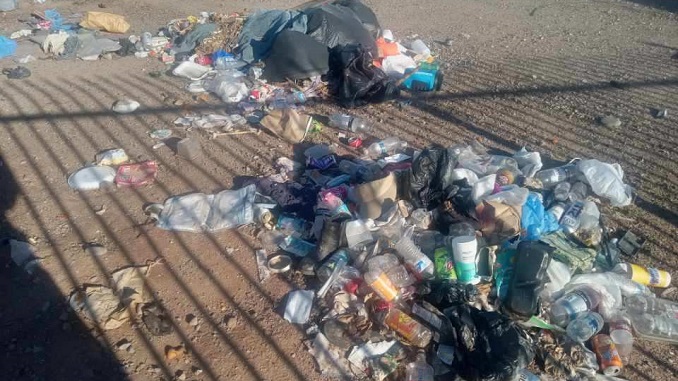
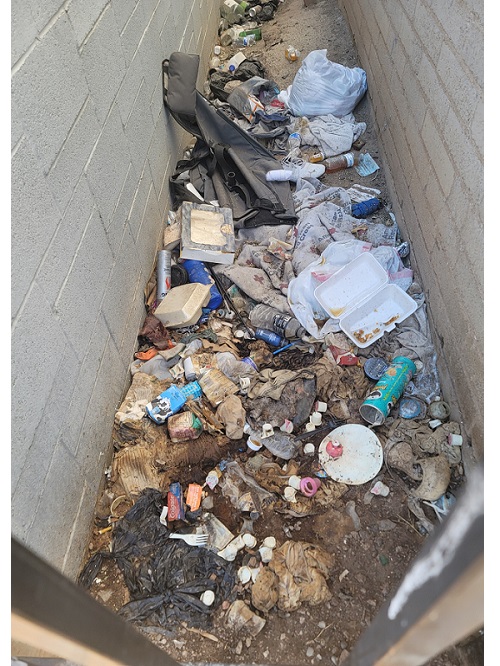
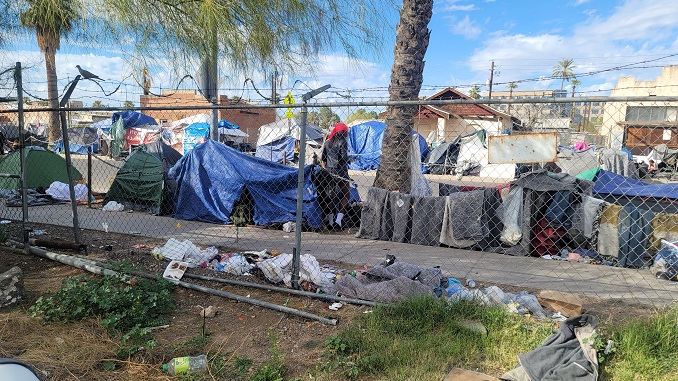
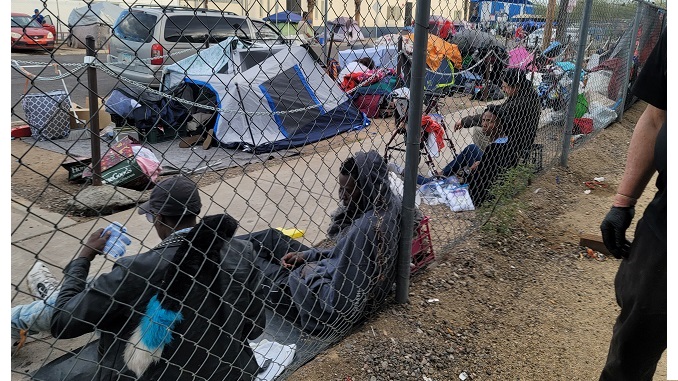
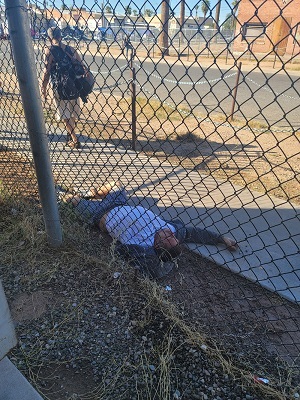
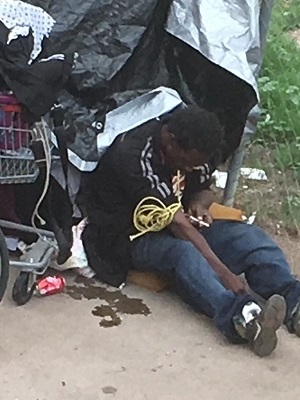
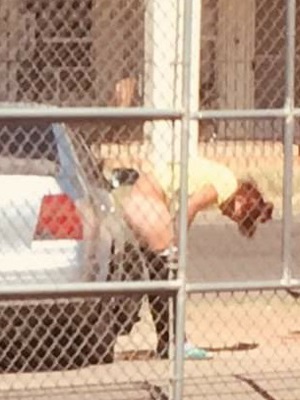
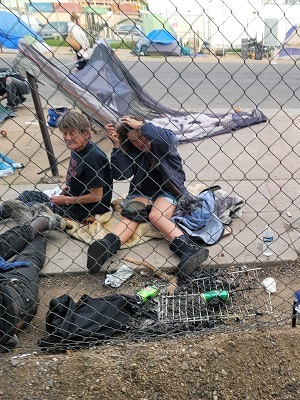
The suffocating stench of urine and feces. Rotting garbage. The occasional whiffs of fentanyl, or the synthetic drug Spice clouding the air. Dead bodies. No, it’s not a Third World nation—it’s a lawless encampment of over 1,000 homeless people in downtown Phoenix, where crime is rampant, and the city does virtually nothing about it.
The city’s inaction provoked a lawsuit by business owners in the Zone who are suffering the consequences of the unchecked homelessness crisis. This week, a Maricopa County judge issued a preliminary ruling, finding that the city has “intentionally stopped—or at least materially decreased—enforcement of criminal, health, and other quality of life statutes and ordinances in [T]he Zone,” effectively making it “off-limits to [law] enforcement.” That’s good news for the business owners, but the decision is just a first step in the long process of solving the problem.
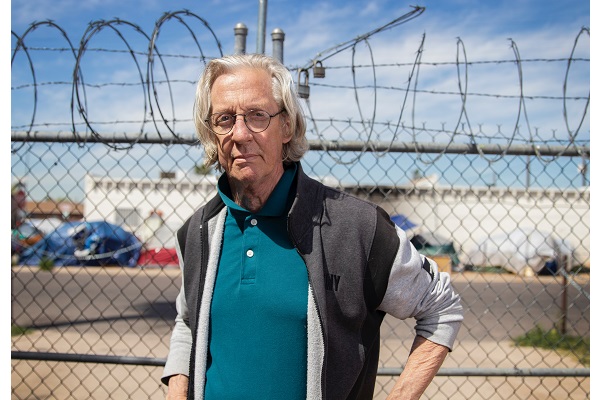
Karl Freund — who was leasing a building in The Zone and is suing the city over the homeless crisis — described to AZ Free News a state of apathy toward improvement for both the homeless and those assigned to handle it.
“You see trash everywhere. These people just don’t give a flip anymore, you know?” said Freund. “I see these people smoking meth wide out in the open. I’ll go over to them and tell them to leave. Then they’ll just go to another corner.”
The apathy has turned the once-thriving residential and business district into a depressed wasteland of death and depravity. Freund had plans to run a real estate business in the building he’d leased. Destruction to his property and the undesirability of the area caused by the homeless encampments has made that impossible; per AZ Free News’ initial report, he spent hundreds of thousands to fight for the property before having to find another to sublet it.
Human waste, garbage, and drug use overwhelm The Zone.
Sanitation is a far-off dream in The Zone — not only for the homeless, but also for those residents and business owners stuck there. These biohazardous slums are also affecting the rest of the state. Photographic evidence submitted in court filings reveals that unmanaged sewage and trash end up in storm drains. Drains which discharge into rivers, washes, and retention bases. The Zone is polluting Arizonans’ water on a daily basis, uninhibited.
AZ Free News spoke with a lawyer on the lawsuit against the city alleging a failure to take care of The Zone, Ilan Wurman, about the environmental hazards that The Zone poses (Brown v. Phoenix). Wurman confirmed that the constant deluge of waste ending up in our waterways violates state law.
“Their trash and waste goes into the storm drains and ends up in the waterways. That’s illegal discharge,” said Wurman.
The human waste and garbage that doesn’t end up in waterways creates other problems. Namely, they attract rodents and flies: a breeding ground for disease.
It was rats that resurrected a “medieval” disease in Los Angeles, California’s homeless population over the last decade: the bubonic plague. That accompanied the resurgence of other diseases rarely seen in this modern age, typhus and typhoid fever, alongside the persistent problem of hepatitis A and staph outbreaks. Around 1,000 were infected by hepatitis A from 2017 to 2019 in Southern California — even before the surge in the number of homeless that occurred during the pandemic — leaving just under two dozen dead. Typhus increased by thirteen-fold over the course of a decade in the area, from just over a dozen to just under 200 cases.
AZ Free News was unable to locate data from either Maricopa County or the state on communicable disease outbreaks other than COVID-19 in recent years.
Both court precedent and statute indicate that the city has a legal duty to not allow these hazards. Wurman referred AZ Free News to the justifications made for this argument in their recent motion for summary judgment issued in March.
“[A]ny person who knowingly maintains or commits a public nuisance or who knowingly fails or refuses to perform any legal duty relating to the removal of a public nuisance is guilty of a class 2 misdemeanor.” — A.R.S. Section 13-2917(D)
The city admits per court filings and testimony that conditions in The Zone are a “biohazard” due to the human waste, drug paraphernalia, and trash. Gina Montes, deputy city manager, said The Zone created “sanitation issues”; Scott Hall, deputy director of the Office of Homeless Solutions, admitted that the cleanups require “sanitation chemicals.”
“Their cleanup crews come in with hazmat gear. They expect us to accept those conditions in their neighborhood when they themselves have to wear those suits,” said Wurman.
The results of cleanup efforts only last a day at most, per testimony given by plaintiffs in court and by residents in interviews with AZ Free News. Cleanup crews also require police escorts due to the risk of violence they face, per city testimony. Yet residents and business owners must face The Zone on their own every day.
Up until last January, the city conducted cleanups three times a week: Mondays, Wednesdays, and Fridays. Items that couldn’t be moved were trashed. That was part of what prompted the DOJ to begin investigating the Phoenix Police Department in August 2021, reflecting tensions between a community desperate for better sanitary conditions and an unwavering political belief in protecting property rights for the homeless. Office of Homeless Solutions director Scott Hall claimed to reporters last November that the city wasn’t aware of property being thrown away.
The city resumed cleanups last December. However, the effects of these cleanups were only temporary since crews conducted these cleanups on a block-by-block basis. By the time crews reached the next block, the previous block they’d just cleaned had returned to its original state. City workers also offered services to the homeless while cleanups were underway; only 33 accepted, with the rest electing to return to a life on the streets.
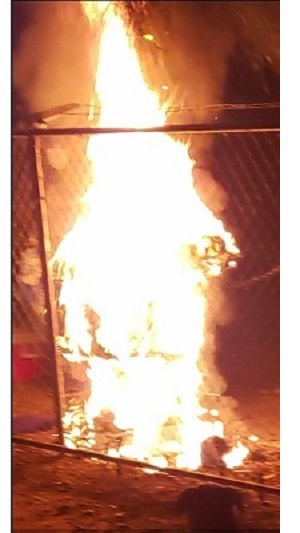
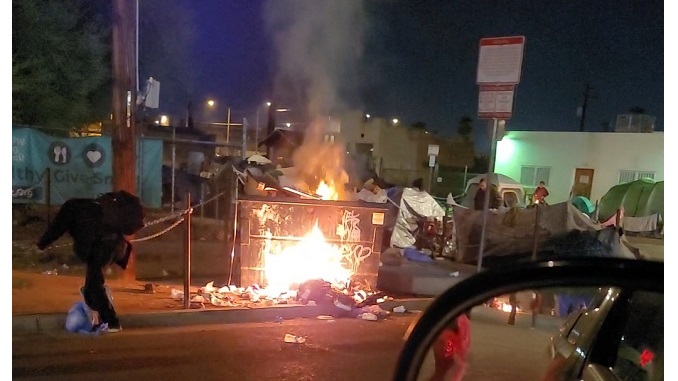
A fire burns in The Zone.
Cities that have dealt with a homeless crisis for far longer have experienced serious environmental dangers from mass encampments. Seattle, Washington has struggled to mitigate its homeless for decades, with reports highlighting 2005 as the first year that city officials first introduced a plan to tackle the problem. Thornton Creek Alliance (TCA), an environmental nonprofit focused on restoring Seattle’s waterways, has spoken out for years about the serious negative consequences of homeless encampments on the environment.
“The impact of homeless camps on nature is a concentrated version of the usual impacts of human settlement on nature: impervious packed soils, concentrations of human body waste, food waste, packaging waste, abandoned equipment and shelter materials, contamination by household and drug chemicals, destruction of existing wildlife and plants, pollution of watercourses and possibly water sources,” explained TCA board member Dass Adams in a statement to AZ Free News. “We have seen these effects here and we take care to discourage encampments in parks and natural areas that exist for healthful benefits for our citizens.”
In other reports, TCA warned that specific public health threats posed by homeless encampments included E. coli fecal coliform bacterial contamination of waterways. Such contaminated waterways usually indicate the presence of other waterborne pathogenic diseases such as typhoid fever, hepatitis A, and dysentery.
AZ Free News spoke with Mike Godbehere, one of the residents suing the city over alleged failure to maintain The Zone. His family’s auto supply company was located within The Zone — it had long predated it but didn’t outlast it.
Godbehere’s grandfather started the family business in 1947, after World War II ended and his service was concluded.
“My grandfather was an auto painter. When he came out of the war, WWII, he began selling services like matching color and pinstriping for body shops. One of the paint companies needed a paint distributor in our town,” said Godbehere. “Our family, four generations, have worked there including cousins and aunts and uncles. It was a business that supported our family through that length of time.”
Four generations interrupted by The Zone. Godbehere still owns the property, but leasing remains an issue. Those who most recently contracted to lease the place left before their lease was up — they opted to pay the remaining 24 months of rent rather than remain.
Godbehere said the smell of the human feces and urine saturating the ground just outside the building overwhelms him. Yet, he shared that the Maricopa County Health Department told him that since his complaint concerned property just inside the sidewalk that it was his responsibility.
Then, there’s the fires. One building on Godbehere’s property is older, with wooden double doors dating back to the business’ beginning. It comes close to going up in flames often, due to the homeless starting fires within several feet of it. Godbehere attempted to communicate with the homeless to dissuade them from starting these fires, then contacted police for assistance, but to no avail. One woman behind most of the recent fires refused city services; under current protocols, the city won’t forcibly remove the homeless from their chosen spots.
“Each day that passes I’m wondering when I’m going to get the phone call that my place will be on fire,” said Godbehere.
Joel Coplin has his art gallery in The Zone. Over the years, he observed that the sanitation issues follow the individuals under housing-first approaches — leading him to oppose it. He said he could only imagine that kind of approach working with supervision. He expressed appreciation for Gov. Katie Hobbs’ proposal to install repurposed shipping containers as supervised housing.
“I’ve taken them to their apartments, and I’m astounded at the rents these people are receiving for this. The tenant has to pay a third or a quarter for it, but the place gets immediately trashed,” said Coplin. “If you look at the tents and how there’s all this garbage, that goes in the apartment. It winds up being a junkyard with a pathway through it from the door to the bathroom and the bed. You have to have supervision otherwise it gets trashed.”
Joel Coplin has his art gallery in The Zone and has witnessed one of the many death that occur there. (Image courtesy of Blake Wilson)
Coplin compared The Zone to one of the seedier boroughs of New York.
“It’s like being in Brownsville, Brooklyn, except there’s no corner store to hang out at, so they all just hang out by their tents,” said Coplin. “I open my door and you can hear them, doing their drugs, playing their music, and having a great time. It’s a beautiful life: free rent, all the drugs you want, all the sex you want — if you have the drugs. The only problem is someone might beat you up for all the drugs.”
About a month ago, Coplin witnessed one of the many deaths that occur in The Zone. A homeless man he’d come to know on a first-name basis, Lamar, was shot and killed. Coplin explained that the homeless have tribe-like groups that fight one another.
Total deaths in The Zone have increased at an exponential rate over the last few years. The Maricopa County Medical Examiner Office reported just over 200 deaths in 2018, a year before the homeless crisis picked up. Last year, there were over 700.
Despite the squalor worsening all around him, Coplin said he’s determined to stick around, hopeful he’ll witness a revival in the area. He and other artists migrated there decades ago because it was affordable: a common backstory for those establishing a historic arts community.
“I want to see it through. I want to see our dream come true and try to put some gas on it. I want these people off the street, in some place better for them so they don’t have to crap on the sidewalk and pour my pee on the plants,” said Coplin.
Corinne Murdock is a reporter for AZ Free News. Follow her latest on Twitter, or email tips to corinne@azfreenews.com.
Intense poverty, frequent crime, social instability, high mortality, poor living standards: these qualities describe third-world countries. They also describe “The Zone”: the sprawling encampment of over 1,000 homeless in downtown Phoenix just blocks from the state capitol and amidst what was once a thriving business district. It’s an area where law and order don’t seem to exist; so much so that locals have given the area another, much darker nickname: “The Thunderdome.”
The crisis reached a new high after the discovery of a premature baby’s remains several weeks before Thanksgiving last year, burned in the middle of the street. A month later, a similar grisly fate befell a homeless man.
“That child burned… that was the beginning of the end for me. I don’t know why that hit us so hard,” said Karl Freund, who was leasing a building in The Zone and is suing the city of Phoenix over their handling of the homeless crisis. “Someone set a child on fire, and then two weeks later somebody burned a body just a block away. Then you see the people that are so mentally ill that you can’t place them in society. We walked out a year ago to see a girl masturbating 20 feet away from my car in the parking lot.”
Death and depravity are a common occurrence in The Zone.
Last month, Phoenix police shot and killed a Spanish-speaking homeless man who lunged at them with scissors. Attempts to incapacitate the man with stun guns were unsuccessful. Police had responded to a 911 call from a woman reporting the man approaching her aggressively while attempting to trespass her property.
Drug deals, addicts using, defecation and urination, assaults, sexual acts, and rapes are also done out in the open with increasing impunity. Gangs run the streets of The Zone, making the homeless pay for their tent space and beating them up at will. Registered sex offenders roam the streets, having been dropped off in The Zone. Businesses close but must continue paying rent.
Homeless sit outside of Angie Ojile’s business and other businesses in The Zone.
The Zone sprung up outside Central Arizona Shelter Services (CASS) Human Services Campus, an organization that provides food, shelter, and more to the homeless. It’s located in a dense and diverse business district that includes a near-historic sub shop, appliance manufacturer, cabinet manufacturer, steel manufacturer, millworker, textile company, metal supplier, door supplier, ironwork company, glass and mirror shops, counter supply store, air conditioning supply store, funeral supply store, motorcycle shop, RV shop, auto repair store, electrical supply store, art museum, custom printer, waste services, paper company, several recycling services, several automotive stores, and several transportation companies. Business owners neighboring The Zone have seen the homeless population — and attendant crime — grow over the last two years and four months.
Angie Ojile, a commercial designer and realtor in The Zone for over 20 years, said that she sees this and more every day. She said she watched four people taken out of the area in body bags in a one-day period. The level of danger is so prevalent that Ojile says that other businesses refuse to come there: pizza shops won’t deliver, and plumbers won’t service the buildings. Limitations on those services pale in comparison to her other, more pressing problem: retaining employees. Ojile told AZ Free News that one young woman she hired was initially excited to work for her, but left out of fear for her safety after several days navigating The Zone.
Ojile says the city is to blame for these troubles.
“Everything they do defies logic. It’s hurting people — not helping people,” said Ojile.
The homeless relentlessly bombard Ojile’s property with human waste, fires, garbage, drug use, assaults, and gang activity. Ojile estimates that she spends more on cleanups around her property than some pay for mortgages.
“The ground is so saturated with feces and urine, I can’t even breathe. We’ve got walls that are so full of feces, it’s disgusting. You can’t even look in that direction,” said Ojile. “We had dreams when we bought this property, and now we’re paying for it.”
Property assessments estimate Ojile’s property to be worth well over $2 million — but only if The Zone didn’t exist. A realtor told Ojile that her property was essentially worth nothing due to The Zone, and that he couldn’t sell the property in good faith due to that. Anyone who bought Ojile’s property — if buyers could be found — would find themselves in the same predicament as Ojile: unable to run her business properly, causing her to fall behind on property taxes.
Ojile said that nobody from the city bothered to return her calls for help. The supervisor representing that district, Steve Gallardo, has never returned her calls. Even an ombudsman wasn’t able to get information for her in a timely manner, something which the ombudsman allegedly remarked was unusual.
“I went to the city immediately for help, but no one would ever get back to me,” said Ojile.
This crisis hasn’t just taken a financial toll on Ojile; it has imposed a great emotional and physical toll. Ojile’s dog has gone missing three times, at least. The homeless have cut her fence to take the dog; she’s had to track down her dog in homeless tents and even an animal shelter.
Last week, Ojile became severely ill while working inside her business — a sickness unlike she’d experienced before. The room she was working in wasn’t completely insulated from the outside: she had to board over one of the windows, since the homeless would break it every time she fixed it and the city would fine her for blight over the broken window. Ojile suspected that she’d been exposed to someone smoking fentanyl.
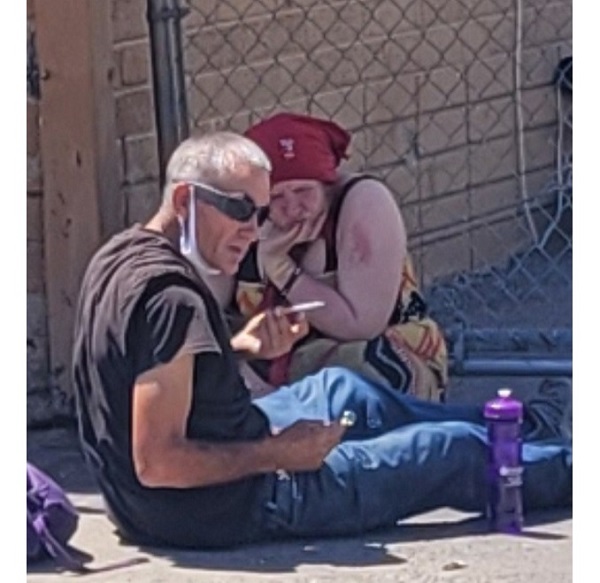
Homeless use drugs inside Phoenix’s sprawling encampment known as The Zone.
Help from law enforcement isn’t always an option for Ojile in situations like that. According to Ojile, officers told her that they wouldn’t enforce the law equally in The Zone for fear of losing their jobs.
Phoenix Police Department (PPD) reported 278 incidents in 2020 and 206 incidents in 2021. There were around 200 incidents last year. There have been well over 4,000 calls from 2019 through last year, with over 1,200 calls for fire department assistance alone last year.
For Freund, the growth of crime in the area has reached a tipping point. He’d hoped to open a real estate office in the building he’d leased, but the state of the area hasn’t made that possible. Freund said that the PPD has not only stopped responding but stopped answering their calls.
“The day-to-day down there is unlivable for anybody and I can’t believe we subject humans to this environment,” said Freund. “Why would you subject humans to that kind of living condition? There’s prostitution, murder, physical beatings.”
Freund fought to open his business in that building, spending hundreds of thousands on property taxes, renovations, and fixing damages caused by the homeless. According to Freund, they’ve attempted to set his building on fire multiple times and stolen all of the copper wiring and pipe. He gave up hope on the property after 20 months; he managed to find another to sublet the property. The thousands he spent in property taxes and beautification wasn’t enough to spur the city to action — just as is the case for so many others in The Zone.
Although these business owners have languished for years, several weeks’ worth of sports fans visiting the city were spared the crisis. Ahead of the lucrative NFL Super Bowl and PGA Waste Management Open that were held in the Phoenix area in February, the city committed to cleanup efforts of homeless encampments. However, these cleanup efforts aren’t permanent. The homeless are free to return to the areas after cleanup ends; they already have. Only 33 of the homeless accepted services during Phase One of the city’s December cleanup, according to the deputy director for the Office of Homeless Solutions, Scott Hall.
Apart from cleanups, the city has directed their millions in funding on a “housing first” or “permanent supportive housing” model, sometimes called “affordable housing.” The theory behind this model is that the homeless will choose to seek employment, become financially responsible, and receive mental health care and/or substance abuse treatment if food and housing are provided. The theory also posits that enabling the homeless to choose their housing and support services will make them more likely to remain in that housing and stick with self-improvement initiatives.
The city has poured millions of funding to create housing; yet available housing hasn’t kept pace with the number of homeless, the retention rates of the homeless in their housing and program participation remains poor, and the crisis is progressively spreading to surrounding areas. Even so, the city allocated another $12 million last October, another $8 million last November, and another $25 million in January to prove the housing first theory correct.
The city recently unveiled their latest attempt at free housing for the homeless on Feb. 8: five shipping containers repurposed for “sustainable” housing. These living structures’ purported sustainability comes at the cost of $200,000 for one-bedroom, one-bathroom’s worth of solar panels providing power, an incinerator toilet, LED lighting, and economical heating and cooling. The Arizona Department of Housing issued a $1.2 million grant for the five units.
Then there was the 24/7, single-stall, $200,000 toilet for the homeless launched in January.
Other city initiatives providing the homeless with more resources also appear to have failed to make a noticeable impact on the crisis.
In December, the city launched an employment program that pays the homeless $65 to work five-hour shifts. However, those directly impacted by or handling the crisis say that these kinds of approaches haven’t led to lasting change.
Ojile said that the homeless she’s known for many years don’t feel like they’re getting help. Some of the homeless she knows in the area have been there for decades. They’re trapped alongside Ojile.
“We can’t get out. They’re crashing our property values,” said Ojile. “There’s people that are homeless that don’t want to be near this.”
A broker estimated the value of Ojile’s property at around $2.4 million. However, the broker informed Ojile that her property is unmarketable due to the state of The Zone.
“[The] values are based ‘as if’ the property was not associated or in proximity to the situation currently occurring adjacent to the Property (i.e. homeless, mental health, drugs, gangs, etc.). Unfortunately, the property is deemed unmarketable at any realistic value at this date due to these issues along with safety concerns that would be perceived by any prospective buyer, tenant or investor that would normally have invested in the property. Further, at this date, the city of Phoenix who is trying to manage a difficult problem, has ‘kicked the can down the road’ and now that ‘can’ is on and surrounding your property. Additionally, since you have disclosed various items to me (break-ins, been threatened, witnessed drug purchases, individuals urinating/defecating on the property, etc.) as a licensed real estate agent held to ADRE Rules and Statutes, I am required to notify all potential buyers, tenants, investors of such. Therefore, as referenced above, post touring the property, which they will see the issues firsthand and my disclosure of all facts I am aware of associated with this property, I again state that the property is unfortunately ‘unmarketable’ at this time.’” (emphasis added)
Angie’s property and others are regularly bombarded with human waste, fires, garbage, and drug use,
Judge Glock, a senior fellow with a Texas-based nonpartisan policy group called the Cicero Institute, said that leaders are gravely mistaken to believe that a housing-first approach works.
“They’re convinced by a very small group that nothing can be done, that anything that moves people off the sidewalk is cruel, and the only option is a house for every single person that costs hundreds of thousands of dollars per person,” said Glock. “It’s an unfortunate mindset, but that’s what a small group of activists have convinced them.”
Jeff Taylor, chairman of the board for the Salvation Army’s western territory, said that residential behavioral health treatment needs to occur before any kind of housing efforts. Taylor shared with AZ Free News just one of many initiatives to house the homeless that failed.
“They took 20 of their star people from the shelter, they got them apartments and they went to Target and got furniture, went to Walmart, got their closets filled with clothes, moved all 20 into apartments and they had employment. Within a week they’d sold everything, and they were running drug dens out of the housing,” recounted Taylor. “The problem isn’t getting someone clean; it’s keeping someone clean. Recovery is measured in years.”
Taylor said that the homeless with mental health or drug addictions were only as good as their treatment programs. What’s more, Taylor expressed concern that the crisis would only worsen due to the newest drug to hit the streets: fentanyl. The potency equivalent of other, more costly hard drugs, such as crack cocaine and heroin, only costs $1 for fentanyl.
“This is a humanitarian crisis that will only get worse,” said Taylor. “Fentanyl is a whole other ballgame.”
Sam Stone, a Phoenix City Council candidate, said that permanent supportive housing wouldn’t incentivize the homeless to get their lives on track. Stone doesn’t live in The Zone, but he’s spent much time there over the years attempting to solve the crisis.
“We have to start from the perspective that chronic street homelessness is not an acceptable lifestyle choice,” said Stone. “What they’re talking about is just warehousing addicts and mentally ill people until they die. Without treatment for their issues, they’re never going to get better. All they ever do is demand we spend more and more money. None of that does anything to change what’s going on. You have to lead with services. You have to switch things around. You have to make it tough to live on the street and easy to get into treatment.”
Stone and others we spoke to referenced Austin, Texas, as a poster child for mitigating homelessness. Austin voters reinstated a public camping ban in May 2021, after the city council ended a similar ban that had been in place for 23 years. Encampments quickly flooded the city, and the homeless were underfoot everywhere. That reality no longer exists: the homeless are few and far between throughout the city, and shelters are operated on a closed-campus basis, meaning that the homeless have to be referred in order to receive services.
Viewing The Zone and Phoenix’s homeless crisis isn’t a partisan issue. Catherine Miranda, a newly elected Democratic state senator representing the district containing The Zone, published a lengthy article last December criticizing the city’s approach to addressing their homeless.
Miranda declared that Phoenix’s housing first dreams had failed her homeless constituents. The freshman lawmaker urged the enforcement of existing street camping bans, prioritization of short-term rather than permanent housing, and treatment of mental health and addiction problems first.
“Phoenix wants to give the homeless permanent homes without addressing the root causes of their homelessness. No wonder it’s been a disaster,” wrote Miranda. “The state and city should refocus on a ‘Treatment First’ philosophy. While the failed ‘Housing First’ model does not require treatment for drug addiction or mental health problems, programs like recovery housing tie to sobriety or mental health checkups.”
Miranda also noted that building houses takes years, resulting in the homeless continuing to live a dangerous, unhealthy lifestyle on the streets.
“While we wait years or decades for these thousands of homes to be built, they want to keep allowing our most vulnerable neighbors, who are struggling with drug addiction and severe mental illness, to live and die on our streets,” stated Miranda.
The Maricopa Association of Governments (MAG) annual point-in-time (PIT) homeless counts over the past few years reflect a historic high in the homeless population, the likes of which haven’t been experienced in well over a decade. Last year’s MAG counted nearly 3,100 unsheltered homeless. That’s a 131 percent increase from 2013, when there were just over 1,300 unsheltered homeless.
The 2022 PIT also reported that 44 percent of homeless were in emergency shelters, transitional housing, or safe haven programs, while 56 percent weren’t. 2020 was the first time in recent years that there were more unsheltered homeless individuals: 49 percent were sheltered homeless individuals, while 51 percent weren’t. However, this decline preceded efforts to mitigate COVID-19 spread, such as reducing shelter capacity.
In 2019, 52 percent were sheltered, while 48 percent weren’t. Even those 2019 numbers reflected a significant decline in the number of homeless seeking sheltered services: the number of unsheltered homeless increased by 22 percent from 2018 to 2019, while the number of sheltered declined by seven percent.
According to the latest Department of Housing and Urban Development (HUD) Housing Inventory Count, Maricopa County and Phoenix had over 12,300 beds available for homeless housing last year. Nearly 8,100 of these were permanent housing, while just over 4,200 were emergency, safe haven, and transitional housing.
A fire burns inside The Zone.
Homeless deaths have also been increasing at a significant rate. The Maricopa County Medical Examiner’s Office reported that homeless deaths more than doubled from over 250 in 2019 to nearly 600 in 2020, with a slight decline to just over 500 in 2021 before skyrocketing to over 700 last year.
Though crimes and deaths have increased in the area, emergency services haven’t been able to keep up. Emails obtained by AZ Free News revealed that the Phoenix Fire Department won’t respond to calls without PPD assistance and assurance that the scene of the incident is secure, due to how dangerous The Zone has become.
Even then, police claims of an incident scene being secure aren’t always accepted by first responders. Emails revealed that the scene could span multiple city blocks and contain crowds likely to assault the emergency responders.
The emails also revealed that first responders considered the Black Lives Matter (BLM) riots of 2020 to pale in comparison to the everyday dangers of The Zone. The first responders noted that they lacked adequate protection and resources to respond in that area.
“At no point during the protests did I feel like our folks were in the potential danger that they face every day responding to the area surrounding CASS,” stated the email.
Freund says he noticed a shift in the city’s handling of the homeless around November 2020. He said that the numbers of homeless in The Zone began to increase greatly around that time, and that the homeless became more resistant to residents’ requests to move. Freund said that law enforcement activity began to slow down around that time as well.
Now, Freund and leaders like Stone are warning that this problem is spreading.
“You walk into The Zone, it’s like you’re walking out of America. It’s a nightmare hellscape that shouldn’t exist anywhere in this country, but it’s also what a lot of our major cities are coming to look like,” said Stone. “Unless we start looking to get our homeless population into treatment or off the streets, The Zone isn’t going to stay in The Zone.”
Click an image in the gallery below for more images:
Corinne Murdock is a reporter for AZ Free News. Follow her latest on Twitter, or email tips to corinne@azfreenews.com.
The surge in deaths from Fentanyl overdoses is overwhelming communities across the country. Fentanyl is responsible for at least 70 percent of all drug deaths in the U.S. According to the Drug Enforcement Administration (DEA), the United States suffered more fentanyl-related deaths than gun- and auto-related deaths combined last year. And it is the number one cause of death among U.S. adults, aged 18-45.
Here in Arizona, the Fentanyl crisis is particularly acute. Fentanyl flows easily into our state across our southern border. Until Washington gets serious about controlling it, Arizona has to take decisive action now to disrupt the supply lines of the drug cartels.
In the rush to “do something” about this very real crisis, some well-intentioned legislators have proposed HB2167, which would spend precious law enforcement resources on seeking murder sentences for individual sellers rather than going after large traffickers. Certainly, we want to punish those who support their drug habit by selling small amounts of Fentanyl, and current Arizona law sends a person who provides illicit drugs to prison for up to 25 years. That is a substantial sentence.
HB2167 would go further so that if a person dies after receiving the drugs – even if it is not “the immediate cause of death” – the person who gave them the drug would be sentenced by the judge as a murderer.
This is problematic because the cartels often press Fentanyl into pills to make them like prescription pills. They do this because Fentanyl is cheaper than the ingredients of the real prescription drugs. And profit is what motivates the cartels. Keith Humphreys, a Stanford University professor who tracks the opioid crisis wrote, “You don’t need land, good weather, peasant labor, processing of crops, etc. Instead, you can whip it up in a small lab, and every gram is 50 times as strong as heroin.”
It is impossible for a buyer to know if the drugs they buy also contain Fentanyl. HB2167 calls for sentencing the person who gave or sold these ersatz drugs as a murderer even if they were unaware that Fentanyl had been added. That could result in real injustice.
Take for example, your daughter goes away to college and falls in with friends who enjoy getting high. If she gave a pill to a friend who later died, your daughter could be sentenced as a murderer without the state having to prove that the drug caused the death! Certainly, your child deserves to be punished, and she can be imprisoned for up to 25 years without HB2167. But it would be wrong to punish her as a murderer with a much longer sentence.
The DEA’s top priorities are interdicting the traffic in Fentanyl and prosecuting the large drug trafficking organizations. But by including “small fish” as I explained above, HB2167 in its current form puts Arizona out of step with the DEA’s priorities. The House Judiciary Committee should amend HB2167 so that it aligns with the DEA by targeting resources to taking down the leaders of the large distribution networks, and putting them out of business. That is the most effective way to make our communities safer.
Pat Nolan lives in Prescott and is the founder of the American Conservative Union Foundation’s Nolan Center for Justice. He is a respected national leader on crime issues.
Drug traffickers who commit homicide may be charged with a Class 1 felony in Arizona under a newly proposed bill.
Class 1 felonies carry a minimum sentence of 10 years, with a maximum sentence of 25 years. Repeat offenders face a minimum sentence of 15 years, with a maximum sentence of 29 years. If the victim is under 15 years old, then the perpetrator would be subject to life imprisonment.
The bill, HB2167, was named after a Yavapai County victim of fentanyl-tainted narcotics, Ashley Dunn, and comes from State Rep. Quang Nguyen. The bill defines “drug trafficking homicide” as occurring when individuals transfer a dangerous or narcotic drug and cause another’s death through the consumption or sale of the drug.
In a press release, Nguyen said that this legislation would help solve the immediate issue of Arizonans’ safety.
“Fentanyl is killing tens of thousands of Americans each year and destroying families,” said Nguyen. “It’s a public crisis that should unite political parties to act urgently. We are in a war to save lives.”
State Representative @QuangNguyenAZ sponsors #HB2167 to combat fentanyl epidemic in Arizona.
26 House Republicans signed onto the bill, and two senators: Ken Bennett (R-LD01) and Eva Diaz (D-LD22). The bill was assigned to the House Judiciary Committee.
Fentanyl’s deadliness not only impacts those who consume it, but those who so much as touch it, whether intentionally or unintentionally. The drug’s toxicity has state officials urging speedy implementation of new protocol to protect law enforcement that may handle the drug. Last June, Arizona Supreme Court Chief Justice Robert Brutinel established a task force to create guidelines for the safe handling of fentanyl. That task force must submit its report by March 31.
Quang’s bill includes stricter punishment for children’s deaths due to drug traffickers’ current operational patterns. With the rise of the border crisis, fentanyl traffickers expanded their targeted clientele to include minors. Over the last year especially, these traffickers have pushed “rainbow fentanyl” that look like candy to entice youth. Fentanyl pills are normally designed to look like oxycodone prescription pills: blue, and stamped with “M30.”
Like their traditional counterparts, these rainbow pills often carry fentanyl doses lethal enough to kill adults.
Almost one year ago to date, health experts and law enforcement warned that the state was facing a burgeoning pediatric fentanyl crisis. In 2022, there were 138 non-fatal opioid overdoses and 28 deaths in minors aged 0-17. That’s a decline of 70 non-fatal opioid overdoses and 19 deaths from 2021, and a decline of 198 non-fatal opioid overdoses and 31 deaths from 2020.
In fact, all non-fatal opioid overdoses and deaths have declined slightly since a peak in 2020.
Though these numbers have declined over the last few years, total drug seizures keep climbing. Law enforcement have seized millions in fentanyl pills amid the ongoing border crisis. According to Customs and Border Patrol (CBP) drug seizure statistics, there have been nearly 26,600 pounds of fentanyl seized along the southern border since President Joe Biden took office.
Seizures more than doubled from the 2020 to 2021 fiscal year. Last month was a historic high in fentanyl seizures for all time: nearly 3,000 pounds of fentanyl.
Corinne Murdock is a reporter for AZ Free News. Follow her latest on Twitter, or email tips to corinne@azfreenews.com.
When video went viral this month of a Florida police officer needing three doses of Narcan after losing consciousness when exposed to fentanyl during a routine traffic stop, it renewed attention to the dangers the deadly drug poses to public safety and healthcare workers.
But protocols for handling fentanyl and other potentially toxic evidence are months from approved within Arizona’s judicial system, even though there are currently hundreds of ongoing fentanyl-related criminal cases in the state’s courts.
Court administrators and presiding judges across Arizona have expressed concerns about safety protocols since 2020 when the number of prosecutions involving the drug started to rise. But it was not until this June that Chief Justice Robert Brutinel of the Arizona Supreme Court established a taskforce to create guidelines for handling fentanyl and other toxic evidence in courthouses.
The Fentanyl and Toxic Evidence Taskforce was given a Dec. 31 deadline to file its report and recommendations. However, the 11 members of the taskforce notified Brutinel in November that they need more time.
As a result, the report’s deadline has been extended to March 31, 2023.
Guidelines are necessary, Brutinel noted in June, due to the “significant rise” of overdoses associated with fentanyl, as well as the corresponding rise in the number of cases in which fentanyl is part of the evidence against a defendant.
“Accordingly, there is the potential risk that the drug evidence and other toxic evidence in these cases will need to be handled in the courthouse,” the chief justice noted, adding that protocols for dealing with fentanyl exposure and for handling the drug is already developed for some industries. “There has been little guidance, however, issued for court personnel who may have to handle packaged evidence of fentanyl, carfentanil, their analogs, or other toxic evidence.”
The chief justice ordered the 2019 National Judicial Opioid Task Force guidelines be used by the taskforce as a reference to address several issues:
Whether such drugs should be inspected and approved by designated court personnel before being allowed into a courthouse
Whether these packaged drugs must always remain in the possession of law enforcement personnel, except by approval of the court
Whether the drugs should ever be handled by court personnel or others during a judicial proceeding, such as attorneys, witnesses, court clerks, and jurors
Whether such drugs should remain in a courthouse or court-related facility during non-business hours
What safety policies should be established for the handling of fentanyl evidence
Whether courthouse personnel should be trained to address possible exposure to fentanyl and other toxic evidence and to properly identify opioid toxicity
Whether Naloxone (Narcan) should be kept in courthouses and other court-related facilities for emergencies and whether any court personnel should be trained in its administration.
One consideration for the taskforce is the need to balance safety concerns for court personnel and members of the public who may be exposed to the drugs during a judicial proceeding against the rights of defendants or even a victim in judicial proceedings to due process and a fair trial, Brutinel noted.
Terri Jo Neff is a reporter for AZ Free News. Follow her latest on Twitter, or send her news tips here.