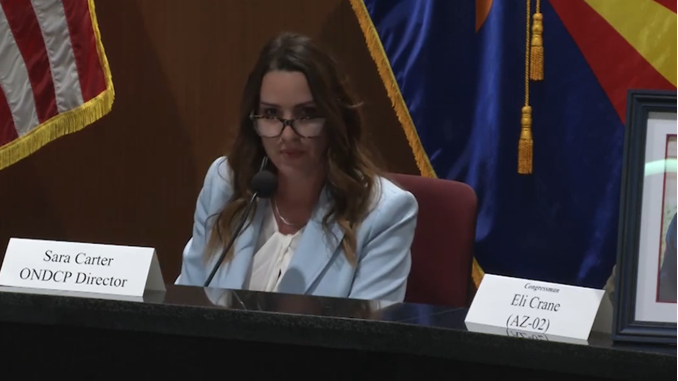
The White House Office of National Drug Control Policy (ONDCP) paid a visit to Arizona last week.
Sara Carter, director of the ONDCP, came to address Arizona’s unique situation with its ongoing drug crisis. Arizona was one of few states to experience an increase in drug overdose deaths rather than a decrease in 2025. Not only that: Arizona had the most drug overdose deaths last year.
While drug overdose deaths decreased 31% nationwide, Arizona experienced a 30% increase in drug overdose deaths.
Republican Rep. Andy Biggs (AZ-05) hosted Carter’s visit to Arizona, and Republican Rep. Eli Crane (AZ-02) joined the pair for meetings according to a press release from Biggs. These meetings were also attended by Drug Enforcement Administration officials, tribal partners, local law enforcement, and Angel Families.
Angel Families include all family members of individuals victimized or killed by criminal illegal aliens. Nearly all of the Angel Families in attendance last week were those whose loved ones fell victim to the crimes and violence resulting from drug cartel activity.
Eight of those families testified at a roundtable hosted at the Arizona State Capitol on Friday. These families claimed that the deaths of their loved ones were preventable through stricter immigration enforcement policies.
Among those to testify were Mary Ann Mendoza, who recounted how her son, Mesa police officer Brandon Mendoza, was killed in 2014 by an illegal alien drunk driver who had a criminal record dating back to 1994 and was living as a fugitive at the time of the crash.
Doug and Patricia Quets shared how their adult son Nicholas Quets, a Marine veteran, was murdered by Sinaloa cartel members in 2024.
Fernando Basurto explained that his grandson, Fernando Jose Basurto Jr., was about to graduate high school and had plans to enter the Air Force when he was murdered by a criminal illegal alien in 2016, who had been released shortly prior to the murder. Basurto said that former Sen. Martha McSally initially soured him on Congress because she refused to see their family to discuss Fernando Jose’s murder.
Patti Fox testified alongside her adult daughter, Carissa Aspnes, who was struck and severely disabled by an illegal alien running a stop sign in 2025. Carissa — a second-generation American on her grandmother’s side, a legal immigrant from Thailand — suffered a traumatic brain injury and now requires full-time care. Fox said local investigators initially covered up the fact that Carissa’s assailants were illegal aliens who entered the country under the Biden administration.
Karen Griffin explained that her teen son, Tyler Griffin, passed away in 2020 after taking a pill he believed to be Tylenol, but was actually laced with fentanyl.
Similarly, Anne Fundner shared that her 15-year-old son, Weston Fundner, passed away in 2022 after taking pills laced with fentanyl.
Carter promised to incorporate those suggestions from Friday’s roundtable into legislative proposals and policies put forth by the Trump administration.
Attendees included Reps. Quang Nguyen (R-LD-1), Nick Kupper (R-LD-25), and Lisa Fink (RLD-27); Sen. Carine Wrner (RLD-4); Maricopa County Supervisor Debbie Lesko; Queen Creek Mayor Julia Wheatley; and Art Del Cueto, formerly president of the National Border Patrol Council.
As part of its mission to address the drug crisis, ONDCP has taken a special focus on Arizona’s increase in drug overdose deaths, especially those involving fentanyl. It is the belief of the Trump administration, and Biggs and Crane, that the border policies of former President Joe Biden are to blame for Arizona’s ongoing drug crisis.
Carter commended Arizona as taking steps to fight back against the drug crisis.
“These communities know firsthand the devastating impact of illicit drugs,” said Carter. “President Trump and his administration will continue to fight for our citizens until every American is free to live a safe and healthy life, free from the scourge of illicit drugs.”
Earlier this month, ONDCP released a 200-page National Drug Control Strategy for 2026.
Under this administration, Trump has signed legislation classifying fentanyl-related compounds as Schedule I drugs; designated cartels as foreign terrorist organizations; designated illicit fentanyl and its core precursor chemicals as weapons of mass destruction; and signed legislation expanding the border wall and increasing deportations.
AZ Free News is your #1 source for Arizona news and politics. You can send us news tips using this link.
Arizona is proving to be a key bridge between deadly drug traffickers and Americans.
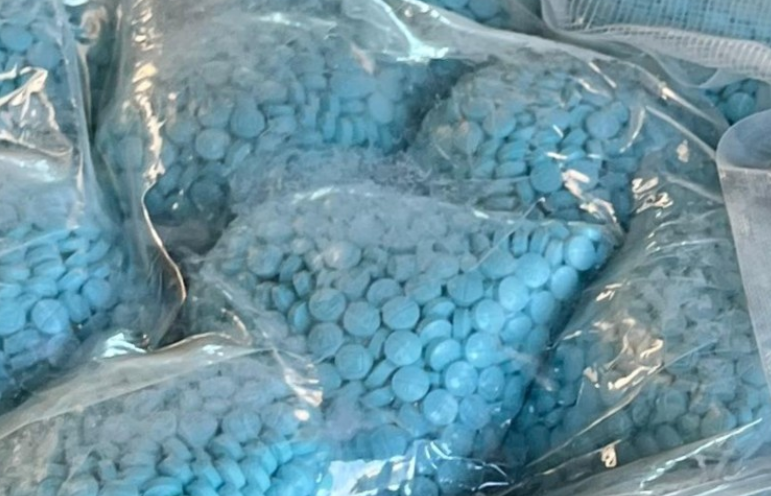
Out of the nearly five million fentanyl pills and powder seized in its most recent enforcement action by the Drug Enforcement Administration (DEA), about three million came from Arizona.
The DEA disclosed this discovery within its action, the second phase of Operation Fentanyl Free America, in an exclusive report to ABC15. The second phase occurred from early January to early February.
The 4.7 million fentanyl pills and 3,000 pounds of fentanyl powder amounted to over 57 million deadly doses of fentanyl. The DEA also seized 147,800 pounds of cocaine, 21,000 pounds of meth, over 26 million meth pills, 1,200 pounds of heroin, 65,000 pounds of illicit marijuana, and over 1,500 firearms.
Arizona consistently leads in fentanyl pill seizures, per the DEA. Special Agent in Charge Apolonio Ruiz said Arizona’s border remains very accessible to cartels and their drug traffickers.
“The Sinaloa Cartel, they have tentacles not only on the south side but pushed over here on the north side. They bring cell members here to develop and start shops in these areas and start pushing the drugs into different areas of Arizona,” said Ruiz.
The DEA plans to roll out more phases of Operation Fentanyl Free America, and agents will target other illicit drugs in addition to fentanyl — heroin, meth, and cocaine — as well as the money and equipment used in the criminal enterprise.
In the fall of 2024, Customs and Border Protection (CBP) seized the largest singular fentanyl seizure in CBP history: approximately four million fentanyl pills.
The seizure weighed over 1,000 pounds.
Last January, three men from Arizona were arrested in Wisconsin over the largest fentanyl seizure in that state’s history. Over 40 pounds of fentanyl disguised as prescription medication were taken. The drugs were estimated to be worth nearly $6 million.
Two of the three men, Dylan and Trevor Hock, were convicted. Dylan received 10 years of prison and 10 years of extended supervision. Trevor also received 10 years in prison. The third man, Jose Gamez, is awaiting trial.
Drug traffickers don’t just use Arizona as a front door to bring in fentanyl and other illicit drugs to the rest of the country.
Fentanyl emerged rapidly during the pandemic as the top drug epidemic in Arizona, then the nation. Fentanyl overtook meth as the deadliest drug in the state. Fentanyl deaths increased by nearly 5,000 percent since 2015.
At present, an average of over three people die every day in Maricopa County due to fentanyl. Similarly, over five people die from opioid overdoses throughout the state, most due to fentanyl.
Last year, there were over 4,900 verified non-fatal opioid overdose events. There were over 2,000 deaths.
The totals for 2025 marked an increase from 2024. Non-fatal opioid overdose events were about 4,000, and there were just under 1,700 opioid deaths.
So far in 2026, there have been over 600 verified non-fatal opioid overdose events and 30 confirmed opioid deaths.
AZ Free News is your #1 source for Arizona news and politics. You can send us news tips using this link.
The Arizona House of Representatives passed a bill unanimously on Monday to intensify prison sentences for fentanyl traffickers. Supporters say it will strengthen law enforcement’s tools against the opioid crisis.
House Bill 2132, sponsored by Rep. Quang Nguyen (R-LD1), lowers the amount of fentanyl that triggers enhanced prison terms in state law. Under current law, mandatory enhanced sentences apply at the 200-gram threshold; the measure approved by the House would apply those penalties at 100 grams.
HB2132 lowers the threshold of possession and trafficking from 200 to 100 grams of fentanyl with a mandatory minimum of five years in prison. Thank you all for your support. pic.twitter.com/ZELUGAQwjx
The bill passed the chamber with unanimous support and now advances to the Arizona Senate for further consideration.
“Fentanyl is killing Arizonans, destroying families, and driving crime across our state,” Nguyen said in a statement following the Monday vote. “HB 2132 targets the dealers who profit from death and puts serious prison time on the table. This bill backs law enforcement, protects our communities, and makes clear that Arizona will not tolerate fentanyl trafficking.”
According to the Arizona House GOP leadership, enhanced sentence ranges under existing law carry mandatory terms of five to 15 years, with longer terms for repeat offenders. Nguyen’s office says applying those penalties at a lower fentanyl threshold better reflects how the drug is moved and sold in real-world trafficking cases.
Critics of stricter sentencing, such as Rep. Alma Hernandez (D-LD20), have argued that enhanced penalties alone may not significantly deter addiction or drug distribution. She told the Judicial Committee in January, “I am just concerned that we continue to move the goal posts,” as reported by the AZ Mirror.
Yavapai County Sheriff’s Office Chief Deputy Jeff Newnum described fentanyl as “a drug of mass destruction,” speaking to the committee. He explained that 100 grams amounts to approximately 1,000 pills, adding that an average sale in his county involves about 30 grams.
“I would love an amendment that lowers it to 30 grams, but I’ll take 100 grams today,” Newnum said per the Mirror. “These are not people, in my opinion, that need to be placed on probation. They need to be put in prison.”
“Public safety is non-negotiable,” Nguyen said in his statement. “House Republicans are taking direct action against fentanyl dealers because Arizona families deserve safe streets, strong laws, and accountability for those who profit from destruction.”
The next stop for HB 2132 is the state Senate, where it will be assigned to a committee before a potential floor vote. A similar measure from Sen. Wendy Rogers (R-LD7), Senate Bill 1061, would lower the enhanced sentencing threshold to nine grams. The bill passed the Senate Judicial Committee in January and is pending a floor vote.
The U.S. Department of Homeland Security (DHS) and U.S. Immigration and Customs Enforcement (ICE) remain steadfast in their core responsibility to defend American communities by apprehending and removing dangerous criminal offenders, even as political leaders intensify efforts to undermine these essential law enforcement operations.
In a recent action, DHS and ICE arrested Anel Billy Irigoyen Portillo, a criminal illegal alien from Mexico previously convicted in the United States District Court for the District of Arizona for importing fentanyl—a deadly narcotic that has ravaged families, fueled widespread addiction, and claimed countless lives across Arizona and the nation.
Portillo’s arrest is in line with the focus of DHS and ICE to target narcotics traffickers and other violent offenders who pose direct threats to public safety.
“While federal agents conduct lawful operations to protect public safety, newly elected Congresswoman Adelita Grijalva has chosen to publicly attack DHS and ICE, portraying enforcement actions as misconduct rather than acknowledging the clear and documented threat posed by violent criminal offenders,” said Representative John Gillette (R-LD30). “This rhetoric undermines law enforcement, encourages resistance to lawful authority, and erodes respect for the rule of law at a time when clarity and cooperation are essential.”
In a press release, Gillette called on officials in Pima County to prioritize full cooperation with DHS and ICE, rather than engaging in obstruction, delays, or politicalization of federal efforts. He urged the following actions to ensure the protection of Arizona communities:
Complete cooperation between Pima County and federal law enforcement.
Effective operational coordination with DHS and ICE.
Termination of political attacks that disrupt lawful enforcement activities.
“DHS and ICE are doing the job the American people expect—removing violent criminals and drug traffickers from our communities,” Representative Gillette added. “Arizona does not need political grandstanding that shields offenders and targets law enforcement. The public wants dangerous individuals removed, and they want their elected officials supporting—not sabotaging—the mission. This issue is not ideological. It is about public safety, the rule of law, and standing with the men and women charged with protecting our communities and our country.”
Ethan Faverino is a reporter for AZ Free News. You can send him news tips using this link.
The Trump administration’s recent deployment of National Guard troops and federal resources to major U.S. cities reflects a growing majority of Americans who are fed up with inaction on public safety. After years of unchecked violence and open-air drug use, many see these moves not as overreach but as long overdue.
Fueling much of this primordial decay is a Fentanyl epidemic, which is now the leading cause of death for Americans under 50. Meanwhile, other rampant street drugs like meth and bath salts are inducing or worsening levels of psychosis, unlike anything in history. The result has been broken people, broken homes, broken cities, and unspeakable violence. Tents and waste sprawl across once beautiful urban centers while needles litter children’s playgrounds, and women avoid pumping their own gas after dark.
The United States’ rate of violent crime, such as rape, robbery, and assault, is nearly three times higher than Europe’s. And the homicide rate? That’s seven times higher. Worse still, an alarming number of these crimes are perpetrated by repeat offenders. Our criminal justice system is failing to carry out the duties of its most basic requirement: to protect the public from career criminals. A quick glance at any morning paper on any given day in any city across America will tell the story.
In Charlotte, NC, Ukrainian refugee Iryna Zarutska survived war only to be brutally stabbed to death on a train by a career criminal who never should have been free. The video of this horrific tragedy plays back in our nightmares over and again. We have seen enough.
The Cicero Institute’s new national poll puts numbers to this sadness and frustration:
82% support life in prison or the death penalty for aggravated murder, even when mental illness is involved.
63% want lenient judges removed from the bench.
75% support electronically monitoring transient sex offenders.
60% want automatic federal investigations into states that repeatedly release violent criminals, something the White House is already looking into.
But nothing captures the stakes more vividly than the testimonies of those who have to live with the consequences of failed policy. Stephen Federico, father of 22-year-old Logan Federico, gave emotional testimony before a House Judiciary subcommittee in Charlotte. He recounted how his daughter was “executed … on her knees begging for her life … begging for her hero, her father. Me. And I could not protect her.” He did not lean on political ideology. He called out a broken system that allowed a man with at least 39 arrests and 25 felonies to remain on the streets, serving little time despite a decade of violent and property crime. “There is only one thing that would have kept my daughter alive,” he said. “Putting a career criminal in prison.”
And if you think it ends there, it doesn’t.
In Kentucky, the anguish of one father has come to embody a nation’s rage. Years after his six-year-old little boy was stabbed to death by a man deemed “criminally insane,” that man was granted parole “good behavior.” Dean Tipton has vowed that if the system will not deliver justice for his son, he will. His words are not a threat born of malice, but of despair. Thankfully, proactive law enforcement officials in Florida picked up the murderer on a parole violation, sparing Mr. Tipton further trauma.
But Americans should not have to wait for a technicality to get violent predators off the street. The voice of America is saying, “Enough.”
While we face rising crime, record overdose deaths, and exploding homelessness, bickering and posturing dominate from the local to the federal level by those who are content with the status quo of death, disease, and despair. The average family does not care about partisan brinkmanship. They care about being safe in their own neighborhoods.
In Athens, GA, Laken Riley, a 22-year-old nursing student, was dragged off her morning jog, beaten, and murdered by an illegal alien who had already been arrested in the U.S. and released back onto our streets. This was not an accident or a tragedy of circumstance. It was the predictable result of a government that refuses to protect its citizens, releasing violent men again and again until they finally kill one of our daughters. Riley’s blood, like Iryna’s and Logan’s, cries out against a broken system that values ideology and excuses over human life.
Yet instead of focusing on these failures, Leftists consumed by political theater are eager to offer aid to our enemy rather than save our cities from this terror. America is not asking for cruelty but for safety. Voters are not asking the government to shrug at addiction or mental illness. They want public spaces reclaimed for families and small businesses, not surrendered to chaos.
That is what the poll numbers capture: a public demand for strong consequences that bring peace to our streets. People want dangerous offenders confined and controlled, drug dealers punished, transient sex offenders tracked, and public spaces cleared of disorder.
The new federal deployments mark a turning point. From state houses to our national capital, citizens are signaling to their elected officials that the duty of government is to protect them. And if current leaders cannot find the gumption to deliver security and justice, they should resign and make way for those who will.
Americans have seen enough. The public’s patience has expired. They are eager to support leaders who will match words with courageous action.
Stefani E. Buhajla is a pollster, political strategist, and Sr. Director of Communications at the Cicero Institute.