Drug traffickers who commit homicide may be charged with a Class 1 felony in Arizona under a newly proposed bill.
Class 1 felonies carry a minimum sentence of 10 years, with a maximum sentence of 25 years. Repeat offenders face a minimum sentence of 15 years, with a maximum sentence of 29 years. If the victim is under 15 years old, then the perpetrator would be subject to life imprisonment.
The bill, HB2167, was named after a Yavapai County victim of fentanyl-tainted narcotics, Ashley Dunn, and comes from State Rep. Quang Nguyen. The bill defines “drug trafficking homicide” as occurring when individuals transfer a dangerous or narcotic drug and cause another’s death through the consumption or sale of the drug.
In a press release, Nguyen said that this legislation would help solve the immediate issue of Arizonans’ safety.
“Fentanyl is killing tens of thousands of Americans each year and destroying families,” said Nguyen. “It’s a public crisis that should unite political parties to act urgently. We are in a war to save lives.”
State Representative @QuangNguyenAZ sponsors #HB2167 to combat fentanyl epidemic in Arizona.
26 House Republicans signed onto the bill, and two senators: Ken Bennett (R-LD01) and Eva Diaz (D-LD22). The bill was assigned to the House Judiciary Committee.
Fentanyl’s deadliness not only impacts those who consume it, but those who so much as touch it, whether intentionally or unintentionally. The drug’s toxicity has state officials urging speedy implementation of new protocol to protect law enforcement that may handle the drug. Last June, Arizona Supreme Court Chief Justice Robert Brutinel established a task force to create guidelines for the safe handling of fentanyl. That task force must submit its report by March 31.
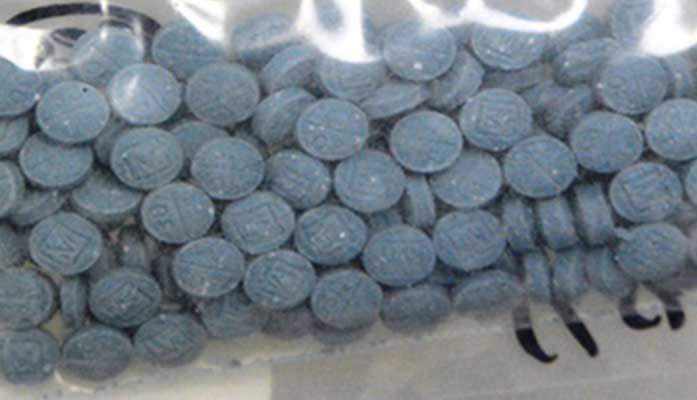
Quang’s bill includes stricter punishment for children’s deaths due to drug traffickers’ current operational patterns. With the rise of the border crisis, fentanyl traffickers expanded their targeted clientele to include minors. Over the last year especially, these traffickers have pushed “rainbow fentanyl” that look like candy to entice youth. Fentanyl pills are normally designed to look like oxycodone prescription pills: blue, and stamped with “M30.”
Like their traditional counterparts, these rainbow pills often carry fentanyl doses lethal enough to kill adults.
Almost one year ago to date, health experts and law enforcement warned that the state was facing a burgeoning pediatric fentanyl crisis. In 2022, there were 138 non-fatal opioid overdoses and 28 deaths in minors aged 0-17. That’s a decline of 70 non-fatal opioid overdoses and 19 deaths from 2021, and a decline of 198 non-fatal opioid overdoses and 31 deaths from 2020.
In fact, all non-fatal opioid overdoses and deaths have declined slightly since a peak in 2020.
Though these numbers have declined over the last few years, total drug seizures keep climbing. Law enforcement have seized millions in fentanyl pills amid the ongoing border crisis. According to Customs and Border Patrol (CBP) drug seizure statistics, there have been nearly 26,600 pounds of fentanyl seized along the southern border since President Joe Biden took office.
Seizures more than doubled from the 2020 to 2021 fiscal year. Last month was a historic high in fentanyl seizures for all time: nearly 3,000 pounds of fentanyl.
Corinne Murdock is a reporter for AZ Free News. Follow her latest on Twitter, or email tips to corinne@azfreenews.com.
When video went viral this month of a Florida police officer needing three doses of Narcan after losing consciousness when exposed to fentanyl during a routine traffic stop, it renewed attention to the dangers the deadly drug poses to public safety and healthcare workers.
But protocols for handling fentanyl and other potentially toxic evidence are months from approved within Arizona’s judicial system, even though there are currently hundreds of ongoing fentanyl-related criminal cases in the state’s courts.
Court administrators and presiding judges across Arizona have expressed concerns about safety protocols since 2020 when the number of prosecutions involving the drug started to rise. But it was not until this June that Chief Justice Robert Brutinel of the Arizona Supreme Court established a taskforce to create guidelines for handling fentanyl and other toxic evidence in courthouses.
The Fentanyl and Toxic Evidence Taskforce was given a Dec. 31 deadline to file its report and recommendations. However, the 11 members of the taskforce notified Brutinel in November that they need more time.
As a result, the report’s deadline has been extended to March 31, 2023.
Guidelines are necessary, Brutinel noted in June, due to the “significant rise” of overdoses associated with fentanyl, as well as the corresponding rise in the number of cases in which fentanyl is part of the evidence against a defendant.
“Accordingly, there is the potential risk that the drug evidence and other toxic evidence in these cases will need to be handled in the courthouse,” the chief justice noted, adding that protocols for dealing with fentanyl exposure and for handling the drug is already developed for some industries. “There has been little guidance, however, issued for court personnel who may have to handle packaged evidence of fentanyl, carfentanil, their analogs, or other toxic evidence.”
The chief justice ordered the 2019 National Judicial Opioid Task Force guidelines be used by the taskforce as a reference to address several issues:
Whether such drugs should be inspected and approved by designated court personnel before being allowed into a courthouse
Whether these packaged drugs must always remain in the possession of law enforcement personnel, except by approval of the court
Whether the drugs should ever be handled by court personnel or others during a judicial proceeding, such as attorneys, witnesses, court clerks, and jurors
Whether such drugs should remain in a courthouse or court-related facility during non-business hours
What safety policies should be established for the handling of fentanyl evidence
Whether courthouse personnel should be trained to address possible exposure to fentanyl and other toxic evidence and to properly identify opioid toxicity
Whether Naloxone (Narcan) should be kept in courthouses and other court-related facilities for emergencies and whether any court personnel should be trained in its administration.
One consideration for the taskforce is the need to balance safety concerns for court personnel and members of the public who may be exposed to the drugs during a judicial proceeding against the rights of defendants or even a victim in judicial proceedings to due process and a fair trial, Brutinel noted.
Terri Jo Neff is a reporter for AZ Free News. Follow her latest on Twitter, or send her news tips here.
The White House’s denial that migrants are walking across the border sparked backlash from Governor Doug Ducey and Border Patrol (BP) leaders.
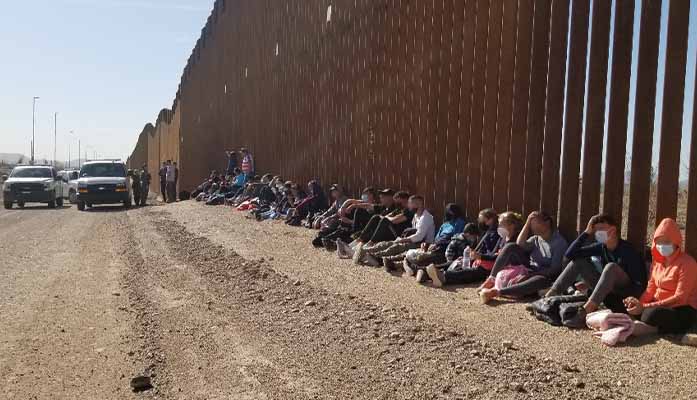
This week, White House Press Secretary Karine Jean-Pierre claimed that illegal immigrants don’t merely walk across the southern border. Fox News reporter Peter Doocy had asked Jean-Pierre why the unvaccinated traveling by plane were refused admission into the U.S. while unvaccinated illegal immigrants could walk into the U.S. and stay.
“It’s not like somebody walks over — that’s not how [it works],” responded Jean-Pierre.
Watch what happens when Peter Doocy asks Karine Jean-Pierre why illegal aliens are released into the country even if they don't have the COVID vaccine, but Novak Djokovic isn't allowed in for the U.S. Open: pic.twitter.com/Jdqmo0IpEN
Jean-Pierre’s denial prompted Ducey to call the White House “clueless.” He stated that the Biden administration’s negligence further affirmed his decision to finish Yuma’s border wall himself. The state closed those gaps last week.
“If only President Biden visited the border, he’d see the mass amount of migrants walking across the border,” wrote Ducey.
The White House is clueless. If only President Biden visited the border, he’d see the mass amount of migrants walking across the border.
This negligence is exactly why Arizona took action to close the border wall gaps near Yuma. 1/ https://t.co/9XQdJe5OJU
The denial prompted similar criticism from the National Border Patrol Council (NBPC). Jean-Pierre’s denial — along with discovery this week of BP Chief Raul Ortiz’s admission in July that Biden’s border policies lacked consequences for illegal immigration — prompted NBPC to demean the Biden administration as the “Barney Fife” administration, a slang term for ineptitude and incompetence.
“[This administration is] importing millions of fraudulent ‘asylum’ seekers,” declared the NBPC. “This mess will take decades to clean up, if it can ever be cleaned up.”
We've been saying it for nearly 2 years. The Barney Fife Administration is single-handedly causing the disaster on our border. They're importing millions of fraudulent "asylum" seekers. This mess will take decades to clean up, if it can ever be cleaned up.https://t.co/bzth4Pv4uB
Along with the historic number of illegal crossings, there have been historic highs of drug trafficking. Earlier this month, Customs and Border Patrol (CBP) reported that fentanyl, meth, and heroin seizures increased greatly from June to July.
CBP Releases July 2022 Monthly Operational Update
In July, fentanyl seizures at Arizona Ports of Entry were up 218% over June. The number of fentanyl seizures also increased by 128%.
As AZ Free News reported at the beginning of this month, hard drugs have largely replaced marijuana for drug smugglers. The main substance seized by far is fentanyl.
NEW: @CBP agents at the Nogales, AZ port of entry seized 625,000 fentanyl pills in five smuggling busts over the weekend, including another 12,000 that were rainbow colored to have a similar appearance to candy or ecstasy. Agents also seized 4lbs of fentanyl powder. @FoxNewspic.twitter.com/Orr38BdFXR
What’s more, smugglers are now disguising fentanyl with rainbow coloring to look like candy or ecstasy, dubbed “rainbow fentanyl.” On Tuesday, the Drug Enforcement Administration (DEA) issued an official warning that the rainbow fentanyl has been discovered in 18 states. Officials warned that drug traffickers are targeting children and young adults with the rainbow fentanyl to spark addiction.
NEW: The DEA has put out an official notice warning Americans of the “alarming” new trend they began seeing this month w/ rainbow colored fentanyl being smuggled into the country & appearing 18 different states. They say cartels are using it to appeal to children & young people. pic.twitter.com/tTtTK85u2B
It appears that the White House isn’t the only leadership sector apparently unconcerned with the state of the border. A source informed the Daily Caller on Monday that Department of Homeland Security (DHS) Secretary Alejandro Mayorkas was vacationing in Maine.
NEW: A source tells me DHS Sec. Alejandro Mayorkas is currently on vacation in South Casco, Maine while the border crisis continues to get worse and worse every day. He had security surrounding him at a picnic tonight. Yet, our border is being flooded with drugs and criminals.
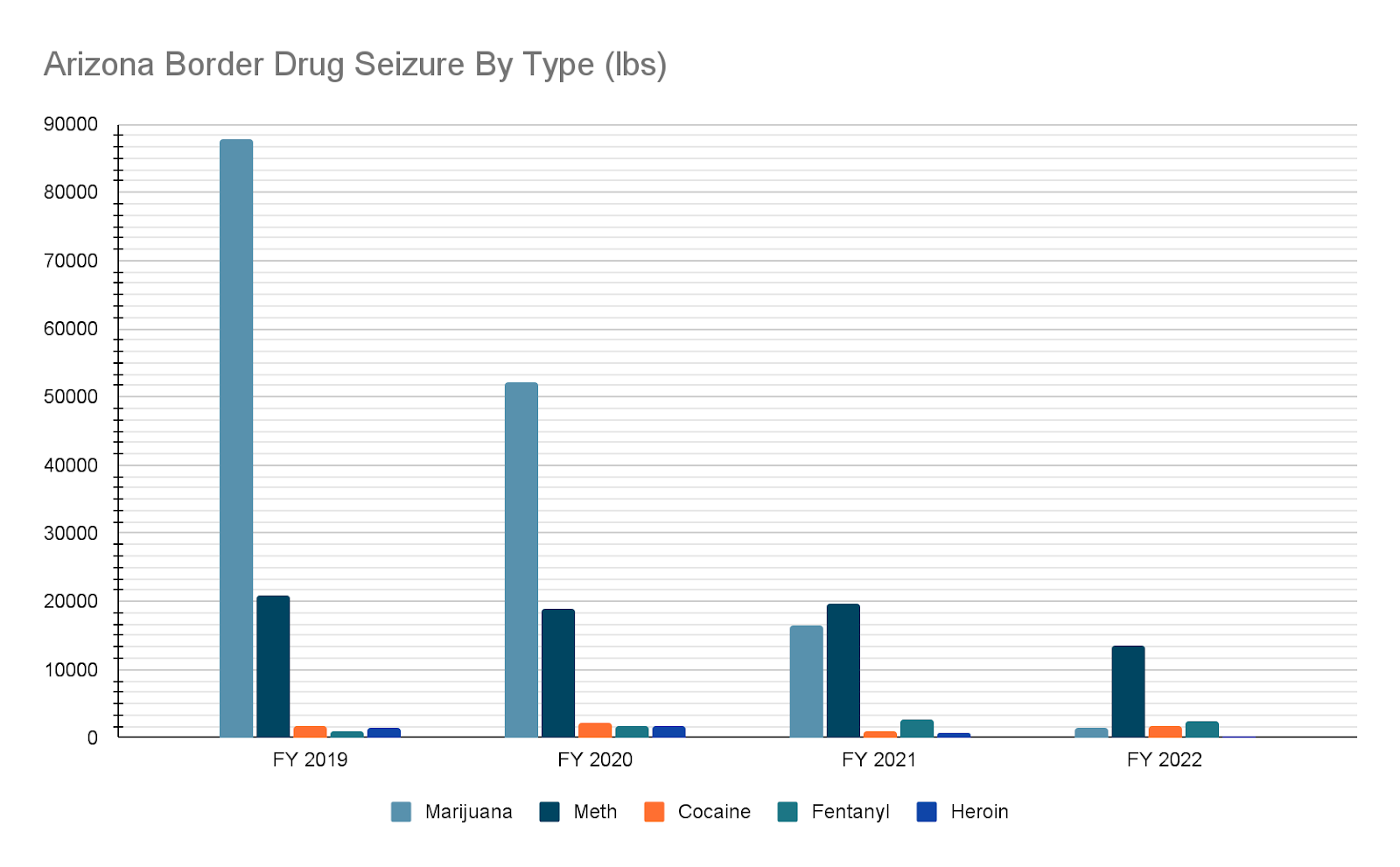
The amount of smuggled marijuana seized at the Arizona border dropped 91 percent so far this past fiscal year while seizures of other, harder drugs have increased. It appears from Customs and Border Patrol (CBP) data that hard drugs like methamphetamine, fentanyl, and cocaine supplanted marijuana as smugglers’ preferred substances.
Ajo Station agents performed a vehicle stop near Gila Bend, AZ. Following a #K9Alert, agents seized 44 pounds of meth. Two U.S. citizens were arrested and face criminal charges.
The decreased seizures correlate somewhat with Arizona’s marijuana legalization through Prop 207, or the “Smart and Safe Arizona Act,” during the 2020 election. Arizona’s marijuana seizures dropped about 35 percent from fiscal years 2019 to 2020, and 71 percent from 2020 to 2021. (The CBP fiscal year runs from October to September).
Arizona’s seizures of meth dropped from nearly 20,800 pounds to nearly 18,900 pounds, nine percent, from 2019 to 2020, then increased by three percent from 2020 to 2021. It appears that this year’s meth seizures will remain within margin, though at present agents have seized 1,100 pounds less than this time last fiscal year.
Conversely, the state’s fentanyl seizures grew over the past three fiscal years. From 2019 to 2020, seizures increased 79 percent, then 65 percent from 2020 to 2021. If seizure rates continue as they have this year, there will be more fentanyl seized than in 2021: over 2,600 pounds.
Fentanyl, one of the deadliest street drugs per CDC overdose data, comes in the form of a pill to resemble its legal counterpart prescribed by doctors. Cartels like the notorious Sinaloa Cartel mark the synthetic opioid with an “M30” stamp to disguise it as the painkiller oxycodone, which is manufactured by pharmaceutical companies.
Overdoses may occur with as low as two milligrams of fentanyl. The National Institute of Health (NIH) reports that fentanyl accounts for the majority of opioid overdose deaths in the U.S.
According to the CDC, Arizona has one of the leading overdose death rates in the country.
Cocaine seizures dropped off in fiscal year 2021, but they’ve remained consistently high over the past three years. Seizures increased from over 1,800 pounds to a high of nearly 2,200 pounds, 19 percent, from 2019 to 2020 before falling by 59 percent in 2021. This year, however, cocaine seizures have rebounded at rates that may surpass 2019 levels and fall slightly behind or run even with 2020 levels.
Heroin seizures have dropped significantly since 2020.
John Modlin, chief patrol agent of Border Patrol (BP) Tucson Sector, last posted about the seizure of personal use marijuana in February, and a major seizure of marijuana in January 2021.
Ajo #USBP agents encountered a United States Citizen at the SR-85 Checkpoint with an extraditable warrant. Upon a search of the vehicle, agents seized personal use marijuana and methamphetamine, 40 fentanyl pills, and a loaded handgun. The case was turned over to @Arizona_DPS. pic.twitter.com/6miEVlmD8m
Ajo #BorderPatrol Agents seized over 235 pounds of marijuana with an estimated value of $81,779.60. So far this fiscal year through December, agents in #Tucson Sector have seized a total of 5,073 pounds of Marijuana. Great Work! @CBPpic.twitter.com/l00dhCv5bd
By comparison, Modlin has posted frequent updates about meth and fentanyl busts over the past year.
Busy day at the Port of Nogales. #CBP officers prevented large quantities of methamphetamine, cocaine, and fentanyl from reaching our communities. Outstanding work! https://t.co/keSC28rYf8
The chief patrol agent for BP Yuma Sector, Chris Clem, hasn’t posted about a major marijuana seizure since last March. However, Clem’s offered more frequent updates on meth, fentanyl, cocaine, and heroin seizures.
— Chief Patrol Agent Chris T. Clem (@USBPChiefYUM) June 22, 2022
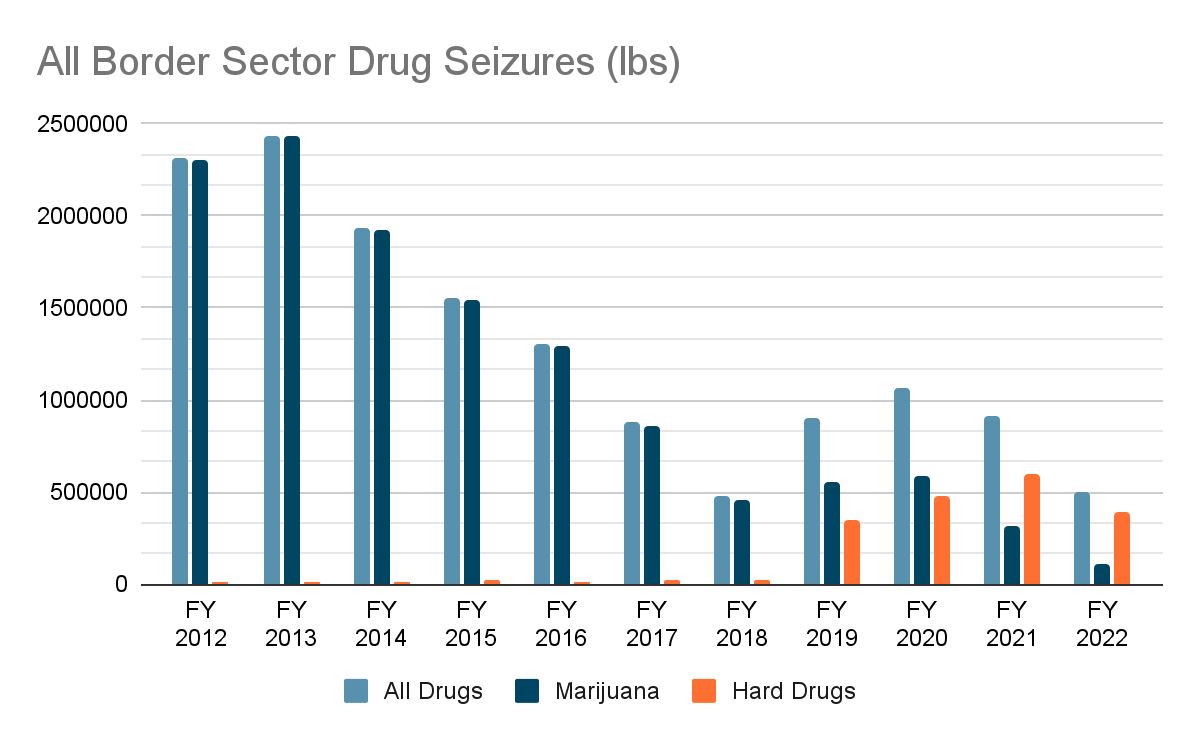
According to CBP data, the number of drug seizures across all border sectors have dropped consistently since 2013. The reduced seizures appear to correlate with marijuana legalization across numerous states, considering the vast majority of drug seizures were marijuana in eight of the past 10 years. All border states except Idaho, Indiana, Wisconsin, North Carolina, South Carolina, and Texas have legalized marijuana for recreational purposes.
In addition to Arizona, the following states have legalized recreational marijuana usage: Alaska, California, Colorado, Connecticut, Illinois, Maine, Massachusetts, Michigan, Montana, New Jersey, New Mexico, New York, Nevada, Oregon, Rhode Island, Vermont, Virginia, and Washington. Additionally, recreational marijuana is legal in Washington, D.C.
Corinne Murdock is a reporter for AZ Free News. Follow her latest on Twitter, or email tips to corinne@azfreenews.com.