Parents want options for their children’s education. That is why so many went to the legislature and the governor and asked them to pass the Universal Empowerment Scholarship Account (ESA) Program for all of Arizona’s students!
The ESA program has been around for 11 years, but it’s only been available for a limited number of students who have qualified under particular classifications. As a mother of a child who has qualified under the category of special needs, I have seen our son thrive with his education for the last 9 years on an ESA. The tax dollars that we have been able to draw down are completely accountable to the state. After submitting all the documentation for every purchase and having it all approved by the Department of Education, we can then have access to the next quarter’s funds.
There is no better advocate for a child than their parents. Public district and public charter schools are not for everyone. We need options for students and parents who don’t thrive in these settings. For our son, the public district school failed us, and the public charter schools disappointed us. That is why we left the “public system” of education. Every child is uniquely different and has different needs. ESAs simply ensure that each child’s needs can be met without significant financial sacrifices from their families.
The latest controversy now seems to be between the parents and the teachers’ unions. But it is not an EITHER/OR for public schools and ESAs. It really is a BOTH/AND. We need strong public schools, and we also need options for our children who don’t fit into that cookie-cutter style of learning. Children may be doing very well in a public school now and that is great, but their needs may change. Or the school may change and then, an ESA may be needed in the future.
If you read House Bill 2853, you will see that there is a significant amount of money that is allocated to the public school system. They also retain all federal and local tax dollars. A student on an ESA only receives 90% of the state per pupil funding. According to the Joint Legislative Budget Committee, a public school child will receive approximately $14,326 in the coming school year, but an ESA recipient will receive $6,966. This is a win-win-win for the student, the public schools, and the taxpayers!
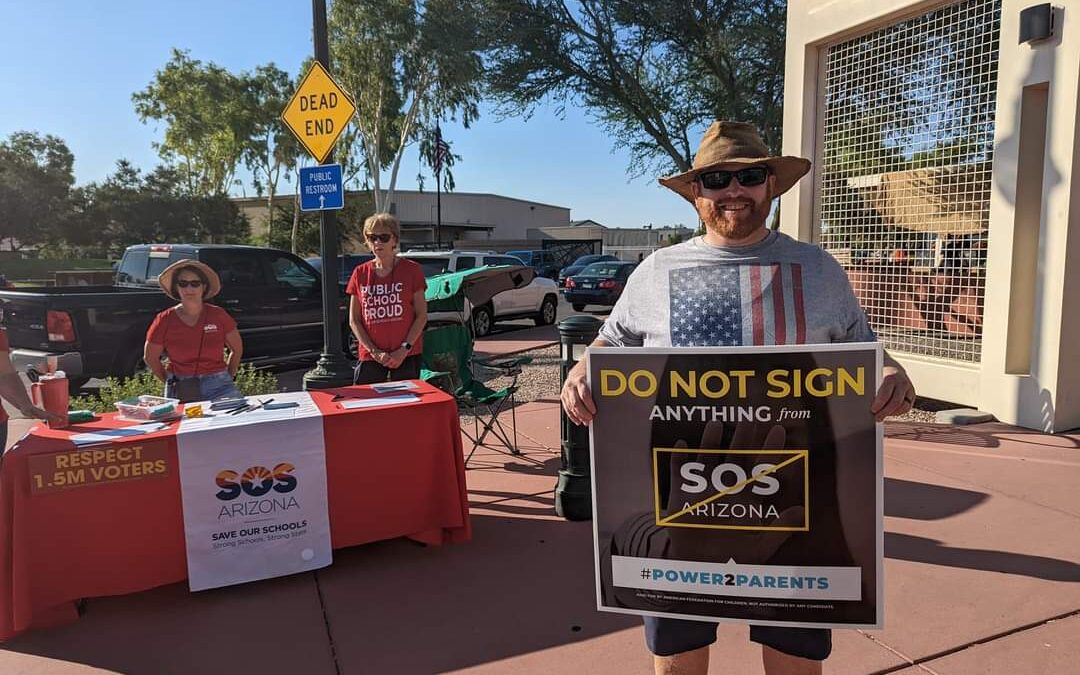
But right now, a group called Save Our Schools is out on the streets attempting to get the people of Arizona to sign a petition that could stop families from having the freedom of school choice. They’re trying to spread the false narrative that the new ESA law only benefits rich parents who want to send their kids to private school. If that were the case, you would expect to see a low demand for these ESAs. And yet, the new ESAs have been so popular with parents across all backgrounds and political spectrums that it has overwhelmed the Arizona Department of Education’s website!
It’s time for the people of Arizona to see through the lies. Save Our Schools wants to defund and deprive Arizona kids from receiving an amazing education. But thankfully, hundreds of parents have joined the Decline to Sign Movement. These engaged parents have been peacefully countering the Save Our Schools petition gatherers before a voter signs it to make sure that they understand what they are signing.
I encourage every voter in Arizona to Decline to Sign any petition from Save Our Schools. When our lawmakers put our children first, that is always a WIN! And that’s exactly what Governor Ducey did when he signed the new ESA law, making Arizona the gold standard for school choice laws in the country. Let’s leave this new law the way it is so that parents have full control over their children’s education. Our state and our kids will be better off if we fund students rather than systems.
Christine Accurso is a wife, mother, and ESA parent leading the charge for the Decline to Sign Movement. You can find out more about this effort here.
With nearly $7,000 becoming available for every K-12 student to attend a private school or be homeschooled through the recent expansion of Empowerment Scholarship Accounts (ESAs), the Arizona Department of Education’s website has been overwhelmed with parents seeking to apply.
The credit becomes available on Sept. 24 but the number of parents applying in advance has created issues for the Department of Education’s website. An advisory posted to the website this week noted “high volume” may cause users to receive an error message when trying to establish an account.
On Saturday, Ducey took to Twitter as word spread about the tremendous interest.
Parents are laying on the pressure! They want options and are excited about Arizona’s universal education savings accounts. https://t.co/aa10cKAufp
The ESA expansion legislation sponsored by Rep. Ben Toma provides families of all 1.1 million of Arizona’s K-12 students the option of allocating 90 percent of state funding which would have been allocated to the student’s district or charter school and have it be available for private school tuition, home-schooling, tutoring, and other educational needs such as transportation, textbooks, and computers.
Among the permitted expenditures for homeschoolers is the cost of specialized teachers for subjects such as foreign language, art, and music.
Homeschoolers can and do apply to this already. Originally it was only for people in D rated school zones. Now anyone who wants to homeschool can pull their tax dollars and use on curriculum and tutors and mentors etc. I know, I am a paid music teacher for a few families.
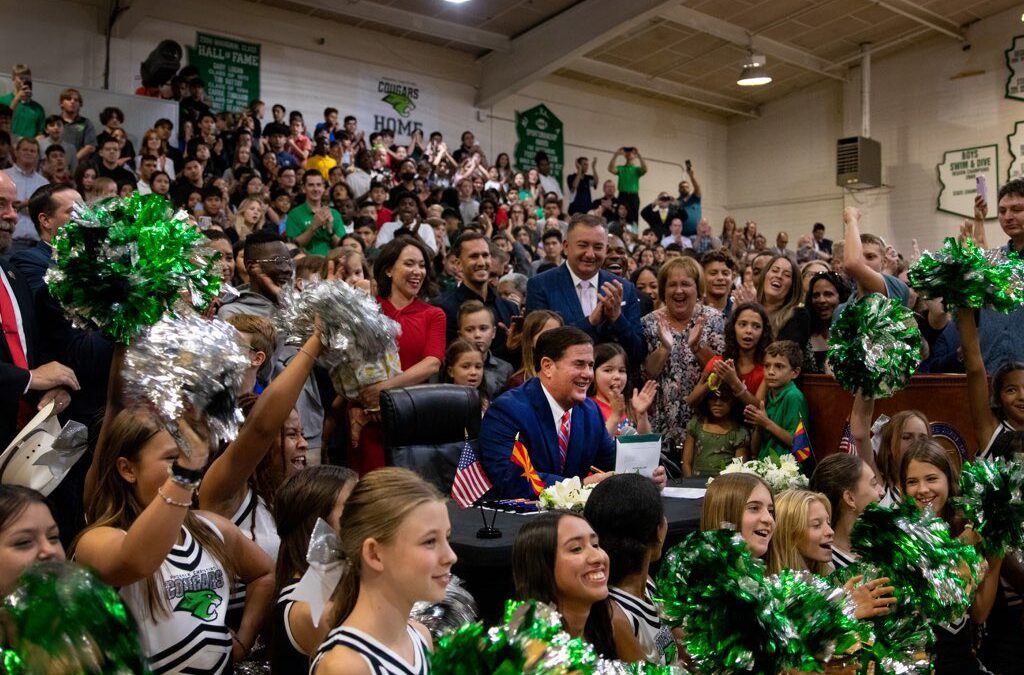
Ducey presided over a Aug. 17 ceremonial signing of HB2853. He later said making ESAs available to all of Arizona’s K-12 students was putting “the power back in the hands of parents, who are best suited to make decisions for their children’s education.”
Jenny Clark, founder of Love Your School, attended last week’s ceremony (Ducey actually signed HB2853 on July 7). Clark says Arizona’s ESA program can be life-changing for Arizona’s students.
“My five children have benefitted from ESAs and I can’t help but think how many kids don’t get the help they need,” Clark said. “Now, they will. Every child in Arizona will have the same opportunities and ability to get the education tailored to their needs.”
Corey A. DeAngelis of the Federation for Children was one of the stakeholders involved in ensuring passage of HB2853, calling it “a national model” that empowers parents. He too used Twitter to comment on what the high demand on the ADE website means.
“This is why the government school monopoly fights so hard against giving families a choice,” DeAngelis wrote. “They’re terrified. They know parents want alternatives.”
A pep rally type celebration was held Tuesday to help promote expansion of Empowerment Scholarship Accounts (ESAs) for all K-12 students in Arizona.
“Today, we celebrate the signing of the most expansive school choice legislation in recent memory,” Ducey said during a ceremonial signing of House Bill 2853 which provides about $7,000 in education credits for every Arizona student to attend the K-12 public, private or charter school of their choice.
“Arizona is now the gold standard for educational freedom,” the governor said.
Arizona’s kids now have more educational opportunities than ever before — and now, the sky’s the limit for their exciting futures ahead. pic.twitter.com/yf0DFMScZ7
The expansion of ESAs under HB2853 was sponsored by House Majority Leader Ben Toma (R-Peoria) with the support of the Goldwater Institute. ESAs are paid out as scholarships for families to use for tuition and tutoring expenses as well as transportation, textbooks, computers, and other costs related to supporting a student’s educational needs.
Our kids will no longer be stuck in under-performing schools. We’re unlocking their educational potential and advancing a bold new era of learning opportunities. pic.twitter.com/HsJJd7F1oG
ESAs served roughly 100 Arizona students back in 2011. Last year that number was 11,000. But with HB2853 now in effect, all 1.1 million students at the K-12 level.
“This reform empowers parents weary of a one-size-fits-all approach to public education to customize their children’s schooling based on their unique needs,” Goldwater Institute President and CEO Victor Riches said when the law took effect. Riches added that Arizona families “deserve the right to choose the best education option for their children, regardless of zip code.”
“States around the nation should follow Arizona’s lead and pass legislation that funds students, not systems,” he said.
Reactions to Tuesday’s signing ceremony event were very positive.
Christine Accurso is one mother helping a coalition of parents fight a 2024 ballot initiative to undo Arizona’s recent universalization of school choice. That group, AZ Decline to Sign, hopes to prevent Arizona families from losing access to up to $6,500 in educational funds through the state’s Empowerment Scholarship Account (ESA) Program.
The organization behind the ballot initiative, Save Our Schools Arizona (SOSAZ), is also made up of parents, as well as teachers and community organizers. They’re supported by the Arizona Education Association (AEA), the state’s primary teachers union.
Accurso appeared on the “Conservative Circus” radio show to discuss the AZ Decline to Sign countermovement. She insisted that SOSAZ was shopping two major lies to Arizona voters.
Accurso said that SOSAZ’s claim that the ESA Program universalization would take $1 billion from public schools wasn’t true for two main reasons: first, that parents choose where to apply their school choice funding, and second, that public schools still receive other taxpayer funds even if they lose out on ESA Program monies.
“They have been pushing lies to everyone to get them to sign a petition to be able to refer this to the ballot,” said Accurso. “No money leaves the public school unless the parent removes the child from the school to choose an ESA. They still get all the federal and local tax dollars — it’s just a portion of the tax dollars.”
Christine Ocurso, mother, discusses her fight against the school union attempting to kill school choice. #550KFYIhttps://t.co/8QulHfc4Pb
— ESAforALL – Decline to Sign Campaign (@AzDeclineToSign) August 13, 2022
SOSAZ’s ballot initiative “Stop Voucher Expansion” which mischaracterizes Arizona’s ESA Program as “vouchers.”
Arizona’s school choice funds are education scholarship accounts. Vouchers are education funds awarded for use at private schools only, whereas education scholarship account funds may be applied to a variety of options, like tutoring.
Arizona’s Democratic leadership has expressed support for the SOSAZ initiative. Most recently, Senator Martín Quezada (D-Glendale), also mischaracterizing Arizona’s school choice funds as “vouchers,” claimed that allowing parents to apply those funds at their discretion was a practice lacking oversight at best, and rooted in racism at worst.
The SOSAZ ballot initiative has also garnered the support of 2024 state legislative candidate and Arizona Democratic Party leader Brianna Westbrook, a gender dysphoric man previously named Mike McDanel.
I urge you to stop by one of these many Save Our Schools stop and sign locations this weekend to add your signature to help prevent the most significant voucher expansion in Arizona state history. The privatization of education is one of the greatest threats to democracy. https://t.co/jIwULIZeNi
In a few short weeks, around 200 children will commit to an education that tends to stand out in this day and age: a “Christian, constitutional, classical” one.
These students of the new private school, Tipping Point Academy (TPA), are just a fraction of the thousands upended or seeking alternatives following public schools’ response to the COVID-19 pandemic: a demographic projected to increase due to the state’s recent and historic universalization of its school choice program, Empowerment Scholarship Accounts (ESAs).
TPA was launched last March by Great State Alliance (GSA), a nonprofit advocating for constitutional liberty since the summer of 2020 when that organization launched in response to the COVID-19 pandemic.
AZ Free News interviewed TPA Founder Jeremy Wood. He was unabashed about God being the core of TPA’s foundations and vision.
“We are working from the presupposition that the word of God is the roadmap for life and living,” he explained. “The Bible is God’s word and truth. It offers knowledge and wisdom and everything you need to be successful in life. Our classes are all taught from a Biblical worldview. Everything we teach is taught from that perspective. We believe that God created the world. He created science, math, astronomy, and the stars, and He made the world to work as a perfect mechanism.”
Wood clarified that core academics and God aren’t mutually exclusive. He explained that TPA operates from Christian premises rather than a secular one. Meaning: TPA offers a classical education that encompasses the likes of Socratic dialogue and natural law and excludes modern, controversial approaches like Critical Race Theory (CRT), Culturally Responsive Education (CRE), Social-Emotional Learning (SEL), and Comprehensive Sexuality Education (CSE). Their version of education includes approaches like “The Noah Plan,” which incorporates the Bible in every subject.
“That’s the difference: the word of God is the foundation of our instruction. That’s not separate from our academics. We’re teaching the kids all the same academics they’re learning in public schools,” said Wood. “Our curriculum isn’t vastly different. It’s more of a philosophical approach for how we apply the methodology of teaching. We apply the principled approach which is based on teaching kids on how to become learners and critical thinkers.”
Wood said that TPA initially started as a desire to provide a better education for his own children. Then, he said that he recognized that education was a frontline in defending liberty, and his desire expanded to offering a better education to his community.
“The government was forcing these shutdowns and mandates, so we decided to stand up and create a solution that was faith-based and protective of our rights to assemble, to meet without fear of needing to shut down, or implement mask policies, or some other weird draconian measures to create barriers between us,” said Wood.
According to Wood, TPA uses a mastery learning model for teaching. Students must master content in each subject, which are “set up like mini dissertations” that require students to compile their research and writing to complete a notebook, or “mini thesis.” Additionally, TPA prioritizes hands-on, project-based learning. Wood cited an example of TPA students learning to apply for a job, use functional math, develop business plans, manage a business, run sales, and market products and services through the campus cafe.
“TPA is about creating critical thinkers,” stated Wood.
Another unique aspect about TPA: they expect parental involvement, almost to the point of a requirement. Wood emphasized that fathers were the key figures that TPA prioritizes for incorporation, but noted that anyone is open to serve through work like administrative support or classroom management. Parents are required to undergo a background check, just like all TPA staff.
“We’re not going to allow you to be a non-present parent. We expect volunteering,” said Wood. “We believe it’s our duty to partner with the parents. If you’re not going to be involved in volunteering, we’ll just tell you right now we don’t think you’re a fit for our school. If we were in it for the money, we’d be telling people everything they wanted to hear to get them in the door. We’re pretty clear on our methodology to keep like-minded people in our community.”
In just over a year of its existence, TPA has already experienced pushback from the establishment educational community.
Save Our Schools Arizona (SOSAZ) has been one of the first to target TPA. The anti-school choice organization’s director, Beth Lewis, characterized the private school as a money-grabbing scheme developed in response to the universalization of ESAs.
It’s no coincidence that schools like Tipping Point Academy are popping up all over AZ, ready to scoop up millions in taxpayer 💰 if universal voucher expansion isn’t stopped 😡 Their mission is to “develop tomorrow’s godly titans” pic.twitter.com/9BAiRleFlh
At $8,500 annually, TPA’s tuition falls below the average private school cost. Average tuition for private schooling in Arizona is nearly $10,300.
TPA’s enrollment ranges between 180 to 200 students, totaling between $1.5 and $1.7 million accrued from tuition. If every parent utilized the $7,000 maximum from the state’s ESA Program, that reduces tuition to $1,500 — which may be paid down for just over $100 on a monthly basis. Interested parents may also qualify for a TPA scholarship.
Wood responded that taxpayer dollars for education should be accessible to all taxpayers — regardless of their beliefs.
“Those are our taxpayer dollars as well. People are welcome to have their opinion. They don’t have to send their kids to our school,” said Wood. “We shouldn’t be discriminated against just because we want our kids to learn about our heritage, our values, our God, as well as the academics.”
Wood added that he hasn’t drawn “one penny” from his nonprofit for compensation. Rather, he said that he sacrificed his own business to launch TPA. The Wood family now lives well within their means, he says, to allow TPA to flourish.
“I think there’s the perception that we don’t want taxpayer dollars going to religion. Well, we’re taxpayers as well, so if this is what we believe we should have a right to allocate our dollars to the education of our choice,” said Wood. “I’m not doing this for a platform. I’m not doing this for fame or money. We’re just trying to create a solution for our families and families that think like us.”
From the very beginning, Wood said that the TPA team relied on God to provide. He shared that they prayed without ceasing for their ideal location where the school sits currently: the site of a former church. By the time Wood discovered the site, it was already under contract to become a multifamily residence. Yet he said they prayed, and three weeks later the property fell out of escrow. Wood then sent a letter to the property owners, explaining his reason for buying. The owners agreed, selling the property at a generous price that Wood described as “essentially the cost of the dirt.” They closed within 30 days on the deal, enabling the TPA team to prepare the location for this past school year.
“We came across a campus in the Northeast Valley, and we believed God was going to deliver this property for us. We didn’t know how,” said Wood. “It was a small, humble beginning.”
TPA’s enrollment is filling up this year but, according to Wood, the main reason that some parents say they can’t enroll their student is due to finances. He expressed hope that increasing awareness of the ESA Program expansion will remedy that issue.
Wood shared that some parents also prefer the frugality of charter schools. He touched on an issue reported by AZ Free News: since charter schools exist within the realm of public schools, they’re under stricter government regulation and susceptible to incidents that occur in public education.
“There’s a perception that they could jump to the charter school path, that there’s a little more autonomy there. People don’t understand a charter school is still a public school,” said Wood. “They’re still under the regulatory thumb of the state government in terms of health requirements. If the government starts pushing for mask or vaccine mandates, or hindering any medical freedoms, the charter schools are still going to have to comply with that.”
TPA will teach all grades, K-12, but enrollment is only open up to the 9th grade at present. The school plans to integrate its current students into high school before opening up its high school classrooms for enrollment.
TPA also launched a feeder school, or “K-prep,” enrolling under 20 children. Wood said their goal is to launch 100 schools over the next decade.
Corinne Murdock is a reporter for AZ Free News. Follow her latest on Twitter, or email tips to corinne@azfreenews.com.