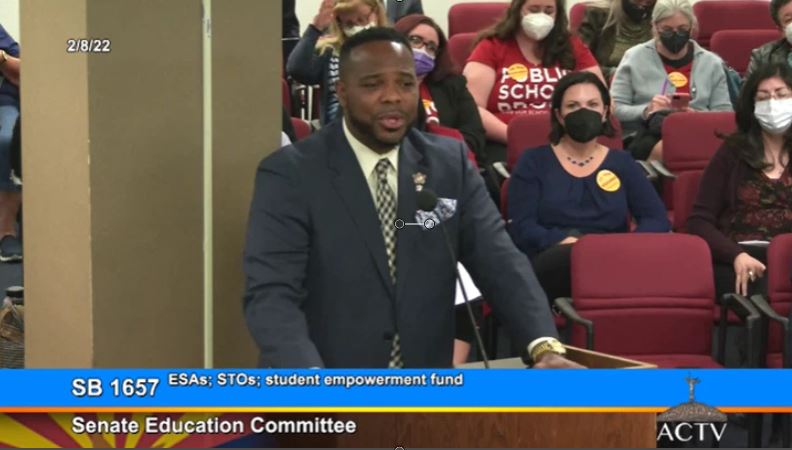
NFL Alumni Association chaplain and Phoenix-based pastor Drew Anderson addressed the Senate Education Committee in favor of a bill to expand Arizona’s school choice system, SB1657, calling school choice the “civil rights movement of our era” and condemning the modern K-12 public school system as “educational slavery.” He insisted that the current education system fails the black and brown community.
“There is nothing more important to humanity right now than school choice,” said Anderson. “In 1865, it was an unpopular decision for a lot of legislators to get together to end a system that was as American as apple pie,” said Anderson. “But here we are in 2022, asking a group of legislators once again to make an unpopular decision, which is to end educational slavery.”
SB1657 would expand eligibility for Arizona’s school choice system, the Empowerment Scholarship Account (ESA) program, by allowing students with: disabilities identified by public school systems in other states; a parent that is a veteran, first responder, or full-time health professional; income that qualifies for federal free and reduced-price lunch programs; a household that receives benefits from Supplemental Nutrition Assistance Program, Temporary Assistance for Needy Families, or Section 8 Public Housing Assistance; participation in federal Title I services for low-income students under the Every Student Succeeds Act (ESSA); residence in the attendance boundary of a school that qualifies for schoolwide Title I Program funding under ESSA or whose governing board submitted a plan to the School Facilities Oversight Board within the last two years requesting additional construction or funding due to exceeding existing capacity; or current or past participation in the Education Recovery Benefit Program, Open for Learning Recovery Benefit Program, or any successor state grant program.
The Senate Education Committee passed the bill along party lines, 5-3. Even Anderson’s testimony on how the current education system fails the children of his community, and how school choice initiatives helped him escape a life of crime, poverty, and even early death wasn’t enough to persuade the three committee Democrats.
State Senator Paul Boyer (R-Glendale), the bill’s sponsor, explained that voters overwhelmingly showed bipartisan support for school choice expansion.
“I just have to mention this — and I don’t normally talk about voters in the chamber — but it’s been brought up twice now,” stated Boyer. “I have a poll from last year, Signal, considered the most accurate pollster by the New York Times. Once voters heard the description of this particular bill last year, they supported this. Seventy percent support. That was last year. This year, again when the particulars of this program were described, 74 percent. It’s an increase of four percent just this year, with strong majorities among Republicans, Democrats, and Independents. This is simply what the public wants and what the parents want.”
During his testimony, Anderson challenged the rhetoric that systems needed to end and funding needed to increase or be left untouched, pointing out that the current system of public funding trapping and hurting minority children was steeped in financial self-interest. He said that the school-to-prison pipeline was the elephant in the room.
“We have school districts who sit and complain about losing funding while all these black and brown kids are going to prison. Nobody complains about public funds going to private prisons to incarcerate black souls, but everybody wants to complain about public funds going to educate black minds,” asserted Anderson. “Why is it okay for public dollars to go to private prisons, but it’s not okay for public dollars to go to private schools?”
Anderson argued further that the $31,000 spent by the state on each prisoner could be mitigated by allowing the $15,000 it would take to offer a student school choice.
“We need a lifeline in the black community right now,” said Anderson. “In 1864 we were chained to plantations, but in 2022 we’re chained to failing schools.”
Boyer asked if Anderson had personally seen ESAs help minority children. Anderson revealed that he had, and was also one of those children who benefited from school choice. The pastor described how he was able to avoid being recruited for selling crack cocaine because he received a scholarship to attend an elite private school in Chicago, Illinois — one that his mother couldn’t dream of affording, though she worked three jobs. Anderson recounted how that education set him on a path to playing for the NFL and eventually earning enough money to ensure his mother didn’t have to work again. Anderson added that of his five childhood friends, three were in prison and two were dead by the time he graduated high school.
“I’m not here because of what I heard. I’m here because of what an ESA did for me,” explained Anderson. “We talk all the time about funds, we talk all the time about test scores. You know what we need to talk about? These private schools that are offering our black and brown kids a 98 percent graduation rate and a 90 percent continuation rate. I’m not worried about an AzMerit score. To hell with that! What I’m worried about is, if I send my kid to Brophy [Preparatory School], 98 percent of those kids are graduating. If I send my kid to Brophy, 90-odd percent of those kids are going to college. Men lie, women lie, but numbers don’t.”
Senator Theresa Hatathalie (D-Coal Mine Canyon) expressed concern that there weren’t accountability measures for the academic progress of ESA students. Boyer reiterated what Anderson pointed out: that private schools have better graduation rates and other indicators of success than public schools have shown.
Anderson brought up data that the graduation rates at Historically Black Colleges and Universities (HBCUs) were higher for students coming from private schools than those from public schools. He said that it wasn’t just about the success metrics, but safety. Anderson described how, just that morning, he witnessed eight black elementary school children exposing themselves to danger because they had to walk to their public school in South Phoenix before daybreak.
“If you’re going to a school where 98 percent of the people are graduating, there’s no other proof, there’s no other test you could give somebody to say the school is succeeding,” said Anderson. “I’ve never watched the news and it says, ‘Harvard graduates rob Circle K, details at six.’ That’s not what you see. But what you do see is, ‘South Mountain High School dropout mugs lady, details at six.’ So instead of test scores, why don’t we worry about graduation rates and continuation rates? If black and brown kids are going to college, that means they’re not going to penitentiaries.”
Corinne Murdock is a reporter for AZ Free News. Follow her latest on Twitter, or email tips to corinne@azfreenews.com.
Another data breach in two years has Empowerment Scholarship Account (ESA) holders wondering if their information is secure with the Arizona Department of Education (ADE). This past week, it was discovered that the state’s contracted payment platform for ESA funds, ClassWallet, had allowed users to search for other ESA account holders and view their names and email addresses.
In a letter sent to ESA holders, ESA Program Director of Communications and Engagement Sarah Raybon explained that they became aware of the data breach last Friday. Raybon assured ESA holders that ClassWallet would resolve that feature over the weekend.
“Today, our team became aware of an issue in ClassWallet portal’s search feature that allowed account holders to view the names and email addresses of other account holders,” wrote Raybon. “Upon discovery, we immediately contacted the Treasurer’s Office (who holds the ClassWallet contract) and we spoke to ClassWallet directly. We have been advised that ClassWallet engineers will be working over the weekend to get this fixed.”
During the Arizona State Board of Education’s meeting last week, parents questioned why a violation of federal law was happening again. They pleaded with the members to remedy these issues sooner rather than later. One ESA parent, Kelly Pichitino, admonished ADE for not cleaning up their act and ensuring any contract holders follow federal law after last year’s data breach.
“I would like to know why, for a second time, my child’s name is available for a stranger to view along with my personal information?” asked Pichitino. “[I] would think that the department would invest a little more thought and care, time and accountability into their actions.”
Further public commentary at the meeting also focused on other issues with the ESA system, such as inappropriate or incompetent staff behavior, apparently arbitrary denial of funds for educational needs, little to no communication and transparency, and relentless rule or policy changes.
These issues were also detailed in written comments, which are available here.
This isn’t the first time that ADE has compromised ESA members’ information unintentionally. As Arizona Capitol Times discovered and reported last January, the ADE failed to properly redact the personally-identifying information of all ESA account holders when fulfilling a public records request to three requestors, one of which was a group that actively campaigns against ESAs: Save Our Schools Arizona (SOSAZ).
Exposed information included parents’ first and last names, email addresses, the grade of their student(s), and any disabilities if a particular student had special needs.
The Arizona Department of Education (ADE) downplayed the data breach, saying that only “some” personal information was shared inadvertently.
“In the course of fulfilling a public records request to three individuals, the Arizona Department of Education (ADE) inadvertently disclosed some personally identifiable information belonging to Empowerment Scholarship Account holders,” stated ADE. “ADE redacted the document subject to the public records request but failed to secure the integrity of the redaction prior to sending the data, and the document was able to be manipulated to reveal private information.”
Corinne Murdock is a reporter for AZ Free News. Follow her latest on Twitter, or email tips to corinne@azfreenews.com.
25 Arizona House and Senate Republicans led by freshman State Representative Jake Hoffman (R-Phoenix) called for Governor Doug Ducey to do something about the school districts defying state law with their mask mandates. The news release on Wednesday revealed that Republican legislators have urged Ducey privately to take action, to no avail. This public statement appears to be their next step in convincing Ducey to enforce the law.
It’s been over a week since the first school district called a mask mandate: Phoenix Union High School (PXU). Other schools followed suit soon after: most recently, Flagstaff Unified School District (FUSD). Ducey hasn’t taken action – though his spokespersons have relayed Ducey’s finger-wagging statements of disapproval in response to those school districts.
The legislators proposed that Ducey respond to the districts’ actions by withholding federal funding, authorizing temporary Empowerment Scholarship Accounts (ESAs) for families, inform families of the law, and take legal action.
Hoffman’s statement explained that the ban on mask mandates included a retroactivity clause that puts it in effect – contradicting school districts’ insistence that the law can’t take place until 90 days after the end of the legislative session, per Arizona statute. He noted that the school districts’ behavior undermined lawful government and bordered on anarchy.
“Under Arizona’s constitutional form of government, local governments do not have the authority or power to usurp state law simply because they disagree, yet that is precisely the kind of illegal activity in which many local governments are presently engaged. The Arizona legislature, with the Governor concurring, very intentionally enacted the laws at hand to protect Arizonans and Arizona children from the threat of government mandating them to wear a mask or be injected with a vaccine,” wrote Hoffman. “A resounding message must be delivered to any local government or subdivision of the state considering defying state law – lawlessness will not be tolerated.”
House Speaker Pro Tempore Travis Grantham (R-Gilbert) signed onto the statement admonishing Ducey. He told AZ Free News that he also supports law enforcement stepping in to enforce the law. Grantham hinted that this debacle sparked a legislative priority for next year – adding more teeth to legislation.
“It’s unfortunate that some of our government-funded schools have chosen to blatantly ignore state law and the will of the majority of Arizonans by instituting mandates regarding students wearing face coverings,” relayed Grantham. “I support executive action by the governor to include withholding of taxpayer dollars and expansion of school choice funding options giving more educational choices to parents. I also support any efforts by law enforcement to enforce state law and I encourage parents and teachers to follow state law when sending their children to school and when on school grounds. Next year I will make it a focus to hold those who violate state law accountable and ensure appropriate funding reductions are in place for districts that purposely violate the law.”
State Representative Joseph Chaplik (R-Scottsdale) also signed onto the statement. He reiterated to AZ Free News that disagreement with the law isn’t justification for violation of it. Chaplik wrote the legislation that effectively banned mask mandates in schools. He, too, asserted that the power to act is in Ducey’s hands.
“Just because some don’t agree with policy and law, we should not disrespect and violate it while also teaching children these illegal tactics,” said Chaplik. “We passed this policy due to the inconsistencies of results with mask use and the unknown long term health issues that can impair our children. We need to stop this madness. The legislature did its job and now the executive branch needs to enforce the law.”
As of press time, Grantham and Chaplik said that they haven’t seen or heard any responses from Ducey.
Corinne Murdock is a reporter for AZ Free News. Follow her latest on Twitter, or email tips to corinne@azfreenews.com.
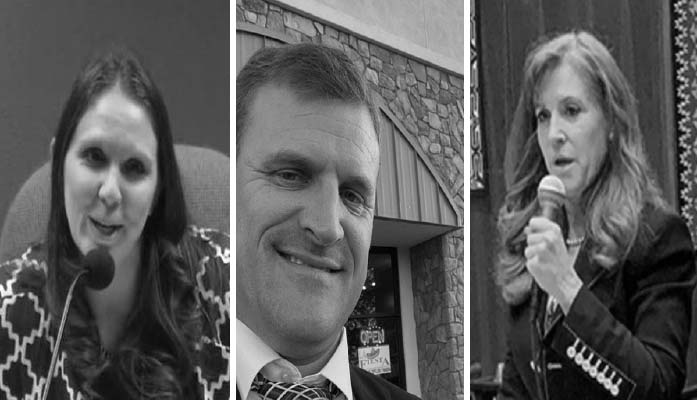
Republican Arizona State Reps. Michelle Udall, Joanne Osbourne, and Joel John are coming under fire for their decision to deny over 700,000 kids school choice opportunities. The trio voted with all House Democrats to reject a proposal to expand the Empowerment Scholarship Account program.
Specifically, Udall, Osbourne, and John voted against an amendment offered by Rep. Shawnna Bolick that would have expanded the Empowerment Scholarship Account (ESA) program to low-income students (about 80% of whom are minorities) and kids of Veterans.
ESAs allow families to utilize their education tax dollars and spend those funds on education choices that they deem best for their children. These dollars can be used to attend micro/pod schools, private schools, hiring tutors, purchasing online curriculum, and other options that may work best for each unique student.
Critics say that by voting no on the Bolick amendment, Udall, Osborne, and John became the only three Republicans to vote against this measure and sided with the teachers’ union and anti-school choice groups like Save Our Schools.
Additionally, a poll conducted by the #1 pollster in the country according to the NY Times showed that 75% of Arizonan’s support school choice and that 73% of Arizonans support this specific effort of helping low-income children. This means that the vast majority of Republican, Democrat, and Independent voters all support school choice.
Supporters of ESAs say students in Arizona needed this expansion especially in light of the drastic learning loss from Covid due to the sub-standard “virtual” education provided due to the refusal of teachers to return to in-class learning.
The State Senate worked into the early hours Wednesday to pass an 11-bill budget packet, and now all eyes turn to the 60 members of the House which is slated to take up the bills Thursday.
But questions remain as to whether House Speaker Rusty Bowers can ensure 31 votes on the budget bill involving K-12 Education funding.
The Senate pushed its bills through a marathon of 16 to 14 party line votes which started Tuesday and did not end until 2:30 a.m. Wednesday. Many of those bills included amendments, including SB1826, the Senate’s K-12 budget bill, which as passed includes a major expansion of eligibility for Arizona’s Empowerment Scholarship Accounts (ESAs).
An ESA allows an eligible child to receive credit for most of the government education funding that would have been paid to the student’s public or charter school. Those funds can then be used toward private school expenses, including tuition, counseling, tuition, and other necessary costs.
The Senate’s K-12 bill jumps the number of students eligible for an ESA from 256,000 to nearly 726,000. However, the House K-12 budget bill, HB2898, does not currently expand ESA eligibility. And two Republicans whose votes are needed to pass any budget bill have been staunchly opposed an ESA expansion.
Those Republicans are Rep. Joel John (R-LD4) and Rep. Michelle Udall (R-LD25). Both have worked as educators, and it was their opposition earlier in the session that killed an ESA expansion bill introduced by Sen. Paul Boyer.
How strong the opposition of John and Udall is to expanding ESA criteria will be tested Thursday due to the fact Senate President Karen Fann included one of Udall’s own education-related bills in the same Senate’s K-12 budget amendment. There are also items in the amendment that John is known to support.
Less than 10,000 of the students in K-12 who are currently eligible for an ESA utilize the program. Assuming the same percent of eligible students enroll under the new criteria as under the current criteria, then nearly 2,000 new students would benefit in Fiscal Year 2022. That number of new students could grow to nearly 6,000 in Fiscal year 2024, according to the Joint Legislative Budget Committee.
Boyer, an educator for a charter school, introduced his bill back in February and was able to get it through the Senate on a 16 to 14 party line vote. It then stalled in the House when it became clear Bowers did not have the necessary 31 votes for passage due to John and Udall’s opposition.
For the last few weeks Boyer had withheld support for the Senate’s 11-bill budget package, which he believed needed to provide more funding for education and paying down Arizona’s debt. With ESA and other expenditures added as amendments his vote turned to a yes. Whether Bowers can find a way to bring John and Udall on board for Thursday’s vote remains to be seen.
Those who support the ESA expansion include the Center for Arizona Policy, the Barry Goldwater Institute for Public Policy Research, and the Republican Liberty Caucus- Arizona.