The state budget sits at $2.5 billion, an unanticipated increase, despite a leap in school choice enrollments.
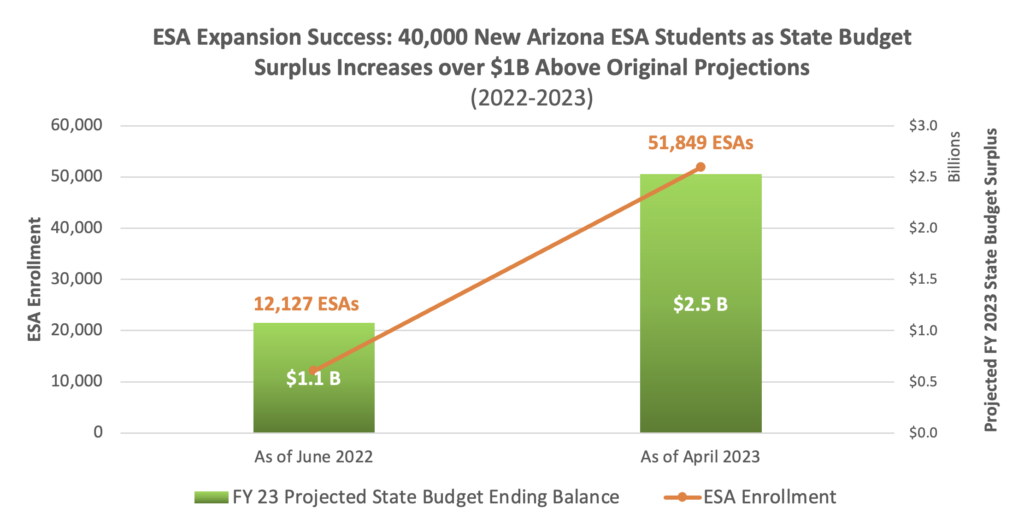
Nearly 40,000 students have joined Arizona’s universal school choice program; 7,000 have joined this year alone. Prior to the Education Savings Account (ESA) Program extension to all students, there were just over 12,100 students enrolled. At present, there are over 51,800.
Yet, this addition of tens of thousands of students didn’t hurt the state budget; the surplus has only increased as ESA Program enrollment increased. The surplus hit $2.5 billion this month, where last June it was $1.1 billion.
The ESA Program has also reflected a cost-saving measure for the state. Each student in the ESA Program receives scholarship funds of about $7,000 — about half of what the average public school spends on each student. Based on current program participants, that means that these students originally cost the state $725 million on average while in public schools, whereas they cost just over $362 million within the ESA Program.
Following these latest figures, ADE opened up enrollment for the ESA Program for the 2023-24 school year.
Arizona’s first in the nation ESA program is officially open for the 2023-2024 school year! Every child deserves a quality education no matter their zip code, and ESAs allow parents from any income level to choose what is best for them! #InParentsWeTrusthttps://t.co/mEm56eKYd7
— Arizona Department of Education (@azedschools) April 17, 2023
Gov. Katie Hobbs has rejected the cost-saving argument of the ESA Program. Shortly after taking office, Hobbs proposed rolling back the ESA Program, making the argument that universal school choice would bleed the state of $1.5 billion over the next decade. Yet, the Arizona public school system takes about $15 billion annually, or $150 billion over the next decade.
The Goldwater Institute, a public policy think tank who pointed out this disparity in an analysis defending universal school choice, argued that Hobbs’ arguments of frugality weren’t intellectually honest.
“To argue that taxpayers can afford the latter, but somehow not the former, defies basic common sense,” stated the organization.
We have a constitutional responsibility to fund our public schools. If we continue down the current path, we will not be able to fulfill that responsibility. That's why my budget called for a rollback of the ESA program to ensure Arizona has a sustainable https://t.co/JnVBGtxuvl…
The state legislature also increased public school funding by $600 million for this year. Anti-school choice activists continue to claim that the schools don’t receive adequate funding.
🔥 States across the nation are rejecting ESA voucher scams 👏 AZ's catastrophic rollout of universal ESA vouchers has become a cautionary tale — and in many states, lawmakers on both sides of the aisle are waking up ⏰ #AZVouchersHurt#AZVoucherWatchpic.twitter.com/awhwjIdC21
The Common Sense Institute found that the state saved $500 million annually after about 31,000 students exited the public school system from 2019 and following the COVID-19 pandemic. They also projected an $8 million end-of-year surplus based on enrollment trends.
According to the Joint Legislative Budget Committee (JLBC) report issued last week, base revenue growth is projected at nearly nine percent – a nearly two percent increase from January’s forecast, or $750 million.
JLBC noted that this year’s fiscal growth rate reflected a 64 percent increase in corporate income tax collections, much higher than the 10 percent increase in the federal collections. Additionally, individual income tax refunds increased by 54 percent.
Corinne Murdock is a reporter for AZ Free News. Follow her latest on Twitter, or email tips to corinne@azfreenews.com.
Arizona’s bet on universal school choice is already paying off. At the same time that enrollment in the state’s Empowerment Scholarship Account (ESA) program is surging, the state’s revenue surplus has gone through the roof.
In the first four months of 2023 alone, enrollment in Arizona’s ESA program has soared by 7,000 students, bringing the total number of children served to over 51,000. And now, new data released this past week by the nonpartisan Joint Legislative Budget Committee (JLBC) show that over a similar period, the state’s estimated revenue surplus has surged by an extra $750 million, putting the total state budget surplus this year at $2.5 billion.
Before Arizona’s historic universal ESA expansion took effect, just 12,000 students were participating in the program. This means that during the first school year where every family in the state can use their child’s public education dollars to customize that student’s schooling, nearly 40,000 new students have received ESA support for private or at-home learning opportunities. And all this is happening as state coffers have overflown with over $1 billion dollars more in revenue than originally forecast.
Sources: Arizona Joint Legislative Budget Committee (JLBC) FY 2023 Appropriations Report: $1,077,036,700 projected FY 2023 ending balance based on enacted budget. Arizona JLBC Finance Advisory Committee April 2023 Briefing Materials: $2,530,157,100 projected FY 2023 ending balance (revised). Arizona Department of Education ESA Program 2022 Quarter 4 Report: 12,127 ESA students. Arizona Department of Education ESA Program Homepage as of April 17, 2023: 51,849 ESA students.
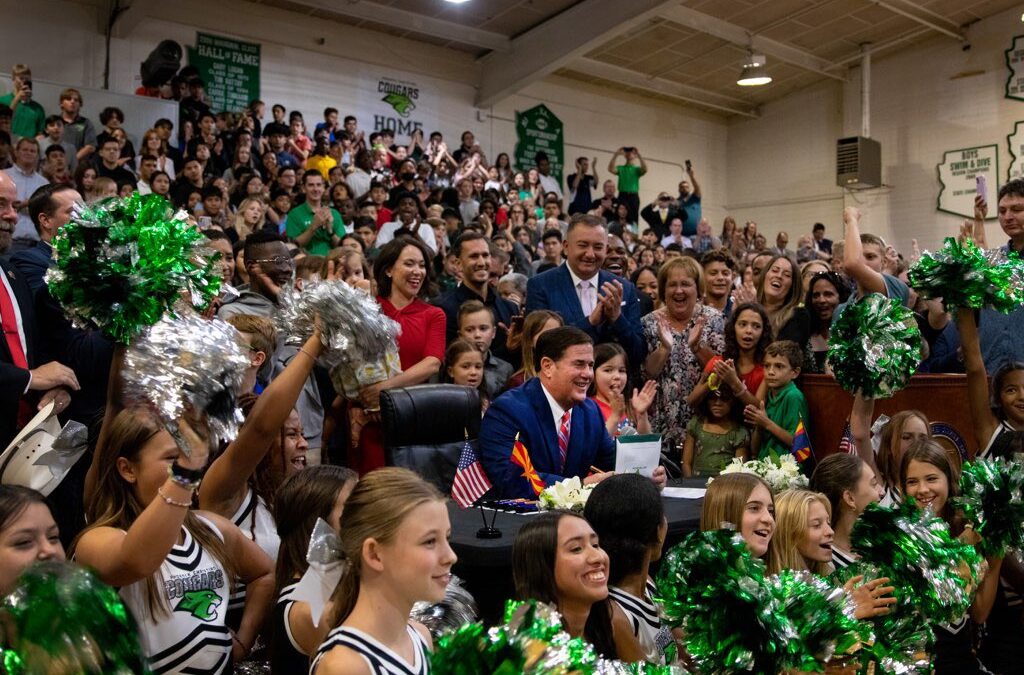
Indeed, this extraordinary economic momentum comes in the wake of Arizona enacting the nation’s first fully universal ESA program. Sponsored by state Representative Ben Toma and signed into law by former Governor Doug Ducey last summer, the new legislation took effect in September 2022.
Since then, leftwing activist organizations such as Save Our Schools (SOS) Arizona have attempted to portray the program as financially ruinous. Yet this same organization—whose leaders were forced to admit that they had miscounted the number of signatures they collected in opposition to the program last fall by more than 50,000—has again opted for partisan wish-fulfillment rather than numerical reality.
With a typical ESA scholarship award around $7,000 per student—that is, about half of the roughly $14,000 spent on average per student in a public district school—the ESA program now serves roughly two kids for the cost of each one in a traditional public school district.
Unsurprisingly, when compared to the roughly $15 billion now spent each year on Arizona public schools, the ESA program makes up only a sliver of total K-12 spending. Scholarship awards for students who’ve joined the program under the universal ESA expansion amount to roughly 2% of the total spending on public school students. In fact, despite claims by SOS and other opponents of school choice that ESAs have drained public schools of funding, state lawmakers increased ongoing public school funding by more than $600 million in the same year that the universal ESA expansion took effect.
In short, the ESA program makes up only a small share of the state’s spending on education, but with over 50,000 participants and growing, it will continue to provide a lifeline for all students in need. It’s already done just that for students with special needs and other vulnerable populations ever since Goldwater created the nation’s first ESA program in Arizona more than a decade ago—delivering life-changing results at lower costs than public school offerings.
Despite such real-world impacts on families, critics have doubled down to suggest that the program’s success is a sign of failure and financial unsustainability. Indeed, teachers union-aligned groups have suggested that because more students have opted into the ESA program than originally estimated, it must be too expensive. (Note the sharp contrast to their usual take on education spending, which is only ever portrayed as an investment, rather than a cost.)
It is true that demand for ESAs has already beaten initial estimates, and it is true that the expansion, which passed in the final days of last year’s legislative session, was enacted separately from the state budget—meaning ESA awards were not incorporated into the projected costs of the original budget. But ESA award amounts have already been factored into the state’s updated budget projections released this January for the current and upcoming fiscal year. In fact, it’s the very same state budget analysts who assume that the program will grow even further to 57,000 students by the end of this school year who also report the state is now sitting on a $2.5 billion cash surplus for next year. (Of note, that surplus is in addition to the state’s $1.4 billion rainy day fund, which former Governor Ducey and conservative lawmakers also accumulated to cushion the state from any future economic turbulence.)
The state budget analysts were characteristically cautious in their recommendations to spread out the massive war chest. They suggested that if all $2.5 billion were spent this year, the state budget would simply break even next year, before the balance increases again to an estimated $600 million surplus by 2026. But in any case, their projections make clear that the same Arizona lawmakers who unleashed universal school choice have helped steward robust economic vitality and have created a situation where Arizona lawmakers are again weighing how best to spend or return excess tax revenues. Indeed, as the JLBC analysts reported in January—even before the latest upward revisions—the state has enjoyed “an increase of $1.06 billion over the original revenue estimate included in the FY 2023 budget enacted in June 2022” due to “significantly stronger revenue growth than originally projected.”
There is no doubt that global financial uncertainty, the risk of fiscal and monetary mismanagement from Washington D.C., and warnings of mild or severe recessions should perennially weigh on the minds of state legislators. But when it comes to ESAs and the state’s financial solvency, one thing is clear: universal school choice and successful economic stewardship easily go hand in hand.
Arizona has just proven it.
Matt Beienburg is the Director of Education Policy at the Goldwater Institute. He also serves as director of the institute’s Van Sittert Center for Constitutional Advocacy.
Arizona’s first-in-the-nation universal school choice program just hit a major milestone, and it is poised for more successes in the months ahead under a Republican’s stewardship.
Last year, the Arizona Legislature expanded the Empowerment Scholarship Accounts (ESA) program to include all eligible K-12 students in the state. Former Superintendent of Public Instruction Kathy Hoffman, a Democrat, was handed the keys to maintain the legislature’s intent for the program. However, Hoffman did not support the universal expansion of ESAs and according to sources, did not take advantage of all available resources afforded to her by the legislature to ensure the program’s positive developments on behalf of students already in – and yet to join – the system.
At the start of this year, new Arizona Superintendent of Public Instruction, Tom Horne, became one of the few Republican statewide officeholders and assumed control of the ESA program, which is under the umbrella of the Arizona Department of Education. Per reports since the transition of power, his administration inherited significant problems with the program, and his staff has had to work around the clock to catch up with the outstanding issues and requests in addition to nurturing the program’s growth.
Recently, though, under Superintendent Horne’s watchful eyes, the program has seen more stability and success than ever before, culminating with a recent announcement from the office that there are now 50,000 students enrolled in the ESA program.
Arizona's first in the nation universal ESA officially hit 50,000 participants today! #EducationForAll
— Arizona Department of Education (@azedschools) March 17, 2023
When asked to respond to the news of this milestone, Superintendent Horne told AZ Free News, “Students should not be trapped in schools that, in their parents’ judgement, do not meet the particular students’ needs. If the schools are afraid of losing students to private or charter schools, they will make a greater effort to please parents with good academic outcomes.”
This news spread quickly around the state and nation – with many advocates and elected officials chiming in to congratulate Arizona and Superintendent Horne.
Congressman Paul Gosar tweeted, “Arizona is leading the country in education reform; 7 of the top 10 charter schools are in AZ and now with ESA, every student has the choice to find the best school he or she wants.”
Arizona is leading the country in education reform; 7 of the top 10 charter schools are in AZ and now with ESA, every student has the choice to find the best school he or she wants. https://t.co/0fRQYKMlpn
Steven Utroska, a Mississippi Director for the State Freedom Caucus Network, wrote, “This is amazing. Could you imagine if 50k students in MS could leave failing government schools and actually get a quality education? It would revolutionize our state, but too many MS politicians would rather pander to the system than provide for the student.”
This is amazing. Could you imagine if 50k students in MS could leave failing government schools and actually get a quality education? It would revolutionize our state, but too many MS politicians would rather pander to the system than provide for the student. https://t.co/kSV9zADNWy
Despite the good news about enrollment numbers with the program, Superintendent Horne and legislative Republicans have their work cut out for them in the months ahead. Democrat Governor Katie Hobbs and legislative Democrats are seeking to defund and undermine the universal ESA program, eliminating school choice for tens of thousands of Arizona students whose families have elected to participate in the historic opportunity to control their children’s education.
Daniel Stefanski is a reporter for AZ Free News. You can send him news tips using this link.
It’s been just over a month since new Arizona Superintendent of Public Instruction, Tom Horne, was sworn into office, and his hire to run the Empowerment Scholarship Account (ESA) Program has been delivering significant results for Arizona families.
Christine Accurso, the new ESA Executive Director, has been a longtime pro-life and school choice advocate in the East Valley. Her family has benefited from the ESA program for years – well before the Arizona Legislature expanded its scope in 2022. After the bill was signed into law by former-Governor Doug Ducey, Accurso singlehandedly led a grassroots army of moms and dads from around Arizona to defeat a campaign meant to refer ESA expansion to the ballot and delay the implementation of school choice and freedom for tens of thousands of children in our state.
Since coming on with the Arizona Department of Education, Accurso has been hard at work to save the expanded ESA program a second time, bringing staffing up to the levels intended by the legislature, handling the huge backlog of funding and reimbursement requests, vetting and approving new applications for the program, and ensuring that parents are receiving timely and relevant information from her office.
To that end, Accurso has been extremely diligent in sending out weekly emails to account holders, explaining what her program is working on, clarifying any previous misconceptions about ESAs, and giving updates on the number of students benefiting from school choice in Arizona. Her first email, sent January 3 (which was her inaugural day leading the program), alerted parents and guardians that there were 45,170 students receiving an ESA. In her email this week, that number was up to 46,971 – and Accurso briefed readers that the program is “receiving a minimum of 150 new applications a day.”
Accurso’s latest email also gave an update on her processing que, which is very helpful for account holders to realize the reasons behind some delays in payment processing or approval of desired resources for students. The Marketplace has a backlog of 4,578; Direct Pay of 4,032; Reimbursements of 24,409; and pre-paid debit cards of 63,125 – and there are 4,000 orders coming in each day to be processed. These numbers are significantly down from the original backlog Accurso inherited from the previous administration (and shared in her January 13 email), which was 171,575 orders.
The ESA Executive Director has also been planning and executing the formation of a parent advisory committee – an action she forecasted in her January 13 email to account holders. Accurso announced in her January 25 email that the application process for this committee was open – with 15 to 30 members selected to serve in a volunteer capacity. There were 140 applications received by the ESA Program for this committee, per Accurso’s February 8 email, and she informed interested readers that “we will be finalizing the candidates and communicating with them soon.”
The February 8 email to account holders was lengthy, which Accurso apologized for, but it was filled with necessary information. Accurso explained that she had “spent her first month as the executive director adjusting our office’s approach to everything in the ESA program to align with the state law.” She clarified the law and requirements for an “individual vs facility/business offering tutoring or teaching services,” and she gave an update on “accessing your ESA funds.” She gave a lot of information on the four ways account holders could access their ESA funds, including some new directives on using the pre-paid debit card. Accurso warned that her office “does plan to cancel the use of debit cards for all accounts that have not submitted the appropriate receipts by the (required) deadline or have purchased unallowable items with the card (For example: Chevron, Chick-Fil-A, Taco Bell and Dillard’s).”
Accurso realizes that one of the deadliest attacks toward ESA programs is the lack of oversight by those entrusted to distribute and steward the funds, and the propensity of some account holders to misuse funds that have been earmarked for specific educational purposes – whether intentionally or unintentionally. This is why she appears to be laser focused on bringing the Arizona ESA program into conformity with the law and the original intent of the legislature. Her weekly updates will continue to provide much-needed guiderails for parents and guardians as the program moves forward under the watchful eyes of Superintendent Horne.
Daniel Stefanski is a reporter for AZ Free News. You can send him news tips using this link.
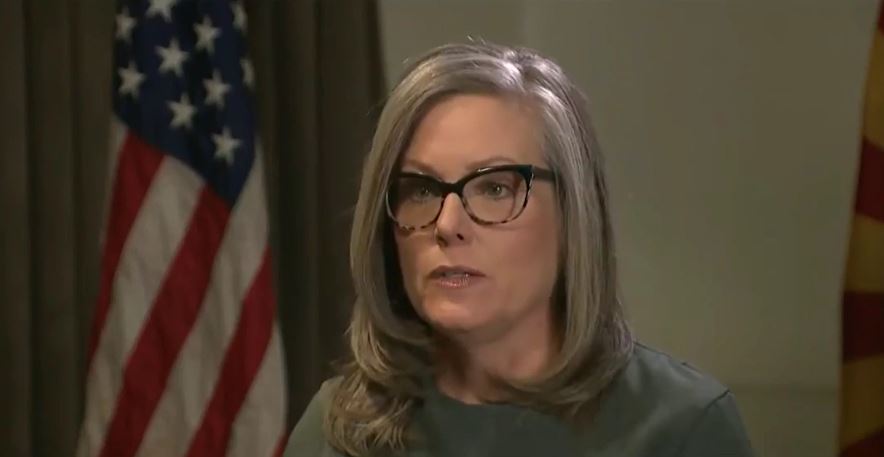
Arizona Governor Katie Hobbs has made no secret of her desire to dismantle the state’s school choice benefits for tens of thousands of children and their families, and this weekend, she was challenged on her desires by Fox News Sunday host, Shannon Bream, during an exclusive interview leading up to the Super Bowl in Glendale.
During the interview, Bream asked the governor why all students shouldn’t have a chance to have the educational opportunities that she had growing up – a reference to Hobbs’ high school graduation from Seton Catholic Preparatory. Governor Hobbs appeared to embrace the rhetoric of school choice proponents as she searched for justification for her positions, responding that her parents “made that choice” and that they “sacrificed a lot” to give her the chance at a private education.
Hobbs went on to say that she wants every student in Arizona to have access to high-quality public education – access that she claimed would not happen under Arizona’s historic Educational Scholarship Account (ESA) program, which was passed last year by the Arizona Legislature. Bream followed up by asking the governor if students should not have a chance to go elsewhere if their school system was failing. Hobbs’ reply was that “the schools are failing because we are failing to invest in them.”
But Governor Hobbs’ rampant claims of the ESA program bankrupting and failing Arizona schools were met with facts from several individuals. Corey DeAngelis, one of the nation’s premier “evangelists” of school choice, tweeted thanks to Shannon Bream for citing his January Wall Street Journal article, showing that Arizona’s ESA program could actually save the state more than $100 million.
And Andrew Clark, Executive Director of Yes. Every Kid. Foundation, tweeted, “The average cost for a family to homeschool is year is about: $2k per kid. Micro-schools and pods are about $5k. Private schools average $10k, charters around $12k. Public schools clock in around $15k. But sure it’s a spending problem for public schools…let’s ignore the facts…”
The average cost for a family to homeschool is year is about: $2k per kid. Microschools and pods are about $5k. Private schools average $10k, charters around $12k. Public schools clock in around $15k. But sure it’s a spending problem for public schools…let’s ignore the facts… https://t.co/b0Rgjq4JAd
Governor Hobbs’ answers on school choice quickly went viral after the recorded interview went live Sunday morning, and Arizona Republicans, who are at the front lines of protecting the landmark ESA program, wasted no time in making their thoughts known.
The Arizona Senate Republicans Twitter account posted: “.@GovernorHobbs response makes absolutely zero sense, other than reinforcing why expansion of ESA school choice is so desperately needed.”
Senator Justine Wadsack tweeted, “So #HypocriteHobbs attended PRIVATE school, and her parents made “sacrifices” to put her there. Even found themselves on food stamps! Had #ESA/#SchoolChoice existed back then, her parents would have been given $7,000 to help with the cost of Katie’s education.”
So #HypocriteHobbs attended PRIVATE school, and her parents made "sacrifices" to put her there. Even found themselves on food stamps!
Representative Quang Nguyen stated, “So if your parents afforded you this great opportunity, shouldn’t you make it possible for other parents to give their children the same opportunity you received as a child? Asking for Arizonans.”
So if your parents afforded you this great opportunity, shouldn’t you make it possible for other parents to give their children the same opportunity you received as a child? Asking for Arizonans. https://t.co/ffMnjxSRMo
Representative Cory McGarr disagreed with Governor Hobbs’ characterizations of district school funding, saying: “Our government schools are failing because we are supposedly starving them of resources?? 73% increase in funding since 2016… Perhaps they are failing because they focus on woke sexualization, feelings and racism and have no accountability because of politicians like this.”
Our government schools are failing because we are supposedly starving them of resources??
73% increase in funding since 2016…
Perhaps they are failing because they focus on woke sexualization, feelings and racism and have no accountability because of politicians like this. https://t.co/xXGMqiFyUq
Representative Matt Gress underlined the foundation of the school choice argument, writing: “.@GovernorHobbs’ parents struggled to provide her with an education THEY thought best. It’s unfortunate she wants AZ families to choose between being on food stamps or sending their kids to the school they choose. Let’s help families. Give them a choice, not push them down.”
.@GovernorHobbs’ parents struggled to provide her with an education THEY thought best.
It’s unfortunate she wants AZ families to choose between being on food stamps or sending their kids to the school they choose.
Representative Austin Smith said, “Booed at the Phoenix Open, health nominee failed in the senate committee and called out for her hypocrisy on school choice on national Sunday show. Bad weekend for Hobbs. Is there anyone who thinks she’s actually an effective leader?”
Booed at the Phoenix Open, health nominee failed in the senate committee and called out for her hypocrisy on school choice on national Sunday show. Bad weekend for Hobbs.
Representative Justin Heap tweeted: “@katiehobbs is committed to ending Az’s ESA program which allows thousands of Arizona children to receive the same private school education she received. Katie Hobbs definitely believes in pulling the ladder up behind her.”
@katiehobbs is committed to ending Az's ESA program which allows thousands of Arizona children to receive the same private school education she received. Katie Hobbs definately believes in pulling the ladder up behind her. https://t.co/zI9tjtBJ53