A new national poll conducted by Pulse Decision Science reveals that pharmaceutical reform represents a powerful and politically advantageous issue for Republican candidates heading into this election cycle.
The data shows the issue effectively consolidates support within the GOP base during primaries while delivering meaningful gains among independent and battleground voters in general elections.
The poll highlights near-universal frustration with the high costs of prescription drugs, creating a rare opportunity for Republicans to claim ownership of an issue that resonates deeply across demographic and partisan lines.
According to the survey, 84% of voters report using prescription medication, underscoring how broadly the issue affects American households. Cost pressures are forcing significant behavioral changes, with 55% of respondents admitting they have skipped doses, turned to over-the-counter alternatives, or ignored doctor recommendations due to high prices.
These coping behaviors are particularly common among younger women, lower-education voters, and independents/moderates.
Voters across the political spectrum overwhelmingly attribute rising drug prices to pharmaceutical industry practices rather than investments in innovation. Major factors cited include:
Increasing profits: 81%
Rising executive compensation: 76%
Unethical business practices: 70%
By contrast, only 52% of voters view research and development costs as a major driver of prices—the weakest factor identified by a wide margin.
This perception creates fertile ground for messaging focused on corporate greed, price gouging, and unfair practices, which the poll indicates resonates strongly even with the Republican base.
When voters are presented with a candidate who supports specific, targeted pharmaceutical reforms—including Most Favorable Nation (MFN) pricing, patent reform, and measures to increase competition—that candidate sees a net +5-point gain in overall support.
Notable gains were recorded among key subgroups:
Hispanics: +10 points
High-propensity general election voters (3 of 4 voting history): +9 points
Women 55 and older: +7 points
Voters in lean Democratic Congressional districts: +7 points
High school education or less: +7 points
Republicans: +6 points
Conservatives: +6 points
Bachelor’s degree holders: +6 points
These shifts demonstrate that pharmaceutical reform serves both a base-unifying issue and a tool for expanding appeal in competitive general election environments.
The poll further shows that framing pharmaceutical reform through an “America First” lens is especially powerful in Republican primaries. Fully 89% of GOP primary voters indicated they are more likely to support a candidate who prioritizes codifying President Trump’s Most Favorable Nation Executive Order.
When paired with messaging that emphasizes America-First pricing, the issue delivers strong consolidation within the Republican coalition. Key subgroup gains in the primary context include:
Males 18-34: +13 points
Voters in lean Republican Congressional districts: +11 points
Mid-turnout voters (2 of 4 voting history): +10 points
Self-described “Not So Strong” Republicans: +10 points
The findings arrive as the Trump administration continues to focus on delivering tangible results on pharmaceutical pricing. On April 23, 2026, President Trump announced the 17th agreement with a major pharmaceutical manufacturer—this time with Regeneron—bringing MFN-style pricing to American patients.
The deal provides every State Medicaid program access to MFN prices on Regeneron products, delivering hundreds of millions in savings. It covers 86% of the branded drug market across 17 leading manufacturers and includes commitments to end foreign freeloading on American innovation.
Key provisions include significant price reductions, such as lowering the price of Regeneron’s cholesterol medication, Praluent, from $537 to $225 when purchased through TrumpRx.
Additionally, Regeneron’s new gene therapy for a rare form of genetic deafness, Otarmeni, will be provided at no cost to American families. The company also committed to a $27 billion investment in U.S. research, development, and manufacturing by 2029, contributing to a total of $448 billion in pharmaceutical investments secured under President Trump in just 15 months.
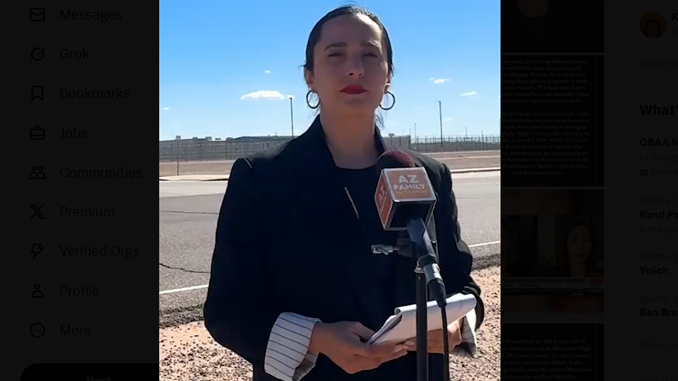
Ethan Faverino is a reporter for AZ Free News. You can send him news tips using this link.
A media mouthpiece for the Islamic regime is praising Rep. Yassamin Ansari (D-AZ-03) for her actions in support of Iran.
Ansari was featured on the front page of an Islamic Republic newspaper, Sazandegi, for her efforts to resist President Donald Trump’s approach to Iran.
🚨 The regime is now openly promoting a NIAC-aligned American congresswoman.
Yassamin Ansari is being praised by an Islamic Republic newspaper, Sazandegi, for opposing U.S. pressure on the regime – pushing no real pressure, no regime change, just “diplomacy” that keeps it in… pic.twitter.com/7ZrpV6cvcd
The congresswoman filed Articles of Impeachment against Secretary of War Pete Hegseth earlier this month. (This title is Hegseth’s preferred alternate, authorized in an executive order last September as an unofficial secondary title; along those lines, the “Department of War” is another option for “Department of Defense.”)
In a statement, Ansari accused Hegseth of high crimes and misdemeanors against Iranians. She also accused Hegseth of abuse of office and undignified conduct, unlawful military actions, and unauthorized disclosure of classified information.
Ansari’s parents came to the U.S. from Iran. As many did, Ansari’s father overstayed a student visa to escape the Islamic Revolution. That visa was initially awarded to him in the early 1970s to attend the University of Oregon for engineering.
Ansari’s mother came approximately a decade later; Ansari told The Guardian that her mother entered as a citizen since her grandfather had completed a medical residency in the U.S. several decades prior. One of Ansari’s grandfathers was imprisoned by the regime, Ansari told The New York Times.
Ansari also told The Times that she desires a secular democracy for Iran. She has condemned the present regime for its terrorism and treatment of women.
“I can say wholeheartedly: I want to see an actual democratic state, a secular state, a state where the people have decided who their leader is,” said Ansari. “Ultimately, I do think there needs to be an internationally monitored referendum, free and fair elections, because Iran is also a very diverse country. There’s 90 million people, and it’s not just Persians. There’s, you know, Armenians, Kurds. There’s different Jews, Baha’is, Muslims. Many people are secular. There’s got to be a coalition, and there’s got to be a model that is representative of everyone.”
Despite those remarks and her parents’ backgrounds, Ansari has proven through her resistance to Trump and stalwart defense of Iran to be a favorite of the Islamic regime.
The National Iranian American Council (NIAC) and Public Affairs Alliance of Iranian-Americans (PAAIA), both pro-Iran lobbyist groups, endorsed Ansari throughout her campaign for Congress.
Ansari has voiced continual opposition to U.S. involvement in the ongoing conflict in the Middle East.
In an interview with The Guardian several weeks ago, Ansari called Trump a mentally ill, evil man that deserved to be removed from office over dragging the U.S. into the war.
“There is no doubt in my mind he is mentally unstable and not all there but I also believe he is a deeply troubled, evil human being that only cares about himself and his family,” said Ansari. “He has shown that throughout his entire life. He has shown that throughout his presidency by ripping away healthcare and basic necessities from the average American, while he and his family have made billions of dollars.”
AZ Free News is your #1 source for Arizona news and politics. You can send us news tips using this link.
Democrats keep attacking President Donald Trump’s Big Beautiful Bill Act of 2025, as a tax cut for the rich. But the data show that the average family GAINED roughly $2,000 on their lower tax bill for this year. Every Democrat in Congress voted no, even as they complained of a “middle-class affordability crisis.” Maybe that’s because $2,000 is peanuts to rich and famous limousine liberal Democrats. But not for the rest of us.
The goal of the Trump tax cut was simple: strengthen the economy with lower tax rates and let working and retired Americans keep more of what they earn. The early evidence confirms this is exactly what has happened. Initial IRS data shows that almost HALF of filers have already taken advantage of the bill’s middle‑income tax provisions.
Income taxes have become such an ingrained part of American life that many workers barely notice how much is snatched from their paychecks – payroll taxes, federal income taxes, state income taxes, etc. We see the net amount and forget the gross amount is what we actually earned. Because less is now taken out, the Trump tax cut functions like a pay raise.
So who is getting a pay raise from the One Big Beautiful Bill? Three major provisions were deliberately crafted to help working‑class and middle‑class Americans keep more of their hard‑earned dollars.
First, the law eliminated income tax on tipped wages, subject to certain caps. For millions of waiters, waitresses, bartenders, baristas, barbers, hairstylists, DoorDash drivers, tour guides, casino dealers, and counter staff at casual restaurants, this means a substantial share of their income is no longer taxed. In some of these occupations, tips make up more than half of total earnings, so the impact is enormous. These workers may lead rich and fulfilling lives, but none of them qualify as Trump’s “rich friends.”
Second, the bill eliminated federal income tax on overtime pay, again with income limits. This provision frees hourly workers from being taxed when they put in extra hours. Put differently, eliminating tax on overtime reduces the number of hours each day that hourly workers labor not for themselves or their families, but for the government. Given how many Americans are paid hourly, this provision overwhelmingly benefits people who are not wealthy.
Third, the tax bill reduces the tax RATE you pay. This incentivizes more work because the reward for getting a job and working more hours is more money.
Through March 25, more than 85 million individual tax returns had been filed. Of those, 37.5 million — 44% — saw an immediate reduction in their tax bill.
The bill also created a forward‑looking benefit for children: Trump Accounts. These accounts help young Americans begin investing early, giving them a head start on saving for education, starting a business, or building long‑term financial security. Children born between Jan. 1, 2025, and Dec. 31, 2028, are eligible for a $1,000 federal contribution, and early tax data shows strong enthusiasm. Roughly 2.6 million returns established Trump Accounts for more than 4 million children, and nearly one million qualified for the federal contribution.
When we account for all of these tax benefits, what we find is that far from being “tax cuts for the rich,” the One Big Beautiful Bill’s tax provisions actually reduced the tax bill paid by the middle class by roughly 14%. Meanwhile, the SHARE of federal income taxes paid by the richest 10% rose from 70% to 77% and the top 1% share rose from 38% to 40%.
If the rich are now paying a larger share of the tax pie, how is the Trump tax cut “a giveaway to the rich?” Maybe the left calls the Trump tax cut “One Big Ugly Tax Bill” because they want every one of us – not just the rich – to pay more taxes.
Stephen Moore is a contributor to The Daily Caller News Foundation, a senior fellow at America First Policy Institute, and a cofounder of Unleash Prosperity.
Nearly half of high school seniors are not proficient in reading or math, and one-third of eighth graders cannot read at a basic level. The aftershocks of pandemic-era school closures are still playing out, with students regressing to levels not seen in more than 25 years, and one in four now chronically absent from the classroom. An overreliance on technology, lax policies around personal devices like cell phones, and weakened discipline standards have only deepened the problem, eroding focus, accountability, and real learning.
The current challenges also extend beyond students. Nearly eight in 10 teachers say they have considered leaving the profession, citing burnout as their pay continues to fall behind that of other college-educated workers. The system is strained at every level, and every person with skin in the game knows it.
Who is at the center of it all? America’s teachers’ unions. While students slip to historic lows in reading and math and classrooms struggle to recover from union-driven school shutdowns, the American Federation of Teachers (AFT) and its president Randi Weingarten appear focused elsewhere, pouring time, money, and political muscle into ideological conflicts and partisan campaigns instead of fixing the schools they supposedly represent.
As president of the nation’s largest teacher’s union, Weingarten represents 1.8 million educators and plays a central role in shaping K-12 policy and the direction of American education. At a moment of historic academic decline, one might expect her influence to be directed toward fixing it.
It’s not. She is focused on her own political ambitions.
Weingarten has directed the AFT’s resources toward organizing and amplifying explicitly political activism, including the anti-Trump “No Kings” rallies. There, she took the spotlight to declare that “we are not going to let Donald Trump continue to do what he has been doing” and ignoring the fact that Americans voted to elect Donald Trump as President, boldly claimed that “we, the people, have to have the ultimate say.”
Unfortunately, this latest spectacle is nothing new. The AFT has a long record of channeling resources into left-wing political campaigns, protests, and advocacy efforts that have little to do with whether students can read, write, do basic math, or are proficient in these core competencies.
The AFT has funneled tens of millions of dollars to left-wing aligned groups and candidates since 2022, and spent most of last year engaged in aggressive legal and activist campaigns against Trump administration-directed education reforms aimed at restoring parental oversight in curricula and de-politicizing the classroom.
This ideological activism was on full display during the pandemic, when Weingarten advocated and defended keeping schools closed far longer than necessary, even as evidence showed it was safe to reopen. After these devastating setbacks from school closures and virtual learning, the average student is less than halfway to a full academic recovery. In some grades, there has been little to no improvement in reading since classrooms reopened. Chronic absenteeism has surged, especially among lower-income students; in 2024, rates were 57 percent higher than before the pandemic, and Weingarten is directly responsible for this generational learning loss.
Even after nearly $200 billion in emergency federal spending on K-12 education, student performance continues to decline. Students are doing worse than they were a decade ago, and lower-performing students are now further behind than their counterparts were more than 30 years ago. National test scores have fallen to their lowest levels in decades, while The Nation’s Report Card data shows the gap between high- and low-performing students continuing to widen.
At a moment when student outcomes are deteriorating at record levels, the priorities for educational leadership like Weingarten should not be difficult to identify. It begins in the classroom: ensuring children are given foundational tools for critical thinking and can learn how to think (not what to think) and supporting teachers and parents as they help students achieve their full potential.
At the American Parents Coalition, we will continue to educate parents on the blatant partisan actions academic leaders like Weingarten are doing, at the expense of our children. It’s time to reclaim parental authority, and to demand teachers’ unions focus on academic success and not divisive ideologies.
Our children do not get another chance at learning. Their childhood is finite. The major setbacks taking hold now will shape not only academic prospects in their immediate future, but also their confidence, opportunity, and quality of life.
Randi Weingarten prioritizes a political agenda over our kids. She promotes policies that cut parents out of their children’s lives. She uses her platform to advocate for herself, not teachers or students. It’s time for Randi Weingarten to be replaced with a true advocate for education.
Friday’s strong jobs report smashed expectations and demonstrated that the economy and labor market are far stronger than the mainstream media suggests. The economy added 178,000 jobs in March, and the unemployment rate fell to 4.3 percent. Real wages rose again, increasing average American living standards.
After a rough February distorted by brutal weather across large parts of the country, the labor market has roared back. The naysayers who insisted that blip represented a crumbling economy were wrong, and the March data makes that plain.
Friday’s jobs report follows a strong ADP employment report on Wednesday that showed small businesses created 112,000 private-sector jobs in March. While the employment picture was more nuanced at bigger companies, small businesses remain the engine of the economy.
Thanks to President Donald Trump’s strong border policies, which have stopped the massive influx of the labor force, the nation is, by any measure, at full employment. The Kansas City Fed estimates that the number of jobs needed each month to keep the unemployment rate steady has fallen from around 150,000 to roughly 50,000.
Elevated oil prices are always a threat to small businesses, the labor market, and the broader economy. But the jobs report shows employers recognize today’s high gas prices as short-term pain that doesn’t alter the administration’s domestic pro-energy agenda, which represents a long-term structural shift. Expanded drilling, streamlined permitting, and a commitment to American energy independence mean that today’s prices are a temporary headache, not a permanent condition.
Meanwhile, the federal government workforce continues to fall. Since Trump took office, federal government jobs are down by 12% and at the lowest level since 1966, a huge victory over big government. Every position shed from the federal payroll is a resource freed up for the productive private economy — the part of the economy that actually creates goods, services, and lasting prosperity.
America’s resilient economy and labor market are a direct result of last year’s Republican tax cuts. The restoration of 100 percent immediate expensing — allowing businesses to write off capital investments in full the year they’re made — gives employers a powerful incentive to expand. The permanent 20 percent deduction for small business income and new interest deductions do the same. Together, these provisions are fueling exactly the kind of investment cycle that produces hiring and wage growth.
Guy Berkebile, chairman of Guy Chemical, a manufacturer south of Pittsburgh, explained the situation at an event hosted by Job Creators Network, Americans for Prosperity, Americans for Tax Reform, and the Pennsylvania Manufacturers Association, featuring U.S. Rep. Scott Perry this week: “Tax cuts leave us business owners with more money to invest in our employees and in expansion. Immediate expensing helps justify the costs of new projects by reducing the payback time.”
Small businesses like Guy Chemical can help Americans connect the dots between tax cuts and more jobs, higher wages, and a stronger economy.
The mainstream media will continue searching for ways to cloud any positive news. Our job is to look at the data clearly and call it what it is: a strong economy, a resilient labor market, and pro-growth policies that are working.
Alfredo Ortiz is a contributor to The Daily Caller News Foundation, CEO of Job Creators Network, author of “The Real Race Revolutionaries,” and co-host of the Main Street Matters podcast.