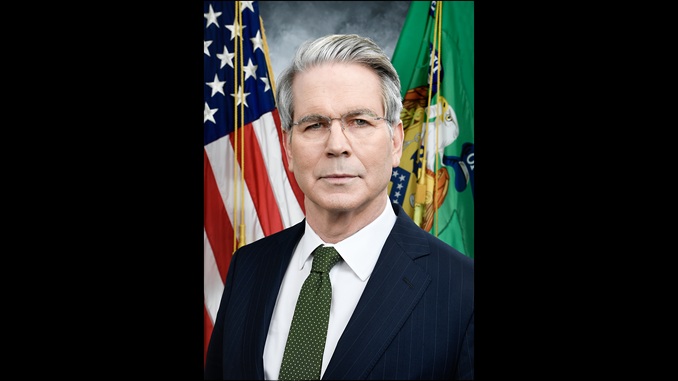
Treasury Secretary Scott Bessent is expected to visit Arizona on Wednesday and Thursday, with stops including a Casa Grande appearance alongside House Speaker Mike Johnson (R-LA) and Rep. Juan Ciscomani (R-AZ-06). The tentative itinerary, provided exclusively to AZ Free News by Treasury Department officials, also includes meetings with manufacturers, business leaders, and community bankers.
Bessent is scheduled to travel to the state on August 5 and 6 to discuss the Trump administration’s economic agenda and efforts to strengthen the integrity of the nation’s financial system, Treasury officials said.
The visit will include a tour of a manufacturing facility in Casa Grande with Johnson and Ciscomani. The three officials are also expected to participate in an economic roundtable with Arizona business leaders.
The Treasury Department had not yet publicly identified the manufacturing facility as of Monday night.
The administration plans to use the event to highlight the effects of the tax and business provisions it refers to as the Working Families Tax Cuts, including incentives for domestic manufacturing and capital investment.
The tax provisions were enacted as part of Public Law 119-21, which President Donald Trump signed on July 4, 2025. The law permanently extended several provisions of the 2017 Tax Cuts and Jobs Act and created temporary federal income-tax deductions for qualified tips and overtime compensation.
The law also allows businesses to immediately deduct qualifying research and development costs and the cost of certain equipment and machinery. It provides accelerated deductions for qualifying investments in new and expanded manufacturing facilities, according to a White House summary.
Arizona Republican lawmakers and Governor Hobbs reached a bipartisan budget agreement in June that eliminated state income taxes on qualified tips and overtime, increased the standard deduction, and added other tax provisions tied to the federal law. Republican legislative leaders described Arizona as the only state to fully adopt the federal tax package at the state level.
🚨FOR IMMEDIATE RELEASE: Arizona Becomes Only State in the Nation to Deliver Historic Trump Tax Cuts As Part of Bipartisan FY 2027 Budget Agreement
The White House, citing a National Association of Manufacturers analysis, said the law’s manufacturing provisions sustained an estimated 119,000 Arizona jobs, $22 billion in state economic output, and $11 billion in wages.
The Congressional Budget Office (CBO) estimated that the law would increase federal deficits by approximately $3.4 trillion from 2025 through 2034, excluding macroeconomic and debt-service effects. The CBO attributed the increase to an estimated $4.5 trillion reduction in revenues, partially offset by a $1.1 trillion reduction in direct spending.
During a separate engagement, Bessent is expected to meet with community bankers from across Arizona alongside Comptroller of the Currency Jonathan Gould.
Bessent and Gould reportedly plan to discuss the administration’s efforts to reduce regulatory burdens on community banks and expand their ability to finance local businesses and economic development.
Reducing regulatory and supervisory burdens on community banks has been one of Gould’s stated priorities. The agency said in May that it had begun tailoring examinations according to a bank’s size, complexity, and risk profile, while giving smaller institutions greater flexibility to use a simplified capital framework.
The Office of the Comptroller of the Currency (OCC) has also revised its model-risk guidance and narrowed the scope of information-technology and cybersecurity examinations for community banks, according to an agency announcement.
“Community banks are anchors of local economies, providing essential banking services and small business lending that helps power job creation,” Gould said in the announcement.
The Arizona meeting is also expected to address the administration’s campaign against fraud, identity theft, money laundering, and other illicit activity involving the financial system.
Trump issued an executive order in May directing Treasury and federal banking regulators to strengthen customer-identification requirements and consider changes to regulations implementing the Bank Secrecy Act.
The order directed Treasury and federal financial regulators to propose stronger risk-based customer due-diligence requirements and consider changes to customer-identification rules. It instructed regulators to examine the use of foreign consular identification documents, invalid or mismatched Social Security and taxpayer-identification numbers, payroll-tax schemes, and accounts associated with workers who lack employment authorization.
It also directed financial regulators to consider whether banks should obtain additional information concerning immigration status and employment authorization when those details are relevant to fraud, identity misrepresentation, sanctions evasion, or another identified financial risk.
The Treasury’s Financial Crimes Enforcement Network (FinCEN ) subsequently issued a June 5 advisory urging banks and other financial institutions to identify and report suspicious activity associated with identity theft, payroll fraud, and the unlawful employment of people without work authorization.
FinCEN said some employers conceal unauthorized workers by using stolen identities, mismatched Social Security numbers, false payroll information, or off-the-books payment arrangements. The agency reported that financial institutions filed suspicious activity reports involving more than $2.5 billion in transactions associated with potential payroll-tax fraud during 2025.
The advisory was issued jointly with the Federal Deposit Insurance Corporation, OCC, and the National Credit Union Administration, and in coordination with the Internal Revenue Service.
The Treasury Department said Bessent and Gould will discuss how Arizona community banks can support the administration’s enforcement efforts while continuing to provide financing and banking services to local businesses.
Additional details regarding the facility, participating business leaders, event times, and press access are expected later on Tuesday.
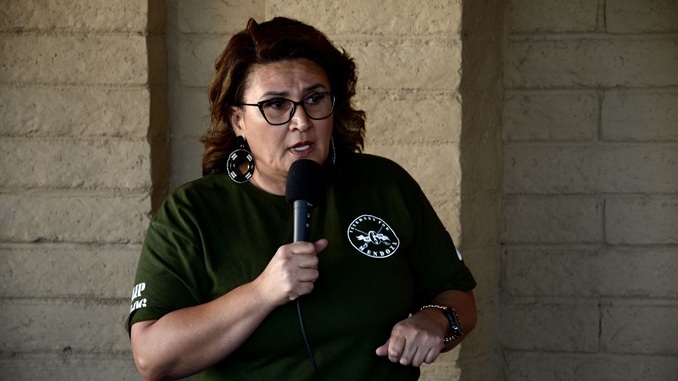
Two years after the attempted assassination of President Donald Trump in Butler, Pennsylvania, the Republican National Committee (RNC) is drawing attention to past remarks by Arizona Democratic congressional candidate JoAnna Mendoza in which she questioned the federal government and compared the United States to countries where democracy has collapsed.
Mendoza, a retired Marine running to represent Arizona’s Sixth Congressional District, made the statements during three separate political appearances released online between 2025 and 2026.
The RNC accused Mendoza of contributing to hostile political rhetoric surrounding Trump and connected her comments to the violence directed against him.
“JoAnna Mendoza continues to spew vile conspiracy theories and the extremely divisive rhetoric that have led to three assassination attempts against President Trump,” RNC spokesman Nick Poche said in a statement provided to AZ Free News. “Americans will never forget what happened in Butler, or the Democrats who refused to lower the temperature and tried to tear our nation apart.”
In the first video, released by LD18 Democrats, Mendoza questioned the reliability of federal intelligence while answering a question about the Middle East and Iran.
Mendoza criticized the Biden and Trump administrations’ handling of Israel, Gaza, and Iran before questioning whether the government possessed reliable intelligence about recent actions involving Iran.
“Can we even trust our intelligence agencies right now?” Mendoza asked. “Can we even trust our government to give us the correct information? And I think the answer to that is no.”
Mendoza said she was alarmed by what she described as the Trump administration’s actions in communities across the country and suggested that the nation’s democratic institutions were being eroded.
“It really scares me to think that, you know, what we’re seeing play out right now across our nation in communities, to see what this administration is doing, I never thought that I would see in the homeland,” Mendoza said.
“I never thought that I would see what has transpired happen here,” she continued. “You see it in countries like the ones I’ve been deployed to where democracy does not exist or has fallen.”
Mendoza did not identify a single policy or incident in that portion of the presentation. Rather, she broadly characterized the administration’s conduct as “unprecedented” and said she entered the race because she could no longer remain on the sidelines.
“What we’re seeing is unprecedented, and this is not the norm,” Mendoza said. “I just couldn’t stand by on the sidelines and watch this happen to our country or to its people, to us, to we the people.”
The third clip came from an interview with MeidasTouch host Ben Meiselas, who introduced Mendoza during a segment criticizing Trump and Republican Rep. Juan Ciscomani (R-AZ06).
During a discussion of border security and Immigration and Customs Enforcement (ICE), Mendoza questioned the training and conduct of ICE agents. Meiselas compared the administration’s practices to propaganda and tactics employed in other countries, and Mendoza agreed with the comparison.
“I know. It’s like we’re living in a third world country,” Mendoza said. “I mean, I’ve been deployed to countries who do not have democracy, who are in authoritarian regimes.”
“I never thought that I would see the government and its federal law enforcement agency turn against the American people,” she added, before alleging a pattern of misconduct involving ICE agents.
The RNC released the clips on July 13, two years after Thomas Matthew Crooks opened fire during Trump’s campaign rally near Butler.
Trump was wounded in the right ear. Former fire chief Corey Comperatore was killed while protecting his family, and rally attendees David Dutch and James Copenhaver were wounded, according to the Secret Service.
The FBI said in a 2024 statement that its investigation found no credible evidence that Crooks worked with co-conspirators. Investigators examined his electronic devices, searches, and online activity but did not determine a definitive motive.
The Associated Press reported that Crooks searched for campaign appearances involving both Trump and then-President Joe Biden and viewed the Butler rally as a “target of opportunity.” Reuters reported that his computer activity reflected a mixture of ideological interests without demonstrating a definitive left- or right-wing motivation.
Trump faced another assassination attempt on Sept. 15, 2024, when Ryan Wesley Routh positioned himself with a rifle near Trump International Golf Club in West Palm Beach, Florida. A federal jury convicted Routh in September 2025, and he was sentenced in February to life plus 84 months in federal prison. At trial, prosecutors presented a letter in which Routh described the incident as an assassination attempt and offered $150,000 to anyone who would “complete the job.”
Routh’s writings demonstrated explicit hostility toward Trump. The Associated Press previously reported that Routh had urged Iran to assassinate Trump in a self-published book and later wrote that “DEMOCRACY is on the ballot and we cannot lose.”
A federal grand jury has also indicted Cole Tomas Allen on charges including attempting to assassinate Trump during an April 25 shooting at the White House Correspondents’ Association Dinner. Prosecutors alleged that Allen ran through a security checkpoint carrying a shotgun and fired at a Secret Service officer, striking the officer’s ballistic vest, as he moved toward the ballroom where Trump was located.
Reuters reported that Allen sent relatives a manifesto describing Trump administration officials as prioritized targets. Prosecutors alleged that Allen disagreed politically with Trump and wanted to “fight back” against government policies he considered morally objectionable. Allen pleaded not guilty, and the case remains pending.
Mendoza is seeking the Democratic nomination to challenge Ciscomani in November.
Mendoza is also facing questions from the RNC about salary payments she has received from her own campaign.
The Mendoza campaign did not immediately respond to a request for comment.
President Donald Trump has issued a select number of endorsements in Arizona races for the 2026 election.
The latest endorsements went to Rep. Juan Ciscomani to retain his seat in the 6th Congressional District, Rep. Paul Gosar to retain his seat in the 9th Congressional District, and Mark Lamb, former sheriff of Pinal County, for the seat opened by departing Rep. Andy Biggs in the 5th Congressional District.
Neither Ciscomani nor Gosar have opponents in their primaries. Lamb faces off against Daniel Keenan, a construction company owner, in the primary.
Trump’s endorsement bundle on Friday referred to Gosar and Lamb as “MAGA warrior[s],” and Ciscomani as “a tremendous champion.”
All three men, Trump promised, were capable of improving border security, stopping migrant crime, strengthening the military, bolstering economic growth, cutting taxes and regulations, boosting domestic manufacturing and energy, supporting law enforcement, and protecting Second Amendment rights.
Ciscomani will likely face off against Democratic candidate Joanna Mendoza.
I’ve stood with President Trump from Day 1 and I’ve never wavered, not once.
I’m honored to have President Trump’s “COMPLETE & TOTAL” endorsement for Governor of our great state of Arizona! 🇺🇸 pic.twitter.com/gGootCd6kV
Here are the other endorsements for Arizona candidates made by Trump so far:
Thomas “Jay” Feely, former NFL kicker, for the seat opened by departing Rep. David Schweikert in the 1st Congressional District. Feely faces off against former State Rep. Joseph Chaplik and technology consultant John Trobough in the Republican primary.
I’ve stood with President Trump from Day 1 and I’ve never wavered, not once.
I’m honored to have President Trump’s “COMPLETE & TOTAL” endorsement for Governor of our great state of Arizona! 🇺🇸 pic.twitter.com/gGootCd6kV
Rep. Abe Hamadeh received Trump’s endorsement to retain his seat in the 8th Congressional District. Hamadeh has no opponents in the primary.
Happy birthday, Mr. President!
My first endorsement from President Trump came on his birthday, June 14, 2022. Even on his birthday he was giving to others. I will never forget that phone call. Thank you for trusting me to be in this battle alongside you to save our country! pic.twitter.com/K1YetQTTGp
Andy Biggs received Trump’s endorsement for the governor’s seat held by incumbent Democratic Gov. Katie Hobbs. Biggs has three other opponents: Schweikert and two businessmen, Scott Neely and Ken Miceli.
I’ve stood with President Trump from Day 1 and I’ve never wavered, not once.
I’m honored to have President Trump’s “COMPLETE & TOTAL” endorsement for Governor of our great state of Arizona! 🇺🇸 pic.twitter.com/gGootCd6kV
Other races have indicated some weigh-in from Trump, but no outright endorsements.
In the attorney general’s race, Trump reposted a county supervisor’s endorsement of Republican primary candidate Rodney Glassman sans commentary last month. Glassman is up against State Senate President Warren Petersen to determine who will face off against the Democratic incumbent, Attorney General Kris Mayes.
But in April, Trump gave Petersen a shout-out at the Turning Point Action (TPA) “Build the Red Wall” event. Trump said Petersen would “help achieve [the] victory” of expanding the “red wall” — the Republican majority.
Trump made a similar post in recent weeks in the secretary of state’s race. The president also reposted a picture sans commentary of another organization’s endorsement of Republican primary candidate Gina Swoboda, former chair of the Arizona Republican Party.
Swoboda took the repost as an outright endorsement, though the other Republican primary candidate in the race, State Rep. Alexander Kolodin, disputed that characterization. Kolodin was also given a shoutout at the TPA event in April.
AZ Free News is your #1 source for Arizona news and politics. You can send us news tips using this link.
Earlier this spring, a federal judge in Phoenix had to step in and protect law-abiding Americans from a prosecutor who had lost all sense of limits. He struck down Kris Mayes’s case against the prediction market Kalshi and, in doing so, exposed one of the more reckless abuses of government power our state has seen in recent memory.
The story should alarm every Arizonan, regardless of whether you have ever placed a trade. In March, Mayes made Arizona the first state in the nation to bring criminal charges against a federally regulated exchange—twenty counts against an American company operating under the direct supervision of the federal Commodity Futures Trading Commission. And she didn’t stop at the criminal docket, either; her allies in the state government pressed a parallel civil campaign to choke an American innovator out of existence.
It took a respected federal judge, appointed by President Trump, to end the spectacle. In finding that federal law leaves “no room for state regulation” of these markets, he warned against precisely the “inconsistent regulatory patchwork that Congress intended to avoid,” and that Mayes tried to foist on Arizonans. Mayes’s crusade was doomed from the start, and any honest lawyer in her office could have told her so. Instead, she torched your tax dollars and Arizona’s reputation, all to chase a headline.
This is what the weaponization of a prosecutor’s office looks like. We have watched the radical left turn the law into a club against the people they dislike: parents, police, people of faith, and President Trump himself. Mayes has now turned that club on the future. Prediction markets let ordinary citizens put their own judgment, and their own money, behind what they actually believe will happen in the economy and the world. They cut through the noise of the mainstream media and pundit class, and they are one piece of a sweeping wave of financial innovation that is remaking the global economy in real time.
President Trump understands this in his bones. While Mayes was busy criminalizing the future, the President was busy building it. His CFTC Chairman, Michael Selig, has led the charge, defending federal authority in courtrooms across the country, advancing clear and sensible national rules, and declaring that America’s financial markets are ready for a new Golden Age. The President has been emphatic that the CFTC must retain exclusive authority over these markets, and he is right. That is America First leadership: clear rules, room to grow, and the confidence that fifty different prosecutors won’t be allowed to strangle American innovation in its crib.
Arizona ought to be racing to the front of that parade. Instead, our Democratic officials keep stomping on the brakes. I led the fight to make Arizona the first state in the country with a Strategic Bitcoin Reserve, only for Governor Katie Hobbs to veto it. I pushed to let Arizonans pay their taxes in digital currency. Again and again, the message from this state’s Democrats has been the same: if you dare to build something new, we will tax it, ban it, or drag you into court. Innovators don’t flee to Texas and Florida by accident. They flee politicians who treat builders like criminals.
I have spent fourteen years at the Capitol doing the opposite—defending the Constitution, guarding taxpayers, and standing up for the right to build without first begging permission from the government. As your attorney general, I will never turn the power of that office into a weapon against a company for the crime of innovating. I will use it to defend Arizonans, to enforce the law as it is actually written, and to show Washington’s worst instincts, and our own state’s, exactly where the line is drawn.
This task is too important to leave to my opponent in the Republican primary. Rodney Glassman didn’t merely vote for Democrats, he ran for the U.S. Senate as a Democrat at the request of another liberal Democratic attorney general, Terry Goddard. So, ask yourself: when the radical left comes for innovation, for crypto, for free markets—and they will come—who do you want holding the line? A proven conservative who has already taken the arrows, or a man who spent the prime of his career carrying the other team’s banner and discovered his “convictions” only when trying to grab President Trump’s coattails?
The attorney general’s job is not to chase headlines by prosecuting the future. It is to be the wall that protects the rights, the savings, and the freedom of Arizonans. Kris Mayes tore that wall down. I intend to rebuild it.
President Trump is leading America into a Golden Age of growth, opportunity, and renewed confidence. Arizona belongs at the front of that charge, but is instead being dragged from behind, handing out indictments to the people who create our jobs. Give me the honor of serving as your attorney general, and I’ll make sure that our great state is exactly where it should be.
President Donald Trump amplified Arizona Congressman Abe Hamadeh’s (R-AZ08) criticism of California’s election system after Los Angeles City Councilwoman Nithya Raman was projected to advance to a November runoff against incumbent Mayor Karen Bass, effectively ending former reality television personality Spencer Pratt’s bid for mayor.
Hamadeh wrote on X that “California is incapable of running free and fair elections consistent with our Constitution that guarantees a republican form of government for states.”
It’s clear, California is incapable of running free and fair elections consistent with our Constitution that guarantees a republican form of government for states. Federalize the election. https://t.co/ppGaJRmKGW
Trump later shared a screenshot of Hamadeh’s post on Truth Social, writing, “No way this could have happened. Rigged Election!”
The comments followed continued ballot counting in the June 2 Los Angeles mayoral primary. The Associated Press reported that Raman, a progressive city council member, will face Bass in the November runoff. The AP reported that the result eliminates Pratt, a Republican and former cast member of “The Hills,” whose campaign drew national attention due to his celebrity and criticism of liberal governance in Los Angeles.
In a follow-up post to Truth Social on Monday, President Trump wrote, “Not possible for Spencer Pratt to have lost the L.A. runoffs after the big lead he had. 3rd World Nation. Rigged Elections! Now they’ll be working on great guy Steve Hilton. Won’t have results for, possibly, TWO WEEKS, according to officials. President DJT.”
The Los Angeles mayoral primary is nonpartisan. If no candidate receives 50% of the votes, the top two candidates advance to a November runoff.
The AP reported that early results released after polls closed showed Bass leading, Pratt in second, and Raman in third. Since then, Los Angeles County has continued processing and releasing results from mail ballots that arrived later. The AP reported that election data showed large numbers of Democrats held onto their mail ballots and returned them in the final days of the race to explain why Bass and Raman performed better than Pratt in later vote-count updates.
California’s vote-counting process has drawn renewed national scrutiny because state law allows mail ballots to be counted after Election Day if they are postmarked on or before Election Day and received within seven days. The California Secretary of State’s Office says mailed ballots for the June 2 election must be postmarked on or before Election Day and received no later than seven days after Election Day. The office also states that all valid vote-by-mail ballots are counted in every election, regardless of the outcome or closeness of a race.
Los Angeles County’s election results page notes that vote-by-mail ballots are included in the first bulletin and that voters who registered after the 29-day registration figure will still have their votes counted, according to the county’s election results text version.
Trump had already criticized the California count before sharing Hamadeh’s post. In a separate Truth Social post, Trump wrote, “Has anybody been watching the CROOKED Election going on in California. Two great Republican Candidates are being cheated, and so is America, which if the Dumocrats are able to fulfill their mission, great trouble and consternation will follow. Watch this ‘Election’ closely!!!”
Trump’s comments referred to Pratt in the Los Angeles mayoral race and Republican Steve Hilton in California’s gubernatorial primary. The AP previously reported that Hilton remained in second place in the governor’s race, ahead of Democrat Tom Steyer, though his lead had narrowed as additional ballots were counted. Democrat Xavier Becerra had already advanced to the general election, while the AP had not yet called the second runoff spot at the time of that report.
The debate has also raised broader questions about California’s use of universal vote-by-mail and extended ballot processing timelines. The AP reported that ballots are mailed to every eligible voter in California and that Los Angeles County processes and counts mail ballots in roughly the order they are received. Early results released after polls closed included mail ballots returned early and votes cast that day, while later updates included mail ballots that arrived closer to or after Election Day.
Raman will now face Bass in the November runoff for mayor of Los Angeles.