By Arizona State Representative Gail Griffin and U.S. Representative Andy Biggs |
After decades of finger pointing and failed negotiations over the rights and distribution of the Colorado River, the future of the West stands at a crossroads. The stalemate over water scarcity between seven western states threatens America’s economy and national security. It’s the kind of stalemate that only a grand deal and a major investment can break through to save our region.
With the Colorado River under strain, and time running out, America needs a visionary, a builder and a deal maker. Thankfully, we have all three of those in President Donald J. Trump.
For over half a century, the construction of large dams and canals was the mark of a truly great president. Beginning with Teddy Roosevelt, the first major water reclamation project in the West—the Roosevelt Dam—was authorized to provide Arizona with water that expanded our country’s agricultural, industrial, and military base.
That achievement proved Washington could turn big ideas into reality. Following Roosevelt, nearly every U.S. President across the political spectrum championed large-scale water infrastructure projects in the West, building the dams, canals, and reservoirs that allowed western states to grow. In fact, the West would not be what it is today had it not been for great presidents building great water infrastructure.
Calvin Coolidge authorized the Hoover Dam and All-American Canal; Franklin D. Roosevelt approved the Colorado—Big Thompson Project; Dwight D. Eisenhower authorized the Glen Canyon Dam, Central Utah Project, and initial storage units in the Upper Basin; Lyndon B. Johnson authorized the Central Arizona Project; and John F. Kennedy authorized the San Juan—Chama Project.
Our nation’s greatest modern presidents have left their mark through building major water infrastructure projects and the time is right for the next wave of investment to begin. Americans want their leaders to put America first, refocusing federal spending at home.
By building something big and meaningful, President Trump could save the West and leave a lasting legacy for the next 250 years in America. President Trump could “Make American Water Great Again.”
Few political figures have had President Trump’s instinct for sensing when a looming issue is about to explode into a defining national moment—spotting opportunities before others see them and acting decisively when others freeze. That instinct, combined with his willingness to act, has led some to speculate that Trump may already be eyeing a major water play in the West. Trump also understands the value of strategic federal assets—such as the Panama Canal—which advance the nation’s interests on a grand scale.
As a builder, constructing a new water resource would fit perfectly with Trump’s identity. A new dam or canal would be the crown jewel of his American portfolio, a monumental project built not for private business but for the American people, turning big ideas into physical steel, concrete, and—most importantly—water that can sustain America for generations.
And he wouldn’t have to start from scratch. Long-shelved proposals—intended to be built but killed by environmental activists—still loom in the background. Big projects like the Marble Canyon Dam (Arizona), Echo Park Dam (Colorado), and Temperance Flat Dam (California)—assumed to be dead—could be revived at any time. President Trump would have the opportunity to succeed where others have failed.
At the same time, numerous new projects have been proposed that could increase water supplies in the West. Large-scale desalination projects, interstate water pipelines, storage facilities, reservoirs, and advanced water reuse systems have all been proposed and are ready to go. Arizona has taken the lead on developing these projects, but multiple western states would benefit from them if any were constructed. With President Trump’s support and blessing, these projects could be moved from a hope to a real revitalization of American infrastructure.
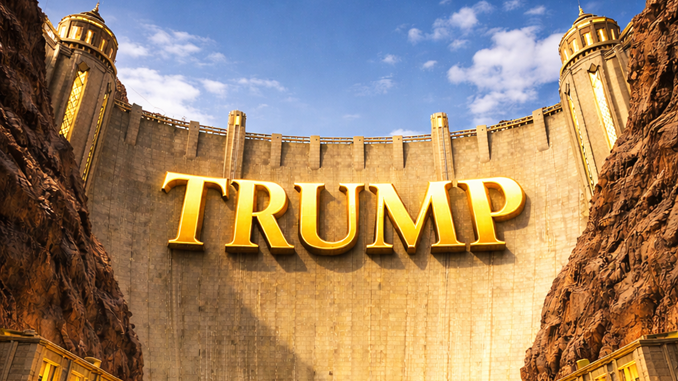
Building any one of these would make a difference. Building all of them would define an era. All President Trump would need to do is pick one, announce it, and build—instantly taking credit and moving us closer to saving the Colorado River for our nation’s economy and national security. Perhaps one could even be named after him: the Donald J. Trump Imperial Dam.
Such a project would not only grant the President unprecedented negotiating power in the West, but also provide thousands of blue-collar jobs that would help to reinvigorate America’s working class. Over 21,000 workers were employed during the construction of Hoover Dam, which created critical jobs at a time when many Americans felt uncertain about the economy.
America remembers its greatest presidents because of what they built—big, bold projects constructed at a scale worthy of a great nation. President Trump can do the same. If President Trump wants to build a lasting legacy, the path forward is clear: solve the Colorado River crisis by building big, bringing new water resources to the West, and increasing the supply for everyone.
Representative Gail Griffin chairs the Arizona House Natural Resources, Energy & Water Committee and has been a leading voice on water and resource policy in the Southwest. Congressman Andy Biggs represents Arizona in the U.S. House of Representatives and has long advocated for policies that strengthen the economy, protect American resources, and support the future of the West.
Arizona’s elected leaders reacted along a partisan divide to the U.S. attack to liberate Iran from the Islamic regime.
Arizona’s Republican congressional officials have signaled support for President Donald Trump’s decision to launch a joint military operation against Iran, and called for an end to the partial government shutdown to ensure full funding for this military venture.
Arizona’s Democratic officials oppose the attack. They are looking to compel a vote on the War Powers Resolution, though all conceded their opposition to the continued existence of the Iranian regime.
Early Saturday morning, the U.S. and Israel attacked over a dozen areas across Iran, at least, including the capital Tehran. The attacks resulted from Iran’s failures to meet nuclear negotiations. Iran retaliated with missile strikes without success.
Key fatalities include several senior Iranian officials. The fate of Iran’s longtime supreme leader, Ayatollah Ali Khamenei, remains disputed as of this report. A spokesman for Iran’s foreign ministry claimed Khamenei was alive. However, President Donald Trump announced on Saturday afternoon that Khamenei was dead.
“[Khamenei] was unable to avoid our Intelligence and Highly Sophisticated Tracking Systems and, working closely with Israel, there was not a thing he, or the other leaders that have been killed along with him, could do. This is the single greatest chance for the Iranian people to take back their Country,” said Trump.
Trump said the bombings would continue until peace was achieved in the Middle East.
Trump urged Iranians to conduct a regime change in an address shared to social media early Saturday morning. Trump said the U.S. attacked Iran to eliminate threats to the American regime.
“I say tonight that the hour of freedom is at hand,” said Trump. “When we are finished, take over your government, it will be yours to take. This will be probably your only chance for generations. For many years you have asked for America’s help but you never got it. No president was willing to do what I am willing to do tonight.”
To the Islamic Revolutionary Guard, armed forces, and police, Trump advised them to cease their resistance.
“Lay down your arms and you will be treated fairly with total immunity, or you will face certain death,” said Trump.
Rep. Abe Hamadeh (R-AZ08) called on Democrats in Congress to end the partial government shutdown in order to provide full funding to the Department of Homeland Security (DHS).
Amid the developing situation in the Middle East, it is critical that @DHSgov be fully funded and all services operational.
It's time for Mark Kelly, Ruben Gallego, and the rest of the Schumer Democrats to end their obstruction and join Congressional Republicans in keeping…
— Office of Congressman Abe Hamadeh (@RepAbeHamadeh) February 28, 2026
Rep. Juan Ciscomani (R-AZ06) said Iran chose this escalation, not the U.S.
“Today’s action by President Trump sends a clear message: the Iranian regime’s aggression and destabilizing threats will not go unanswered,” said Ciscomani. “For decades, the Iranian regime has funded terror, attacked our allies, and threatened American servicemembers.”
Today’s action by President Trump sends a clear message: the Iranian regime’s aggression and destabilizing threats will not go unanswered. For decades, the Iranian regime has funded terror, attacked our allies, and threatened American servicemembers. President Trump and his…
Rep. Yassamin Ansari (D-AZ03) expressed reluctance to recognize Trump’s authority to launch a war without congressional authorization. Ansari’s parents came to the U.S. as Iranian refugees of the Islamic regime.
“Consistent with my previous votes, public statements, and the consensus in my district, I believe no president — Republican or Democrat — has the authority to launch military strikes of this magnitude without Congressional approval,” said Ansari. “I want a free Iran and a future of democracy and dignity for the Iranian people. Those goals must be part of a coherent strategy that does not risk chaos or another endless war in the Middle East and require seriousness and leadership equal to the stakes.”
Rep. Greg Stanton (D-AZ04) said none would mourn the collapse of the Islamic Republic, but that Trump was wrong for launching such an attack.
“[T]he United States cannot be dragged into another open-ended foreign war. Americans know the cost of conflicts with no clear strategy, no defined objectives, and no end in sight, and they do not want to repeat those mistakes,” said Stanton.
My thoughts are with all U.S. service members and personnel in harm’s way, and I pray they return home safely.
The Iranian regime has murdered Americans, violently repressed its own people, and fueled instability across the region. No one will mourn its collapse.
Rep. Adelita Grijalva (D-AZ07) accused Trump of entering the U.S. into another “forever war,” characterizing this latest attack as both reckless and needless.
“Taking the United States into a major military conflict without debate or the consent of the people’s representatives is a clear violation of Congress’s constitutional war powers,” said Grijalva.
Trump’s attacks on Iran are completely reckless, blatantly unconstitutional, and needlessly put our troops and innocent civilians in harm’s way.
Taking the United States into a major military conflict without debate or the consent of the people’s representatives is a clear…
Sen. Ruben Gallego claimed there was another pathway for the U.S. supporting Iranian regime change without going to war.
“Young working-class kids should not pay the ultimate price for regime change and a war that hasn’t been explained or justified to the American people,” said Gallego. “Strikes are underway and Congress hasn’t voted. No President gets to drag working-class Americans into another war without authorization.”
Tim is right. Strikes are underway and Congress hasn’t voted. No President gets to drag working-class Americans into another war without authorization. Bring the Senate back. Take the vote. https://t.co/mwzaFwNwoF
Sen. Mark Kelly, like Grijalva, questioned Trump’s promise of keeping the U.S. out of war.
“The Iranian people deserve freedom. They deserve the right to choose their own leaders. So, what’s the plan for what comes next?” said Kelly. “I don’t think Donald Trump knows the answer, and that’s dangerous when American lives are on the line.”
After promising to keep America out of war and instead focus on lowering costs for families, Donald Trump has launched a large-scale military operation against Iran.
We’ve seen this playbook before. Weeks of inflated claims, selective facts, and talk of imminent threats that led…
While Democratic elected officials invited illegal aliens to the State of the Union (SOU) on Tuesday, Republicans invited Americans victimized by illegal aliens.
The Department of Homeland Security (DHS) notified the public on social media that certain elected representatives were planning to bring illegal aliens as their guests.
“Democrats are once again prioritizing illegal aliens above the safety of American citizens,” stated DHS.
Sen. John Hickenlooper invited Caroline Dias Goncalves, an illegal alien brought illegally into the country as a child now residing on an expired visa; Rep. Seth Moulton invited Marcelo Gomes da Silva, another illegal alien brought illegally into the country as a child and residing on an expired visa; and Sen. Chuck Schumer brought the mother of a detained illegal alien, Dylan Josue Lopez Contreras.
We are not the same.
While Republicans are bringing victims of crimes committed by illegal criminal aliens to the State of the Union, some Democrats in Congress are planning to bring ILLEGAL ALIENS.
Democrats are once again prioritizing illegal aliens above the safety of… https://t.co/ikRZ0Vy5ZX
Ahead of the SOU, the Republican Study Committee (RSC) held a press conference addressing the consequences of softened immigration policies.
Rep. Abe Hamadeh opened the press conference to discuss his American Border Story Memorial Act (H.R. 6643), to establish a memorial in D.C. for victims of illegal alien crime.
“It seems like we’re forgetting about the people who have been victimized by illegal alien crime, and instead focusing on what the leftist media wants to focus on the news of the day,” said Hamadeh.
Also present was the American Border Story, which advocates for angel families: those who lost loved ones to crimes committed by illegal aliens. Nicole Kiprilov, executive director, supported Hamadeh’s bill to establish the memorial.
“We will never stop fighting until there isn’t a single family who doesn’t have to endure this devastating loss, ever again,” said Kipperlove.
🚨 LIVE NOW: RSC Press Conference – The Real Cost of Democrat Policies https://t.co/MbxJAS9uG5
Among those angel moms who spoke were Alaska resident Sandy Snodgrass, who lost her son Robert Bruce Snodgrass to fentanyl in 2021; California resident Agnes Gibboney, who lost her son Ronald de Silva to a shooting from a known illegal alien gang member in 2002; and Missouri resident Boni Driskill, who lost her daughter Lacy Marie Ferguson to a drive-by shooting committed by illegal aliens in 2003.
On Monday, President Donald Trump designated Feb. 22 as “Angel Family Day.” In attendance as guests of honor were families of those slain by illegal aliens.
“If you’ve lived the nightmare that we have lived, you understand the importance of the job that he is doing in securing our nation and fighting for our families,” said Riley.
Among Trump’s guests to the SOTU was Dalilah Coleman, a first-grader injured in a car accident caused by an illegal alien driving with a CDL. Trump encouraged Congress to pass the “Delilah Law,” to prohibit states from issuing CDLs to illegal aliens.
During the SOTU, Trump also brought up the 2023 murder of Texas teenager Lizbeth Medina. Medina’s killer, Rafael Romero, was an illegal alien. Medina’s mother, Jacqueline, was also in attendance at the SOTU.
“We’re getting [illegal aliens] the hell out of here fast, we don’t want ‘em,” said Trump. “The first duty of the American government is to protect American citizens, not illegal aliens.”
Trump announced that “zero” illegal aliens were admitted to the country in the last three months.
AZ Free News is your #1 source for Arizona news and politics. You can send us news tips using this link.
The National Republican Congressional Committee (NRCC) released a new installment of its “Inside the Majority” video series spotlighting Juan Ciscomani (R-AZ06) on Wednesday. Ciscomani’s Southern Arizona district is rated a “Toss-Up” by the Cook Political Report ahead of the 2026 election.
The NRCC describes the series as highlighting Republican members viewed as critical to maintaining GOP control of the U.S. House of Representatives.
The episode featuring Ciscomani is available on YouTube and on X:
WATCH: Arizona Republican @JuanCiscomani's incredible story epitomizes the American Dream
Now as a dad serving his community in Congress, Juan's fighting to give every Arizona family the opportunity to "pursue their own version of the American Dream"
Arizona’s 6th Congressional District is considered one of the most competitive House races in the country. The Cook Political Report currently rates the district as a “Toss-Up,” reflecting its narrow partisan split.
Ciscomani first won the seat in 2022 by approximately 1.5 percentage points after the district flipped from Democratic to Republican control. He was reelected in 2024 by roughly 2.5 percentage points, increasing his margin and adding more than 5,000 votes to his prior total.
An incredible day as my family joins me for my swearing-in ceremony to begin my second term in Congress!
I’m deeply honored and humbled by your trust in me and I’m ready to keep fighting for AZ06 and protect the American Dream. Ready to get to work! 🌵🇺🇸 pic.twitter.com/rUX8jOqcNB
— Congressman Juan Ciscomani (@RepCiscomani) January 3, 2025
Ciscomani is currently the only declared Republican candidate in the race and was endorsed by President Donald Trump in an April 2025 post to Truth Social. The President wrote, “Congressman Juan Ciscomani is a Tremendous Champion for Arizona’s 6th Congressional District! As a Member of the POWERFUL Appropriations Committee, Juan is fighting hard to Secure the Border, Stop Migrant Crime, Strengthen our Military/Vets, Support our Great Law Enforcement, and Protect our always under siege Second Amendment. Juan Ciscomani has my Complete and Total Endorsement for Re-Election — HE WILL NOT LET YOU DOWN!”
In the video, Ciscomani discusses his immigration background and legislative priorities.
“My name is Juan Ciscomani and I was born in Mexico,” Ciscomani says in the segment. “I immigrated with my family when I was 11 years old, and then, after a long process, became a U.S. citizen along with my family back in 2006. Sixteen years after becoming a U.S. citizen, I became a member of the United States Congress.”
Ciscomani references his first bill to pass the House, which focused on expediting veterans’ disability claims and expanding workforce opportunities for transitioning service members.
He also highlights the Working Families Tax Cuts Act, which he says is intended to prevent scheduled tax increases and expand tax relief provisions.
“The Working Families Tax Cuts Act is having an immediate and enormous impact in the district,” Ciscomani says in the video. “Not only does it avoid the cliff of a lot of taxes going up by the thousands in my district, but it also introduces great ways to have people keep their hard earned money. These are all quick and immediate ways that people will be able to see the benefits of this act.”
According to NRCC materials, the legislation includes provisions related to the Child Tax Credit, the standard deduction, Social Security taxation, tipped wages, overtime pay, and savings accounts.
NRCC spokesman Ben Petersen said Ciscomani’s district is central to the party’s majority strategy.
“Juan Ciscomani embodies what it means to be an effective representative—he shows up, listens and delivers results on the issues that matter most to Arizona families,” Petersen said. “From securing the border to ensuring water reliability and supporting our veterans, Juan has proven he’s a fighter for Arizona.”
Speaking to his motivations for serving in Congress, Ciscomani observed, “When I look at my kids in the future that I want for them, which is for them to find their path and have a shot at the American dream. What motivates me is my family and all those families out there that I want them to have a real opportunity in this country to go pursue their own version of the American dream. That’s what motivates me, so that we can do what we do here. To have families out there at home can go do what they were called to do.”
When first elected to Congress in 2022, Ciscomani became the first naturalized U.S. citizen born in Mexico elected to represent Arizona in the U.S. House of Representatives. He serves on the House Appropriations Committee and has advocated for federal funding for infrastructure, border security, water projects, and veterans’ services within the district.
January’s jobs report smashed expectations and signals a turning point in the labor market where job creation catches up with broader economic conditions. The report shows 130,000 jobs created, the unemployment rate falling to 4.3%, and labor force participation rising.
Economic growth last quarter was above 4% and is projected to be 4% again this quarter. The Dow Jones recently reached 50,000, as I predicted last fall. And gas prices and inflation are low.
Now workers are starting to feel the benefit in terms of associated job creation and wage growth. The jobs report shows workers’ real wages continuing to significantly rise, a stark contrast to their declines during the Biden administration.
An added bonus: Parasitical federal government jobs continue to decline, falling 34,000 last month and more than 10% since Donald Trump took office. Government jobs too often padded previous employment reports when the relevant metric should be productive private-sector job creation.
Strong labor-market, economic, and financial-market growth doesn’t happen in a vacuum. It’s the result of good public policy that empowers Main Street over big government.
Exhibit A is last year’s Republican tax cuts. These tax cuts prevented the largest middle-class tax hike in history from occurring. They empowered small businesses by restoring and making permanent 100% immediate expensing and locking in a 20% deduction on earnings. These tax cuts are game changers for job creators, incentivizing them to expand, hire, and raise wages.
Despite delivering one of the most consequential tax cuts in modern American history, however, Republicans are somehow trailing Democrats on the issue of taxes, according to new Fox News polling. Even though every single Democrat voted against them.
This isn’t just backwards. It’s political malpractice fueled by a media ecosystem that has abandoned facts in favor of Democratic talking points. Voters have been told again and again — by headlines, by cable news panels, by progressive activists masquerading as journalists — that Republicans are the party of “tax breaks for billionaires.”
In reality, these are middle-class tax cuts that actually make the tax code more progressive.
A stronger economy, rising 401(k) balances, and higher living standards will help blunt the impact of this misinformation and convert some independents. But small businesses and conservatives have a responsibility to spread the word to right this polling wrong.
Every small business with a tax-savings story needs to speak up in their communities, with their employees, and on their social media, explaining how these tax cuts have helped them survive and thrive. That’s the least they can do in return for these tax savings.
Meanwhile, conservatives need to start singing from the same page on these uniting economic issues. A strong opportunity, affordability, and standard-of-living message, combined with a focus on deporting violent criminals and sanity on culture issues, is the winning approach Republicans need to boost their polling and hold onto Congress this fall.
The first step is connecting the dots between small-business tax cuts, job creation, and affordability.
Alfredo Ortiz is a contributor to The Daily Caller News Foundation, CEO of Job Creators Network, author of “The Real Race Revolutionaries,” and co-host of the Main Street Matters podcast.