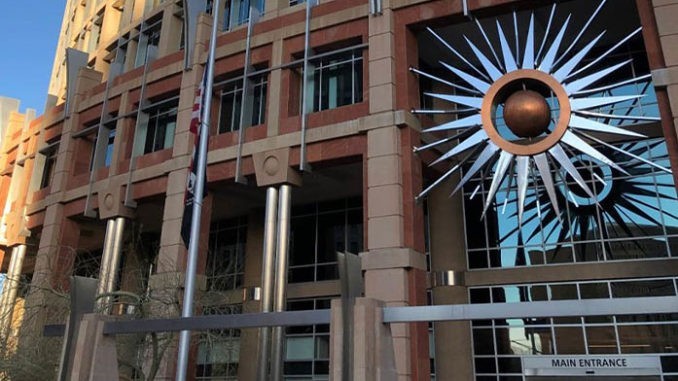
The city of Phoenix is operating a program to investigate federal agencies under President Donald Trump, according to public records.
The city publicly promotes its Community Transparency Initiative (CTI) as a complaint intake system and informational resource for the public on immigration matters.
However, records obtained by Judicial Watch reflect that the city of Phoenix tasks its employees and law enforcement with documenting, reporting, and investigating more than just federal immigration officials.
CTI, developed through the Office of Transparency and Accountability (OAT), was initially developed to take in reports and complaints concerning Immigration and Customs Enforcement (ICE) personnel.
The city’s employee training materials reveal that CTI has a much larger scope of oversight beyond ICE to include more federal agencies. City employees are trained to document and report all encounters involving federal law enforcement personnel. They are also trained to maintain records of time and resources devoted to work done concerning CTI.
Agencies under city of Phoenix employees’ purview were indicated to include the Federal Bureau of Investigation; United States Secret Service; Alcohol, Tobacco, Firearms, and Explosives; United States Postal Inspection Service; Border Patrol; Drug Enforcement Agency; United States Marshals Service; Federal Air Marshal Service; Federal Protective Service; Capitol Police; and the Transportation Security Administration.
Under CTI, the Phoenix Police Department uses its Special Investigations Division to review CTI complaints, investigate for criminal or civil rights violations, and pass along findings to Arizona Attorney General Kris Mayes. Both the police and fire departments have been involved in implementing CTI.
The initiative also connects residents with multiple progressive nonprofit organizations: the national and Arizona chapter of the ACLU, Immigrant Legal Resource Center, National Immigration Law Center, Informed Immigrant, Florence Project, International Rescue Committee, Phoenix Legal Action Network, and the Immigrant Advocacy Network.
CTI also refers residents to its Office of Refugee and Immigrant Support, established in March 2023 amid the height of the illegal immigration crisis under former President Joe Biden. The office provides refugees and asylum seekers with integration services, including access to healthcare, housing, childcare, education, and employment.
Around the same time in 2023, Gov. Katie Hobbs’ administration allocated $60 million to house, feed, and provide other resources to the homeless and illegal immigrants. $13 million went to the city of Phoenix.
In recent years, the city spent around $8 million of its $396 million in American Rescue Plan Act funds on refugee and immigrant services.
In early March of this year, the city authorized spending up to $500,000 through June 2028 for legal counsel through Coppersmith Brockelman PLC, a favorite law firm among top Democrats such as Gov. Katie Hobbs, though the CTI website and later reporting stated that the city spent $1 million to hire the firm. Sam Coppersmith, a managing partner to the firm, was formerly a Democratic congressman for the 1st Congressional District and a chairman of the Arizona Democratic Party.
Judicial Watch didn’t receive any records confirming that the city formally considered any other law firms to provide outside legal counsel for CTI.
Following this authorization for outside legal counsel, the city passed a policy banning ICE enforcement operations from city-owned property. Mayes later issued a defense of the city’s action.
AZ Free News is your #1 source for Arizona news and politics. You can send us news tips using this link.
A national survey of Democratic voters found that 59% would react positively to a hypothetical military takeover removing President Donald Trump from power, while 31% would react positively to news of his assassination, according to published results from the Center for Strategic Politics.
The survey, commissioned by Liberal Currents, examined Democratic voters’ presidential preferences, policy positions, and reactions to five hypothetical scenarios involving Trump leaving office. The publication released its analysis Sept. 21.
The military takeover scenario described military leaders removing Trump and assuming control of the United States under a stated rationale of safeguarding the Constitution. Respondents were asked how they would feel upon seeing such a news headline.
The accompanying graphic showed 43% responding very positively and 16% somewhat positively. Another 13% were neutral, while 10% responded somewhat negatively and 18% very negatively.
We polled five routes for Trump to leave office before the end of his term. A plurality of Dems support four of them, including a military coup and death by natural causes. The only one underwater, an assassination, is still supported by 29%. pic.twitter.com/C3qb2H0R8j
For the assassination scenario, the published crosstabs reported 23% very positive and 8% somewhat positive responses. Negative reactions totaled 43%, with 25% neutral. The hypothetical headline described Trump being assassinated while speaking at a rally.
The center’s social media caption cited 29%, while its published crosstabs reported 31%.
Positive reactions also totaled 56% for Trump dying in his sleep, 86% for impeachment and removal, and 84% for the scenario invoking the 25th Amendment.
The questions measured respondents’ anticipated emotional reactions to hypothetical headlines. They did not directly ask whether respondents would participate in or authorize violence.
The same survey also found majority support for a future Democratic administration pursuing criminal prosecutions of Trump administration officials, with one question extending to officials who served under former President Joe Biden.
Criminal prosecutions of Trump officials are generally favored by Dems, with clear majorities indicating support in all cases. Voters also support prosecution of officials from both the Trump and Biden admins over US support for Israel's genocide in Gaza. pic.twitter.com/OF6tRVasF8
Seventy-seven percent favored pursuing prosecutions of Trump administration members over actions taken by Immigration and Customs Enforcement and Customs and Border Protection. A separate question naming Stephen Miller drew support from 73%.
On military actions, 72% favored prosecuting administration members over lethal strikes on boats in South America, while 66% favored prosecutions over actions taken during the war in Iran.
Another 69% favored prosecuting Pete Hegseth in response to a question that described him as directing the military “to violate national and international law.” That characterization appeared in the question itself.
The question encompassing both administrations drew 57% support for pursuing prosecutions over actions related to what the questionnaire called “Israel’s genocide in Gaza.” Twenty-two percent opposed pursuing those prosecutions, and 22% were unsure.
Although the graphic’s headline described Democrats as wanting officials jailed, the questions asked whether the next Democratic administration should pursue criminal prosecution. They did not ask respondents to determine guilt or select a punishment.
In his analysis accompanying the poll, Liberal Currents writer Chance Phillips noted that assassination was the only one of the five scenarios in which negative reactions exceeded positive reactions.
“Thankfully, on net Democrats are not pro political violence,” Phillips wrote, referring to the assassination responses.
That conclusion did not account for the majority’s positive response to a military seizure of government. The scenario explicitly described military leaders removing Trump from power and assuming control of the United States, with 59% responding positively and 28% negatively.
The Center for Strategic Politics describes itself as part of the progressive community and says its work is funded through grassroots contributions.
The English-language survey included 683 Democratic voters nationwide, contacted Sept. 3 and Sept. 8–10 through SMS-to-web and online panels. Researchers weighted responses by age, ethnicity, and gender and reported a margin of error of plus or minus 3.75 percentage points.
A new study from the Joint Economic Committee (JEC) found that household inflation has been lower this presidential term than the last.
The JEC published a data brief on Thursday that reflected that the average household faced $2,881 less in additional costs from rising prices during the first 20 months of President Donald Trump’s second term — from January 2025 through August 2026 — than the first 20 months of former President Joe Biden’s term — from January 2021 through August 2022.
That cost difference amounts to an average reduction of nearly 41%.
“The comparison does not mean prices declined during President Trump’s second term,” stated the JEC. “Rather, the analysis finds that the cumulative increase in household costs was substantially smaller than during the comparable period under President Biden.”
During the first 20 months of Biden, the average American household experienced $7,081 in additional costs. Arizona was above this average. The average Arizona household experienced $8,427 in additional costs during that same time frame.
During the first 20 months of Trump, the average American household experienced $4,200 in additional costs. Arizona was below this average. The average Arizona household experienced $4,000 in additional costs during that same time frame, a reduction of $4,427 from the prior administration.
In Arizona, that cost difference between administrations amounts to an average reduction of nearly 52%.
In December 2025, the White House released an analysis reflecting that states experienced a difference in year-over-year inflation based on the political affiliations of their leadership. Conservative-leaning states experienced an overall average 2.5% inflation rate, whereas liberal-leaning states experienced an overall average 3% inflation rate.
Conservative states experienced an average 3.4% year-over-year inflation rate for housing, 2.5% for food and beverage, 3.5% for energy, and 0.7% for transportation, compared to liberal states experiences of 3.6% inflation rate for housing, 2.7% for food and beverage, 5.2% for energy, and 2.5% for transportation.
The consistent rates of heightened inflation rates under liberal governance remained true when distinguishing states based on the political affiliations of the governor and legislature, and state control.
States led by conservative governors experienced 2.3% year-over-year inflation rate overall, 3.2% inflation rate for housing, 2.4% inflation rate for food and beverage, 2.9% inflation rate for energy, and 0.6% inflation rate for transportation.
States led by liberal governors experienced a 3% inflation rate overall, 3.7% inflation rate for housing, 2.7% inflation rate for food and beverage, 5.3% inflation rate for energy, and 2.1% inflation rate for transportation.
States with conservative legislatures experienced a 2.4% inflation rate overall, 3.3% inflation rate for housing, 2.4% inflation rate for food and beverage, 2.9% inflation rate for energy, and 0.6% inflation rate for transportation.
States with liberal legislatures experienced a 3% inflation rate overall, 3.6% inflation rate for housing, 2.7% inflation rate for food and beverage, 5.1% inflation rate for energy, and 2.5% inflation rate for transportation.
States in which the legislature had neither a conservative or liberal majority experienced a 3.1% inflation rate overall, 4.5% inflation rate for housing, 2.7% inflation rate for food and beverage, 7.7% inflation rate for energy, and 0.9% inflation rate for transportation.
States defined as under conservative control experienced a 2.3% inflation rate overall, 3.3% inflation rate for housing, 2.4% inflation rate for food and beverage, 2.9% inflation rate for energy, and 0.6% inflation rate for transportation.
States defined as under liberal control experienced a 3% inflation rate overall, 3.6% inflation rate for housing, 2.7% inflation rate for food and beverage, 5.4% inflation rate for energy, and 2.7% inflation rate for transportation.
States defined as under neither conservative nor liberal control experienced a 2.8% inflation rate overall, 3.8% inflation rate for housing, 2.7% inflation rate for food and beverage, 4.7% inflation rate for energy, and 0.7% inflation rate for transportation.
Arizona was defined as having a conservative affiliation. The state experienced a year-over-year inflation rate of 2.6% overall, 1.8% for housing, 2.6% for food and beverage, 2.3% for energy, and 1.4% for transportation.
The city of Phoenix was also included as a major metro area for that analysis, but it was defined based on the state’s assigned affiliation of “conservative.” The city experienced a year-over-year inflation rate of 1.4% overall, -0.1% for housing, 1.1% for food and beverage, 6.7% for energy, and 0.8% for transportation.
AZ Free News is your #1 source for Arizona news and politics. You can send us news tips using this link.
President Donald Trump signed a temporary federal funding measure Wednesday that finances government operations through Dec. 11 while Congress works on fiscal year 2027 appropriations.
The House approved the Senate-amended version of H.R. 6500 on Sept. 1 by a vote of 370-48, with 14 members absent. The supporting votes included 193 Republicans, 176 Democrats, and one independent.
Arizona’s House delegation divided 5-4 on the measure.
Republican Reps. Juan Ciscomani (R-AZ-06), Abe Hamadeh (R-AZ-08), and Paul Gosar (R-AZ-09) joined Democratic Reps. Greg Stanton (D-AZ-04) and Adelita Grijalva (D-AZ-07) in voting for the bill. Republican Reps. David Schweikert (R-AZ-01), Eli Crane (R-AZ-02), and Andy Biggs (R-AZ-05) joined Democratic Rep. Yassamin Ansari (D-AZ-03) in opposing it.
The Senate passed the measure Aug. 8 by a vote of 90-6. One senator voted present and three did not vote. Arizona Democratic Sens. Mark Kelly and Ruben Gallego both supported the bill.
The enrolled legislation generally continues programs covered by the 12 annual appropriations acts at rates derived from fiscal year 2026 funding. Those appropriations encompass defense, homeland security, veterans’ services, transportation, housing, health, education, federal land management, and other government operations.
The law directs agencies to take limited funding actions during the stopgap period and generally prevents projects that received no money or authority during fiscal year 2026 from being initiated. It also permits agencies to fund civilian compensation at rates needed to avoid furloughs after reducing or deferring eligible administrative expenses.
For Arizona, the measure maintains funding for federal personnel and operations along the international border, at military installations, in national forests and parks, and throughout the state’s federal health care and veterans’ systems.
Ciscomani said a shutdown would have disrupted military pay, required Customs and Border Protection personnel and other federal law enforcement officers to continue working without pay, and affected services for nearly 80,000 veterans in his southern Arizona district.
Today, I voted for a bipartisan, temporary Continuing Resolution (CR) to prevent another government shutdown. A government shutdown is not a political game; it has REAL consequences. It disrupts pay for our troops, leaves CBP agents and law enforcement working without pay, and…
“A government shutdown is not a political game; it has REAL consequences,” Ciscomani said. “It disrupts pay for our troops, leaves CBP agents and law enforcement working without pay, and disrupts services for the nearly 80,000 veterans I have the privilege of representing.”
The stopgap also keeps some new fiscal year 2027 spending from beginning until Congress enacts regular appropriations. Ciscomani said operating under a continuing resolution could postpone $42.7 million in proposed projects for Arizona’s Sixth Congressional District that had cleared initial appropriations hurdles.
He concluded, “I have NEVER supported a government shutdown—partial or full. Arizona families should not have to pay the price for Washington’s dysfunction. The House did the right thing today by coming together to keep the government open, keep essential services running, and continue delivering for Arizona.”
One provision with a direct Arizona connection authorizes the Interior Department to fund its assumption of the remaining responsibilities of the Office of Navajo and Hopi Indian Relocation.
The relocation office was created to administer benefits arising from the federal division of disputed Navajo and Hopi lands in northeastern Arizona. Its remaining work includes administrative appeals, fiduciary responsibilities, land management, and livestock obligations. Congress directed Interior Department to begin handling those outstanding responsibilities as part of the office’s closure, according to a Congressional Research Service report updated in February.
The law also provides additional funding authority for the Indian Health Service (IHS) at operating rates of $75.8 million for health services and $8.3 million for facilities. The money is intended to staff and operate facilities opened, expanded or renovated during fiscal years 2022, 2026 and 2027. The legislation states national account rates and leaves facility-level allocations to the agency.
The IHS maintains Phoenix, Navajo, and Tucson administrative areas with hospitals, clinics, and health centers located throughout Arizona. The Phoenix Area system provides health and community services to approximately 180,000 Native Americans in Arizona, Nevada, and Utah through service units and tribally operated facilities. The Phoenix Indian Medical Center alone provides direct services to more than 171,000 patients.
Wildfire and disaster operations also received special treatment in the stopgap.
The Interior Department and U.S. Forest Service may spend at rates needed for wildfire suppression during the approximately 10-week funding period. Arizona fire officials entered 2026 anticipating increased fire activity because of persistent dryness, fine fuels, drought-stressed vegetation, and tree mortality.
The law gives the Federal Emergency Management Agency (FEMA) similar flexibility to fund disaster response and recovery. It also extends the National Flood Insurance Program through Dec. 11.
Transportation programs that were scheduled to expire Sept. 30 will continue through Dec. 11 under a separate division of the legislation. The extension provides a proportional share of fiscal year 2026 highway and mass transit funding and extends the federal government’s authority to spend from the Highway Trust Fund.
Federal funding accounts for most of the money used in Arizona’s highway construction program. ADOT’s 2026-2030 program includes $2.77 billion for pavement and bridge preservation, $742.9 million for highway expansion, and $603.6 million for modernization.
The law also authorizes the Transportation Department to spend at the rate needed to maintain Essential Air Service. The program subsidizes commercial flights connecting Page and Show Low with Phoenix and Prescott with Denver and Los Angeles.
The Transportation Department’s May 2026 program report listed annual subsidies of approximately $4.4 million for Page, $5.9 million for Show Low, and $6.3 million for Prescott, totaling about $16.6 million.
Federal nutrition and housing programs serving Arizona residents will also continue.
The law maintains mandatory payments and activities under the Food and Nutrition Act, which covers the Supplemental Nutrition Assistance Program (SNAP). Arizona reported that 451,762 people received SNAP benefits in May 2026.
The measure allows the Department of Agriculture to spend at rates needed to maintain participation in the Special Supplemental Nutrition Program for Women, Infants and Children (WIC) and the existing caseload for the Commodity Supplemental Food Program (CSFP). Arizona administers the latter program as the Commodity Senior Food Program, providing monthly USDA food packages to qualifying residents who are at least 60 years old. The state projected an average monthly caseload of 29,931 people during fiscal year 2026 in its budget materials.
The Department of Housing and Urban Development may use prior-year balances to prevent families from losing tenant-based rental assistance because of insufficient funding during the 2026 calendar-year cycle. The City of Phoenix’s Housing Choice Voucher program alone assists more than 7,000 households.
H.R. 6500 also extends a series of veterans’ programs through Dec. 11. Those provisions cover rural mental-health services, suicide-prevention grants, assistance for family caregivers, ambulance reimbursement for qualifying rural veterans, housing support for homeless veterans, transportation to VA facilities, and adaptive sports programs for disabled veterans and service members.
The Department of Veterans Affairs estimated Arizona’s veteran population at 467,010 in fiscal year 2025. Nearly 160,000 Arizona veterans received disability compensation totaling an estimated $4.24 billion annually, while more than 53,000 participated in VA education programs.
The law also permits the Small Business Administration to adjust spending to meet demand for 7(a), 504 and Small Business Investment Company financing. The 7(a) program is the agency’s primary lending program and guarantees qualifying loans for real estate, equipment, working capital, business acquisitions, and other expenses.
H.R. 6500 keeps those operations and programs funded until Congress enacts the applicable fiscal year 2027 appropriations bill or the stopgap expires on Dec. 11.
The Arizona Chamber of Commerce is advising residents opposed to data centers to go offline to prove their commitment.
The chamber issued a press release on Tuesday advising that those who wish to see a data center moratorium should “take that position to its logical conclusion” by entering its newly launched Arizona Offline Pledge.
The pledge requires participants to give up all technologies and services which rely on data centers, including social media, artificial intelligence, streaming services, online banking and digital payments, cloud storage, GPS navigation, video conferencing, and telehealth.
The chamber said data center expansion is necessary for modern life.
“Arizona can address legitimate concerns about data center growth without hitting pause on the infrastructure modern life depends on,” said the chamber.
For anyone ready to put a moratorium on new data centers, here’s your chance to really commit.
Take the Arizona Offline Pledge and give up the everyday benefits digital infrastructure makes possible: smartphones and social media, streaming and GPS, telehealth and online… pic.twitter.com/idU6D6PVUb
Courtney Coolidge, chamber executive vice president, said that halting in the face of opposition wasn’t an option.
“Concerns from communities shouldn’t be dismissed, and we aren’t suggesting a data center belongs on every corner,” said Coolidge. “But Arizona has never responded to difficult growth challenges by simply stopping. We solve problems.”
Among those leading on the call for a moratorium are Attorney General Kris Mayes, who called it “the only sane thing to do.” Mayes said Arizona was guilty of “excessive data center development” and was vulnerable to some of the most negative impacts from it.
“The Colorado River is in serious distress, and Wall Street firms are seeking to ship La Paz County’s groundwater to Phoenix to fuel the Valley’s growth — against the wishes of the county’s residents and leaders,” said Mayes. “We owe it to our communities, homeowners, and future generations of Arizonans to better manage our water and power needs before any new data center approvals are issued.”
The only sane thing to do is to pause the approval of new data centers.
Data centers are power- and water-intensive, and Arizona is challenged on both fronts right now.
Arizona may be one of the most exposed states in the country to the negative impacts of excessive data…
Earlier this summer, Gov. Katie Hobbs approved the budget passed by the Republican-led state legislature which included a three-year freeze on tax breaks for new data centers, but which did allow the construction of new data centers to continue.
Hobbs has also advocated for a water usage fee for new data centers — one cent for every gallon used, on par with what the average Arizona family pays — and the money collected would go into the Colorado River Protection Fund.
When we put people over data centers, the change isn’t just a line item—it’s felt at every kitchen table. I signed a 3-year pause on new data center tax breaks and invested that money into making childcare affordable and protecting healthcare and food assistance for Arizonans. pic.twitter.com/IRHTr3ehWg
— Governor Katie Hobbs (@GovernorHobbs) July 7, 2026
President Donald Trump issued a statement on Monday criticizing those opposed to data centers as desirous of “end[ing] up being backwards and poor,” and that these developments would result in “far lower” taxes and a greater number of jobs.
“If we kill the Golden Goose, you will only have yourselves to blame,” said Trump. “China could not be happier with this anti Data Center movement. Actually, they can’t believe it is happening!”