by Terri Jo Neff | Apr 25, 2021 | News
By Terri Jo Neff |
Two judges, one from Maricopa County and the other an Associate Justice of the Arizona Supreme Court, agreed Friday that the Senate Audit of Maricopa County’s 2020 General Election can move ahead for now. Both judges also ordered the parties to submit several court filings in the coming days.
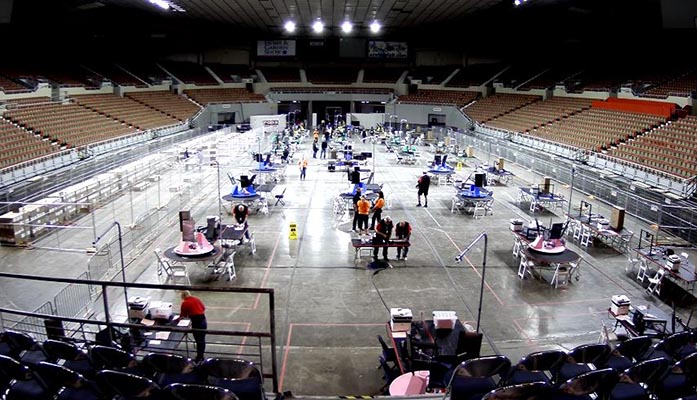
Several hundred of the nearly 2.1 million ballots cast by Maricopa County voters were audited Friday and Saturday. The volunteer counters are looking only at the race for U.S. President and the contest between Mark Kelly and then-Sen. Martha McSally.
For a short time Friday it looked like no audit activities would take place after Judge Christopher Coury of the Maricopa Superior Court agreed to issue a stay requested by the Arizona Democratic Party and Steve Gallardo, the only Democrat on Maricopa County’s five-member Board of Supervisors.
But the stay order was contingent on the plaintiffs posting a $1 million bond in the event they lost their case. AZ Dems chair Raquel Teran announced Friday afternoon that no bond would be posted, meaning the audit can continue unimpeded, for now.
Two other orders issued by Coury are currently in force: that the Senate and its contracted audit team comply with state law and that no blue or black pens can be on the floor of the Veterans Memorial Coliseum where the audit is being conducted.
Coury will be a key player in the audit this coming week, as he ordered the parties back to court Monday morning for an evidentiary hearing on the merits of the lawsuit. The judge set several deadlines for the attorneys, including an order for the audit’s written policies and procedures to be filed by the Senate and general contractor Cyber Ninjas on Sunday.
Teran and Gallardo -who says he joined the lawsuit in his personal capacity as a Maricopa County voter- must decide how far they want to push their allegations about the audit operations, given the fact Senate President Karen Fann and the other defendants have petitioned to the Arizona Supreme Court, which has also ordered a series of legal briefings in the case.
Fann and Sen. Warren Petersen of the Senate Judiciary Committee are named as defendants along with former Arizona Secretary of State Ken Bennett who is serving as the Senate’s audit liaison. The other defendant is Cyber Ninjas, the company Fann contracted with to conduct the audit with help from three subcontractor.
The Senate defendants are represented by Kory Langhofer and Thomas Bastille, who have been involved in several of the election-related lawsuits filed since Nov. 3. Florida-based Cyber Ninjas and its owner Doug Logan have retained Phoenix attorney Alex Kolodin as their Arizona legal counsel.
Another key player is Associate Justice Clink Bolick of the Arizona Supreme Court, who affirmed Coury’s earlier orders during an emergency conference Friday afternoon. Bolick set separate deadlines for the Senate’s challenge to the legality of the lawsuit, with all those filings needing to be in by the end of business April 29.
Participating in the emergency conference with the justice was attorneys for Arizona Secretary of State Katie Hobbs, who has pushed back on Fann’s previous assurances that the Senate’s audit would be “independent” and “transparent.”
Hobbs has pointed to Rep. Mark Finchem’s admitted role with the audit in light of his repeated insistence that President Joe Biden really did not win the popular vote in Arizona, and thus was not entitled to the state’s electoral votes. She also wrote to Attorney General Mark Brnovich with concerns that auditors may not be complying with Arizona’s Elections Procedures Manual (EPM).
For his part, Brnovich was the first prominent Republican to insist after the general election that there was no fraud involved in Biden’s victory. He replied to Hobbs on Friday, suggesting she notify his office when she has “credible facts and not conjecture or politics” for him to investigate.
Another player who could impact next week’s audit operations is First Amendment attorney David Bodney, who warned Fann and Bennett that the audit team’s current refusal to allow journalists to report on audit activities from the main floor of the Veterans Memorial Coliseum.
Bennett, as the audit liaison, is requiring media representatives to sign up for a six-hour shift as an observer. However, observers are prohibited from having cellphones or even pen and paper on the floor.
“Requiring journalists to become active participants in the events on which they seek to report is as unprecedented as it is untenable in a representative democracy,” Bodney wrote. “It also violates the First Amendment, which compels that members of the press be allowed access to report on these public proceedings. “
Bodney also warned that legal action could be forthcoming.
“By making the proceedings accessible to some journalists, you cannot arbitrarily deny access to others or require that others satisfy peculiar conditions not imposed upon those whom you favor,” he wrote. “In the event the audit proceeds while barring the press, we are committed to pursuing all legal remedies we deem appropriate to secure our clients’ rights under the First Amendment,” Bodney said
by AZ Free Enterprise Club | Apr 23, 2021 | Opinion
By the Free Enterprise Club |
Vaccines should always be voluntary and never be forced. But COVID-19 came in like a wrecking ball last year, and perhaps its most significant contribution to the world has been an overwhelming growth in government overreach.
From the abuse of emergency orders to the senseless “mask mandates,” some government officials have leapt at the chance to dangle the carrot of “normalcy” in the faces of their citizens in order to take away more of their freedoms. Unfortunately, many have taken the bait. And now, we find ourselves at a crossroads.
The latest promise to return to normal comes in the form of “vaccine passports.” This ridiculous concept would serve as “proof” that a person has been vaccinated so he or she can have access to all the freedoms they should already be able to enjoy as an American citizen. As you would expect, Big Tech is first in line to team up with the government on such an initiative. And New York has already implemented the “Excelsior Pass” so that its citizens can “be a part of [the state’s] safe reopening.” (Given Governor Cuomo’s handling of the pandemic, what could go wrong?)
But nothing about this is normal.
It’s not normal for companies to collect the private health data of individuals. And it’s certainly not normal to force American citizens to submit to certain medical procedures as the price of doing business.
Thankfully, some of our lawmakers here in Arizona have not fallen asleep on this issue. Earlier this month, Congressman Andy Biggs introduced his No Vaccines Passports Act. This piece of legislation would prevent federal agencies from issuing any standardized documentation that could be used to certify a U.S. citizen’s COVID-19 status to a third party, such as a restaurant or an airline.
And just a few days ago, Arizona became the sixth state to ban COVID-19 passports when Governor Ducey signed Executive Order 2021-09. This prevents state agencies, counties, cities, and towns from issuing measures that require an individual to provide documentation of their COVID-19 vaccination status in to order to enter a business, building, or area to receive a government service, permit, or license. It also prevents businesses that contract with the state to provide services to the public from requiring documentation.
While this is certainly a step in the right direction, Governor Ducey’s executive order still allows for businesses, schools, and health providers to ask about an individual’s vaccine status.
That’s why lawmakers should consider additional action on this issue. One option being considered is HB2190. This bill, sponsored by Rep. Bret Roberts (R-LD11) and Sen. Kelly Townsend (R-LD16), would prohibit a company that conducts business in Arizona from refusing to provide everyday services, transportation, or admission because a person does not divulge whether they have received a particular vaccine. It would also prohibit a state, county, or local government entity from offering anyone a special privilege or incentive to receive a vaccine.
Currently, HB2190 is awaiting action in the senate, and negotiations are underway on potential amendments to the bill. Regardless of what those amendments are, Arizona lawmakers need to work toward stopping vaccine passports. They are a serious threat to our civil liberties. And while we all want to return to normal, we must remember that “normal” shouldn’t come with a price tag.
by B. Hamilton | Apr 21, 2021 | News, Politics
By B. Hamilton |
On Tuesday, the Democrats in the Arizona House of Representatives attempted to prevent a vote on an election integrity bill, and then when that failed, Rep. Athena Salman called for a boycott of the state if the bill passed.
Earlier in the day, Democrat lawmakers refused to show up to work in order to prevent a quorum as part of their effort to block a vote on SB1485.
Later, in a vote along party lines, Sen. Michelle Ugenti-Rita’s bill passed and is now headed back to the Senate.
SB1485 would remove people from the Early Voting List (EV), who don’t return their mail ballot for two consecutive election cycles from the permanent list, which allows voters to automatically receive a ballot before each election.
Not everyone shared Salman’s view. Sen. TJ Shope, a moderate Republican, tweeted his support for the bill:
Sen. Salman and the Arizona House Democrats continue to make discredited statements about SB1485, including allegations that the bill would “purge” the early voting list and “infringe” on voting rights.
The reason the bill heads back to the Senate is that it was amended to win the support of more Republican lawmakers in the House.
The amendment softened the bill, according to experts.
Before the amendments, a person could be removed from EVL after not using an early ballot in two consecutive primaries and general elections. Under the amendments, a person would have to miss all elections within a two-year period including city or other minor elections, to be dropped from the EVL.
In all cases, voters remain registered to vote. They are simply dropped from the list of mail-in ballot recipients.
by B. Hamilton | Apr 21, 2021 | News
By B. Hamilton |
On Tuesday, conservatives lamented Governor Doug Ducey’s decision to veto legislation that would have strengthen parental input in the Sex Education curriculum offered to their children. They also questioned why the governor would then turn around and issue an Executive Order on the subject.
Cathi Herrod, president of the Center for Arizona Policy, said the governor’s veto sent the “clear and deeply disappointing message” to parents that the “government knows better.” She also noted that the governor’s Executive Order “fails to implement the prohibition of sex education prior to fifth grade.”
The bill, SB 1456, prohibits schools from providing Sex Ed to any students below the fifth grade – including education on AIDS and HIV. It also required schools to make all Sex Ed curriculum available for parental review two weeks in advance, at minimum.
RELATED ARTICLE: Arizona Legislature Passes Bill Requiring Parental Permission for All Sex Ed Curriculum
The bill passed along party lines in both the House and Senate.
SB 1456, sponsored by Senator Nancy Barto, did not prohibit or dictate any curriculum in grades 5-12; it “merely would have ensured parents opt their children into instruction on human sexuality,” according to Herrod.
Barto said that the governor’s veto undermined parent’s rights. She said that the “commonsense bill” aimed to “put sensitive decisions about Sex Ed and parents’ hands.”
“An Executive Order is no substitute for parental rights grounded in law. The bill created workable transparency solutions for parents and stopped Sex Ed for younger school age children – something an overwhelming a mature overwhelming majority of Arizona support,” continued Barto. “The veto undermines every single elected Republican Legislature who voted to defend parents and address the frustrations they face with the current status quo that provides opt out for some sexual materials and opt in for others. Arizona is one of the best states to raise a family, but this decision is inconsistent with that reputation. While I am extremely disappointed, my commitment to parents’ fundamental rights remains unchanged. I will continue to work with my colleagues to protect Arizona parents.”
Herrod challenged statements made by Governor Ducey in his veto letter. Specifically, the governor claimed that he was concerned that child abuse prevention education would be prohibited. Herrod countered that “abuse prevention is not sex education, and would not have been blocked by any provision in SB 1456.
“Unfortunately, to my knowledge, this concern was not brought to the attention of lawmakers by the executive branch prior to the veto.”
“Make no mistake, the need to advocate for the parent’s ability to guide the education of their children, especially with regard to matters of human sexuality,” said Herrod in her press release. “will continue to be a key priority for us, and the many Arizonans who supported SB 1456.”
The governor’s Executive Order requires the State Board of Education to adopt the following requirements by June 30, 2021:
- All meetings held for the purposes of reviewing and selecting the sex education course of study must be publicly noticed at least two weeks before occurring and be open to the public.
- Any proposed sex education course of study must be available and accessible for review and public comment for at least sixty days before the governing board or governing body decides whether to approve that course of study.
- At least two public hearings within the sixty-day period before the governing board or governing body approves any course of study must be conducted.
- Once a course of study has been approved, a school district or charter school shall make the sex education curricula available for parental review, both online and in-person at least two weeks before any instruction is offered.
- Any existing sex education course of study must be made available and accessible for review both online and in person.
by Terri Jo Neff | Apr 16, 2021 | News
By Terri Jo Neff |
On Feb. 12, 2019, Pat Call had been serving on the Cochise County Board for more than a decade representing for the Sierra Vista area, which includes the Army’s Fort Huachuca. It was also the day Call and his two fellow supervisors took part in a public and then a private meeting which ended with his appointment as justice of the peace of the Sierra Vista Justice Court.
The new job paid twice Call’s supervisor salary despite the fact he was not an attorney and had no judicial experience. But there was no advance public notice that Call was even interested in the position, and during the meeting Call suggested the board not utilize a nomination committee to review any perspective candidates, all of whom were lawyers with experience in justice court operations.
The Arizona Supreme Court announced Wednesday that it will hear a local resident’s challenge to Call’s appointment based on alleged violations of Arizona’s Open Meeting Law and Conflict of Interest Statute. The case is being watched by public agencies and government attorneys across the state.
“When it comes to holding public officials accountable for backdoor deals, this is the most important case in Arizona history,” appellate attorney David Abney said after the justices accepted the case for review.
Abney is one of three attorneys representing David Welch, the Sierra Vista resident who challenged the appointment. He told AZ Free News it does not matter that Call’s term on the bench ended in December 2020.
“There are still penalties and sanctions that can be assessed against those who violate the open-meeting and conflict-of-interest laws,” Abney said. “So Justice of the Peace Call’s departure does not insulate him or his collaborators from liability.”
The county defendants contend they did nothing improper in filling the court vacancy, and point to the fact the Cochise County Attorney’s Office provided legal advice throughout the process.
“The Arizona Legislature has made clear that, for a plaintiff making claim to a private right of action under Arizona’s conflict of interest or open meeting laws, he or she must be ‘affected by’ the alleged violation,” according to the county’s petition for review to the supreme court. The county contends Welch has no standing to challenge the board’s action.
Welch lives within the boundaries of the Sierra Vista Justice Court and had a misdemeanor case pending at the court at the time of Call’s appointment. His case would have been heard by Call, but the county attorney’s office had the case dismissed the day Call took office.
The county later invoked the ratification option in Arizona’s Open Meeting Law to reaffirm Call’s appointment as justice of the peace during a special meeting in March 2019. Welch, however, takes the position shared by Arizona Attorney General Mark Brnovich that the supervisors may still be open to personal liability if it is shown they engaged in misconduct.
But it is not only the open meeting law issues that Welch has challenged.
Public records show Call engaged in discussions about how to fill the court vacancy he was awarded a few hours later. He also took part in an executive session with the other supervisors, a deputy county attorney, and the county administrator just before being appointed.
Arizona’s conflict of interest statute requires a public officer who has a substantial interest in any decision of a public agency to make known such interest. Then the public officer “shall refrain from participation in any manner…in such decision.”
There is no ratification option in that statute to simply “do-over” or reaffirm a decision.
A judge from outside Cochise County initially dismissed Welch’s complaints on the basis of a lack of standing to bring the challenges. That ruling was overturned in a unanimous Arizona Court of Appeals decision in October 2020, which sent the case back to the lower court for a new hearing on Welch’s arguments.
For now the case is on hold while the supreme court reviews the appellate decision. Attorney Chris Russell has been on Welch’s case from the beginning and understands some residents are frustrated the case has been going on more than two years with no immediate end in sight. But he is looking forward to the attention the Arizona Supreme Court’s review will generate.
“Corruption thrives in the darkness,” Russell said. “Without open and transparent government free from conflicts-of-interest we are no better than a cabal run by the rich and powerful. History has proven that such a circumstance is always detrimental to the people.”
The supreme court has given the parties until early May to file any updated legal briefings before oral arguments are conducted later this year.