by Terri Jo Neff | May 25, 2021 | News
By Terri Jo Neff |
Arizona’s forecasted budget surplus of $1.5 to $2 billion means a lot of potential massaging of the $12.8 billion budget spending plan released Monday after months in negotiations with Gov. Doug Ducey.
The surplus also means legislators will be more likely to flex their muscle in hopes of ensuring their constituents and pet projects are covered in the budget, with encouragement from Sen. TJ Shope (R-LD8), who said last week there is “plenty of money if we need to buy people off” to secure votes.
On Monday, Sen. Michelle Ugenti-Rita (R-LD23) tweeted an apparently rhetorical question about the budget plan.
“Instead of having a clean tax cut bill members could vote on, Senate leadership added to the tax bill an increase in unemployment insurance benefits, a 10 year extension of the Angel tax credit (which doesn’t expire for 3 yrs) and a $180M tax credit for low income housing. Why?” she tweeted.
Ugenti-Rita also expressed frustration Monday that some items have been included in various budget bills despite the fact the issue was previously voted down by the legislature. One such example is a storage fee increase for impounded vehicles.
“Funny thing is, a bill with this provision in it died in the Senate the other week,” she tweeted. “Wonder how many more dead bills have been resurrected in the budget..?” She also called out a “level of excessive spending” she cannot support as a fiscal conservative.
Members of the Senate Appropriations Committee will convene at 9 a.m. Tuesday, while their House counterparts are set to meet at 8 a.m. In a strategic move, Senate President Karen Fann appointed Senate Majority Leader Rick Gray (R-LD21) to Appropriations in an effort to blunt any committee opposition from Ugenti-Rita.
As to Shope, he made it known weeks ago his support for the budget would be contingent on funds to widen a dangerous section of Interstate 10 between Casa Grande and Chandler. The result was $50 million earmarked in the budget for Shope’s project.
But while Shope received what he wanted, it is unclear whether Republicans such as Sen. Paul Boyer and Rep. David Cook will have their demands sufficiently met to ensure their budget votes. Boyer (R-LD20) outlined his budget priorities last week, including concerns about Arizona’s debt, Rainy Day Fund, and insufficient funding for the state’s universities.
Cook (R-LD8) is unhappy Ducey and the legislative budget team included the increase in unemployment benefits, although whether the increase ever kicks in next year is contingent on several economic thresholds. While on the House side, Rep. Jake Hoffman (R-LD12) is leading the charge to increase the state’s spending on elections by cutting millions from other projects, including a boost in salary for state employees.
Sen. J.D. Mesnard, a Republican for LD17, has been involved in the budget process, and cautioned his fellow legislators that “a million dollars here or there” of new expenditures “adds up.” Which can put other budget features at risk, including a much-touted plan to transition Arizona to a flat-tax method for income tax.
Republicans only have a two vote majority in each chamber, giving each of the 16 Senators and 31 Representatives within the Republican caucus some leverage in budget negotiations. Normally there may be enough Democrat-friendly priorities built into the budget bills to persuade one or two to cross the aisle, but the size of proposed tax cuts -currently at $3 billion over the next three years- could slam that door shut.
by Terri Jo Neff | May 24, 2021 | News
By Terri Jo Neff |
Questions remain in the aftermath of the U.S. Census Bureau’s release last month of the 2020 Decennial Census which put Arizona’s official population at nearly 7.16 million.
That figure, up more than 746,000 from a decade earlier, represented the eighth largest increase by number and the ninth fast growth rate in the country. But census officials determined it was not enough to earn Arizona its 10th seat in the U.S. House of Representatives.
There was much finger pointing at the time of the announcement that Arizona’s population fell 250,000 short of estimates even though Gov. Doug Ducey’s AZ Census 2020 Taskforce reported that census enumerators and volunteers attempted to reach 99.9 percent of all households in the state despite COVID-19 lockdowns and social distancing challenges.
But according to a theory by a former official who served in the Trump Administration’s Commerce Department, the reason some states ended up with unexpected results might have more to do with how the Census Bureau calculates the number of people who live in known households that did not fill out a census questionnaire.
Adam Korzeniewski is a Marine Corps combat veteran who specializes in fiscal and economic policy as well as national security topics. In an article published earlier this month in The American Mind, he cites the Census Bureau’s reliance on estimates as cause for concern for some states, including Arizona.
Federal law does not allow the Secretary of Commerce to rely on statistical sampling to fill in the blanks for households that do not respond to the census. But other methods are allowed, and Korzeniewski believes some of those need to be questioned.
According to the U.S. Census Bureau, demographic characteristics about the people who live in every verified residence is necessary to obtain “a complete and accurate census. Unfortunately, not all households respond to the census questionnaire. When that happens, a census taker first turns to administrative records from the IRS and other government agencies to fill in the blanks about who likely lives in that household.
If a reliable administrative record is not available and the local census taker is unable to contact the household after three visits, information can be obtained from a neighbor, landlord or building manager. This is referred to as a proxy response.
The last method the Census Bureau uses is imputation, a statistical technique officials say makes the overall dataset “more accurate than leaving the gaps blank” by using what data is known to filling in what data is not known.
“We recognize that using information from these three techniques — imputation, using administrative records, and proxies — may not always match the reality of an address’s occupancy status or the characteristics of the people who live there,” the Census Bureau says. “However, these techniques are widely used in statistics because they have been proven to be more accurate than leaving the information blank.
Public records show about 1,172,000 “people” were imputed nationwide in 2000 and 1,163,000 in 2010. The 2020 figure has not been released yet although it is expected to be higher due to COVID-19 related difficulties.
But Korzeniewski, who also served in Trump’s Treasury Department, wrote in his article that the Census Bureau used another form of imputation in 2020 which he contends is based on statistical sampling. This occurred when census officials decided to utilize a “Group Quarters Imputation” due to problems gaining access to “households” located in places like colleges and residential healthcare facilities.
The greater reliance on such imputation was not part of the 2020 Decennial testing phases nor did state census officials have any input on the decision, Korzeniewski wrote. That could be the basis for Arizona officials to acquire state-by-state imputations records from the Census Bureau with details of the types of imputation used.
“To my knowledge, the Census does not normally produce such documentation and it takes years for the Census to publish studies on itself,” Korzeniewski wrote, adding that states would also need to ask for records pertaining to the decision-making processes around the data calculation processes in order to determine whether it has grounds to challenge the Census outcomes.
“Successfully challenging the Census results would affect appropriation and could affect apportionment,” he wrote. “The Census typically takes years to officially release information on the Decennial, making it impossible for states to seek redress if action is not taken quickly.”
by Terri Jo Neff | May 22, 2021 | News
By Terri Jo Neff |
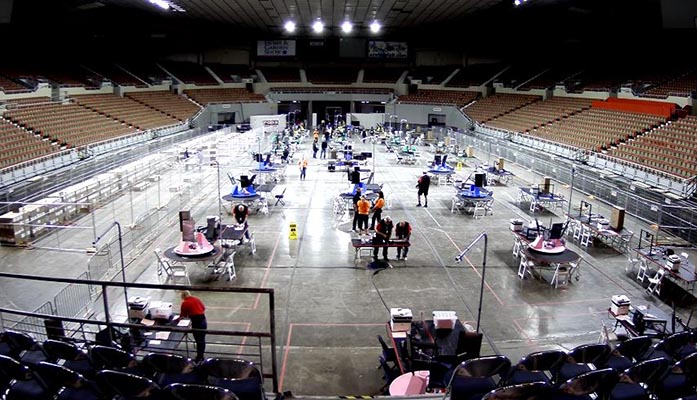
Four members of the U.S. Congress -including two from Arizona- sent a letter this week to the U.S. Department of Justice (DOJ) criticizing one of its deputies for “unnecessarily” weighing in on the Arizona State Senate’s ongoing audit of Maricopa County’s election process.
Representatives Andy Biggs and Paul Gosar, both Republicans from Arizona, and Reps. Matt Gaetz (R-Florida) and Marjorie Taylor Greene (R-Georgia) call a May 5 letter from DOJ attorney Pamela Karlan to Senate President Karen Fann “an attempt at intimidation, with the goal of convoluting this important audit.”
Fann is one of two state senators who signed a subpoena in January which led to Maricopa County officials being required to turn over election department records, hundreds of voting machines, and the nearly 2.1 million ballots cast by Maricopa County voters in the 2020 General Election. Karlan’s letter suggested either the Senate or the auditors may be in noncompliance with federal law, and that the elections records and the ballots “are at risk of damage or loss.”
According to Biggs, Gaetz, Gosar, and Taylor Greene, many of Karlan’s comments were previously expressed by what the four representatives call “three left-leaning organizations,” suggesting the DOJ is “more concerns with your political fellow-travelers than election integrity.” The May 17 letter signed by the four representatives also told Karlan they are “confident in the integrity” of the ongoing audit which is set to run through the end of June.
“In a constitutional republic, the most important thing you can do is make sure the integrity of our election system is protected, free, transparent, and open,” their letter states.
That letter to Fann is not the first received by the senate president in connection to Karlan’s concerns about the audit. On May 7, the Public Interest Legal Foundation (PILF) sent a letter to Fann urging her to push back on Karlan’s concerns, which PILF President J. Christian Adams and PILF Litigation Counsel Maureen Riordan characterize as threats.
Adams and Riordan told Fann that Karlan “is doing the bidding of, and acting as a surrogate for, the Democratic Party, not as an objective law enforcement official and representative of the U.S. Department of Justice.” They added that Karlan “is engaging in a partisan abuse of power well outside the traditions of the Department as well as the delegation of power under federal statutes and the controlling legal authority governing those statutes.”
PIFL, a 501(c)(3) public interest law firm, urged the Senate President to resist responding to Karlan’s “inappropriate and unjustified letter” and offered to share additional insights into the DOJ’s alleged politically motivated effort if Fann is interested. As of press time Fann had not replied to the PIFL letter, according to the group’s spokesperson.
by AZ Free News | May 20, 2021 | News
On Wednesday, the Phoenix City Council approved in a 5-4 vote, the creation of a police oversight office. Last November the Council considered the same plan, which is described as “radical” by City Councilman Sal DiCiccio, but rejected it in a 5-4 vote.
DiCiccio and other opponents believe the creation of the office is the end of well-funded police force as the money will be shifted away from policing and to projects and activists determined to reduced policing.
Councilmembers Laura Pastor, Betty Guardado and Yassamin Ansari and Mayor Kate Gallego joined Garcia in voting yes on the plan. Councilmembers Ann O’Brien, Jim Waring, Debra Stark and Sal DiCiccio voted no on the measure.
by AZ Free Enterprise Club | May 15, 2021 | Economy, Opinion
By the Free Enterprise Club |
Unions are in decline in America, and it’s no surprise as to why. Most do not offer any sort of value to the overwhelming majority of workers.
You would think they could take a hint. In 2017, workers at Nissan in Mississippi and Boeing in South Carolina rejected union representation by a wide margin. In 2019, Volkswagen employees in Tennessee voted against unionizing for the second time in recent years. And just last month, employees at an Amazon facility in Alabama largely rejected joining the Retail, Wholesale, and Department Store Union.
So, what solution has labor unions come up with? Will they focus on bringing more value to members or potential members? Will their leadership stop supporting liberal and other far-left causes? Will they stop pushing socialist policies and politicians?
Nope. Their solution is to force American workers to join unions through legislation.
H.R. 842, also known as the Protecting the Right to Organize (PRO) Act, would enact sweeping changes to the National Labor Relations Act. And it’s dangerous in 3 particular ways.
- The PRO Act repeals all state right-to-work laws. Currently, 27 states have right-to-work laws, including Arizona. These laws ensure workers can choose whether or not to join a union and pay for representation. The PRO Act would remove these laws, which could cause some workers to lose more of their wages and others to lose their jobs…
>> READ MORE >>>