by AZ Free News | Feb 18, 2021 | Economy, News
PHOENIX – On Wednesday, the House Ways and Means Committee approved legislation that revises Arizona tax structure for taxpayers and protects small business from over taxation by the federal government, without impacting the state general fund. The vote on HB 2838, sponsored by Rep. Joseph Chaplik, was divided along party lines.
In November 2020, the Internal Revenue Service issued guidance (Notice 2020-75) that pass-through entity businesses may claim deductions above the $10,000 State and Local Tax (SALT) cap. In response, at least seven states have imposed a new tax structure at the pass-through entity level permitting this deduction as intended by the federal government. Under HB 2838, Arizona would join those other states, providing small businesses significant potential tax savings.
“Small businesses are the backbone of the Arizona economy, and I will do everything in my power to protect them,” said Chaplik. “As Arizona businesses recover from an unprecedented economic downturn, I remain committed to providing them every opportunity to thrive in this challenging environment. HB 2838 frees up critical capital for business owners and doesn’t cost the state a dime in tax revenue.
“Republicans voted to help all businesses with tax relief without negatively impacting our state revenues. Democrats voted ‘no’ and are not willing to help their businesses in their districts,” claimed Chaplik.
All 31 members of the House Republican Caucus have signed their support for HB 2838. It will next be considered by the whole House.
by AZ Free News | Feb 12, 2021 | News
PHOENIX – Newly-elected Senator Mark Kelly stunned moderate Democrats and Republicans during the recent “vote-a-rama,” in which the U.S. Senate began the process to pass a COVID-19 relief bill via reconciliation.
While a majority of Arizonans believe that abortion should only be legal in some cases, Kelly came out in favor of denying lifesaving care to children who survive abortions.
“Senator Kelly’s vote against compassionate legislation to protect babies born alive after failed abortions is deeply disturbing and out of step with Arizona pro-life values,” said Mallory Quigley, spokeswoman for Susan B. Anthony List. “This popular, common ground legislation to provide lifesaving care to children who survive abortions should have easily passed. Arizona voters are watching and looking ahead to 2022. We will ensure Arizonans do not forget that their newly-elected senator failed to stand up for the most vulnerable. Mark Kelly is too extreme for Arizona.”
A large majority of Americans believe babies born alive during failed abortions should be protected under the law. That majority is even larger in Arizona.
A new report by Tessa Longbons, a research associate at Charlotte Lozier Institute (CLI), shows that protections for babies who survive abortions are inconsistent across the United States, with fewer than half of states maintaining sufficient protections. However, Arizona has been on the forefront of laws protecting mothers and babies including those survivors of botched abortions.
A bill proposed by Arizona State Rep. Walt Blackman that would criminalize abortion was soundly condemned by both pro-life and pro-choice groups reflecting the more moderate stand on the issue.
by AZ Free News | Feb 11, 2021 | News
The Arizona State Commerce Committee has passed Rep. Jeff Weninger’s HB2772, which will make sports betting legal in Arizona on a 9-1 vote. The bill was supported by Gov. Doug Ducey, numerous sports teams and Native American tribes.
Sen. TJ Shope is running a mirror of the bill in the Senate.
The bills would allow pro sports teams like the Arizona Diamondbacks and tribes that already run casinos to have sports betting operations, according to an Associated Press report.
The bills would legalize fantasy sport betting from online operators, and it would allow new betting at horse racing tracks and groups like the VFW, which would be able to sell Keno tickets.
Ducey’s General Counsel Anni Foster testified in front of the Committee as to the status of current discussions with the tribes and asserted that the state already “has an agreement in principle” with them. That agreement is critical for the bill to take effect this year due to the fact that the Gaming Compact between the State and tribal governments essentially controls gaming in Arizona.
All federally recognized tribes in Arizona have a Gaming Compact with the State. The Compact with each of the 22 tribes is substantially identical.
The Compacts gave tribes exclusive rights to operate slot machines and casino style gaming, limited the number of slot machines and casinos, established comprehensive rules governing gaming, and set minimum internal control standards for casino operations.
Rep. Pam Powers Hannley was the lone “no” vote. She expressed concerns about the lack of information about what data will be gathered from the bettors using the systems.
by AZ Free News | Feb 6, 2021 | News
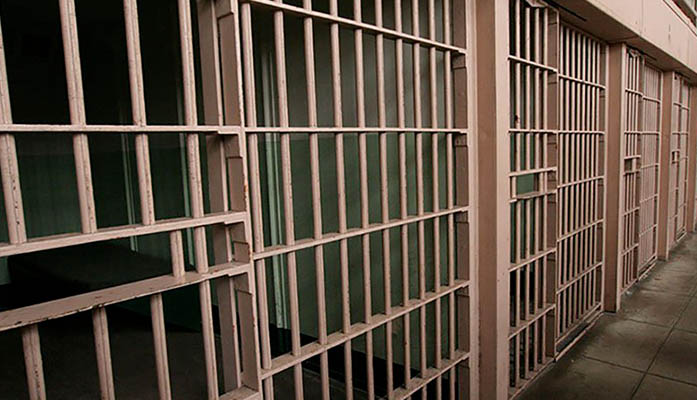
PHOENIX – In response to the escape of two inmates from the prison in Florence last month, State Rep. David Cook has introduced new legislation that would toughen penalties for correctional facility escapees.
“Following the recent successful capture of two dangerous escaped state prison inmates, I was dismayed to learn that they could only be charged with a Class 4 felony,” said Cook in a press release. “It is only by the grace of God that nobody was injured, or worse, while these criminals were at large. The penalty needs to fit the crime and this change in statue does exactly that.”
Inmates John B. Charpiot and David T. Harmon escaped from a medium security unit at Arizona State Prison Complex-Florence on January 23. The two men managed to break into a tool room and steal tools to cut through the outside fence. After they escaped, the men attempted to rob an employee at a nearby hotel. They were captured on January 28, in Coolidge.
Cook’s bill, HB 2790, cosigned by Representatives Kevin Payne (R-21), Frank Pratt (R-8), Bret Roberts (R-11), Ben Toma (R-22), and John Fillmore and Jacqueline Parker (R-16), as well as Senators Vince Leach (R-11), T.J. Shope (R-8), and Kelly Townsend (R-16) increases the penalty for escape from a Class 4 to a Class 2 felony.
Cook says his bill gives prosecutors and judges a “wider array of options and greater discretion when charging or sentencing an offender.”
A Class 2 felony is the highest non-murder felony classification in state law and carries a sentencing range of anywhere from 3-35 years imprisonment, depending on the offender’s prior criminal history and whether a weapon was used. Under the law, any sentence for an escape conviction must be served consecutively to the sentence that the inmate was serving at the time of their escape.
“I commend the tremendous efforts by state and local law enforcement to protect the public and quickly apprehend the two escapees. HB 2790 respects their efforts and those of all who uphold public safety in our state. Moreover, it respects those who have been crime victim and their families who are likely to endure additional traumatic stress if their perpetrator escapes,” concluded Cook.
by AZ Free News | Jan 21, 2021 | News
A State House committee was forced to postpone Tuesday’s discussion of a bill about who has authority to set energy policy in Arizona after almost all House Democrats failed to show up for a floor session earlier in the day at which the bill was to get its First Read.
The Committee on Natural Resources, Energy & Water (NREW) was to meet at 2 p.m. to consider HB2248, which seeks to rein in the Arizona Corporation Commission (ACC) regulation of critical electric generation resources. However, the bill had to be dropped from the committee’s agenda when the required First Read was not conducted at 1:15 p.m. because only 28 of 60 House members showed up for the floor session.
House members are split 31 Republicans and 29 Democrats. Public records reveal an overwhelming majority of those not present for Tuesday’s floor session were Democrats.
HB2248 sponsored by Rep. Gail Griffin (R-LD14) is in response to various Green New Deal mandates implemented by the ACC in recent years for how public service corporations can do business. It makes clear that legislators -not the ACC’s five members- have authority for establishing policies related to critical electric generation resources, whether biomass, coal, fuel-cell technology, geothermal, hydroelectric, natural gas, nuclear, solar, wind, or petroleum fuel products.
HB2248 would prohibit the ACC from adopting or enforcing any “policy, decision or rule” which directly or indirectly regulates what types of critical electric generation resources to be used or acquired by a public service corporation within Arizona’s energy grid “without express legislative authorization.”
The bill’s First Read was finally conducted Wednesday afternoon, according to House spokesman Andrew Wilder. It will go back to the NREW committee which Griffin chairs, but not until Jan. 26 at the earliest. The last day for the House to consider the bill is Feb. 18.
Sen. Sine Kerr (R-LD13) has introduced SB1175, a companion bill to HB2248. The bills would amend Title 40 of the Arizona Revised Statute by adding a new section designated as ARS §40-213. The amendment would not apply to any ACC policy, decision, or rule adopted before June 30, 2020 but would be retroactive to that date if passed.
Griffin and Kerr’s bills are supported by the Barry Goldwater Institute for Public Policy Research, the Free Enterprise Club, the Market Freedom Alliance, the Americans For Prosperity-AZ, and the Republican Liberty Caucus of Arizona.