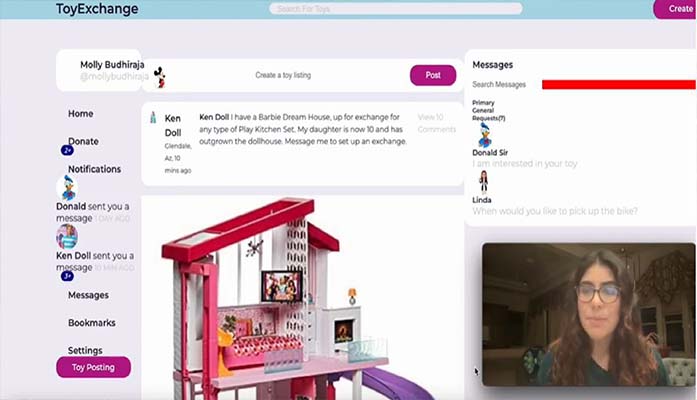
A BASIS Peoria high school student won one of this year’s congressional app development challenges for her app enabling parents to exchange or donate their children’s toys.
Rep. Debbie Lesko (R-AZ-08) featured the winner, Molly Budhiraja, and her app, “Project Toy Exchange,” in her weekly newsletter issued last Saturday.
Budhiraja’s app will be displayed on the Congressional App Challenge website and in the U.S. Capitol, along with other winners nationwide. Budhiraja will have the opportunity to showcase her app to Congress during the annual #HouseofCode festival, a large science fair.
“I am so pleased to congratulate Molly Budhiraja for winning this year’s Congressional App Challenge,” stated Lesko in a press release. “Project Toy Exchange is a great app that connects parents with each other and encourages people to donate toys to children in the community. It is an honor to represent so many bright students, and it is wonderful to see how they use their talents and creativity through these apps to help others!”
Budhiraja thanked the congresswoman in a LinkedIn post, expressing excitement about the future of her app.
“I was honored to meet such an enthusiastic and intelligent woman leader in our community, who not only does remarkable work for our state, but our nation as well,” stated Budhiraja. “It was a pleasure to talk about my app and my future goals with the congresswoman and her team.”
The second-place winners were Mountain Ridge High School students Apramey Akkiraju and Rohan Agrawal. The teens created a “COVID-19 Tracker” app that provided color-coded maps detailing case count concentrations in the Western part of the country, as well as data on case and death counts.
Third-place winners were Challenge Charter School students Alexandra Acuna and Tori Lugo. The pair created the “Math4Life2” app, which helps children with multiplication problems and seeks to make math more fun.
All three apps proposed creative solutions to real issues facing Arizonans: rising costs of toys due to the inflation crisis, advising concerned Arizonans about COVID-19 spread, and fostering a positive relationship with math amid declining test scores.
One of the second-place winners, Agrawal, was last year’s champion, along with Dens Sumesh, a BASIS Peoria student. The pair created the app “DebateEV,” a website that collects existing debate card evidence and makes it accessible via a search format similar to Google’s. Agrawal and Sumesh stated that forced transition to remote learning, coupled with their ongoing involvement in their high school debate club, inspired the app.
Last year, Reps. Ann Kirkpatrick (D-02), Andy Biggs (R-04), David Schweikert (R-06), and Ruben Gallego (D-07) also hosted challenges and named winners.
Kirkpatrick awarded first place to “Memolog” by Gregory School students Erik Wisnom, Chris Allen, Ted Roberts, and Karl Ramus. Their app applied memorization techniques to any piece a student needed to memorize.
Biggs’ winner was an artificial intelligence-based wildfire prevention system by Hamilton High School student Prisha Shroff.
Schweikert awarded first place to “Zubin’s Dungeon Quest” by BASIS Scottsdale student Zubin Sidhu, a video game that blended education with entertainment.
Gallego’s winner was “Surviving the Pandemic While Back-to-School” by University High School students Kamille Cuison, Liana Kay De Guzman, and Nathan Caldwell-Meeks. Their app informed students about the background, treatment options, and safety protocols for COVID-19.
The 2021 Congressional App Challenge reported producing over 2,100 fully functioning apps. Over 7,100 students entered the competition through 340 congressmens’ challenges.
The annual Congressional App Challenge is funded by the Omidyar Network, Amazon (Web Services), theCoderSchool, Facebook, Replit, Accenture, Rise, ACT: the App Association, Comcast NBCUniversal, and CGI.
In addition to Lesko, Kirkpatrick, Biggs, Schweikert, and Gallego, Rep. Raul Grijalva (D-03) is also hosting a challenge this year.
Corinne Murdock is a reporter for AZ Free News. Follow her latest on Twitter, or email tips to corinne@azfreenews.com.
The State of Arizona has initiated a lawsuit against the Buckeye Elementary School District (BESD) and its longtime superintendent Kristi Wilson in an attempt to recover what the attorney general’s office (AGO) contends is public monies “illegally paid” by the district to Wilson in violation of the Arizona Constitution’s Gift Clause.
The 70-page lawsuit filed Wednesday notes BESD paid more than $500,000 to Wilson or on her behalf that was not owed under her employment agreements. The AGO also raises questions about the legality of $1.7 million in “additional compensation paid under three agreements from July 2016 through December 2021, for total compensation of $3,274,505.
As superintendent, Wilson is responsible for 5,200 students across seven elementary schools. Her compensation was about 100 percent higher than the average pay for the superintendents of Arizona’s three largest school districts during the same five-year period.
Wilson and BESD came under investigation by the AGO following a detailed report by the Arizona Auditor General in April which raised questions about whether the additional compensation called for in Wilson’s three employment agreements violated state law.
The auditor’s report had harsh words for district officials, who reportedly omitted “critical information” and other records during the audit. Some officials were also chided for a lack of transparency that kept the public in the dark about Wilson’s performance and her compensation.
Wednesday’s lawsuit is not the first undertaken by Attorney General Mark Brnovich related to Arizona’s Gift Clause, which prohibits the payment of public monies unless such payment serves a public purpose and the value received by the public is not far exceeded by the consideration being paid by the public.
“Transparency and accountability are not electives in our public school districts,” Brnovich stated in announcing the lawsuit against Wilson and BESD. “Hardworking taxpayers expect these public funds to be expended in accordance with the law and the best interest of students.”
Wilson was named BESD’s superintendent in 2013. From FY2014 through FY2016, her annual compensation averaged $172,813. But over the next five years, her annual salary under three employment agreements ranged from a low of nearly $339,000 to a high of nearly $800,000.
The lawsuit states that in comparison, the superintendents at Arizona’s three largest districts earned from $208,600 to $306,179 per year. Another comparison noted by the AGO is that BESD paid its teachers an average of $44,536 in 2019.
Terri Jo Neff is a reporter for AZ Free News. Follow her latest on Twitter, or send her news tips here.
Northern Arizona University (NAU) will offer illegal immigrant scholarships for the 2023-2024 academic year — even if they’re eligible for deportation. NAU partnered with TheDream.US, a scholarship program fund operated by the New Venture Fund: one nonprofit arm of the leading leftist dark money networks, Arabella Advisors.
The scholarships aren’t exclusively earmarked for Deferred Action for Childhood Arrivals (DACA) and Temporary Protected Status (TPS) recipients. Any illegal immigrant that came to the U.S. before the age of 16 and before 2017 may apply for these scholarships.
In a statement, NAU President José Luis Cruz Rivera said that the scholarships aligned with their university’s goal to make higher education accessible to all students. Rivera credited the passage of Proposition 308 for affirming this move.
“Through this partnership, NAU will further the will of the people of Arizona as expressed in the passage of Proposition 308, which affords Arizona Dreamers with in-state tuition and provides an invaluable pathway to upward economic mobility and social impact,” said Rivera.
Expanding opportunities for Dreamers is good for the country. We are better together. And together we advance better days. #DACApic.twitter.com/5a2vBoxvRU
Arizona State University (ASU), Benedictine University, and Grand Canyon University (GCU) also partner with TheDream.US.
Prop 308 awards in-state college tuition to Dreamers; voters approved the measure narrowly, 51 to 49 percent. The proposition was backed by at least $1.2 million of out-of-state dark money networks.
TheDream.US reports that at least 1.3 million illegal immigrant youth are eligible for DACA. Of the approximately 98,000 who graduate from high school each year, the program estimated that only five to 10 percent (65,000 to 130,000) enroll in college on average.
Extending permanent legal status to our nation’s Dreamers is the only moral path forward. Their undocumented status being simply an artifact of our country’s long-standing tradition as a beacon of hope. #DreamActNowhttps://t.co/DaMvQGni8O
Per AZ Free News past reporting, New Venture Fund (NVF) has initiatives outside of immigration reform advocacy. NVF launched the Fair Elections Center, which is behind the progressive elections reform activist project, Campus Vote Project (CVP).
In October, Secretary of State Katie Hobbs, now governor-elect, selected CVP Vice Chair Anusha Natarajan for the 2022 John Lewis Youth Leadership Award: a Barretts Honors College student, Andrew Goodman Fellow, and digital producer for the student newspaper at Arizona State University (ASU).
In 2020, Oscar Hernandez Ortiz — a DACA and TheDream.US scholarship recipient, strategist with the Arizona Bar Foundation, former fifth-grade teacher, Greater Phoenix Economic Council member, ASU graduate, former state legislature policy intern, and Arizona Department of Education Latinx Advisory Council member — wrote an Arizona Republic op-ed attacking the Trump administration’s efforts to end DACA. While at ASU, Ortiz founded the Undocumented Students for Education Equity, a resource hub for illegal immigrants.
NAU isn’t the only partner school for TheDream.US. The program lists over 80 “Partner Colleges.”
TheDream.US offers two scholarship types: the National Scholarship, which the program suggests for Arizona applicants, offers up to $16,500 for an associate degree and $33,000 for a bachelor’s degree; and the Opportunity Scholarship, which offers up to $80,000 for a bachelor’s degree to illegal immigrant students located in states without access to college because they either must pay out-of-state tuition or can’t gain admission to state universities. Applications close Feb. 28.
(Note: TheDream.US removed award amounts from its National Scholarship page earlier this year).
TheDream.US founders are: Don Graham, chairman of Graham Holdings Company (formerly The Washington Post), former director of Facebook, and former member of the Pulitzer Prize Board; Carlos Guitierrez, chairman and CEO of Empath, former chairman and CEO of Kellogg’s, and former Secretary of Commerce for the Bush administration; and Henry R. Muñoz III, former finance chairman for the Democratic National Committee.
Among senior staff at TheDream.US: its president Candy Marshall, the former chief human resources officer for the Bill & Melinda Gates Foundation; director Maria Gabriela Pacheco, who immigrated illegally to the U.S. as a child; communications manager Sadhana Singh, a recipient of DACA and a TheDream.US scholarship; program manager Melanny Buitron, a DACA recipient; data manager, and Camila Salkhov, a Dreamer.
Corinne Murdock is a reporter for AZ Free News. Follow her latest on Twitter, or email tips to corinne@azfreenews.com.
Fentanyl overdose kits are the latest among necessary school supplies for University of Arizona (UArizona) students.
Amid the burgeoning fentanyl crisis, Pima County supplied all 15 of the UArizona fraternity houses with fentanyl overdose treatment kits for the upcoming semester.
The county supplied the houses with Narcan kits as part of a year-long drive initiated by one of their Community Mental Health and Addiction interns, Aiden Pettit-Miller. UArizona’s Emergency Medical Services team and Interfraternity Council (IFC) also assisted.
Miller, a senior student at UArizona, says he launched the initiative after one of his high school friend’s roommates at Arizona State University (ASU) overdosed on fentanyl in 2020.
Narcan is the brand name for the medicine naloxone, and is also used to treat overdosing from other opioids: heroin, oxycodone (OxyContin), hydrocodone (Vicodin), codeine, and morphine. First responders rely on the treatment for suspected overdosing.
The Arizona Department of Health reports over 1,400 opioid deaths so far this year. AZDHS folds fentanyl-related deaths into the “RX/Synthetic” category, which includes “all other opioids” except heroin, such as oxycodone and hydrocodone. This year, the number of RX/Synthetic deaths is nearly 1,400 (97 percent).
In 2021, there were over 2,000 opioid deaths; just over 1,900 (94 percent) of deaths were RX/Synthetic. The fatality rate per 100,000 population dropped this year from 28 percent to 20 percent.
Amid the border crisis ushered in by the Biden administration, fentanyl deaths arose as the leading cause of death among adults aged 18 to 45 years old.
Teens accounted for 77 percent of adolescent overdose deaths last year. The demographic spike correlated with efforts by cartels to ply youth with the deadly drug, such as “rainbow fentanyl.”
Fentanyl became the subject of the Drug Enforcement Administration’s (DEA) first public safety alert in six years, issued last September. As part of their campaign to raise awareness about the deadliness of fentanyl, “One Pill Can Kill,” the DEA discovered that about 60 percent of fake prescription pills contain lethal doses of fentanyl. The discovery marked an increase from the 2021 average of 40 percent.
These fake pills are marketed and disguised to appear legitimate via social media and e-commerce platforms.
Did you know that 6 out 10 seized #fakepills contain a lethal dose of fentanyl? #fakepills seizures are up and our #DEAHouston Associate Lab Director for South Central Jamie Vasquez speaks on the fake pills seizures that come through the lab. #OPCKpic.twitter.com/SbAL0zQXpI
On college campuses like UArizona, victims of fentanyl overdosing range widely. The partygoer looking for a high and the student looking for extra focus are at equal risk. UArizona, along with ASU, ranks consistently as one of the top party schools in the nation, and Adderall is a popular go-to for students studying for exams or finishing hefty assignments. Both popular party drugs and study boosters may be obtained illicitly, and both are likely to contain deadly doses of fentanyl.
During finals do not risk it, do not buy any adderall from a “friend”, or social media it is likely a counterfeit pill with a lethal dose of fentanyl. pic.twitter.com/YnMoF8C4nY
UArizona is also looking to create an organization called “Fraternities Fighting Fentanyl” with their School of Public Health, the fraternities, and the student-run emergency medical service. The organization will hand out fentanyl test strips, Narcan, and educational pieces to students.
Corinne Murdock is a reporter for AZ Free News. Follow her latest on Twitter, or email tips to corinne@azfreenews.com.
Northern Arizona University (NAU) launched a climate change program geared toward a career focused on corporations’ Environmental, Social, Governance (ESG) scoring. The program spans four courses, each costing $500 — $2,000 total.
NAU announced the online, non-credit certificate program last week. The courses will prepare students for greenhouse gas (GHG) accounting. GHG is a key part of ESG.
“[This will] help working professionals gain the skills needed to address climate change at the corporate or organizational level,” stated the press release.
In the program, students will quantify the greenhouse gas emissions from individual products or commodities, business or corporation operations, and local communities. Then, the students will propose and defend emission management, reduction, and mitigation strategies.
NAU explained in its course description of the program that most large corporations were expanding GHG accounting hires at a rapidly multiplying pace.
“Companies see aggressive emission reduction goals as good for business and a way to market themselves as climate-friendly. However, companies cannot manage what they don’t measure. Therefore, the need for skilled GHG accountants is growing exponentially,” stated NAU.
The university also pointed out that the Securities and Exchange Commission (SEC) proposed a rule change in March requiring all publicly traded companies to report their climate-related finance risk.
The SEC rule would require companies to include these ESG findings in their registration statements and periodic reports. This would include governance and risk management processes of climate-related risks; the potential or current material impact of climate-related risks; the potential or current strategy, business model, and outlook impact of climate-related risks; and the impact of climate-related events on financials. It would also require disclosures of a GHG emissions target or goal, and GHG emissions from purchased electricity (or other energy forms) as well as upstream and downstream activities in its value chain.
SEC Chair Gary Gensler declared that mandatory ESG disclosure would better serve investors’ decision-making and hold corporations accountable.
“I believe the SEC has a role to play when there’s this level of demand for consistent and comparable information that may affect financial performance,” said Gensler.
The timing of this course is significant, given that state leaders such as Treasurer Kimberly Yee oppose ESG. In September, Yee modified the state’s investment rules to prevent ESG ratings from investment considerations.
NAU sustainability professor Deborah Huntzinger stated that environmental policymaking required quantifiable data that ESG approaches like GHG accounting offer. Huntzinger and NAU Online director of continuing education Brenda Sipe created the new GHG accounting program.
“To design effective policies, whether at the corporate or national level, to mitigate rising emissions and human-driven climate change, we need to accurately track emissions,” stated Huntzinger. “Robust training in the best practices in GHG accounting will lead to a more educated workforce that can better inform corporate, organizational, community and national discussions about effective climate change mitigation strategies.”
Along with Huntzinger, carbon analyst Heather Aaron will teach the courses.
The World Economic Forum (WEF), the globalist lobbying organization that serves as a pioneer for ESG scoring systems, identifies GHG accounting as a critical component of ESG. In a July publication, the WEF issued guidelines advising that GHG was key to quantifying the “carbon value” of corporations.
The WEF, along with numerous powerful corporations and advocates of progressive reforms like ESG such as George Soros, BlackRock, Vanguard, JP Morgan Chase, Amazon, General Motors, the Sierra Club, issued comments or engaged in meetings with the SEC in support of the ESG mandate (though many offered suggestions for improvement).
NAU will also offer its GHG program at the graduate level, requiring students to complete a minimum of 12 credit hours. The regular course commences on Jan. 30 and remains open for six months of access.
Corinne Murdock is a reporter for AZ Free News. Follow her latest on Twitter, or email tips to corinne@azfreenews.com.
In the last year, Arizona has added nearly 15,000 manufacturing jobs. But the demand for skilled workers to fill those jobs along with thousands of others across the state which require specialized training is drawing attention to the importance of ensuring students have access to trade or vocational schools.
The Imagine America Foundation (IAF) is focused on promoting the value of specialized career education and helping students get the hands-on training they need. One category the IAF concentrates on is the skilled trades, which includes a variety of occupations running the gamut from production, installation, maintenance, and repair.
“Because the world runs on machines and energy, those able to service them will always be in demand,” according to a recent IAF report titled Pandemic-Proof Careers in Skilled Trades. “Through economic downturns, pandemics, or other natural disasters, keeping these pieces moving will always be crucial to keeping society moving.”
The growth in demand for skilled trade jobs across Arizona is being powered by emerging technologies, a concerted effort by Gov. Doug Ducey to attract certain industries, and an aging workforce set to retire in the next few years.
“For young people deciding on a career or those looking to make a career change that better aligns with the stability, demand, flexibility, and ROI they seek, this growth comes at the perfect time,” the IAF report notes.
IAE recently highlighted several “hot emerging skilled trades” which can offer a more pandemic-proof career. Those jobs include:
Aircraft and avionics equipment mechanic / technician
Electrician
Heating, air conditioning, and refrigeration mechanic / installer
Heavy vehicle and mobile equipment service technician
Industrial machinery mechanic, machinery maintenance, or millwright
Machinist or tool and die maker
Medical equipment repairer
Solar photovoltaic installer
Welder
Wind turbine service technician
Scholarships and other tuition assistance for vocational and trade schools has also become more common in the last few years, with the Arizona Community Foundation leading the way away from a college-only mindset.
That example is now being followed by one of Cochise County’s largest employers, which has created a new scholarship for high school seniors interested in obtaining the training needed for a skilled trade job.
The program announced last month by Sulphur Springs Valley Electric Cooperative (SSVEC) Foundation will award $4,000 to five students who plan to attend a trade school, skilled job training program, or apprentice program in 2023 instead of seeking a traditional higher education degree.
“Our Directors recognized the importance of encouraging, and providing resources, to students who plan to attend a trade school or certified program rather than a degree from a college or university,” said Marcus Harston, SSVEC’s Community Relations Manager.
More information on the SSVEC Foundation Trade Scholarship Program is available here.
Some companies across Arizona are getting even more involved in training the new employees they need. Several, including Boeing and Gulfstream Aerospace Corp., are now working directly with educational institutions to ensure a quality workforce.
For instance, Gulfstream has partnered with Arizona State University and Chandler-Gilbert Community College to turn out maintenance specialists for the company’s fleet of luxury jets.
In addition, the Governor’s Office recently featured Prescott-based CP Technologies which has joined forces with Embry-Riddle Aeronautical University and Yavapai College to train and hire upwards of 200 employees.
Another example is battery manufacturer KORE Power, which is working with Rio Salado College and West-MEC to facilitate training for the advanced manufacturing workers needed at the company’s Buckeye facility.
And Boeing has partnered with Mesa Community College to offer a boot camp for students interested in various electrical wiring technician jobs. Since 2019, more than 350 students have graduated from the boot camp with over 200 getting hired at Boeing, according to the Governor’s Office.
Terri Jo Neff is a reporter for AZ Free News. Follow her latest on Twitter, or send her news tips here.