On Monday, the Biden administration announced that Mohave Valley Elementary School District received over $586,000 for mental health program funding. The funds will pay for up to 22 new positions.
This latest round of funding was part of over $95 million issued across 35 states. In total, the Department of Education (ED) has awarded $286 million to 264 grantees in 48 states for mental health programs.
The funding originated from the Bipartisan Safer Communities Act (BSCA) enacted last June as part of the Biden administration’s National Mental Health Strategy. The BSCA’s primary initial purpose was to reduce gun violence in schools and surrounding communities.
Last September, the Biden administration issued nearly $1 billion through BSCA for more mental health program funding. Arizona received an allocation of over $20.8 million.
The Biden administration also issued $122 billion in American Rescue Plan Act (ARPA) funding to hire more school psychologists, counselors, and mental health professionals in K-12 schools. ED reported that, compared to pre-pandemic staffing numbers, school social workers have increased by 48 percent, school counselors have increased by 10 percent, school nurses have increased 42 percent, and school psychologists have increased 10 percent.
The Biden administration earmarked these funds for “high-need” local education agencies (LEAs), such as those with high rates of poverty as well as high student-to-mental health professional ratio, high rates of chronic absenteeism, exclusionary discipline (e.g. suspension, expulsion, seclusion, or restraint), referrals to the juvenile justice system, bullying or harassment, community and school violence, or substance use. High-need could also include those who experienced a natural or man-made disaster, or a traumatic event.
Buried within the ED guidance on usage of these funds, the agency encouraged a total overhaul of traditional disciplinary practices.
“Rather than focusing on changing behavior through punishment or removal from the learning environment, school leaders should consider adopting practices that will help educators support students by identifying the root cause of the behavior and developing effective strategies to eliminate or mitigate it,” stated ED. “Building a school culture of curiosity and growth mindset that prioritizes solution-based thinking may encourage pro-social behavior.”
Some of the punishment alternatives included “art program, mindfulness, and body movement activities.” ED also suggested that non-violent behavior be met with conflict resolution training and programs rather than exclusionary discipline.
The Biden administration left it up to each state’s education authority to determine what constituted “high need.” However, the administration noted that the state may require LEAs to describe how they promote meaningful cultural and linguistic engagement. ED further noted that school-based violence prevention programs must be “culturally affirming” in addition to supporting positive relationships, resilience, self-control, empathy, and persistence.
“SEAs may also require LEAs to describe their process for meaningful culturally and linguistically centered student, parent, family, educator, staff, and community engagement and evidence of how that engagement informed their school safety and climate plans, related policies, and strategies,” stated ED.
The ED noted that the permitted use of funds wasn’t limited to improving students’ mental health. ED noted that permitted fund usage included educator and school staff surveys, convenings, and educator outreach efforts.
ED also encouraged funds to be used to prevent and address identity-based bullying. The Biden administration now recognizes sexual orientation and gender identity as protected classes under anti-discrimination law.
Corinne Murdock is a reporter for AZ Free News. Follow her latest on Twitter, or email tips to corinne@azfreenews.com.
Mesa Public Schools (MPS) appeared hesitant in a recent governing board meeting to discuss the secretive gender transition plan, which had been in place for years. Most parents were unaware of the plan until recently, which included an opt-out provision allowing the school to keep the plan secret from parents.
Governing board member Rachel Walden attempted to discuss this gender transition plan during Tuesday’s meeting. However, the district lawyer said that discussion of the plan constituted legal advice and would require the board to go into an executive session, out of the public’s view. The form’s promise of secrecy conflicted with Arizona’s parental rights laws.
“There is no other process that involves plans, paperwork for children without parental consent. But this issue can’t even provide parental notification?” asked Walden.
Teachers and Counselors should NOT suggest putting children on a transgender support plan but that is happening. Parents will not be notified. This is the meeting last night. I was prohibited from talking to the district lawyer under "legal advice." pic.twitter.com/qUPWZyCgAa
Walden clarified that, following discovery of the parental notification opt-out provision of the gender transition plan, MPS modified the form to strike the provision.
☝️That form was updated after it was discovered but it's clear there is no process on which the parents are involved
MPS has reportedly had the controversial gender transition plan since 2015. The original form asked students if their parents were aware and/or supportive of their gender transition. If either are answered in the negative, the form asks the student whether they give consent for the school to disclose their “transgender or gender nonconforming status” to their parents.
Arizona law states that parents have “a right to access and review all records relating to the minor child.”
The current version of the MPS gender transition plan looks virtually the same as the prior version, with the exception that parents or guardians will be notified of the plan if the student requests changes to Synergy, the online student information portal.
The MPS plan appears to be based on model documents. Chicago Public Schools issued a gender transition plan document with similar formatting and the same title.
Controversy over the gender transition plan surged last summer, after the district implemented new guidelines for handling transgender students. MPS defended its actions, arguing that their guidelines aligned with federal guidelines.
The guidelines included an assertion that students had the right to be addressed by their preferred names and pronouns, regardless of whether they had their name legally changed. MPS further declared that students should be allowed to use facilities intended for the opposite sex, such as restrooms, locker rooms, shower facilities, and single-sex classes.
Students also aren’t required to provide proof that they underwent any kind of medical treatment for gender transition as a condition of this special treatment.
“A transgender student is not required to provide verification that the student is undergoing or has undergone medical treatment for the purpose of gender transition as a condition for changing a student’s name and/or gender markers in the District’s records,” read the guidelines.
MPS also asserted that students must be allowed to participate in physical education activities and sports in accordance with their gender identity, though they could not compete in teams designated for the opposite sex in accordance with Arizona law.
Corinne Murdock is a reporter for AZ Free News. Follow her latest on Twitter, or email tips to corinne@azfreenews.com.
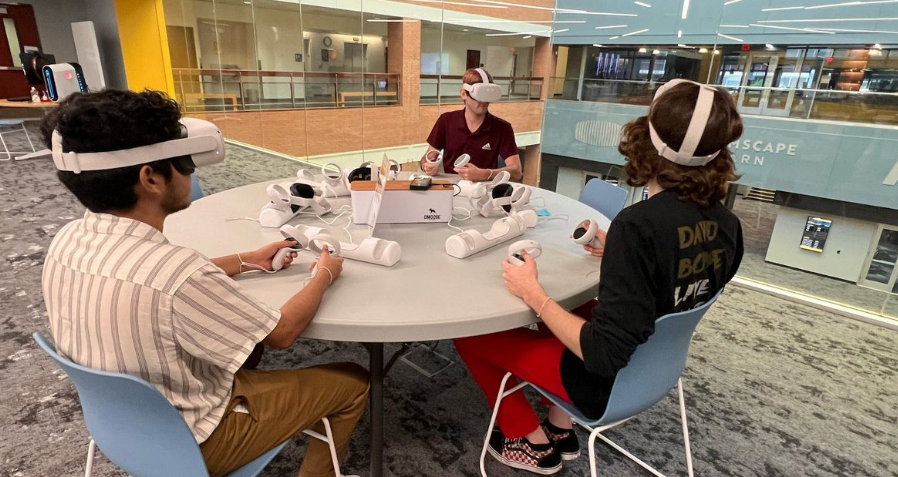
Arizona State University (ASU) has replaced its in-person labs with virtual reality (VR) for its introductory biology courses.
ASU officials explained that they made the switch to increase inclusivity after marking a decline in science, technology, engineering, and math (STEM) graduates. The university soft-launched the switch last spring to conduct a comparison study, with one class using VR labs and the other using traditional labs. ASU reported that “historically underrepresented” students in the class with VR labs performed better versus that category of students in the class with traditional labs.
Inside Higher Ed reported that students in the class with the VR lab enjoyed watching the cartoon animals and storylines presented, and that some cried when the fictional matriarch of a digitized dinosaur family died in one of the storylines.
Since the historically underrepresented students did well, ASU decided to transition all introductory biology classes to VR.
However, Barrett Honors students had media lab grades one point higher than the collective of students attending VR lab classes. (97 percent versus 96 percent).
Once the VR helmet is on and the wrist sensors are snapped in, students in Biology 181 are transported into another world. 🦕
Introductory biology classes aren’t the only use of VR at ASU campuses. The university is looking to use the technology for a wide range of other classes and programs, such as filmmaking and their Learning Futures program.
#ASU students at Learning Futures are developing a VR learning space called Huddle that will be tested by an ASU class this semester.
ASU began expanding its use of VR through its partnership with VR company Dreamscape in 2020.
In addition to logistical fixes with implementing VR for classes, ASU noted that it was seeking to improve diversity, equity, and inclusion arrangements: more diverse narrator voices, and more diverse avatar options to represent a wider array of the student population (such as body types, gender expression, disability).
Corinne Murdock is a reporter for AZ Free News. Follow her latest on Twitter, or email tips to corinne@azfreenews.com.
Microsoft founder Bill Gates will deliver the keynote speech for this year’s Northern Arizona University (NAU) graduation.
Gates will deliver the keynote address on Saturday during NAU’s 3 pm ceremony for the College of Engineering, Informatics, and Applied Sciences as well as the College of the Environment, Forestry, and Natural Science. NAU will also award Gates with an honorary doctorate.
NAU President José Luis Cruz Rivera said in a press release that Gates was a thought leader that exemplified NAU values.
“It is our privilege to recognize Bill Gates for his pioneering work in science and technology and his long standing thought leadership and philanthropic commitment to creating a world where every person has the opportunity to live a healthy life and live up to their full potential,” said Cruz Rivera.
Gates has advanced and pioneered on several progressive initiatives in science and technology. Most recently, Gates shared with ABC News that he would like the country to rely mainly on nuclear energy in the future to achieve energy independence. Gates also believed that artificial intelligence (AI) should be advanced most for use in health and education.
In recent decades, Gates has also bankrolled efforts to normalize the consumption of bugs or lab-grown meats as an alternative to meat.
Last year, Politico revealed that Gates had helped orchestrate the global responses to the COVID-19 pandemic. Gates’ philanthropy — the Bill & Melinda Gates Foundation, one of the largest in the world — identified vaccine developers and invested in each step of the vaccine development process. His organization also played a role in a global distribution plan for the shots.
In his statement, Cruz Rivera also expressed gratitude that the Bill & Melinda Gates Foundation provided significant financial support to the university.
“As NAU advances its mission to deliver equitable postsecondary value, we are honored to have the support of the Bill & Melinda Gates Foundation as we seek to ensure that the talent and aspirations of people in Arizona and beyond are met with the opportunity to realize economic mobility and social impact—shaping a brighter future for themselves and the communities they represent,” said Cruz Rivera.
Gates’ organization donated just over $500,000 to NAU last October for expanding equity.
On Tuesday, Gates wrote in his blog that he agreed to give a commencement speech at NAU because he believed NAU was “redefining the value of a college degree.” Gates dismissed the traditional notion that the more prestigious and exclusive schools were, the more valuable the degree. Gates said that accessibility, affordability, and economic mobility were better metrics to determine the value of a college’s degree, and declared that NAU was an “emerging leader” by that standard.
NAU had a 57 percent six-year graduation rate as of the latest Arizona Board of Regents data from 2021. Last summer, NAU didn’t rank within the top 100 of the nation’s best universities. They ranked 288.
Gates commended NAU’s achievements in diversity, equity, and inclusion: he praised the fact that nearly half of all NAU’s 30,000 students were “people of color,” mainly Hispanic or Native American, as well as the fact that many were first-generation college students or from low-income families.
Gates commended NAU’s equity-based financial aid structure favoring Native Americans from Arizona tribes over other races.
Corinne Murdock is a reporter for AZ Free News. Follow her latest on Twitter, or email tips to corinne@azfreenews.com.
Attorney General Kris Mayes has claimed that universal school choice will bankrupt the state, despite expenditure data showing that school choice saves the state money.
Mayes made the claims in a Saturday letter threatening to sue Gov. Katie Hobbs and the state legislature over last year’s universalization of the state’s Empowerment Scholarship Account (ESA) Program. Mayes blamed the ESA Program for the state’s decision to deny her office ongoing funding, claiming that the program was a “catastrophic drain” on state resources.
Thank you @AZAGMayes for speaking up. This universal voucher program is dangerous for our public schools but also our entire state and vital programs we rely on. We cannot allow this program to continue as is. Reign it in and protect our kids, their schools and our state!! https://t.co/gUg0THlHYs
The state budget reached an unanticipated increase to $2.5 billion despite the 40,000 leap in ESA Program enrollments. Total ESA enrollments reached nearly 52,000 in March. At present, there are nearly 54,000 students enrolled.
ESA Program students provide a cost-saving measure for the state. Each student receives up to $7,000 in scholarship funds — about half of what the average public school spends on each student.
Current ESA Program participation reflects a cost savings of about $363 million. Originally, those students without universal school choice would cost the state about $725 million.
Although Mayes named Hobbs as an opponent on this issue, Hobbs wouldn’t side with the slim-Republican majority supporting school choice in this fight over ESA Program funding. Hobbs has previously proposed rolling back the ESA Program on the grounds that it would cost the state $1.5 billion over the next decade.
Hobbs omitted the fact that the Arizona public school system costs $15 billion annually. If every one of the estimated 1.15 million students joined the ESA Program, the cost would be just over $8 billion annually.
After Mayes’ letter, other Democrats joined in on the call to roll back the ESA Program. State Rep. Judy Schwiebert (D-LD02) insisted that the ESA Program funds were taken away from other, more important issues.
“We need to fight the fentanyl crisis; protect our children; combat elder abuse; fund our secure & safe elections, and deal with the homelessness, housing, teacher & water crises,” stated Schwiebert.
We must cap universal ESA vouchers in the upcoming budget. They now threaten to bankrupt AZ. We need to fight the fentanyl crisis; protect our children; combat elder abuse; fund our secure & safe elections, and deal with the homelessness, housing, teacher & water crises.
— Representative Judy Schwiebert, AZ House LD2 (@JudyForAZ) May 8, 2023
State Rep. Austin Smith (R-LD29) countered that claim, declaring that ESA Program funding would cause bankruptcy was untrue.
This is just blatantly untrue. ESA’s are not bankrupting Arizona. There should be a misinformation disclaimer here. https://t.co/tqpsH70Q24
Mesa Public Schools (MPS) Board Member Rachel Walden shared that MPS had more funding at present than they had prior to the ESA Program universalization.
MPS has more $$ now than prior to the ESA expansion, above the national avg, with 9,000 less students. They still get federal, local funding regardless. They should be asking why public school is draining the tax payer. ESA students run on half this amount. pic.twitter.com/82Dul38Rhz
Last week, Governor Katie Hobbs signed HB 2456 into law, continuing the Arizona State Schools for the Deaf and the Blind (ASDB) for four years.
Today, I signed HB2456, which will continue The Arizona State Schools for the Deaf and the Blind for the next 4 years. While I am happy to sign this bill, ASDB continuation should never have been in question. We should never have let ASDB parents, teachers and students be held…
— Governor Katie Hobbs (@GovernorHobbs) May 1, 2023
In a letter to Secretary of State Adrian Fontes, Hobbs explained the reasons why she signed the bill from the Legislature, writing, “The Arizona State Schools for the Deaf and the Blind (ASDB) is a cornerstone of the visually impaired and Deaf and hard of hearing communities in Arizona. For over 110 years, ASDB has moved forward with their mission of providing well-rounded, high-quality education to children who are blind, visually impaired, hard of hearing or deafblind from birth to grade 12.”
Hobbs, though, did not stop with this positive reinforcement of the bill, deciding to attack legislators over their deliberations. She stated, “The ASDB community was treated with a lack of respect and was not given equal access to participate in the legislative process. Parents, students, and teachers were made to worry about the continuing existence of their school while caught in the middle of political games being played by a fringe minority of the Legislature.”
The Democrat governor encouraged “the Legislature to reflect on the passage of HB 2456 and send (her) a bill next session that includes a full eight-year continuation.”
Republican legislators didn’t take kindly to the governor’s volley in their direction – especially Senator Jake Hoffman, who was one of the principals in shaping the proposal to ensure adequate oversight. He told AZ Free News, “Sadly, Katie Hobbs continues to engage in childish behavior and play petty partisan games in both her rhetoric and actions. Delivering the highest quality educational services to Arizona’s deaf and blind children is not only the right thing to do, it’s a constitutional obligation. Democrats’ exploitation of this important Arizona community in an attempt to score cheap political points is both despicable and highly offensive. Republicans are committed to providing the best education possible to every child, including the deaf and blind, and allowing for greater oversight furthers that mission.”
HB 2456 garnered significant bipartisan support on the floors of both legislative chambers; however, the process and debate was extremely partisan in nature – largely due to the number of years for the continuation. When the proposal was first put before the full House for a vote, it passed 60-0. The Senate then amended the bill and approved it 27-1, with two Democrats not voting. The House then concurred with the Senate’s changes, giving the final green light to transmit it to the Governor’s Office by a vote of 58-0, with one Democrat member not voting and one seat vacant.
Although most of their members voted to clear the bill from the chamber, the Arizona Senate Democrats Conference was furious after the vote, tweeting the following response to the Senate Republicans’ statement: “Try talking to the community before you speak on their behalf.
You know that the Conference Committee recommended 8yrs., the House passed 8yrs., the community asked for 8yrs. Senator Hoffman is dragging his caucus down with him.”
Try talking to the community before you speak on their behalf.
You know that the Conference Committee recommend 8yrs., the House passed 8yrs., the community asked for 8yrs.
— Arizona Senate Democrats (@AZSenateDems) April 13, 2023
On April 14, the Senate Democrats also issued a series of tweets that blistered Republicans for “attacking the Arizona State School for the Deaf & the Blind.” The Democrats charged the Republicans were engaging in “discrimination,” writing, “This community has seen and dealt with this type of ableism and protectionism before. It was this type of thinking that allowed the disabled to be stripped of their autonomy and their fundamental rights in the past. Disability does not equate to incompetence and reviving this history of bias and prejudice is not only discriminatory, it’s dangerous and wrong. Republicans are performing a type of prejudicial bias that we cannot let go unchecked. Discrimination against the disabled should never go unchallenged.”
🚨 YOU MIGHT HAVE MISSED THIS: Republicans are attacking the Arizona State School for the Deaf and Blind #ASDB
— Arizona Senate Democrats (@AZSenateDems) April 15, 2023
Of course, Senate and House Republicans would vehemently disagree with the framing from their colleagues on the other side of the aisle. During the legislative process, the Senate Republican Caucus shared a clip of Senator Jake Hoffman on the floor during the Committee of the Whole consideration of the bill, explaining “why an 8-10 year continuation of these schools without proper oversight would be a big mistake.” In his remarks, Hoffman said that “the Constitution gives us the authority and responsibility to provide educational services for deaf and blind children. Yet for some reason, we’ve been treating this incredibly important community within our state like we do the paper pushers at ADOA (Arizona Department of Administration)…. Our job, that the Constitution tasks us with, is to provide the best possible education to deaf and blind children in our state.” He championed the Legislature’s efforts to ensure oversight at ASDB and stewardship of taxpayer resources.
Daniel Stefanski is a reporter for AZ Free News. You can send him news tips using this link.