by Matthew Holloway | Feb 27, 2026 | News
By Matthew Holloway |
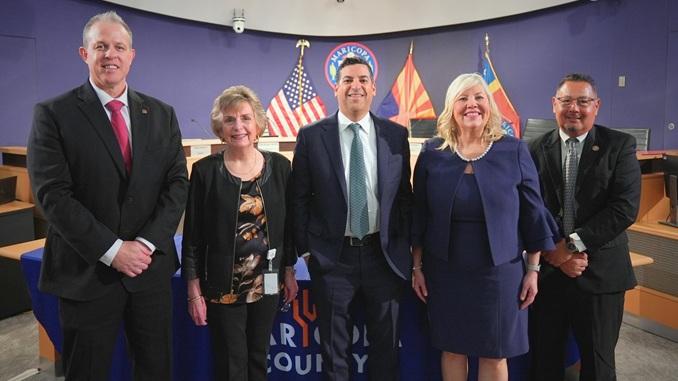
The Maricopa County Board of Supervisors has sent a letter to Maricopa County Recorder Justin Heap regarding preparations for in-person early voting for the upcoming July Primary Election, urging cooperation to ensure sufficient voting locations, staff, and equipment are in place.
In a joint statement dated Feb. 24, 2026, Board Chair Kate Brophy McGee and Vice Chair Debbie Lesko said the board delivered the letter to Recorder Heap now that his office “oversees that important function.”
The supervisors emphasized that “big decisions need to be made in short order” to guarantee that in-person early voting is adequately staffed and resourced for the 27-day early voting period prescribed by state law.
The letter requests that Heap provide the “same level of service that Maricopa County voters have come to expect in past years, when the Board oversaw in-person early voting.” The supervisors wrote that this includes a “large number of sites spread out evenly and fairly across our county” during the early voting period.
Brophy McGee and Lesko also asked whether the recorder would collaborate with the board’s elections department, which they described as “staffed, resourced, and experienced in this area.”
According to the Board’s Feb. 24 statement, the letter followed a court filing by Recorder Heap in which he indicated he was willing to cooperate on logistical issues. Supervisors also said they had sent a staff-level communication outlining key decisions that must be made to meet statutory deadlines.
The board approved a requested $550,000 budget increase for the Recorder’s Office, earmarked for signature verification efforts. “Signature verification is under the complete and total control of the recorder,” Brophy McGee stated in a press release on Wednesday regarding the $550,000 increase. “While we have questions about the recorder’s new process, we will proceed with the recorder’s budget requests to ensure sufficient resources are in place by the 2026 primary. Our top goal is fair and secure elections.”
The supervisors gave Heap until Friday to respond to the board’s letter so that preparations can proceed in advance of statutory deadlines for the July Primary. The statement concludes that if the recorder does not respond, the board will assume he can manage in-person early voting “without our help.”
Matthew Holloway is a senior reporter for AZ Free News. Follow him on X for his latest stories, or email tips to Matthew@azfreenews.com.
by Matthew Holloway | Feb 26, 2026 | News
By Matthew Holloway |
Arizona House Concurrent Resolution 2048, sponsored by State Representative Michael Way (R-LD15), passed the Arizona House Government Committee last week in a party-line vote and now heads to the full Arizona House of Representatives.
HCR 2048 is a proposed constitutional amendment that would prohibit salary increases for elected state officers from taking effect during their current term. It would also require legislators, the Governor, and other statewide executive officers to forgo regular salaries and subsistence payments if the general appropriation bill is not signed into law by April 30.
The measure states that compensation withheld during a budget delay would not be paid retroactively. Salaries would resume with the first full pay period after the budget becomes law.
“If we do not pass a budget on time, we should not get paid. It is that simple,” Way said in a statement. “Arizonans are expected to meet deadlines in their jobs. Lawmakers should be held to that same standard. If we fail to finish the budget by April 30, there should be consequences.”
The resolution is described as complementing House Concurrent Resolution 2005, introduced by Rep. Justin Wilmeth (R-LD2), which would require the Legislature to adjourn its regular session by April 30.
“Deadlines matter,” Way said. “Families and businesses across Arizona operate on them every day. State government should do the same.”
If approved by the full Legislature, HCR 2048 would be referred to Arizona voters at the next general election.
Way represents Legislative District 15, which includes Mesa and Queen Creek in Maricopa County and San Tan Valley in Pinal County.
Matthew Holloway is a senior reporter for AZ Free News. Follow him on X for his latest stories, or email tips to Matthew@azfreenews.com.
by Matthew Holloway | Feb 26, 2026 | News
By Matthew Holloway |
Arizona House lawmakers advanced a package of Department of Child Safety (DCS) reform bills following a special oversight hearing led by House Committee on Government Chairman Walt Blackman (R-LD6) and Vice Chair Lisa Fink (R-LD27).
The Feb. 19 hearing focused on legislative oversight and proposed structural reforms to the state’s child welfare system. According to reporting from State Affairs, several of the measures discussed during the hearing have since advanced through committee and moved forward in the legislative process.
Blackman and Fink convened the hearing at 1:00 p.m., with lawmakers reviewing testimony and examining proposals addressing accountability, placement stability, child protection procedures, and oversight mechanisms within DCS.
In a news release, Blackman stated, “Arizona’s child safety system exists for one reason: to protect children. When the state takes custody, there is no room for excuses. This hearing is about accountability and enforceable change. We will put facts on the record, press for answers, and advance reforms that put child safety ahead of bureaucracy.”
Vice Chair Fink said lawmakers would examine how DCS responds to abuse reports, how placements are selected and monitored, and why “preventable failures keep reoccurring.” She added, “We are advancing reforms that strengthen kinship care, raise standards in group settings, and require action when credible abuse is reported.”
Reform Measures Advance
Six reform-related bills were advanced by the House committee amid continued scrutiny of foster care oversight.
- HB 2035 (Fink): Expands eligibility for kinship placement, requires timely identification and notice to relatives and significant connections, and increases transparency when kinship placement is denied.
- HB 2041 (Fink): Clarifies that a parent’s inability to provide basic necessities based solely on lack of financial resources should not be treated as neglect.
- HB 2611 (Blackman): Establishes enhanced safety requirements for group care settings, including employee screening and training standards, and protections focused on youth safety and continuity of care.
- HB 2860 (Blackman): Creates an independent oversight committee to review DCS performance and critical incidents, including reporting requirements and dedicated funding for oversight operations.
- HB 4004 (Keshel): Requires DCS to respond to credible abuse or neglect reports and prohibits screen-outs when an alleged abusive parent has parenting time or legal decision-making authority.
- HB 4049 (Fink): Adds DCS to the list of agencies exempt from restrictions on employing legal counsel outside the Attorney General’s Office.
The Arizona Department of Child Safety has faced sustained legislative scrutiny in recent years related to foster placements, case management workloads, and agency oversight following a series of tragic deaths, which led to a Senate investigation in August of 2025. The agency committed to a series of internal reforms during a September 2025 stakeholder meeting convened by State Senator Carine Werner (R-LD4).
The reform bills now move forward in the legislative process for further consideration.
Matthew Holloway is a senior reporter for AZ Free News. Follow him on X for his latest stories, or email tips to Matthew@azfreenews.com.
by Matthew Holloway | Feb 25, 2026 | News
By Matthew Holloway |
The U.S. Department of State is urging American citizens in multiple Mexican states to shelter in place due to ongoing security operations, road blockages, and related criminal activity, according to a February 23 advisory shared by Congressman Abe Hamadeh’s (R-AZ8) office.
According to the State Department’s “Security Alert – Update 4: Ongoing Security Operations – U.S. Mission Mexico,” U.S. citizens in specific locations are urged to seek shelter and minimize unnecessary movement.
The alert identifies the following affected areas:
- Jalisco State, including Puerto Vallarta, Chapala, and Guadalajara
- Baja California State, including Tijuana, Tecate, and Ensenada
- Nayarit State, including the Nuevo Nayarit/Nuevo Vallarta area near Puerto Vallarta
- Areas of Colima, Guanajuato, Guerrero, Estado de Mexico, Michoacan, Nuevo Leon, Oaxaca, Puebla, Queretaro, San Luis Potosi, Veracruz, and Zacatecas
The State Department said U.S. government staff in Guadalajara (Jalisco), Puerto Vallarta (Jalisco/Nayarit), Ciudad Guzman (Jalisco), Tijuana (Baja California), Chiapas, and Michoacan are sheltering in place “until all blockades are cleared,” and urged U.S. citizens in those locations to do the same.
The advisory noted that incidents were reported on February 22, but stated that conditions have returned to normal in:
- Quintana Roo State, including Cancun, Cozumel, Playa del Carmen, and Tulum
- Sinaloa
- Tamaulipas
The State Department directed travelers to consult the general Mexico Travel Advisory for additional information.
Flight Disruptions in Puerto Vallarta
The alert states that flights in Puerto Vallarta continue to experience disruptions due to the availability of flight crews. The U.S. Embassy said it is in close contact with airlines to monitor developments.
All other airports in Mexico are reported to be operating normally. The advisory indicates there are no known security-related flight disruptions at airports outside of Guadalajara and Puerto Vallarta. Travelers are advised to confirm flight status directly with their airline.
The alert also states that some, but not all, scheduled flights are departing from Guadalajara. Travelers whose flights to the United States are canceled may be able to book connecting flights through other Mexican cities.
Road Closures Reported
Mexican authorities have reportedly curtailed operations on some toll roads due to February 22 blockades. Areas cited include:
- Puebla
- Guerrero
- Tamaulipas
- Nayarit
- San Luis Potosi
- Tijuana
- Queretaro
- Veracruz
- Mazatlan
U.S. citizens are advised to check the Mexican toll road authority @CAPUFE on X for updates regarding road closures.
Actions Recommended
The State Department outlined the following actions for U.S. citizens in affected areas:
- Seek shelter and minimize unnecessary movements
- Avoid areas around law enforcement activity
- Monitor local media for updates
- Follow directions from local authorities
- In case of emergency, call 911
- Keep family and friends advised of location and well-being
Assistance Information
The alert provides contact information for U.S. Embassy and consular services in Mexico:
- From Mexico: (55) 2579-2000
- From the United States: 011-52-55-2579-2000 or +1-301-985-8843
- Department of State – Consular Affairs: +1-888-407-4747 or +1-202-501-4444
The advisory also directs U.S. citizens to review the Mexico International Travel Information page, enroll in the Smart Traveler Enrollment Program (STEP), and monitor official State Department channels for updates.
Congressman Hamadeh’s office stated that the information was provided directly by the U.S. Department of State.
In November 2025, Rep. Hamadeh said reports that the Trump administration was considering potential military operations against drug cartels in Mexico were “excellent news,” writing on X, “The narco-terrorists are the barbarians at the gates. Pushing poison and chaos into our country.”
“Arizona, in particular, has been a pipeline for their operations,” the Congressman said, concluding: “It’s time to wipe the Mexican Cartels off the face of the earth.”
Matthew Holloway is a senior reporter for AZ Free News. Follow him on X for his latest stories, or email tips to Matthew@azfreenews.com.
by Matthew Holloway | Feb 24, 2026 | News
By Matthew Holloway |
The Arizona House Commerce Committee voted to advance House Bill 4001, sponsored by Rep. Jeff Weninger (R-LD13), last week. The bill would impose new regulatory requirements on so-called alternative nicotine products to curb youth access. The measure now heads to the full House for further consideration.
HB 4001 proposes a new statutory framework governing the sale, manufacture, and marketing of alternative nicotine products, defined generally as non-combustible nicotine products such as e-liquids, vaping devices, nicotine pouches, and similar products, under a newly added chapter to Title 4 of the Arizona Revised Statutes.
The bill would expand the enforcement authority of the Arizona Department of Liquor Licenses and Control (DLLC) to oversee compliance, including age-verification standards and licensing requirements for retailers and manufacturers. Retailers would be required to obtain location-specific licenses and comply with rules designed to prevent sales to those under 21 years of age. Packaging that “resembles toys, food, candy, games, electronic devices, or cartoons” would be prohibited. HB 4001 also includes penalties for violations, from fines to possible license revocation for repeated offenses. In committee, the bill passed by a 9-1 vote, according to the legislative record, signaling strong bipartisan support in the majority-controlled chamber. Voting records show the bill was approved with Republican backing and limited opposition.
Proponents of HB 4001 have cited concerns about the availability of flavored nicotine products and vaping devices that appeal to minors, pointing to national and state trends showing continued youth usage despite longstanding age restrictions on tobacco products. Public health groups note that while traditional cigarette use among teens has declined, many young people continue to experiment with vape products, particularly flavored varieties, which federal data show remain widely used among middle and high school students.
“As a small business owner, I believe in free markets, but free markets only work when everyone follows the rules,” Weninger said in a statement. “Right now, bad actors are exploiting gaps in the law, marketing nicotine products like toys, skirting age checks, and pushing products that cannot be traced or verified. That must stop.”
“HB 4001 puts Arizona on the side of parents, public safety, and responsible businesses,” he continued. “If you sell nicotine in this state, you will verify age, follow the law, and stop targeting kids. If you manufacture these products, you will meet clear standards and stand behind what you sell. This bill protects minors and supports businesses that play by the rules.”
The bill’s passage in committee comes amid ongoing legal and regulatory efforts in Arizona aimed at reducing youth access to nicotine products. In 2025, the state raised the minimum legal sales age for tobacco and related products to 21, aligning with federal law and prompting the Attorney General’s Office to increase compliance enforcement. The AGO has conducted compliance inspections and pursued legal actions against retailers found selling to underage buyers. Public health advocates have also highlighted the risks of nicotine exposure to adolescent brain development.
Not all voices are aligned behind HB 4001’s approach. The Council for Citizens Against Government Waste (CCAGW) recently issued a letter from the group’s president, Tom Schatz, urging Arizona legislators to oppose the bill, arguing that the measure creates an inconsistent regulatory framework by regulating certain nicotine alternatives under liquor laws while leaving other tobacco products outside the same regime. The group contends that the licensing requirements and compliance costs could disproportionately burden smaller retailers and create competitive disadvantages, while equivalent requirements for combustible cigarette sellers are absent. Meanwhile, similar legislation in the state Senate, Senate Bill 1367, targets another facet of nicotine enforcement, focusing on illegal, imported vape products that evade federal oversight and appealing packaging designed to attract minors. SB 1367 would require wholesalers to document lawful product origins and empower state agencies to seize unauthorized shipments; it carries potential fines and penalties for non-compliance.
HB 4001 does not include new state tax provisions. Its licensing fees are structured to fund enforcement activities if the bill becomes law. The measure’s next stop is a House floor vote, where further debate and possible amendments could occur before final passage in the chamber.
Matthew Holloway is a senior reporter for AZ Free News. Follow him on X for his latest stories, or email tips to Matthew@azfreenews.com.