This is a provocation and an outright challenge for parents and guardians to take an inventory of their children’s mental health and level of intelligence after investing in public education. If you’re rearing teenagers who’ve endured government schools since pre-K, can you honestly say your kids are smarter, more respectful, and willing to take responsibility for their choices? Or is there increased mistrust, tension, and constant power struggles?
Some will say rebellion, gender confusion, and anti-traditional sentiments are part of every coming-of-age story. Many believe dysfunction between parents and children is a rite of passage, a sign of natural progression toward adulthood. Perhaps, to an extent, this is true. Clashes of personalities and worldviews are commonplace in most families. However, there are sure ways to test whether outside influences are driving unnecessary wedges between you and your child. If you’ve tried tough love, barring social media, confiscating electronics, assigning extra chores, intervening in unhealthy relationships, yet there’s no improvement — then it’s time to do something audacious.
Here are five reasons to pull your kids out of public schools.
1.No one loves and cares for your children like you do. — This point assumes you’re a dedicated parent doing everything in your purview to accept your children as unique individuals while passing along good morals. You balance “spoiling” them with the necessary disciplines that encourage gradual maturity and independence. You seek their well-being above all else and your standards are rooted in traditional values. Just know that our current public education model is constantly evolving to replace you as the primary influencer and arbiter of truth and morality. Government schools are gravitating toward social-emotional learning which entreats your children to develop inappropriate levels of confidentiality with other “trusted adults.” Furthermore, this system takes advantage of any area of perceived neglect on your part, especially when you fail to address identity issues. Of course, parents typically know when to explore an idea, apply correction, or ignore silliness altogether. Understand that this is the sphere of authority that radical educators, administrators, and board members are increasingly trying to disrupt. The most egregious message they’re sending your children is one that says they can be anything they want to be, including the opposite gender.
2.Student safety is rapidly deteriorating. — I once confronted a school board member about the pattern of predatory behavior among certified and classified staff. In less than two years, this Arizona school district had multiple incidents of adults grooming and/or assaulting students. In two high profile cases, where the workers were convicted of sex crimes, the criminal employees were allowed to quietly resign. The board member — who happened to be friends with one assailant that sexually assaulted a student — defensively assured me, “There’s pedophiles in every school district.” I assume she was either condoning or confirming this as a fact. A 2017 study showed 10% of students will experience sexual misconduct from a district employee by the time they graduate high school. Today, that percentage is likely higher and still represents only a small fraction of unreported cases. We know government entities protect their own when accusations fly. Additionally, a 1997-2022 research study revealed a 2,086.7% increase in school shooting incidents, from 15 incidents during the 2009-2010 academic year to 328 incidents in 2020-2021. Imagine, the radical majority of board members and administrators believe replacing student resource officers with DEI-certified social workers is the solution to this problem.
3.Your kids aren’t learning in public schools. — Although national, state, and district test scores may not provide concrete evidence of learning outcomes (i.e. a student can excel in collaboration with peers but fail to perform in isolated settings), these numbers serve as indicators to warn us of potential risks. Think of those assessment results like a cholesterol test that can indicate chronic heart problems. Regardless of how healthy and energetic the patient feels, a caring and ethical physician will bring this to the patient’s attention and prescribe immediate lifestyle changes to prevent medical crises. Logically speaking, standardized English, reading, and math scores are no different. Depending on which source you consult, Arizona is ranked anywhere between 45 and 49 out of 50 for K-12 education. Regardless of whether these numbers are based on a biased sample of traditionally educated students, it’s still in heart attack range. Loving parents are paying attention and making immediate lifestyle changes to prevent their children from graduating without basic survival skills.
4.Government (co)dependency creates moral hazard. — Since the Department of Education’s inception, more and more Americans believe state-regulated academics are a prerequisite to survival “in the real world.” Add to this the rabid feminist doctrines that shame and drive some women — who might otherwise educate their own children — outside the home to compete in the workforce, thereby producing a dual income situation that necessitates publicly funded childcare. Not to mention, family members and local churches are taking less responsibility to support parents than they did in the past. Since the government made it easy to queue up at the beginning and end of the workday, parents assume teachers, administrators, counselors, and coaches are primarily liable when kids fail. Unfortunately, the pervasiveness of public education has created an illusion of mitigated risks wherein parents have the convenience of temporarily “handing off” their children to government employees with minimal oversight. Then, when something goes wrong, parents quickly assert their rights…often without taking responsibility for directing their children’s education.
5.Public education is a corrupt financial enterprise. — In 2019-2020, the National Center for Education Statistics revealed the United States spent an estimated $870 billion on elementary and secondary schools. In 2023, Arizona reportedly spent a whopping $12.6 billion (not including charter schools). Last year, Mesa Public Schools (MPS) alone carried a classroom budget that was 10.6% higher than the state average. MPS is a morally corrupt and dangerous district that’s being sued for transitioning students’ gender without parental knowledge. Also, the majority of students are not minimally proficient in math or reading. Nowhere in the world of investment would Americans put up with such an alarming deficit. Yet, day after day and year after year, parents keep sending their children into these cesspools.
All this to say, parents, you have options and the time to explore is now.
Don’t wait around for things to get better — they never will. While there are a few decent educators holding on to the good they see in their classrooms, it’s impossible for the government to care about your child or your family. Don’t let your sons and daughters graduate high school with a 3rd-grade reading comprehension. Stop letting the government usurp your authority. Divest the trust you placed in public education and start asking questions. Get comfortable with confrontation. If your child is being bullied, and the district refuses to do something about it, remove them before the situation prematurely ends their young life. What appears to be an extreme and rare situation today can become your personal tragedy tomorrow. Be proactive. Intervene. Drastic times call for drastic measures.
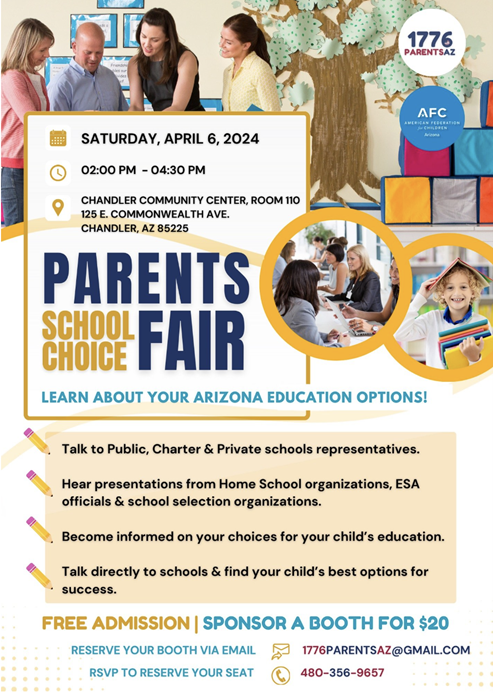
And if you’re free Saturday, April 6 @ 2pm, come learn about your education options here in Arizona. You don’t need to settle for public school. Hope to see you there!
Tiffany is the Founder of Restore Parental Rights in Education, a grassroots advocate for families, educators, and school board members. For nearly two decades, Tiffany’s creative writing pursuits have surpassed most interests as she continues to contribute to her blogBigviewsmallwindow.com. She encourages everyday citizens to take an active role in defending and preserving American values for future generations.
A retired educator once told me, “Parents don’t have rights, they have responsibilities.” Considering this viewpoint alongside the comment below, I can’t find any context in which these statements are appropriate.
In the same vein, former state Governor Terry McAuliffe (D-VA) said, “I don’t think parents should be telling schools what to teach.” Not to mention, the National School Board Association incited FBI Director Merrick Garland to declare war against parents.
In light of all the anti-parental rights sentiments infecting our education system, I declare:
Children are an inheritance, a reward, and a gift from God (Ps. 127:3). Therefore, they belong to their parents/guardians, not government employees. If your beliefs run contrary to this truth, then the following commentary was written with you in mind.
Two incidents lead to my discussion on parental rights in education. The first involves backlash I received after posting this flier in a parent group on social media:
Group members were appalled that I used the page to inform parents of their right to choose how their children are educated. One said, “I wonder what teachers would think?” Another member incoherently stated that teachers were being “used as political pons.” (I think she meant “pawns,” but we’ll blame public education for the error). The elementary shoving match in the comment section revealed that my primary opponent was, in fact, a teacher.
I was pitifully accused of being a “political operative” and called out for not focusing on strengthening relationships in the district. Never mind that I’m one of five people willing to attend board meetings. I’m also willing to find common ground with opposing leaders to improve academic success and student safety.
Our Parental Bill of Rights is one radical majority vote away from destruction. So, if giving parents options to circumvent government schools triggers you, then you’re part of the problem.
The second incident occurred on January 25, 2024, when teacher and Peoria Education Association (PEA) President, Trina Berg, requested public comments be moved to the end of the board meeting. Berg stated:
“My request is that we consider, and you have a discussion, and vote on moving public comments to the end of the board meeting. The reason why is because we have business we have to do. And I would appreciate it if we actually came in and did our business first … People still have the ability to speak on whatever they want, but it’s when business is done.”
Wouldn’t you know that public comments were relocated from position 5.1 to position 9.1 at the February 8 board meeting. Peoria Unified School District (PUSD) Board President Rebecca Proudfit — appointed by the financially compromised Maricopa County Superintendent Steve Watson — led the charge in compliance with Berg’s request.
When confronted about moving the comments, Proudfit claimed some teachers were uncomfortable with the atmosphere at PUSD board meetings. She also said the results of a survey — somehow received by educators but missed by parents — favored changing the meeting format. When pressed further about the timing of her decision, Proudfit said, “[Berg] did email me afterwards to say thank you … But I swear I wouldn’t do anything like that just because someone asked me to do it.”
Bear in mind, this is the same Trina Berg who staged an illegal sick out in defiance of the board’s decision to resume in-person learning after the 2020 winter break. District emails reveal that Berg and her co-conspirator, PEA Treasurer Jessica Batty (also a teacher), planned the union-backed catastrophe. At one point, Berg wrote, “[W]e are trying to show that this decision was especially dumb for retention.”
Berg’s shenanigans — which resulted in the closure of 13 schools — disrupted academic progress and left parents without childcare. So, why wasn’t this activist, posing as a teacher, fired?
The statement, “Teachers are not the primary stakeholders in public education,” is true contractually and financially. This is why teachers’ unions exist. Of course, educators typically have children, own property, and pay taxes in their district. But from a business standpoint, certified staff members do not hold revenue-generating positions — they are paid to provide a community service. For clarification: parents (and constituents) are patrons, students are beneficiaries, teachers are public servants.
Without parents and students, teachers wouldn’t have jobs.
When it comes to directing a child’s education, the law clearly identifies parents as the experts. And whether we consider parents “good” or “bad,” their rights are protected under the United States Constitution. The place of a teacher is to transfer knowledge, not propaganda, and foster an environment that’s conducive to learning, not excessive self-expression.
Communist dictator Vladimir Lenin — the man history deems responsible for the death of 10 million people — is credited with saying, “Give me just one generation of youth, and I’ll transform the whole world.” This is the ideological framework of someone who aims to incite rebellion and break family bonds. I implore leftist educators to reject radical approaches to instruction, abandon hypercritical theories, and, instead, work to form an alliance with parents/guardians.
Finally, I commend sensible and honorable educators who practice transparency, partner with families, and build strong support networks for their students. You are the teachers we can entrust with our youth. Now more than ever, your skills and compassion are needed to shape young minds for the betterment of society and secure the future of our nation.
Tiffany Benson is the Founder of Restore Parental Rights in Education, a grassroots advocate for families, educators, and school board members. For nearly two decades, Tiffany’s creative writing pursuits have surpassed most interests as she continues to contribute to her blog Bigviewsmallwindow.com. She encourages everyday citizens to take an active role in defending and preserving American values for future generations.
For the past three years, the people of Arizona have been forced to deal with the fallout of a struggling economy, rising prices, and an inflation rate that, at one point, was the highest in the country. With this in mind, Republicans got to work, delivering the largest tax cut in state history and following that up with a budget that included tax rebates for Arizona families.
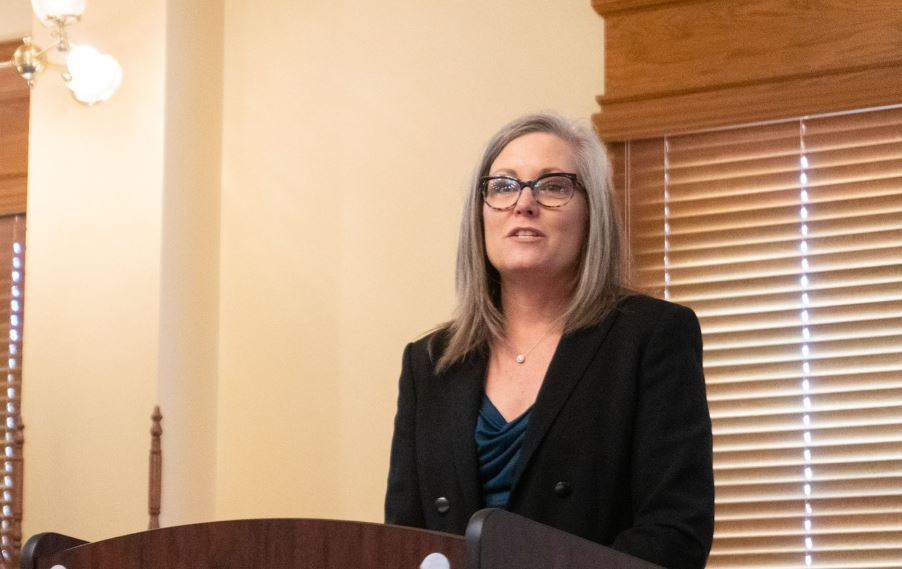
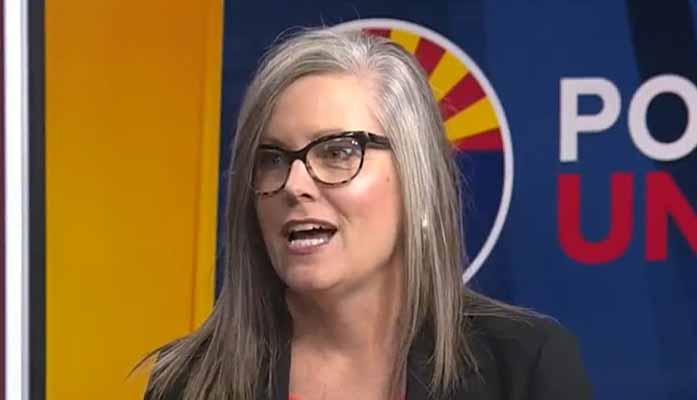
But Governor Katie Hobbs clearly has much different priorities when it comes to your hard-earned money. True to her 10-year history of pulverizing Arizona taxpayers, Hobbs announced during her State of the State address in January her desire to—you guessed it—massively grow the size of state government. And judging by the executive staff hiring spree that Hobbs is on as governor, it’s clear that this isn’t just empty rhetoric…
Gov. Katie Hobbs has introduced legislation that would end the entirety of Arizona’s school choice program come 2032.
On Monday, Hobbs announced the release of the bill, part of a forthcoming package, to bring to heel and then end the Empowerment Scholarship Account (ESA) program.
In the press release announcing the legislation, neither Hobbs nor Democratic leaders mentioned the provision ending the entire ESA Program: both the universal and special education components. The coalition characterized the legislation as containing accountability and transparency measures.
As justification for the legislation, the governor repeated claims of misused ESA funding that have been debunked by Arizona Department of Education (ADE) officials.
“Arizonans deserve to know their taxpayer dollars are being spent giving Arizona children the education they deserve, not on luxury car driving lessons, ski trips, and water park passes,” said Hobbs. “We must bring accountability and transparency to the ESA program.”
The bill, SB1399, was introduced by Sen. Minority Leader Mitzi Epstein (D-LD12). Under the bill, the ESA Program would end on July 1, 2032 unless continued by an act of the legislature approved by the governor.
The bill also would:
Require educators at ESA-funded schools to have a higher education; at least three years of teaching experience; and specialized skills, knowledge, or expertise related to the subject matter of instruction
Require fingerprinting and background checks for ESA-funded educators and tutors
Prohibit sales of items purchased using ESA funds
Require preapproval of transactions of $500 or more
Require the purchase of the least-expensive version of educational goods or services
Require ADE to disclose the legal rights waived by admission to the program
Require ADE to estimate the funds needed for the ESA program for the upcoming fiscal year
Implement additional performance and fiscal reporting requirements for ESA-funded schools
Require ESA-funded schools to adhere to outside individualized education programs or Section 504 plans
Establish annual audits of ESA-funded schools
Establish a legislative committee review of the ESA program to determine its economy and efficiency, achievements and shortcomings
Epstein also didn’t mention the bill’s total eradication of the ESA Program. Rather, the senator indicated that her issue with the ESA Program concerned its universalization.
“The unaccountable government expansion of ESA vouchers has put our state’s financial security, and our students, at risk,” said Epstein. “These commonsense safeguards will be vitally important for giving Arizona children a safe and quality education, and bring the same accountability and oversight to ESAs that we expect for any taxpayer spending.”
Today, @GovernorHobbs joined Senate Democratic Leader @MitziEpstein and House Democratic Leader Lupe Contreras in introducing a package of bills that will increase accountability and transparency in the ESA voucher program.
Similarly, House Minority Leader Lupe Contreras (D-LD22) — anticipated to introduce mirror legislation soon — said that the legislation consisted of “basic standards” for transparency and accountability.
The governor put the legislature on notice of the forthcoming legislative package earlier this month.
The day after Hobbs dropped her legislation, ADE Superintendent Tom Horne released the latest data on the ESA Program. Horne reported a projected surplus of $28 million through the 2024 fiscal year, which ends in June.
Citing the projected surplus, Horne denounced the accusations from Hobbs and Democratic lawmakers that the state’s budget woes were attributable to the ESA Program expansion.
“Whatever budget issues state lawmakers are facing this year, they have not been created by the ESA program or any other aspect of basic state aid for education,” said Horne. “The fact there is a surplus in basic state aid, including the ESA program, demonstrates our commitment to good financial stewardship.”
Matt Beienburg of the Goldwater Institute, a major proponent of the ESA Program, said that Hobbs’ proposal constituted “an all-out assault” on students and their families as well as a “government takeover” of private schools.
“Building off Gov. Hobbs’s recent proposal to rip away 50,000 ESA scholarship awards, this legislation goes even further and would terminate the entire ESA program—including for students with special needs—before thousands of these children even complete their studies,” said Beienburg. “This legislation would impose a government takeover of private school tuition rates and operational decisions, attempting to destroy private education and parental autonomy, forcing thousands of families back into a system they’ve desperately tried to escape.”
Corinne Murdock is a reporter for AZ Free News. Follow her latest on Twitter, or email tips to corinne@azfreenews.com.
Arizona Senate Republicans are throwing a challenge flag over the state’s Democrat Governor’s shocking recognition of School Choice Week.
On Tuesday, the National School Choice Awareness Foundation announced that Governor Katie Hobbs had “officially proclaimed January 21-27 as Arizona School Choice Week.”
The Foundation expressed thankfulness to Hobbs for her ceremonial action, writing, “Governors play a key role in raising school choice awareness, so we’re grateful to Gov. Hobbs for helping Arizona families explore high quality education options.”
This praise for Hobbs earned a sharp retort from the Arizona Senate Republicans Caucus “X” account. They stated, “This has got to be a JOKE, right? Governor Hobbs has been dead set on dismantling Arizona’s universal school choice program since she entered office. She currently wants to pull nearly 50,000 students out of the program as reflected in her budget proposal.”
🤔This has got to be a JOKE, right? Governor Hobbs has been dead set on dismantling Arizona’s universal school choice program since she entered office. She currently wants to pull nearly 50,000 students out of the program, as reflected in her budget proposal. ⬇️⬇️⬇️ https://t.co/yPOQhWmRIG
Cathi Herrod, one of Arizona’s top advocates for family and school choice issues, echoed the sentiments from the State Republicans, posting, “When you think you can’t be surprised by anything that happens, you see this…from a governor trying to do all she can to dismantle school choice. Unreal.”
When you think you can’t be surprised by anything that happens, you see this….from a governor trying to do all she can to dismantle school choice. Unreal. https://t.co/UxGxLkfB0E
Hobbs, perhaps in a show of regret for her published commendation, returned to form on her education position on the same day of the Foundation’s social media post. She shared a clip from her recent State of the State address before the Arizona Legislature, renewing her vow to “address the lack of accountability and transparency in Arizona’s ESA program.”
We must also address the long-term health of our K-12 schools – which means we must address the lack of accountability and transparency in Arizona’s ESA program. pic.twitter.com/euXxDSytHO
Arizona Republicans and Democrats enter the second year of a divided state government at odds over the future of the historic Empowerment Scholarship Accounts (ESA) program. Democrats wanted to reform or end the program in 2023, before Hobbs acquiesced to legislative Republicans in the Fiscal Year 2024 budget compromise, which left these school choice opportunities completely intact. In the aftermath of last year’s budget passage and in her latest State of the State address, Hobbs has redoubled her rhetoric against ESAs as she attempts to rally her base in a pivotal election year for Arizona.
While Democrats have sharpened the political and legislative knives against the ESA program, Arizona Republicans have remained stalwart defenders of all school choice opportunities for families in the Grand Canyon State. Senate President Warren Petersen and House Speaker Ben Toma have led the charge in the state legislature to counter the governor’s actions and to hold the line for the tens of thousands of boys and girls enrolled in the program.
Daniel Stefanski is a reporter for AZ Free News. You can send him news tips using this link.