by Corinne Murdock | Jul 18, 2023 | Education, News
By Corinne Murdock |
Three of the Arizona State University (ASU) professors behind a campaign to oppose an event featuring conservative speakers argue that only inclusive persons belong on university campuses.
In an opinion piece published in the Arizona Republic, the three professors argue that those who reject inclusive ideals were the real threat to debate and therefore should be barred from participating in democratic exchange. The trio — Barrett Honors College professors Jenny Brian, Michael Ostling, and Alex Young — noted that they weren’t opposed to all conservative speakers, referencing a 2018 event featuring conservative legal scholar Robert George.
Earlier this year, the three professors signed onto a letter petitioning Barrett Honors College leadership to oppose an event featuring conservative personalities Dennis Prager, Charlie Kirk, and Robert Kiyosaki. The trio insisted that their original letter wasn’t an attempt to cancel the event, but merely a means of expressing consternation. AZ Free News learned that on-campus marketing of the controversial event was removed following the complaint letter. 37 of 47 Barrett faculty members signed onto the letter.
“By platforming and legitimating their extreme anti-intellectual and anti-democratic views, Barrett will not be furthering the cause of democratic exchange at ASU, but undermining it in ways that could further marginalize the most vulnerable members of our community,” read the letter. “Our collective efforts to promote Barrett as a home for inclusive excellence demand we distance ourselves from the hate that these provocateurs hope to legitimate by attaching themselves to Barrett’s name.”
In terms of reported attempts to recruit students to boycott the event, the three professors denied the charges. The trio added that they held an alternative “teach in” event preceding the T.W. Lewis Center event: “Defending the Public University.”
The three professors also denied responsibility for the dissolution of the T.W. Lewis Center and dismissal of its executive director, Ann Atkinson.
“As Barrett faculty, we see a brighter future for public higher education. We will continue to fight for a university ‘measured not by whom it excludes, but by whom it includes,’” stated the trio. “The ‘antagonistic cooperation’ of democratic exchange in Arizona’s public universities deserves to be defended against those who reject the inclusive ideals that make it possible.”
The letter was met with immediate response from a vocal critic of the Barrett Honors faculty opposed to the T.W. Lewis Center event: ASU humanities professor Owen Anderson. He criticized the three professors’ opinion piece as a poor display of logic and reason.
“[W]hat was their argument? They never gave one (not one that got above informal fallacies),” wrote Anderson. “No professor would give a good grade to a paper like this from a student. How can a professor who thinks this way teach others?”
Corinne Murdock is a reporter for AZ Free News. Follow her latest on Twitter, or email tips to corinne@azfreenews.com.
by AZ Free Enterprise Club | Jul 12, 2023 | Opinion
By the Arizona Free Enterprise Club |
Universities are supposed to be the “marketplace of ideas.” With a “green light” rating from the Foundation for Individual Rights and Expression (FIRE), you would think that Arizona State University (ASU) would understand this. But apparently, the school would rather be just another woke university that shuts down free speech. Now, the T.W. Lewis Center for Personal Development—a center of the Barrett Honors College—and its executive director Ann Atkinson have found out the hard way.
Back in February, Atkinson organized an event on “Health, Wealth, and Happiness” as part of a series from the Lewis Center focused on connecting students with professionals who can offer career and life advice. Speakers for the event included Rich Dad, Poor Dad author Robert Kiyosaki, radio talk show host and founder of Prager U Dennis Prager, founder and president of Turning Point USA Charlie Kirk, and heart-transplant cardiologist Radha Gopalan. For a university that offers classes on subjects like witchcraft and critical theories of sexuality, this event felt pretty tame by comparison. But the mere mention of these conservative speakers caused more than 75 percent of the Barrett Honors College faculty to have a meltdown…
>>> CONTINUE READING >>>
by Corinne Murdock | Jun 17, 2023 | Education, News
By Corinne Murdock |
Arizona State University (ASU) advocated for keeping pornographic LGBTQ+ books in K-12 classrooms.
The university featured commentary from professors on the subject as part of a feature story dedicated to Pride Month issued last week.
“In June, Pride Month is a time to promote inclusivity, raise awareness and celebrate the contributions the LGBTQ+ community has made to society,” read the article.
ASU classified an explicit graphic novel, “Gender Queer: A Memoir,” as an example of a banned book that qualified as a source of knowledge. The book details a wide variety of gay sexual acts and fantasies carried out by minors and adults.
English professor Gabriel Acevedo, who focuses some of his teaching on expanding students’ knowledge of LGBTQ+ literature, said that banning these kinds of books would limit students’ intellectual growth.
“By limiting that knowledge or not providing access to it, we are underestimating the student’s abilities to make choices that fit their lives,” said Acevedo. “We learn by reading. We learn by engaging these topics. If we don’t know these topics (because) we don’t engage with these materials, are we learning?”
School of Social Transformation Justice and Social Inquiry professor Madelaine Adelman said that LGBTQ+ content in K-12 schools is important for fostering acceptance.
“Why would they want to be in a place where they don’t feel accepted? Why would they want to continue their education in that space?” said Adelman.
Adelman co-founded the Phoenix chapter of the Gay Lesbian and Straight Education Network (GLSEN) in 2002 and served as its co-chair until 2013. Adelman was also a founding member of GLSEN’s National Advisory Council in 2004, departing the council in 2013. Adelman joined GLSEN’s Board of Directors in 2010.
The GLSEN Phoenix chapter appears wherever controversy over sexualizing children occurs. Recurring issues arise with GLSEN’s network of Gay-Straight Alliance or Gender-Sexuality Alliance (GSA) clubs in schools. GLSEN Phoenix also conducts LGBTQ+ affirmation training that schools have required teachers to attend, such as Cocopah Middle School.
In December 2021, GLSEN Phoenix urged teachers to create secret libraries to hide controversial or banned content.
Over the last few years, GLSEN has spoken out against bills to protect minors, such as last year’s ban on gender transition surgeries.
The Arizona Department of Education (ADE) had a working relationship with GLSEN under former Superintendent Kathy Hoffman.
ASU and GLSEN have numerous other ties, including the program manager for the Transgender Education Program (TEP), Cammy Bellis. Her work at ASU over the past decade concerned establishing greater awareness and normalization of LGBTQ+ lifestyles in K-12 environments.
One of the GLSEN Phoenix board members who encouraged the creation of secret libraries in schools, Andi Young, recently received her master’s degree in social work from ASU. Young is currently the co-chair of the board, and serves as a therapist/licensed master social worker with Beckstein Behavioral Health. Young describes herself as an “LGBTQ-affirming therapist” that assists teenagers and adults in living their “full, true, authentic selves.”
Corinne Murdock is a reporter for AZ Free News. Follow her latest on Twitter, or email tips to corinne@azfreenews.com.
by Corinne Murdock | Jun 13, 2023 | News
By Corinne Murdock |
The former USA Today editor-in-chief took over the Arizona State University (ASU) initiative to “reimagine” local journalism efforts.
The editor-in-chief, Nicole Carroll, formerly served as editor of The Arizona Republic for nearly 20 years prior to joining USA Today. Both outlets are owned by the Gannett Company, where Carroll also served as president of news.
USA Today hired Carroll following her Pulitzer Prize award for coverage of former President Donald Trump’s border wall plans.
Under Carroll, The Arizona Republic broke precedent by endorsing a Democratic candidate, Hilary Clinton, in the 2016 presidential election. The editorial board at the time asserted that former President Donald Trump wasn’t conservative and therefore not qualified.
“Clinton has the temperament and experience to be president,” wrote the board. “Donald Trump does not.”
In early 2020, just weeks before the declaration of a national emergency over the COVID-19 outbreak, The Arizona Republic said it would no longer endorse candidates.
In a press release, Carroll said that reporters should embrace disruptive solutions when delivering the news.
“We must create and embrace disruptive solutions to engage and empower people with the news and information they need to strengthen our communities and democracy,” said Carroll.
ASU said that Carroll’s role would be to develop new strategies and business models for local reporting through ASU Media Enterprise.
Under Carroll, major articles included what was widely perceived as a hit piece portrayed as news rather than opinion against Supreme Court (SCOTUS) Justice Brett Kavanaugh ahead of his confirmation.
In one of Carroll’s last opinion pieces for USA Today before departing, Carroll featured former SCOTUS Justice Sandra Day O’Connor and discussed how the current SCOTUS erred in overturning Roe v. Wade.
Last summer, Carroll highlighted the USA Today goal of increasing gender and race-based diversity in newsrooms.
Carroll took over for her former longtime colleague: professor and managing program director, Mi-Ai Parrish, who’d most recently served as the publisher for The Arizona Republic. Both Carroll and Parrish served on The Arizona Republic editorial board together.
Together, Parrish and Carroll led on The Arizona Republic’s 2016 Clinton endorsement, along with Arizona Republic columnist Phil Boas.
“Our editorial board’s DNA is strongly conservative,” said Boas.
WATCH THE ARIZONA REPUBLIC’S CLINTON ENDORSEMENT HERE
Parrish was friends with newly-appointed Ninth Circuit Court judge Roopali Desai, casting her as a diversity appointment.
“Interviewing fellow Athena and rockstar pal Judge Roopali Desai, first So. Asian on @US9thCircuit for an Asian Am Wonder Women evening. #truthmatters #justicematters #inclusionmatters,” tweeted Parrish.
ASU Media Enterprise houses Arizona PBS, the public broadcasting channel and platform; Issues in Science in Technology, a public policy forum partnering with the National Academies of Sciences, Engineering, and Medicine; Zocalo Public Square, a humanities journal; Global Sports Matters, a sports publication; Transformations, an online magazine for narrative essays that serves as a publishing channel of the Los Angeles Review of Books; Narrative Storytelling Initiative, a writing projects cohort; Future Tense, a Washington, D.C. partnership with New America and Slate magazine to analyze and project technology’s impact on society; Leonardo, a problem-solving initiative combining the arts, sciences, and technology; KBAQ, a classical public radio station; Digital Audiences Lab, a student-led social media campaign strategy program; Innovation Happens, a student podcast to highlight the diversity of ASU.
Corinne Murdock is a reporter for AZ Free News. Follow her latest on Twitter, or email tips to corinne@azfreenews.com.
by Corinne Murdock | Apr 19, 2023 | Education, News
By Corinne Murdock |
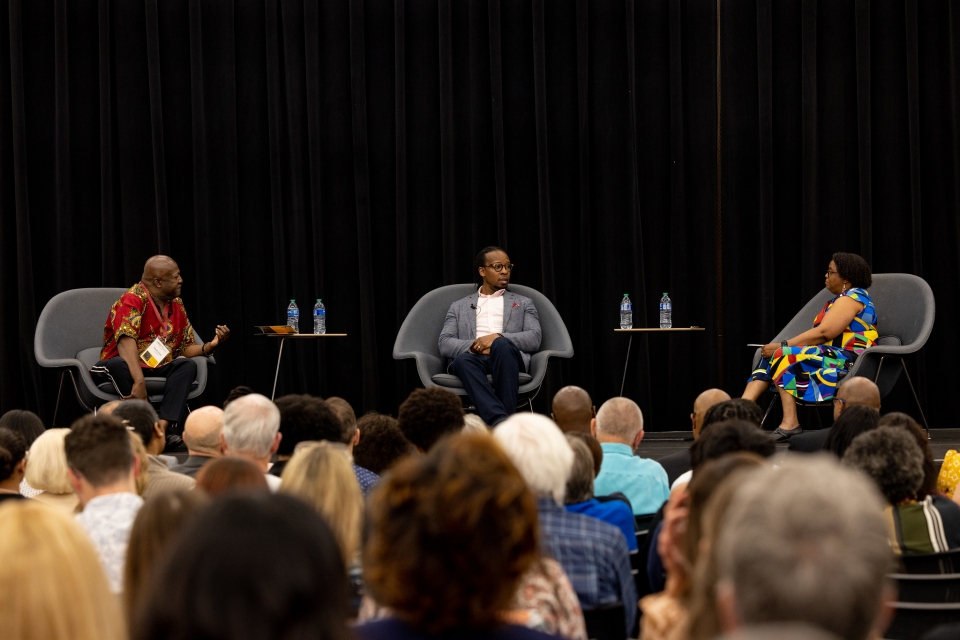
Arizona State University (ASU) featured prominent anti-racist proponent Ibram Kendi last Thursday, who proposed an authoritarian rule by anti-racist elite. Kendi said it wouldn’t be necessary for most of the country to support anti-racism — just those with power to mandate it. ASU characterized this solution and others presented by Kendi last week as the necessary steps for “meaningful change.”
“In order to create a society whereby we have policies and practices that are equitable and just and fair — and provide equal opportunity for all, and institutions that are built on those policies — we don’t necessarily need to create a critical mass of Americans who are anti-racist,” said Kendi. “We just need enough people who can get into positions of power, who will then institute [anti-racist] policies and practices.”
The campus venue for Kendi’s speech had to be relocated, reportedly due to outsized interest in the event. ASU estimated that about 1,200 individuals registered for the event. Kendi was the keynote speaker for the event: ASU’s annual A. Wade Smith and Elsie Moore Memorial Lecture on Race Relations. The College of Liberal Arts and Sciences as well as the School of Social Transformation organized the event.
During his speech, Kendi advocated for reparations for descendants of slaves. He also claimed that Arizona law impedes voting rights for “black, brown, and indigenous people.”
Kendi, a humanities professor and founding director of the Boston University Center for Antiracist Research, has written several books promoting Critical Race Theory (CRT) concepts such as institutional racism and anti-racism. In his 2019 book “How To Be An Antiracist,” Kendi claimed that everything has to do with race.
“There’s no such thing as a non-racist or race-neutral policy,” wrote Kendi.
Moderating Kendi’s speech were School of Social Transformation associate professors David Hinds and Lisa Anderson, also an associate dean in the Graduate College.
Anti-racism has support across the state’s university system. Last summer, a Northern Arizona University (NAU) teacher development affiliate made anti-racism the focus of its annual summer conference. NAU also trained faculty in anti-racism as part of diversity, equity, and inclusion (DEI) efforts.
Support for anti-racism policies and practices has also dictated Arizona’s K-12 schools in the past — though the current Arizona Department of Education administration opposes it. Arizona’s first inductee into the National Teachers Hall of Fame declared that even “nice, white folks” could be racist if they didn’t subscribe to anti-racism, and that teachers opposed to anti-racism shouldn’t be allowed to teach black children.
School districts in recent years have established or supported policies and groups that subscribe to anti-racism, such as Scottsdale Unified School District (SUSD) and Litchfield Elementary School District (LESD).
Corinne Murdock is a reporter for AZ Free News. Follow her latest on Twitter, or email tips to corinne@azfreenews.com.