A couple weeks ago, after Mayor Gallego did her interviews and headed home from the City Council meeting on September 6, she posted a photo on X of her pouring milk from a $7 half-gallon carton into an empty bowl next to a knife. (Because what normal person doesn’t enjoy eating cereal with a knife?)
While Gallego says she is not banning meat, there is no meat in the photo.
There’s been a lot of false info about my work to make PHX more sustainable.
What I’m not doing: ❌ banning meat or milk
What I am doing: ✅ increasing housing options ✅ improving walkability and transit ✅ reducing emissions and energy bills ✅ enjoying cereal pic.twitter.com/ZzViZ3bT0O
What made her post this image with these self-righteous campaign slogans under her Official X account?
The power of Public Comment.
Earlier that day, about a dozen Grassroots citizens attended the Phoenix City Council meeting and told the mayor they do not support policies banning meat.
A constant factor was brought up by multiple public speakers: Gallego is the Vice-Chair of the C40 Cities. According to the C40 Cities website, “C40 is a global network of mayors of the world’s leading cities that are united in action to confront the climate crisis.” C40 has many documents outlining the organization’s desire to reduce and abolish the consumption of meat.
And the citizens don’t want it!
The troubling fact is, on March 4, 2020, Gallego and the Council passed the 2025 Phoenix Food Action Plan. In Strategy 2, under Goal 1, the fifth “Progress on Action” creates a new policy for the Office of Environmental Programs (OEP) at the City of Phoenix to enter a contract with Arizona State University to “establish an AgriFood Tech Incubator in 2023 to accelerate ventures in sustainable food systems…”
But this is nothing new. The City of Phoenix has multiple policies for sustainable food systems in the 2020 Greenhouse Gas Emissions Inventory report conducted by ASU. And Gallego also has many policies tied to ASU. In fact, she is funding and has teamed up with the college for multiple environmental and sustainable projects. What type of environmentally sustainable policies does ASU believe in?
Let’s check out their degrees in “Sustainable Food Systems.” The Bachelor of Science degree states, “Students become effective agents of change” and “Students are engaged in an active community collectively working to achieve the 2030 United Nations Sustainable Development Goals.” The degree for Online Master of Science in Sustainable Food Systems lists Kathleen Merrigan as the leader of the degree program.
According to ASU’s biography page for Merrigan, she is the Kelly and Brian Swette Professor in the School of Sustainability and executive director of the Swette Center for Sustainable Food Systems. She was listed as one of Time magazine’s Top 100 Most Influential People in the World in 2010. And she is a partner in Astanor Ventures along with being an advisor to S2G Ventures—two firms investing in ag-tech innovation. Merrigan also holds a PhD in Public Policy and Environmental Planning from Massachusetts Institute of Technology.
In an article titled, “In Light of Climate Change Debates, ASU Continues Sustainability Efforts,” Merrigan is quoted as saying, “Get rid of the plastic water bottles, eat less meat…” to make ASU more sustainable. Furthermore, ASU has a research program that is teamed up with Merrigan and the Swette Center for Sustainable Food Systems. The program states it is ASU’s desire to find out how to implement “dietary shifts towards plant-based diets” through “interventions.” Peoples’ eating habits in reaction to COVID-19 lockdowns, a major intervention on society, are listed in this document.
Now, consider one major food intervention taken by Mayor Gallego. Just two weeks after passing the 2025 Phoenix Food Action Plan, she decided to lock Phoenix down due to COVID. After the lockdown began, the Medical Director for Disease Control with the Maricopa County Department of Public Health, Dr. Sunenshine, gave public testimony at the March 23, 2020 Phoenix City Council meeting. Dr Sunenshine stated that the Mayor shut the city down without reaching out to her office first. Dr. Sunenshine also said she would have recommended staying open.
Locking down the city implemented the most direct intervention on eating habits we have seen in our lifetime. Shutting down restaurants cut off 50% of our food supply because the government prevents restaurant food from being sold in grocery stores. The lockdown drastically constrained supply, damaged the supply chain for food, and helped lead to the astronomical food prices we see today.
While Gallego is able to say she is not literally banning meat, she is implementing policies that make meat more expensive and will lead to major reductions of meat consumption in the future. Dare I suggest by 2030?
Just to demonstrate that Gallego is implementing an ideology and that this is not isolated to only Phoenix, consider this. On April 24, 2023, Gallego posted a video with Mayor Quinton Lucas from Kansas City celebrating his “first fully-autonomous ride with Waymo.” Does Kansas City have a plan to reduce meat consumption?
Of course, they do! Under Lucas, Kansas City passed its Climate Action Plan in September 2022. Kansas City’s Climate Action Plan Food section in each division of Kansas City lists promoting plant-based diets!
Another city recently popped up in the news cycle. Chicago is possibly going to open city-owned grocery stores, so I looked up their action plans. In 2021, Chicago began reducing red meat from its schools, juvenile detention center, and Chicago Park District menus. The same document identifying Chicago reducing meat claims Chicago wants “to foster more racially and socially equitable supply chains across the region.” They are saying the quiet part out loud! They want to disrupt the supply chain to reduce meat consumption. Now, if Chicago does end up opening city-owned grocery stores, do you think they will sell meat? Absolutely not!
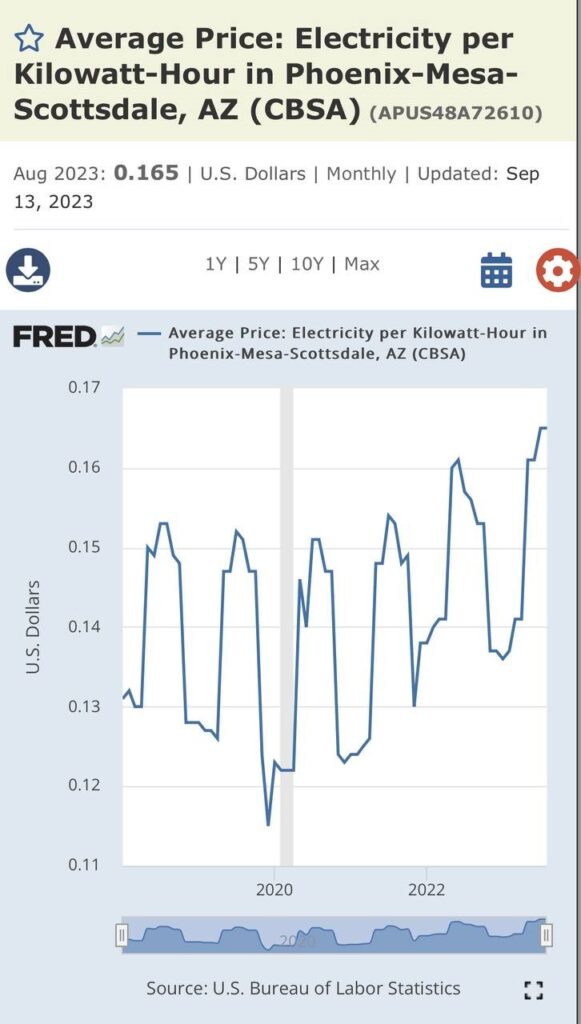
But let’s get back to Mayor Gallego’s post from a little over a week ago. Her claim of reducing energy costs is another bold-faced lie. Gallego teamed up with the “Climate Mayors” from across the country to release an op-ed on September 10, 2023 claiming the implementation of green energy plans have reduced the cost of energy!
But mayors cannot claim they are reducing energy costs! The cost of energy is set by Corporation Commissions with utilities providers. Mayors have nothing to do with the cost of energy.
But let’s pretend they do. The Federal Reserve states that the cost of energy for the Greater Phoenix Area is skyrocketing! It’s higher than any point over the past five years!
The policies Mayor Gallego is implementing are detrimental to our well-being and set to a radical left agenda. They should not be accepted, and they should not be tolerated.
That’s why it’s critical for the people of Phoenix to stand up, speak up, give public comments, and more. It’s the best way to stop these radical policies that price people out of being able to afford meat, interrupt the supply chain of meat, and make energy costs skyrocket.
Jeff Caldwell currently helps with operations at EZAZ.org. He is also a Precinct Captain, State Committeeman, and Precinct Committeeman in Legislative District 2. Jeff is a huge baseball fan who enjoys camping and exploring new, tasty restaurants! You can follow him on X here.
The Department of Defense (DOD) headed to Arizona State University (ASU) this week to seek out more diversity hires.
On Tuesday and Wednesday, the Biden administration’s DOD came through its Taking the Pentagon to the People Program (TTPTTP) initiative. The program was created by the DOD’s Office for Diversity, Equity, and Inclusion (ODEI).
In a press release, ASU advised students that the DOD was seeking out a “diverse workforce.” ASU executive vice president and chief operating officer, Chris Howard, said that the Pentagon was aiming for “inclusive excellence.”
According to a DOD Equity Action Plan from last April, TTPTTP’s express purpose is to “improve racial equity in the U.S., and bolster the ranks and presence of minorities working in DOD.”
The following includes the speakers and recruiters present at the event:
Air Force Civilian Services: Kristine Billings, Affirmative Employment program manager;
Air Force Personnel Center: Ed Bujan, Force Renewal Programs chief recruiter; Crystal Garza, Force Renewal Talent Management Branch Diversity and Inclusion program manager;
Arizona Army National Guard HQ: Lance Leon, executive officer;
Army Combat Capabilities Development Command: Michael Bailey, acting director; Ja-Neen Owens, Technology Integration and Outreach Branch HBCU/MI program manager;
Army Intelligence and Security Command HQ: Michael Nilius, senior exploitation analyst;
DOD Civilian Personnel Advisory Service: Desiree Seifert, associate director; Bruce Bixby, HR Specialist;
DOD Counterintelligence and Security Agency: Israel Sanchez, recruiter; Kevin Lukacs, Developmental Division Team Chief;
DOD Diversity Management Operations Center: Victoria Bowens, Diversity & Inclusion associate director;
DOD Finance and Accounting Service: Maylene Vazquez de Jesus, DFAS Limestone career programs coordinator; Michelle Lugo-Bonet, DEI program manager;
DOD Human Resources Activity: LaTasha Dawkins, Senior Disability Program manager; Sam Drummond, Workforce Recruitment Program director;
DOD Institute of International Education: Michael Saffle, Boren Awards Program specialist;
DOD Language & National Security Education Office: Larry Rentz, principal consultant with Rentz Group;
DOD Logistics Agency: Honney Barner, PEO Strategic Communications & Collegiate Partnerships director; Martina Miles Johnson, R&D operations integrator;
DOD Office of Force Resiliency: Olivia Logan, Violence Prevention Cell communications specialist;
DOD Office of the Under Secretary of Defense for Personnel and Readiness: Charmane Johnson, ODEI;
DOD SMART Scholarship Program: Corinne Beach, deputy program manager;
DOD Threat Reduction Agency: Daisy Valentin, Outreach Program manager; Rudy Chavez, Test Diagnostics Branch engineer; Kiran Shah, Test Diagnostics Branch chief; Jesus Elias, Human Resources Division ABQ chief; Sharon Morrow, small business director; MiChele Stevenson, Mentor-Protege Program manager;
Department of the Air Force: Ed Bujan, Force Renewal Programs chief; Crystal Garza, Diversity and Inclusion program manager;
Department of the Navy: Cache Carter, FA Staffing and Classification section head;
National Guard Bureau: Jacqueline Ray-Morris, DEI Special Emphasis Programs Equal Employment Opportunity manager;
Naval Criminal Investigative Service: Shelagh Hopkins, intern program specialist; Sam Tubb, NCIS Pacific Operations desk officer; Eric Powers, field training agent/investigator;
Office of the Secretary of the Air Force: Jenise Carroll, Office of Diversity and Inclusion deputy director;
Office of Naval Research: Michael Simpson, Naval STEM Grants Program Officer;
Prevention Workforce Representative: Elizabeth Gaylor, prevention researcher; Laura Neely, senior research psychologist; Olivia Logan, communications specialist;
U.S. Army Intelligence and Security Command HQ: Rita Scamurra, HR specialist; Ken Schimpf, offensive cyber capability developer; Michael Nilius, senior exploitation analyst;
Washington Headquarters Services: Mary Michelle Eveleigh, Human Services Directorate Talent Acquisitions and Outreach Branch chief recruiter;
White House Initiative on Advancing Educational Equity, Excellence, and Economic Opportunity for Hispanics: Melody Gonzales, executive director; Emmanuel Caudillo, Management and Program analyst; Kevin Lima, deputy director; Jasmin Chavez, confidential assistant
Work-Life and Special Programs Division: Mininia Hawkins, Work-Life and Special Programs Division chief
Corinne Murdock is a reporter for AZ Free News. Follow her latest on Twitter, or email tips to corinne@azfreenews.com.
A professor hailing from China with a World Economic Forum (WEF) background is behind critical race and gender theory research on children at two of Arizona’s taxpayer-funded universities.
Sonya Xinyue Xiao teaches psychological science and performs developmental research on moral and gender development at Northern Arizona University (NAU). Xiao was a postdoctoral scholar at the Arizona State University (ASU) T. Denny Sanford School of Social and Family Dynamics (SSFD) from 2020 to 2022, where she taught until last year. NAU has Xiao on a tenure track.
Presently, Xiao is also an affiliated research fellow for the Cultural Resilience and Learning Center (CRLC) in California and a member of the Diversity Scholars Network in the National Center for Institutional Diversity at the University of Michigan (UM). Xiao’s UM profile declares her social priority on children, youth, and families, with her specific focus pertaining to that priority on gender, sexuality, sexual orientation, race, ethnicity, social class, and socioeconomic status.
“[Xiao] is investigating how early adolescents’ multiple intersecting identities in gender and race/ethnicity are related to their prosocial behavior toward diverse others over time, with youth from diverse ethnic racial backgrounds,” stated her UM profile.
Additionally, Xiao has served as the programming committee member for the Sexual Orientation, Gender Identity and Expression (SOGIE) Caucus of the Society for Research in Child Development (SRCD) since 2021. The SRCD has repeatedly opposed efforts to restrict or ban gender transitions for minors.
Xiao’s published research papers have declared the need for parents to raise their children to embrace gender theory in themselves and their peers, under the claim that rejection results in poor social and emotional outcomes later in life, as well as to engage their children in diverse friendships, under the claim that those as young as preschoolers can be racist.
Characteristics aligning with progressive critical race and gender theories are what Xiao defines as “prosocial behaviors” throughout her research.
Finally, the last paper I started in grad school class on #gender is out in time for #PrideMonth! I was auditing carol's gender class, and that was the semester when covid hit….The paper has been in submission for 14months! Nonpaywalled version here: https://t.co/VEHUH7WEtN
— Sonya Xinyue Xiao, Ph.D. (@SonyaXinyueXiao) May 30, 2023
Last year, Xiao contributed to a chapter entry in a book, “Gender and Sexuality Development.” The chapter expanded the understanding of gender to many gender identities.
Check out this new meta-analysis on understanding predictors of prejudice toward trans individuals 👏 The authors tested 15 predictors, all but one are important (e.g.,political orientation, social dominance orientation, religiosity, gender essentialism) https://t.co/Q16biGeq2m
Xiao’s work includes “gender integration,” which studies the differences between genders with the ultimate goal of total integration. Xiao’s team with the T. Denny Sanford School of Social and Family Dynamics (SSSFD) holds the belief that gender is fluid and not binary; they receive federal funding through the Institute of Education Sciences (IES).
Xiao’s research has also relied on participants’ self-reported gender identities. Elsewhere, her current research team’s most recent release of preliminary findings asked children “how much they think they look like girls and how much they think they look like boys,” and reported that 10 percent thought they looked like both genders, and nearly one percent believing they didn’t look like either gender.
we are doing school-based research in AZ now and ask an open-ended question "what's your gender?” and the reader/experimenter says "for example, I am a girl."
In May, Xiao’s work on gender integration was featured in an IES blog series focusing on “research conducted through an equity lens.” SSSFD professor Carol Martin said that their work aims to achieve diversity, equity, and inclusion in education. Martin further insisted that teachers need to break up naturally-occuring gender segregation in their students to encourage diversity.
“We study the importance of having diverse classrooms (mixed-gender in our case) and breaking down barriers that separate people from each other but stress that this diversity matters only when it is perceived as inclusive and fosters a sense of belonging,” said Martin. “For some students, additional supports might be needed to feel included, and we hope to identify which students may need these additional supports and what types of support they need to promote equity in classrooms around issues of social belongingness.”
— Sonya Xinyue Xiao, Ph.D. (@SonyaXinyueXiao) May 6, 2023
According to her LinkedIn, Xiao attended Tianjin University of Science and Technology before beginning her career as a teacher at Zhenguang Primary School in Shanghai, China. While at Tianjin, Xiao had two notable back-to-back volunteering stints in 2010: first, a two-month gig at the Shanghai World EXPO 2010, then a month-long gig at the World Economic Forum (WEF) Summer Davos. For the latter gig with the WEF, Xiao reported providing document and verbal translation at the Lishunde Hotel, as well as assistance to conference attendees.
China’s practice of its cultural subversion tactics on U.S. soil, especially involving children, have been widely reported over the years, most recently concerning TikTok. While the Beijing-based company behind the app pushes content ranging from the mind-numbing to dangerous to foreigners, it restricts Chinese youth to a domestic version, Douyin, which contains only educational and inspirational content. In its short existence, TikTok has become a major influence in American children’s development.
Papers published while at ASU or NAU where Xiao was the principal author are listed below:
Xiao has also contributed in over a dozen other research papers uplifting critical race and gender theories, as well as promoting “nurturant parenting,” described as inductive discipline and punishment avoidance, versus the disciplinary model of “restrictive parenting,” described as punitiveness, corporal punishment, and strictness. That paper on nurturant versus restrictive parenting further advised that white parents should avoid restrictive parenting to ensure their children behaved better toward non-white peers.
Other papers to which Xiao contributed argued that white parents who claimed to be color-blind or were displaying evidence of “implicit racial bias” caused their children to have less empathy toward Black children.
A survey conducted in part by Arizona State University (ASU) researchers revealed that a majority of Arizonans, Californians, and Texans oppose “trans rights.”
The survey is the latest from a joint polling project among researchers from ASU, Stanford University, and the University of Houston.
According to the survey, a majority of Arizonans opposed the idea of gender identity dictating bathroom usage by 54 percent, women’s sports participation by 63 percent, and minors receiving gender transition surgery and drugs by 51 percent.
The researchers remarked that this pattern of majority opposition to gender ideology dictating bathroom usage, sports participation, and medical procedures existed from the blue state of California, the purple state of Arizona, to the red state of Texas.
Independents in Arizona — now the largest voting population — opposed gender ideology dictating bathroom usage by 48 percent, women’s sports participation by 65 percent, and minors receiving gender transition surgery and drugs by 46 percent.
Most Democrats in Arizona, as well as Texas and California, believed gender ideology should dictate bathroom usage, but were more evenly divided when it came to participation in women’s sports. Most Democrats opposed bans on gender transition procedures for minors, though there were a higher percentage of those unsure on the issue than their Republican counterparts.
The study also reflected that women were more likely than men to support gender ideology determining bathroom usage, women’s sports participation, and minors receiving gender transition procedures across all three states.
Additionally, those with higher levels of education were more likely to support gender ideology determining bathroom usage across all three states: those with high school degrees were less supportive than those with some college education, and those with some college education were less supportive than those with four years of college education or a postgraduate degree. However, for women’s sports and minors receiving gender transition procedures, no significant differences were noted.
The researchers also reported that the presence or absence of religious beliefs served as a strong indicator whether an individual supported or opposed gender ideology.
“Across the red, purple and blue states of Texas, Arizona and California, residents who regularly attend religious services are significantly more likely than those residents who never attend religious services to support policies that restrict the ability of transgender people to choose which bathroom to use, participate in women’s sporting events, and (for children) receive gender-affirming medical treatment,” stated the survey report.
Over 1,000 Arizonans participated in the survey: the second in a series of five surveys, the first of which was on abortion. There, a majority across all three states expressed support for abortion with little or no restrictions (62 percent of Arizonans, 69 percent of Californians, and 54 percent of Texans).
Corinne Murdock is a reporter for AZ Free News. Follow her latest on Twitter, or email tips to corinne@azfreenews.com.
Higher education, ideally a bastion of free thought and inquiry, should eagerly embrace a multitude of voices and perspectives—we usually call that thinking and learning. Yet, in practice, the ubiquitous doctrines of inclusion inscribed into university charters are not without exceptions. These exceptions materialize from the judgments of self-appointed arbiters of speech, who wield the authority to classify ideas and individuals as hateful and unsafe as they break from a general orthodoxy of perspective. Disguised as protections of students from pernicious notions, these arbiters diligently strive to condemn, censor, and chill speech they do not like – while university leadership does nothing.
I experienced this exact condemnation when I orchestrated a university-sanctioned event in my capacity as the Executive Director of the T.W. Lewis Center for Personal Development at ASU’s Barrett Honors College. The event, titled “Health, Wealth, and Happiness,” took place at ASU Gammage Auditorium on February 8, 2023. Esteemed experts joined the panel, with Dr. Radha Gopalan, a distinguished heart transplant cardiologist, engaging on health; Robert Kiyosaki, expert on money and the acclaimed author of “Rich Dad Poor Dad,” delving into wealth; and Dennis Prager, co-founder of PragerU and, for over 40 years running, a nationally syndicated radio host, addressing happiness. Complementing the panelists were speakers Charlie Kirk, the visionary behind Turning Point USA, and Tom Lewis, a notable businessman, philanthropist, and namesake donor of the Lewis Center.
At Arizona State University (ASU), the culture of arbitration of speech has infiltrated deeply. This might come as a surprise given ASU’s acclaimed reputation for its free speech policies and its president’s commitment to this cause. In June, I published editorials in the Wall Street Journal“I Paid for Free Speech at Arizona State” and in the National Review, “Some Universities Care About Free Speech…Until They Don’t,” in which I revealed the free speech crisis at ASU’s Barrett Honors College while I also praised ASU for its free speech policies, at least as they state them on paper. I had hoped for a steadfast defense against blatant infringements on free speech that undermine ASU’s policies and declarations. Regrettably, my optimism faded. With each day, ASU’s actions, or lack thereof, erode my confidence in their stated defense of free speech.
It is imperative to grasp the suppression of speech in our academic institutions and to fully comprehend the essence of true freedom of thought which can only come from true freedom of speech. Only then can we embark on endeavors that genuinely promote the education and advancement of society.
ASU President Michael Crow may declare that “speakers speak at ASU,” but can we truly consider speech as free when over 80% of the faculty retaliates against speech they deem “wrong”? Do free speech ideals hold when deans prescribe limitations on speakers’ speech? Can we claim freedom of speech when marketing materials are removed due to faculty offense, while contrasting viewpoints bask in promotional spotlight? Is speech uninhibited when professors dedicate valuable class time to condemn the speech of other units? Does true free speech persist when professors discourage student participation in an event? And then stand vigilantly at the event entrance, watching attendees approach. Can we genuinely say that speech is free when college deans fire leaders and dismantle centers that uphold values no longer in harmony with the college’s leanings? The resounding answer is no. This is free speech under siege.
On August 3, 2023, a group of scholars who convened at Princeton established the “Princeton Principles for a Campus Culture of Free Inquiry.” This assembly distinctly underscores the pressing predicament faced by numerous higher education institutions that falter in upholding cultures of robust and uninhibited speech.
The Princeton Principles squarely confront this concern: “Some members of the university community argue that robust freedom of inquiry permits speech that can ‘harm’ students’ well-being or hinder institutional efforts to attain particular conceptions of social justice or ‘diversity, equity, and inclusion.’”
The case of the Lewis Center is illustrative, with 39 of the 47 Barrett Honors College faculty launching a nationwide condemnation campaign against the Health, Wealth, and Happiness program, speakers, donors, and staff. The Barrett deans actively endorsed this campaign and exercised censorship of speech the faculty found objectionable. The campaign led to intimidations and firings, which is to say prices to pay—sanctions—for exercising free inquiry and speech.
Having policies and ratings extolling free speech alone isn’t enough if university leadership doesn’t enforce their own standards. My experiences at ASU revealed a bureaucratic machinery that prioritizes safeguarding the institution’s interests over addressing free speech violations. I spent months reporting these violations internally and escalated the matter to ASU’s upper echelons and even testified in a legislative hearing. As of mid-August 2023, ASU and its board maintain that they have discovered “a series of examples of unfettered free speech,” aligning with the arbiters.
Self-governance alone proves inadequate in safeguarding our First Amendment rights on campus. The arbiters of speech are not likely to relinquish their control in the absence of decisive action by leadership. The responsibility rests upon parents, students, donors, the media, concerned citizens, and elected officials to unite and reestablish freedom of speech without fear of retribution, for there is no freedom of anything if it comes with a penalty for its exercise, including speech.
The Princeton Principles underscore that “If there is clear and convincing evidence that faculty members and administrators are not adequately fulfilling their responsibilities to foster and defend a culture of free inquiry on campus, other agents including regents, trustees, students, and alumni groups in the wider campus network may and indeed should become involved.”
Gratitude must be extended to parents, students, alumni, donors, lawmakers, and concerned citizens for following this story who rallied behind the cause of free speech. Special acknowledgment should be given to leaders like Arizona Senator Anthony Kern and State Representative Quang Nguyen for co-chairing the Joint Legislative Ad Hoc Committee on the Freedom of Expression at Arizona’s Public Universities. And sincere thanks should be extended to Arizona Speaker of the House Ben Toma and Arizona Senate President Warren Petersen for their unwavering support of free speech for all.
Despite receiving broad support, sustained vigilance is imperative. We must persist in recognizing speech suppression and holding university leadership accountable for defending the realm of free speech, even for ideas deemed offensive, such as, laughably, health, wealth, and happiness.
Ann Atkinson can be reached at her Twitter handle, @Ann_Atkinson_AZ.