by Brian Anderson | Oct 18, 2022 | Opinion
By Brian Anderson |
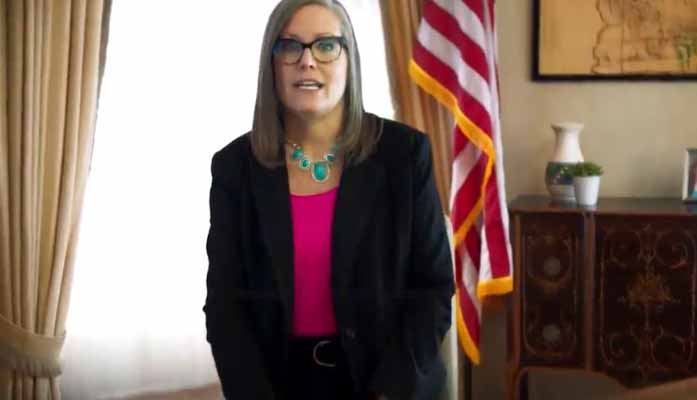
“The debate debacle continues this morning,” the TV anchor said, laughing. “The never-ending story of Democratic candidate Katie Hobbs choosing not to debate her opponent, Kari Lake.”
That’s what Arizona voters heard last week as they woke up and turned on one of Phoenix’s most popular morning news programs. They’ve been hearing it for months.
Hobbs’ refusal to debate Lake, the Republican nominee, has become the defining story of the gubernatorial race, one that started out as a 20-year precedent-breaking decision and has morphed a larger-than-life narrative about the Democrat’s political judgment and skittishness, with multiple left-leaning media outlets, from MSNBC and The View to the Arizona Republic and the New York Times, all asking the same question: What in the world is she thinking?
Hobbs claims it’s because her opponent is too far to the right. In reality, her national headline-making stage fright has been going on for much longer than the general election.
It began in April when Hobbs declined to participate in a June 30th debate with her Democratic primary opponent Marco López, the former mayor of Nogales and chief of staff at U.S. Customs and Border Protection under President Barack Obama. With one exception, Hobbs was the only statewide candidate in Arizona who declined. López used light political pressure hoping to change her mind — he’d often ask the crowd: “¿Dónde está Katie?” — but, when approached by the local press in May, Hobbs’ campaign claimed that she had (conveniently) scheduled “multiple events in Tucson” on June 30th and couldn’t make the two-hour drive back to Phoenix.
López understood. So, he wrote a letter to the Citizens Clean Elections Commission, the government body that organized the debate, granting it permission to “reschedule the debate to a time and date that fits into the Secretary’s busy schedule” over the next 40-plus days. Hobbs declined to reschedule.
When June 30th arrived, a local reporter reached out to Hobbs for comment on her absence. She must have been pretty busy that day, what with “multiple events in Tucson.” But why were no photographs posted online? Oh, about those events, her campaign responded … um, they were canceled. The candidate had come down with a (convenient) case of COVID.
Three days later, Hobbs was spotted, mask-less, waving a flag at a crowded parade in Flagstaff. A superb immune system, indeed.
It wasn’t long after the general election began that Hobbs announced she would not be debating Lake, either. Instead, the Democrat demanded separate one-on-one TV interviews — but that’s not how the Clean Elections process works. Candidates who bow out are not rewarded for doing so. Hobbs insisted that Lake would create a spectacle if the debate format were not right, so the Commission held a formal meeting to appease her, during which its chairman asked her campaign manager point-blank: “Is there any scenario where Ms. Hobbs will share the stage with Ms. Lake in a debate?”
She dismissed his “hypothetical” question and refused to offer an alternate format, and the Commission ruled that the October 12th debate would go on with or without the Democrat in attendance. (Lake said that her opponent was free to change her mind at any time.)
The morning of October 12th, Hobbs joined MSNBC for a softball segment … a little too soft. Because Hobbs got a little too comfortable and accidentally blabbed to the host, as if in the middle of a private conversation, that “PBS is also giving me the same format that Kari Lake has.”
Oops. That secret arrangement wasn’t supposed to come out until after Lake’s interview that evening.
You see, Arizona PBS is the Commission’s official broadcast partner, a relationship that provides the station with unique access to high-profile debates in exchange for complying with the Commission’s rulings when candidates disagree. It turned out that Arizona PBS had struck a side-deal with the Hobbs campaign to shoot and air the one-on-one interview she’d been begging for, right as voters received their early ballots.
The Commission had no clue that the station violated its agreement — and wouldn’t have until it was too late, had Hobbs not accidentally revealed it on live TV. The Commission was forced to cancel the long-planned debate with hours to spare in order to find a new broadcast partner it could trust. In response, Lake held a press conference condemning Arizona PBS’ “backroom deal” with Hobbs, which a source informed her was made at the behest of Michael Crow, the politically connected and contentious president of Arizona State University. (ASU owns and operates Arizona PBS.)
Approached for comment the next morning, Crow denied directing the backroom deal with Hobbs but acknowledged that “he let his preference be known” to the station (which I am certain Arizona PBS interpreted in the exact way that Crow meant it). The Commission’s executive director described himself as “bewildered” by Crow’s political meddling — casting him as “the most powerful man in Arizona” other than the governor — and decried the appearance that “ASU was playing favorites with the candidates.”
Much like Crow, Mi-Ai Parrish, a managing director at ASU who helps oversee Arizona PBS, also “wouldn’t say who made the call to invite” the Democrat. Hobbs herself is similarly claiming now that “I wasn’t involved in those conversations” with ASU — which, again, is a strange series of denials coming from several people who insist they did the right thing.
A Republican state legislator has already announced plans to file a bill that will strip the state’s ties to Arizona PBS as a result of it circumventing the Clean Elections ruling. And, unfortunately for ASU, it doesn’t appear that Hobbs will be in a position to veto it.
Outside of vomiting on herself on-stage, I cannot fathom a single humiliation Hobbs could have endured in a 30-minute debate that would have been worse than the six-month headache of negative headlines her refusal has caused. Two separate polls released this month reflect that reality, finding that the Republican nominee enjoys a 3-point lead heading into Election Day, with even CNN’s Dana Bash acknowledging Monday that “the fact that [Hobbs] won’t debate has given Kari Lake a very wide opening.”
At the end of the day, Arizonans vote for who shows up — and, so far, Katie Hobbs hasn’t.
Brian Anderson is founder of the Saguaro Group, an Arizona-based political research firm.
by Corinne Murdock | Sep 19, 2022 | Education, News
By Corinne Murdock |
Last week, Arizona State University (ASU) launched a hate speech surveillance campaign with assistance from the federal government.
ASU’s McCain Institute received support from the Department of Homeland Security (DHS) Targeted Violence and Terrorism Prevention (TVTP) Grant Program to launch SCREEN Hate, an effort to monitor youths’ online activity. The institute told parents and caregivers that it was only a matter of time before the minors in their lives were discovered and corrupted by hate online.
“Trusting that your family’s values will protect them is not enough,” warned the campaign site.
The campaign resources came from DHS and leftist organizations like the Southern Poverty Law Center (SPLC), the Anti-Defamation League (ADL), UNESCO, Common Sense Media, and the National School Boards Association (NSBA).
The NSBA coordinated with the Biden administration to investigate parents and community members for domestic terrorism based on their school board activism. When reporters discovered this coordination between the DOJ and NSBA, the NSBA issued an apology letter that they later backdated on their website weeks after our reporting pointed out the letter’s absence online. It was only when the NSBA uploaded and backdated its apology letter that they deleted their celebratory press release about the Biden administration heeding their petition to investigate parents.
One of the SPLC resources insinuated that devout Christians constituted extremist beliefs.
“Extremist beliefs say that one group of people is in dire conflict with other groups who don’t share the same racial or ethnic, gender or sexual, religious, or political identity,” stated SPLC. “Extremists believe that this imagined conflict can only be through separation, domination, or violence between groups.”
One resource from UNESCO advises individuals on how to “stop the spread of conspiracy theories.” The organization asserts that the world can’t be divided into objective good or bad, and that no powerful forces with negative intent are secretly manipulating events.
Another resource, from the ADL, framed the 2020 George Floyd riots as peaceful protests, and those opposed to the rioters as white supremacists and extremists. The resource, “White Supremacy Search Trends in the United States,” also claimed that white supremacy was behind the January 6 protest at the Capitol.
Search trends that the ADL deemed “white supremacist” included any inquiries about the truth behind the Black Lives Matter (BLM) organization. The organization also declared that search trends reflecting concerns about the “great replacement theory” were rooted in conspiracy. ADL said that Arizona was the third in the top ten states it deemed to have the highest consumption of extremist content.
SCREEN Hate directs individuals to download the “Resilience Net” app in order to access a directory of practitioners who specialize in violence and terrorism prevention. It’s part of the One World Online Resilience Center (OWORC), a DHS-funded initiative from the Massachusetts-based organization founded by Boston Marathon survivors, One World Strong.
SCREEN Hate is the latest initiative of the McCain Institute’s Preventing Targeted Violence Program, which mainly focuses on combating right-wing extremists and white supremacy. The McCain Institute attributes the program’s focus to the DHS declaration that white supremacists were the biggest threat to the U.S., citing the 2020 Homeland Threat Assessment.
The Biden administration has labeled Americans supportive of former President Donald Trump as “MAGA Republicans” that present a “clear and present danger” to the country.
“Donald Trump and the MAGA Republicans represent an extremism that threatens the very foundations of our republic,” declared Biden. “MAGA Republicans do not respect the Constitution. They do not believe in the rule of law. They do not recognize the will of the people.”
During Sunday’s speech commemorating the 21st anniversary of 9/11, Biden alluded to his administration’s focus on rooting out present domestic terror threats at home.
That same day, Vice President Kamala Harris clarified Biden’s intent in a subsequent interview with MSNBC. The pair discussed the Biden administration’s focus on combating the “threat from within,” which Harris concurred was comparable to 9/11.
“I think [that threat] is very dangerous and I think it is very harmful. And it makes us weaker,” said Harris.
Corinne Murdock is a reporter for AZ Free News. Follow her latest on Twitter, or email tips to corinne@azfreenews.com.
by Corinne Murdock | Aug 30, 2022 | Education, News
By Corinne Murdock |
Arizona State University (ASU) won’t disclose the full scope of its hiring decisions resulting in four women leading STEM-related schools and a department within the last 18 months.
ASU acknowledged a hiring pattern earlier this month when it published a feature article contextualizing the exclusively female appointments as “leading the charge for more diversity in STEM.” The hires were Tijana Rajh, made director of the School of Molecular Sciences; Donatella Danielli, made director of the School of Mathematical and Statistical Sciences; Patricia Rankin, made chair of the Department of Physics; and Nancy Manley, made director of the School of Life Sciences.
The article doesn’t mention the professional accomplishments of these women. Instead, the article focused on how the women felt undermined in STEM through a glass ceiling, an “old boys club,” bias, and the sexism of male colleagues doubting their abilities. The article did mention the women’s equity-related accomplishments such as organizing panels on women in math leadership and stocking female sanitary products in the bathrooms.
ASU expressed a goal of balancing the proportions of women and men leading and studying STEM-related subjects. However, ASU stated that gender didn’t play a role in their hires of Rajh, Danielli, Rankin, and Manley.
“ASU is out to change those numbers – and, as evidenced by the hirings of Rajh, Danielli, Rankin and Manley — in a meaningful way,” read the article.
When AZ Free News reached out to ASU, spokesman Jay Thorne said that the university doesn’t comment on individuals who weren’t hired.
“The four women noted in the story were hired, some of them quite some time ago, in an open competitive process, each from highly credible institutions. Not much else to say that wasn’t in the story,” said Thorne. “If there is another particular angle you are interested in, let me know. Otherwise, the story speaks for itself and the university has no comment about other candidates for these positions.”
When we requested further background on why the four women were chosen at the exclusion of other, possibly male candidates, noting that the entirety of the article focused on the women shattering glass ceilings and overcoming sexism without mentioning any of their accomplishments, this was the only response we received:
“Yep. Understood. Fair enough. Thank you,” wrote Thorne.
Although Thorne wrote that ASU doesn’t comment on those who weren’t hired, College of Liberal Arts and Sciences dean Patrick Kenney felt it necessary in the article to disclose that men were rejected.
ASU also revealed in the feature article that both tenure and non-tenure track female faculty increased in other STEM areas, namely the School of Molecular Sciences.
Corinne Murdock is a reporter for AZ Free News. Follow her latest on Twitter, or email tips to corinne@azfreenews.com.
by Corinne Murdock | Jun 13, 2022 | Education, News
By Corinne Murdock |
Of nearly 400 national universities, none of Arizona’s three public universities broke the top 100 on the latest rankings of national universities. The lowest-ranked school was Northern Arizona University (NAU) at 288, followed by Arizona State University (ASU) at 117, and then University of Arizona (UArizona) at 103.
This data came from the U.S. News 2022 college rankings.
NAU tied for their 288 ranking with 10 other schools, barely eking out a ranking at all. After 288, U.S. News ranked each school without specificity in a range of 299 to 391. Among those not given a specific ranking were University of Phoenix and Grand Canyon University.
The 10 schools tied with NAU were Dallas Baptist University in Texas, East Tennessee State University, Long Island University in New York, Marshall University in West Virginia, Middle Tennessee State University, Portland State University in Oregon, South Dakota State University, University of Hawaii at Hilo, University of Puerto Rico – Rico Piedras, and University of Texas at Arlington.
NAU averaged a six-year graduation rate of 55 percent, with those who didn’t receive a Pell Grant doing better (61 percent) than those who did (50 percent).
NAU’s median starting salary for alumni is $48,100, and average an acceptance rate of 82 percent.
ASU tied for their 117 ranking with four other schools: Rochester Institute of Technology in New York, SUNY College of Environmental Science and Forestry in New York, University of South Carolina, and University of Vermont.
ASU averaged a six-year graduation rate of 69 percent, with those who didn’t receive a Pell Grant doing better (71 percent) than those who did (59 percent).
ASU ranked 1 for most innovative school, 10 for best undergraduate teaching, tied at 54 for top public schools, tied at 70 for best colleges for veterans, 139 for best value schools, and tied at 179 for top performers on social mobility.
ASU’s median starting salary for alumni is $54,400, and average an acceptance rate of 88 percent.
UArizona tied for their 103 ranking with 13 other schools: Clark University in Massachusetts, Creighton University in Nebraska, Drexel University in Pennsylvania, Loyola University Chicago in Illinois, Miami University in Ohio, New Jersey Institute of Technology, Saint Louis University in Missouri, Temple University in Pennsylvania, University of California Santa Cruz, University of Illinois Chicago, University of San Francisco in California, University of South Florida, and University of Tennessee Knoxville.
UArizona averaged a six-year graduation rate of 64 percent, with those who didn’t receive a Pell Grant doing better (68 percent) than those who did (59 percent).
UArizona tied at 46 for most innovative school and for top public school, tied at 62 for best colleges for veterans, ranked 122 for best value school, and tied at 143 for top performers on social mobility.
UArizona’s median starting salary for alumni is $55,600, and average an acceptance rate of 85 percent.
The top ten national universities were, in order: Princeton University ranked at 1; Columbia University, Harvard University, and Massachusetts Institute of Technology tied at 2; Yale University ranked at 5; Stanford University and University of Chicago tied at 6; University of Pennsylvania ranked at 8; and California Institute of Technology, Duke University, Johns Hopkins University, and Northwestern University tied at 9.
The remaining three of the eight Ivy League schools — Brown University, Cornell University, and Dartmouth College — fell outside the top 10 but ranked within the top 20.
Corinne Murdock is a reporter for AZ Free News. Follow her latest on Twitter, or email tips to corinne@azfreenews.com.
by Corinne Murdock | Apr 21, 2022 | News
By Corinne Murdock |
A Democrat-backed nonprofit wants State Representative Mark Finchem (R-Oro Valley), Congressman Andy Biggs (R-AZ-05), and Congressman Paul Gosar (R-AZ-04) disqualified from the upcoming midterm election for organizing the January 6 protest.
Arizona State University (ASU) law professor and legal expert Ilan Wurman told “The Conservative Circus” that the lawsuit not only misinterprets constitutional law but represents the bad habit of both parties to weaponize the Constitution.
“Just after the Civil War, this clause of the Fourteenth Amendment was enacted to prevent individuals who had been office holders, federal and state office holders, who had taken an oath to uphold the Constitution, who then seceded from the Union, unconstitutionally seceded from the Union, and then took up arms against the government of the United States. By the way, that is an insurrection,” explained Wurman.
The nonprofit, Free Speech for People, invoked the Fourteenth Amendment to argue that Finchem, Biggs, and Gosar were responsible for the U.S. Capitol intrusion because they helped organize the preceding protest.
The lawsuit against Finchem, Biggs, and Gosar is part of a national campaign to “ban insurrectionists from the ballot” under Section 3 of the Fourteenth Amendment: the “14Point3 Campaign.” Congresswoman Marjorie Taylor Greene (R-GA-14) and Congressman Madison Cawthorn (R-NC-11) also face lawsuits under the campaign. Last month, a federal judge in North Carolina ruled in favor of Cawthorn.
Section 3 of the Fourteenth Amendment reads as follows:
“No person shall be a Senator or Representative in Congress, or elector of President and Vice-President, or hold any office, civil or military, under the United States, or under any State, who, having previously taken an oath, as a member of Congress, or as an officer of the United States, or as a member of any State legislature, or as an executive or judicial officer of any State, to support the Constitution of the United States, shall have engaged in insurrection or rebellion against the same, or given aid or comfort to the enemies thereof. But Congress may by a vote of two-thirds of each House, remove such disability.”
The nonprofit behind the lawsuit, Free Speech for People, also filed another lawsuit last month against the Federal Election Commission (FEC) concerning the debunked Russiagate collusion.
Finchem called the lawsuits “desperate.”
Corinne Murdock is a reporter for AZ Free News. Follow her latest on Twitter, or email tips to corinne@azfreenews.com.