by Staff Reporter | Feb 8, 2026 | News
By Staff Reporter |
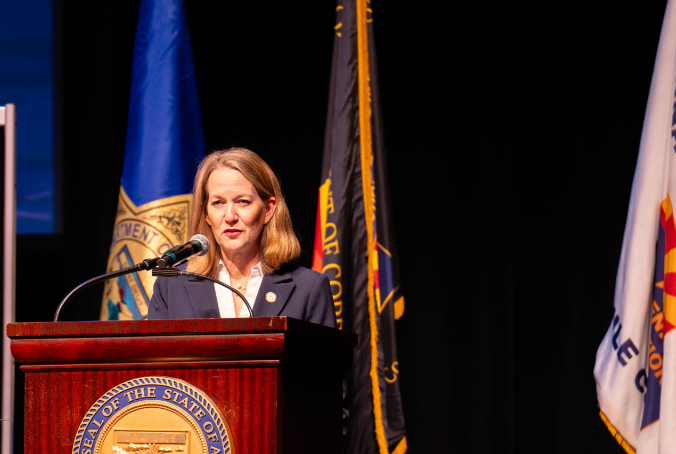
The GOP-led Arizona House censured Attorney General Kris Mayes over remarks they say endangered law enforcement.
The House passed HR2004 on Thursday with only Republican support. All Democrats voted against the measure.
State Rep. Joseph Chaplik (R-LD3), the bill sponsor, said in a press release that Mayes had spoken in a manner that proved her lack of fitness for office. House Republicans are urging the attorney general to resign.
“This was not a slip of the tongue. These reckless statements, which she has refused to retract, put officers in danger. When the top law enforcement official in the state fuels confusion, criminals listen and peace officers pay the price,” said Chaplik. “Our officers deserve leadership that protects them, not an Attorney General who puts targets on their backs.”
Last month, Mayes offered a response to the increased federal immigration enforcement in a sit-down interview that political leaders from both parties said was inappropriate and dangerous.
The attorney general faces accusations that she effectively created a legal justification for shooting ICE and other law enforcement agents in an interview with 12News.
“[I]f you reasonably believe that your life is in danger and you’re in your house or your car or on your property, that you can defend yourself with lethal force,” said Mayes.
Mayes later told KTAR News that Renee Good would have been justified in shooting ICE. Good was shot by an ICE agent last month after she began driving her car at him. Good was present on the scene to disrupt immigration enforcement operations. Her partner yelled at Good to drive after ICE agents ordered Good to stop and exit the vehicle.
“If you are really sure that they are ICE and they present a badge or they present identification, then I would not recommend using lethal force against them. But one of the worries that I have is [that] we have a Stand Your Ground law in Arizona,” said Mayes. “If you reasonably believe that your life is in danger and especially if you’re in your home or your automobile, essentially the Castle Doctrine, you can use lethal force to protect yourself.”
Gov. Katie Hobbs told reporters that Mayes’ speech was “inappropriate” and advised her to issue a retraction.
“It is the responsibility of every elected official to turn down the temperature and do everything we can to be very careful with our language about ramping up the potential for violence,” said Hobbs. “We are seeing across the county people’s fear increasing and the potential for violence.”
So far, Mayes has maintained that her remarks were misunderstood: she didn’t advise the shooting of ICE agents, she advised ICE agents that they were in danger of a justified shooting because they often wear masks.
“Arizonans do not want masked agents entering their homes without warrants. It is un-American and it threatens the rights and safety of everyone in our state,” said Mayes. “We have all witnessed the increasingly chaotic and dangerous activity of ICE agents in cities across the country.”
AZ Free News is your #1 source for Arizona news and politics. You can send us news tips using this link.
by Staff Reporter | Feb 8, 2026 | News
By Staff Reporter |
New polling reflects a continued high level of support for President Donald Trump’s mass deportations.
Earlier this week, the White House shared two sets of polling data that declare opinions of deportation remain positive.
Republicans, independents, and swing voters who responded all shared majority positive opinions on mass deportations in one poll from Cygnal: Republicans, 97%; independents, 59%; and swing voters, 64%. Only 25% of Democrat respondents expressed support for mass deportations, and 67% said they opposed.
This polling data came from just over 1,000 voters likely to vote in this year’s midterm general election.
A significant majority of all respondents also aligned when it came to interpretations of immigration law and enforcement.
73% of all respondents agreed that entering the country without permission constitutes breaking the law. 61% overall supported deportations for illegal aliens. 64% determined that illegal aliens were a very to somewhat severe problem: 33% of Democrats, 60% of independents, and 97% of Republicans.
A slimmer majority amounting to 58% of respondents rejected the Democrat-led proposal to defund Immigration and Customs Enforcement (ICE). Less than that, 54% overall, supported ICE enforcing federal immigration laws.
The Democrats’ fight within Congress to defund ICE mustered a partial shutdown this week.
The shutdown arose beyond Democrats’ general disagreement with mass deportations. Democratic leaders oppose Department of Homeland Security (DHS) approaches to carrying out immigration enforcement. Two American activists in two separate incidents died last month after their protests against ICE turned into interference with law enforcement operations.
Both individuals, Renee Good and Alex Pretti, were shot by ICE agents after refusing law enforcement orders.
Anti-ICE activists have also taken to protesting across Arizona. The Phoenix ICE office has been vandalized repeatedly, sometimes with death threats, and been subjected to protests that have devolved into rioting as activists resisted law enforcement orders.
This week’s partial shutdown was much shorter-lived than the longest one in America’s history that occurred last year, lasting over 40 days from October to November. President Donald Trump signed a spending package lifting the shutdown on Tuesday.
The second poll shared by the Trump administration came from Harvard University Center for American Political Studies (CAPS) and Harris. That polling reflected that 73% of Americans believe criminal illegal aliens should be deported. 2,000 registered voters served as respondents. Most of the voters said that price increases, inflation, and affordability along with immigration were their top two concerns.
Overall, the Harvard-Harris polling found that Trump’s approval rating on key issues (the economy, immigration, foreign affairs, administering the government, handling inflation, reducing the cost of government, returning America to its values, tariffs and trade policy, and fighting crime in America’s cities) ranged from 39% to 47%. The president’s highest rating level was 51% for response to anti-ICE protests in Minneapolis.
Overall, 38% of voters said the country was on the right track: 74% of Republicans, 15% of Democrats, and 24% of independent voters. Likely voters, not weighted in the median total, were at 43%. Congressional approval was worse: 32% overall.
35% of overall voters said their financial situation was improving, and 40% said it was declining.
Other polls have found dramatically different sentiments among the American people. Another three-day poll conducted by Ipsos determined that 62% of Americans believe current ICE enforcement activities go too far.
AZ Free News is your #1 source for Arizona news and politics. You can send us news tips using this link.
by Ethan Faverino | Feb 8, 2026 | Economy, News
By Ethan Faverino |
Arizona House Republicans on the Natural Resources, Energy, and Water Committee have taken action to address skyrocketing gas prices and utility bills, passing a sweeping package of bills designed to lower fuel costs, enhance energy reliability, and defend ratepayers.
Under the leadership of Chairman Gail Griffin (R-LD19), the measures align with the House Republican Majority Plan’s core priorities of unleashing economic prosperity, promoting government efficiency, and protecting individual rights and liberties.
The legislation, which advanced on a party-line vote with Democrats in opposition, targets the challenges faced by Arizona families, particularly in Maricopa and Pinal Counties, where severe summer fuel blend requirements have driven up prices at the pump. By prioritizing affordability and reliable power, these bills aim to ease the financial burden on households amid rising energy demand.
“The cost of living for Arizona families, including gas and electricity, continues to increase, and Republicans are acting,” stated Chairman Griffin. “This package puts affordability first by lowering fuel costs, protecting ratepayers from higher utility bills, and making sure Arizona has dependable power as demand grows. The Majority Plan is clear: government should work to ease the cost burden on families, not make them worse.”
Bills Tackling High Gas Prices
- HB 2145 (Rep. Griffin): Amends motor fuel statutes to empower the President of the Senate and Speaker of the House to jointly request EPA fuel waivers during shortages if the Governor does not act, providing a defense against price surges.
- HB 2400 (Reps. Willoughby, R-LD13, and Biasiucci, R-LD30): Implements a seasonal suspension of the state’s 18-cent gas tax from May through September in Maricopa and Pinal Counties. The bill ensures local governments are reimbursed for lost highway revenue through allocations from the Arizona Highway User Revenue Fund, including $27.588 million to counties, $39.93 million to cities and towns, and $5.082 million to larger municipalities. It also includes an emergency clause for immediate implementation and exempts the Department of Transportation from rulemaking for one year.
- HB 2696 (Rep. Willoughby): Directs the Arizona Commerce Authority to prioritize reducing fuel and gas prices as its primary objective for two years, expiring December 31, 2029. The authority must collaborate with the oil and gas industry to study repealing the cleaner-burning gasoline blend, building new pipelines, establishing a strategic reserve, and exploring in-state refineries, including reviving a proposed facility in Yuma County. Status updates will be provided to legislative committees, with a final report due by October 1, 2026.
- HB 2955 (Rep. Willoughby): Amends motor fuel standards to end the expensive summer fuel blend in populous counties, subject to EPA waiver under the Clean Air Act. It allows for gasoline compliant with ASTM D4814 and vapor pressure limits, addressing supply shortages and enabling lower-cost alternatives.
- HCM 2008 (Rep. Willoughby): A concurrent memorial urging Congress and the EPA to eliminate the federal gas tax on Arizona’s cleaner-burning gasoline in Maricopa and Pinal Counties from May to September or grant the EPA administrator emergency waiver authority for costlier blends. This recognizes Arizona’s progress toward National Ambient Air Quality Standards while highlighting the undue tax burden on specialized fuels.
Supporting these efforts are additional bills to promote long-term solutions:
- HB 2014 (Rep. Fink, R-LD27): Requires the Department of Environmental Quality (ADEQ) and Arizona Department of Agriculture to conduct air emissions modeling and feasibility studies on alternative gasoline blends, including federal reformulated, California phase 3, and conventional options. Reports must be published by September 30, 2027, with $100,000 appropriations each for modeling and studies.
- HB 2401 (Willoughby and Biasiucci): Mandates biennial reviews by ADEQ of fuel formulations available under federal standards, assessing air quality impacts in regulated areas, and submitting recommendations to the Department of Agriculture, the Governor, the President of the Senate, the Speaker of the House, and the Secretary of State by December 31 of each review year.
- HB 2428 (Griffin): Authorizes voluntary mobile emissions reduction credit programs, permitting emissions credits for nonroad engines under Clean Air Act guidelines, with permits issued by ADEQ for up to 20 years, supported by chambers of commerce, utilities, and Maricopa County.
“Today we heard from organizations with the time and resources to lobby against affordable prices for Arizona families, but not from the families paying more at the pump,” explained Majority Whip Julie Willoughby. “Working families cannot take time off to come to the Capitol and ask for relief; that is why we are here to help be their voices.”
“Eighteen cents a gallon may sound small to some, but it matters to families trying to make ends meet,” Willoughby added. “I will do everything in my power to deliver relief now while we continue working to fix the fuel blend and supply problems. Families need lower prices, not excuses.”
Bills Ensuring Energy Reliability and Ratepayer Protections
- HB 2331 (Reps. Marshall, R-LD7 and Heap, R-LD10): Renames and expands energy reliability statutes to require public power entities and service corporations to prioritize domestically produced fuels, minimize foreign reliance, and evaluate resources for affordability, reliability, and cleanliness. Defines “clean energy” to include low-emission sources like nuclear and natural gas, with reliable sources needing at least 50% capacity factor and rapid ramp-up capabilities. The bill emphasizes hydrocarbons and finds domestic sourcing essential for public health and safety.
- HB 2756 (Reps. Griffin and Blackman, R-LD7): Adds provisions for public power entities and electric corporations to report quarterly on new extra-high load factor customers, including interconnection requests and completions. These customers must be factored into load growth projections. The Arizona Corporation Commission (ACC) is directed to adopt rules on contracts, minimum billing, and pre-execution reviews to protect other ratepayers, excluding member-owned cooperatives. Requires cost-of-service studies within 180 days and an ACC workshop within 90 days to assess impacts on residential bills and potential new customer classes.
These bills now advance for further legislative consideration.
Ethan Faverino is a reporter for AZ Free News. You can send him news tips using this link.
by Ethan Faverino | Feb 7, 2026 | News
By Ethan Faverino |
On Friday, Arizona Governor Katie Hobbs signed a Republican bill passed on a bipartisan vote by the Arizona Legislature to change the date of the 2026 primary and permanently move Arizona primaries to the second to last Tuesday in July.
The legislation permanently shifts the primary election date earlier, ensures timely ballot access for military voters overseas, and mandates clearer guidelines for political party observers at polling sites, marking a significant step toward greater election integrity and consistency ahead of the 2026 election cycle.
HB 2022 addresses longstanding issues with Arizona’s election calendar by moving the primary from August 4 to the second-to-last Tuesday in July – specifically July 21 for 2026.
This two-week adjustment resolves conflicts with federal requirements under the Uniformed and Overseas Citizens Absentee Voting Act (UOCAVA), which mandates that ballots be sent to military and overseas voters at least 45 days before an election. Previously, Arizona’s timeline risked delays, potentially disenfranchising service members.
By advancing the date, the bill ensures that ballots are mailed on time, giving voters abroad ample time to receive, complete, and return them.
The measure also enhances transparency and oversight by explicitly requiring authorized political party observers to be permitted at all voting locations, including early voting centers and emergency voting sites.
The bill was sponosored by Rep. Alexander Kolodin (R-LD3) with a mirrored bill (SB 1425) sponsored in the Arizona Senate by Sen. Wendy Rogers (R-LD7).
“Arizona law has always intended to protect the integrity of our elections, including for military voters and at ALL voting locations,” said Rep. Kolodin. “I am delighted that Governor Hobbs agreed with me that this commonsense reform and legislation is necessary.”
“This was a unified Republican effort leading the way from start to finish,” Senator Rogers added. “By working together across chambers, we delivered a commonsense election bill that protects military voters, brings clarity to our election calendar, and strengthens transparency for Arizona voters. This is how the process should work.”
New voter deadlines are as follows:
- Voter Registration Deadline: June 22, 2026
- Ballots are mailed to voters on the Active Early Voter List and In-Person Early Voting Begins: June 24, 2026
- Primary Election Day: July 21, 2026
The Primary date change also impacts filing deadlines for candidates running for office.
Filing Dates:
- Partisan Primary Candidate Filing: Feb. 21, 2026 – March 23, 2026
- Precinct Committeemen Write-In Deadline: April 6, 2026
- Write-In Candidate Filing Deadline: May 22, 2026
The measure had the full support of the Arizona Freedom Caucus (AFC). In a statement, AFC Chairman Senator Jake Hoffman (R-LD15) said, “Governor Hobbs signing Representative Kolodin’s HB 2022 is a huge win for election integirty in Arizona. While Adrian Fontes is making radical and unserious legislative proposals, like expanding unaccountable, sprawling voting centers and reinstating a permanent early voter list, Representative Kolodin is leading with bipartisan supermajorities.”
Ethan Faverino is a reporter for AZ Free News. You can send him news tips using this link.
by Staff Reporter | Feb 7, 2026 | News
By Staff Reporter |
In the latest escalation between Maricopa County leaders’ legal jockeying for elections authority, the Board of Supervisors reportedly subpoenaed staff with the Recorder’s Office.
Recorder Justin Heap issued a statement on Tuesday accusing the board of attempting “to intimidate and bully” his staff and “unduly influence” the pending court ruling. The recorder and board have been fighting for months in the Maricopa County Superior Court over who has proper authority over which elections administration powers.
“Their actions are beyond inappropriate,” said Heap. “My staff has bent over backwards to work with the Board, yet despite our earnest efforts the Board continues to engage in unhinged, emotional, and unprofessional behavior.”
Within the hour of Heap’s post, supervisor and former chair Thomas Galvin quoted Scripture that appeared to allude that the truth of the matter was beyond Heap’s remarks.
“‘And you will know the truth, and the truth will make you free.’ – John 8:32,” posted Galvin.
Galvin also shared a video from Chair Kate Brophy McGee addressing the accusations from Heap. McGee said their subpoena concerned an apparent conflict between Heap’s remarks during his annual budget request and sworn testimony on voter disenfranchisement from Heap’s staff, both of which took place last week on separate days.
“At Maricopa County, we count every lawful vote. That’s why we take any claim of disenfranchisement seriously, and have asked the Recorder’s office to provide further testimony regarding conflicting claims recently made by Recorder Heap and his staff,” said McGee. “This is an important issue and we need straight answers. If any voters are being disenfranchised, we will fix it immediately. If not, then the Recorder’s office must clarify to the court why it provided such testimony. Maricopa County voters need the truth.”
During last week’s board hearing, Heap said no voters had been disenfranchised since he took office in January 2025.
“We stated that we want this machine to make sure that we don’t disenfranchise voters. We didn’t say that any voters have been disenfranchised since I took office in the administration,” said Heap.
Two days earlier, Heap’s chief of staff, Sam Stone, issued sworn testimony in the Maricopa County Superior Court that disenfranchisement was occurring in the present.
“We had two potential places we would have made the substantial changes to one or the other to bring this in, to not disenfranchise voters, which is happening now,” said Stone.
Stone directed the court to testimony from Janine Petty, senior director of voter registration, who said disenfranchisement occurred during the 2024 election when certain provisional ballots were processed as federal-only due to time constraints even though they were voted as a full ballot.
“[Those provisional ballots] would be counted, but they would not be afforded the full ballot. So they would be duplicated by the elections board to be a federal ballot, when that voter was entitled a full ballot and voted a full ballot,” said Petty.
Heap earned a legal win on Wednesday against the board after the Maricopa County Superior Court rejected the board’s move to stop America First Legal (AFL) from representing Heap in court going forward.
AFL sued the board on behalf of Heap last summer over the contested elections administration powers, a battle stemming from a “lame duck” agreement between the outgoing recorder, Stephen Richer, and a board majority also on their way out.
AZ Free News is your #1 source for Arizona news and politics. You can send us news tips using this link.
by Matthew Holloway | Feb 7, 2026 | News
By Matthew Holloway |
A slate of bills designed to strengthen oversight of Arizona’s Supplemental Nutrition Assistance Program (SNAP) advanced Monday as House Republicans moved to implement federal reforms enacted under H.R. 1. The bills include new work requirements, stricter eligibility verification, and measures to reduce payment error rates
The actions follow a separate advancement of Medicaid and health-related bills tied to federal H.R. 1 reforms by the Arizona House Health and Human Services Committee, part of a broader state response to changes enacted under the federal budget reconciliation act.
House leaders said the measures correspond to provisions in the federal law signed into effect on July 4, 2025, which included updates to SNAP work requirements, eligibility criteria, and administrative rules.
“H.R. 1 made it clear that work expectations and eligibility rules matter again,” Committee Chairman Rep. Selina Bliss (R-LD1) said. “Our SNAP reforms reinforce responsibility while protecting parents, seniors, and the disabled. This package keeps the program strong so it can continue serving families who qualify and rely on it.”
Key bills advanced under the SNAP reform package include measures to tighten employment and training provisions for SNAP participants, adjust work requirement waivers, and increase data verification for eligibility determinations. The bills advanced with a ‘Do Pass’ recommendation 7-4.
One bill, HB 2206, would require the Arizona Department of Economic Security to reduce the SNAP payment error rate to 3 percent — a target state lawmakers say could reduce improper payments and lower the risk of federal cost-sharing penalties tied to high error rates under H.R. 1.
Failure to act, Republican lawmakers said, could expose Arizona to federal penalties related to improper payments and high error rates, effectively shifting more program costs onto state taxpayers. According to legislative budget estimates, the reduction would save taxpayers tens of millions of dollars annually.
“SNAP should be a hand up, not a blank check,” House Majority Leader Michael Carbone (R-LD25) said. “When benefits flow to people who no longer qualify or who do not even live here, the program is weakened for families who truly need help. These bills tighten eligibility, reinforce work expectations, and protect taxpayers while keeping SNAP available for the vulnerable.”
Mandatory employment and training requirements for certain SNAP recipients are addressed in HB 2442, which would align Arizona law with updated federal work provisions enacted under H.R. 1. The bill requires eligible participants to engage in job readiness, employment, or training activities as a condition of receiving benefits, reflecting federal standards adopted through the reconciliation package.
HB 2448 focuses on waivers and exemptions for work requirements, narrowing the circumstances under which SNAP recipients may be exempted from employment obligations. The legislation responds to federal changes limiting broad waiver authority and seeks to ensure exemptions are applied more narrowly and in accordance with updated eligibility rules.
Expanded eligibility verification requirements for SNAP and other public assistance programs are proposed under HB 2797, which applies additional data checks to confirm income, employment status, residency, and overall eligibility. The bill also directs suspected fraud cases to be referred for further review, including potential federal prosecution.
The committee’s agenda also included adjustments to employment reporting requirements for able-bodied adults without dependents and limits on backdoor waivers unless approved by the Legislature.
Matthew Holloway is a senior reporter for AZ Free News. Follow him on X for his latest stories, or email tips to Matthew@azfreenews.com.