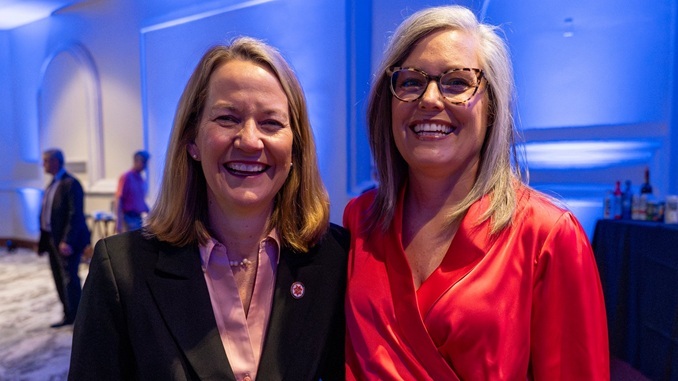
A new complaint filed this week alleges that Arizona’s governor, secretary of state, and attorney general may have participated in a straw donor scheme.
The complainant, San Tan Valley resident Gary DeBerge, has asked Arizona District Attorney Timothy Courchaine and Maricopa County Attorney Rachel Mitchell to look into what he says are “mysterious and unexplained” irregularities in the campaigns of Gov. Katie Hobbs, Secretary of State Adrian Fontes, and Attorney General Kris Mayes.
A copy of the complaint obtained by AZ Free News alleges that recent filings by one of the campaigns reflect “repeatedly altered reported receipts by millions of dollars” due to alleged eliminations of prior reported contributions.
Elect Katie Hobbs, the governor’s reelection campaign account, issued 10 amended reports for the 2026 Quarter 2 report, several of which varied by millions of dollars.
Exempt small contributions amounting to less than $100 totaled more than $1.4 million in the original filing and the first amended report, dropped to $0 in the second and third amended reports, then rose to nearly $400,000 in subsequent amended reports.
Total receipts amounted to more than $2.6 million in the original filing, but jumped to $3.1 million in the first amended report, then dropped below $1.7 million in the second amended report, then rose again to more than $2.2 million in the third amended report, and then rose again, back to more than $2.6 million in subsequent amended reports.
Donations under $100 are considered eligible for aggregate rather than individual reporting.
The complaint petitioned investigators to determine whether the millions moved around in amended filings reflected “a calculated attempt to obscure the true source and disposition” of the funds.
As noted by the complaint, Hobbs’ campaign reported much smaller totals of exempt small contributions throughout 2025 and the first quarter of 2026. Exempt small contributions across five quarters amounted to $600,000 in total. Then, in the second quarter of this year, the campaign reported a surge in exempt small contributions that amounted to more than double what the campaign pulled for an entire year and a quarter.
“Elect Katie Hobbs has reported approximately $1.4 million in exempt contributions and then later reported that those same contributions never existed,” stated the complaint. “This should immediately raise questions regarding the accuracy of one, if not all, of the recent filings made by this committee.”
The Trump administration and Republican leaders in Congress have initiated investigatory efforts into straw donor schemes by online fundraising platforms.
An example of this was illustrated prominently in the media earlier this year, when investigative reporters discovered that ActBlue, the primary fundraising platform for Democrats, allegedly misattributed around $100,000 in donations across thousands of individual political contributions over five years to one Elizabeth Waffle, an 88-year-old woman in Michigan living in a trailer with limited income. ActBlue allegedly misattributed more than 13,000 donations that occurred once or multiple times on a daily basis.
The complaint also questioned the number of contributors listed as “not employed” across the three campaigns’ 2026 filings to date.
Below are the total number of instances in which individual contributors were listed as “not employed” for the three report filings due so far this year and the four report filings made in 2025. These instances exclude retirees and may include individuals who contributed more than once.
Candidate
“Not Employed” or “Unemployed” in 2026 Filings
“Not Employed” or “Unemployed” in 2025 Filings
Katie Hobbs
46,335
26,643
Andy Biggs
26
21
Kris Mayes
17,530
13,162
Warren Petersen
0
0
Adrian Fontes
12,640
3,294
Alexander Kolodin
2
1
AZ Free News is your #1 source for Arizona news and politics. You can send us news tips using this link.
The National Republican Congressional Committee (NRCC) is targeting Democratic congressional nominee Amish Shah over his documented support for admitting Washington, D.C., as the 51st state. The criticism comes as Arizona’s competitive First Congressional District race moves into the general election.
The NRCC said Thursday that Shah supported the proposal on multiple occasions while serving in the Arizona House of Representatives and characterized statehood as an effort to expand Democratic power in Congress. The committee cited a 2021 letter signed by Shah and a 2023 concurrent resolution listing him among its sponsors.
The D.C. Statehood Compact, an organization supporting admission, lists Shah among 33 Democratic Arizona lawmakers who signed the 2021 letter. The lawmakers wrote that “the State of Arizona supports admitting Washington, D.C. into the Union” and urged the state’s congressional delegation to support federal statehood legislation.
Two years later, Shah joined more than two dozen Arizona House members and eight state senators sponsoring House Concurrent Resolution 2034. The measure, which died in committee without receiving a floor vote, would have proclaimed support for admitting Washington, D.C., as a state and enacting federal legislation granting statehood to its residents.
The resolution argued that District residents pay federal taxes, serve in the military, and remain without full voting representation in Congress. It also cited the 2016 districtwide referendum in which approximately 86 percent of voters supported statehood.
Federal statehood legislation would preserve a smaller federal district containing the White House, Capitol, Supreme Court and other federal buildings while admitting the residential and commercial portions of Washington as the State of Washington, Douglass Commonwealth. The proposed state would elect two senators and initially one voting member of the House. Delegate Eleanor Holmes Norton and Sen. Chris Van Hollen reintroduced companion measures in January 2025.
Republicans have argued that admission would produce two reliably Democratic Senate seats and an additional Democratic vote in the House. District voters have supported the Democratic presidential nominee in every election since they first participated in 1964. Former Vice President Kamala Harris received 90.28 percent of the District’s vote in 2024, while President Donald Trump received 6.47 percent.
NRCC spokesman Ben Petersen linked Shah’s statehood position to the committee’s broader criticism of his policy record.
ALERT: Arizona Democrat Socialist @DrAmishShah pushed for making Washington D.C. 🟦 the 51st state — a Democrat power grab
Uncovered docs revealed Socialist Shah wanted to create two new Democrat-held U.S. Senate seats and a Democrat U.S. House seat 🟦🟦🟦
In a post to X, Petersen wrote, “Arizona Democrat Socialist @DrAmishShah pushed for making Washington D.C. the 51st state — a Democrat power grab. Uncovered docs revealed Socialist Shah wanted to create two new Democrat-held U.S. Senate seats and a Democrat U.S. House seat.”
“Socialist Amish Shah demonstrated he’s a partisan Democrat obsessed with seizing power to force unpopular far-left tax hikes on Arizonans,” Petersen said, adding, “Arizona families can’t afford Socialist Shah rubber-stamping a radical left agenda in Congress.”
Shah’s campaign describes him as an independent voice who worked across party lines during his five years in the state Legislature. His campaign says his congressional priorities include lowering costs, protecting Social Security, Medicare and Medicaid, and defending abortion rights.
The new attack follows a contentious Democratic primary in which Shah openly criticized national party leaders. In May, Shah accused the Democratic Congressional Campaign Committee of interfering in the race after it endorsed former television journalist Marlene Galán-Woods. Shah said the committee had previously assured candidates that it would remain out of the primary and described its intervention as “hubris.”
Shah defeated Galán-Woods and two other candidates in July and will face Republican nominee Jay Feely in November. Feely, a former Arizona Cardinals kicker, received Trump’s endorsement during the Republican primary. The open district includes Scottsdale, northeast Phoenix, Fountain Hills, and Paradise Valley and is expected to help determine control of the U.S. House.
The NRCC has also focused on remarks Shah made about taxes and the Democratic Party’s progressive wing. During a Democratic forum this year, Shah called Trump’s tax cuts “abominable” and said he would use his platform to “prosecute” Trump and congressional Republicans “as vigorously as I can.”
During a 2018 appearance that resurfaced in the 2024 campaign, Shah said the country’s economic system was unfair, blamed Reagan-era tax reductions for contributing to inequality and welcomed what he called a “huge progressive movement” within the Democratic Party. Shah also said during the 2024 campaign that he opposed extending the Trump tax cuts because many of their beneficiaries were wealthy.
Shah previously won the district’s Democratic nomination in 2024 and lost to Republican Rep. David Schweikert by approximately four percentage points Schweikert left the seat open after forgoing reelection to run unsuccessfully for governor.
The federal government ran a $432.308 billion deficit in July, marking the largest monthly deficit since March 2021, according to the Joint Economic Committee’s latest Monthly Fiscal Update.
The July deficit brought the federal government’s total deficit for the fiscal year through July to $1.799 trillion. The figure is 10.46% higher than the $1.629 trillion deficit recorded during the comparable period in FY25.
The federal government has spent $1.40 for every $1 it has collected in revenue so far in FY26, with 28.62% of total outlays not covered by federal receipts.
For comparison, the federal government recorded a total deficit of $1.775 trillion during fiscal year 2025.
In July, the Fed gov ran a deficit of $432.308B, the largest monthly deficit since March 2021. FY2026-July, deficits were $1.799T. This means 28.62% of outlays in FY2026 were not paid for by revenues & for every dollar the Fed gov received in revenue, it spent $1.40.…
— Joint Economic Committee Republicans (@JECRepublicans) August 13, 2026
The Congressional Budget Office’s (CBO) most recent 10-year budget projections estimate that the federal deficit will reach $1.853 trillion in FY26, followed by $1.887 trillion in FY27 and $2.080 trillion in FY28.
Federal net outlays totaled $766.318 billion in July, bringing total net outlays for the fiscal year through July to $6.284 trillion.
That represents a 5.17% increase compared to the $5.975 trillion in net outlays recorded during the same period in FY25. Total federal outlays reached $7.010 trillion during FY25.
The largest categories of federal spending so far in FY26 have been Social Security, Medicare, income security and veterans benefits, net interest on the national debt, defense, and Medicaid.
Social security accounted for $1.384 trillion in spending through July, or approximately 22% of all federal outlays. Medicare accounted for $954.52 billion, or 15.2%.
Income security and veterans benefits accounted for another $968.31 billion (15.4%), while net interest on the federal debt totaled $931.36 billion (14.8%).
Defense spending totaled $764.71 billion through July, representing 12.2% of federal outlays, while Medicaid spending reached $598.21 billion (9.5%).
In July alone, Medicare accounted for $174.25 billion in federal spending, followed by Social Security at $140.68 billion, income security and veterans benefits at $119.28 billion, net interest at $104.15 billion, defense at $86.05 billion, and Medicaid at $58.30 billion.
The CBO currently projects total federal net outlays of $7.449 trillion for FY26, increasing to $7.772 trillion in FY27 and $8.151 trillion in FY28.
Federal spending has continued to exceed revenue despite receipts also increasing compared to the same period last fiscal year.
The federal government collected $334.010 billion in net receipts during July. For the fiscal year through July, total net receipts reached $4.485 trillion.
That is a 3.19% increase from the $4.437 trillion collected during the comparable period in FY25. Total federal receipts reached $5.235 trillion durning FY25.
Individual income taxes remain the largest source of federal revenue, generating $2.369 trillion through July, or 52.8% of all federal receipts.
Social insurance and retirement taxes generated another $1.523 trillion, accounting for 33.9% of receipts.
Corporation income taxes have generated $292.91 billion so far in FY26, representing 6.5% of total receipts. Customs duties have brought in $154.47 billion (3.4%), while all other receipts accounted for $146.22 billion (3.3%).
In July, individual income taxes generated $173.27 billion, while social insurance and retirement taxes generated $139.07 billion. Corporation income taxes generated $13.57 billion during the month.
Customs duties recorded a negative $8.55 billion in July, compared with $135.69 billion collected during the comparable period of FY25. Despite the July figure, customs duties have generated $154.47 billion for the fiscal year to date.
The CBO projects federal receipts will total $5.596 trillion in FY26, $5.885 trillion in FY27 and $6.071 trillion in FY28.
While federal receipts have increased 3.19% compared with the same point in FY25, net outlays have increased by 5.17%
The difference between federal spending and revenue has contributed to the $1.799 trillion deficit accumulated through July.
The federal government’s fiscal year ends September 30, meaning the July figures cover 10 months of FY26.
Ethan Faverino is a reporter for AZ Free News. You can send him news tips using this link.
The state ceased imposing mandatory guardrails for parent caregiver payouts nearly a year ago.
The year of potentially runaway spending may have wasted nearly half a billion dollars, a new report from the auditor general revealed.
The audit found that the Arizona Health Care Cost Containment System (AHCCCS) and the Department of Economic Security (DES) had failed to implement cost-control requirements to the Arizona Long Term Care Services (ALTCS) program, within which is one of the biggest program costs: the Parents as Paid Caregivers (PPC) service delivery model.
PPC was established during COVID with substantial funding from the federal government, initially with the intent of being a temporary program. However, stakeholders desired permanence for the program when those pandemic dollars ran out. Gov. Katie Hobbs received approval from the Biden administration to make PPC permanent in 2024, which required Arizona to cover more than a third of the costs.
According to the audit, AHCCCS and DES leadership acted contrary to state law in order to implement laws how and when they saw fit, not how and when it was required of them.
One of the main cost-control requirements the agencies failed to implement was the standardized assessment tool.
AHCCCS suspended the tool in mid-October 2025, 16 days after initiating it according to state law. Those assessments made between Oct. 1 and 16, 2025, were reversed.
As a consequence, the auditor general estimated that the agency failed to realize between $133 million and $493 million in potential cost reduction “risking additional cost increases and shortfalls.”
DES was forced to request $83 million in supplemental appropriation from the state legislature for fiscal year 2026 as a consequence.
The threat of legal action reportedly prompted the agency to buck state law.
“AHCCCS reported that it halted implementation due to the threat of litigation and instead of implementing the policies it created it decided to engage in emergency rulemaking,” reported the audit.
The auditor general did assess that the tool lacked the ability to contain costs in the long term, and suggested legislative changes and federal approval.
The audit also reported that AHCCCS and DES failed to fully implement other cost-control measures, including executing processes to ensure parents reside in the state for at least six months prior to becoming paid caregivers, and prohibiting payments for parent-provided services between 10 p.m. and 6 a.m. and when the child isn’t home.
Further, AHCCCS and DES were found to have not enforced the 40-hour limit on parent-provided care until April of this year. The agencies were required to implement that limit back in July 2025. The audit found this delay caused DES to overpay some parents.
AHCCCS and DES ignored the law by delaying the limit for 10 months to avoid penalizing parents.
“[D]espite lacking the authority to do so, [the agencies] delayed enforcing the requirement because [they] sought to increase compliance through an educational and not punitive approach,” stated the audit.
The audit also found that DES was inconsistent about maintaining member records and ensuring the accuracy of member assessments. The auditor general warned that the former could result in unsupported service authorizations and impair payment oversight, and the latter could result in incorrect payments, waste, and mismatched service authorizations.
The auditor general issued 11 recommendations:
Implement the required standardized assessment tool
Continue developing a formally documented Extraordinary Care Review process
Develop and implement a procedure to seek legal counsel prior to programmatic changes
Develop and implement all required cost controls and oversight processes to ensure functionality
Update monitoring processes to ensure timely oversight of compliance with contractual and statutory obligations related to ALTCS and PPCG
Require provision of timely access to utilization and vendor payment records
Develop and implement regular assessments of the 40-hour limit
Establish corrective action requirements for lack of enforcement concerning 40-hour limit
Conduct an analysis to identify additional cost-control measures to improve ALTCS finances
Implement any additional cost controls for ALTCS as discovered with aid of governor’s office and CMS
Notify the legislature of analysis results and plan of action
Roberta Harrison, AHCCCS interim director, responded that she disagreed with the auditor general’s findings but promised to implement the 11 recommendations. Harrison cited federal Medicaid requirements, legal and procedural considerations, data limitations, and implementation timelines as hindering agency compliance.
DES agreed with one of the findings, that required cost-control measures weren’t fully implemented, and disagreed with the other three. DES agreed to implement all but five of the 20 recommendations.
The auditor general’s office plans to follow up with AHCCCS and DES in six months’ time.
AZ Free News is your #1 source for Arizona news and politics. You can send us news tips using this link.
The City of Surprise announced it has suspended its use of automated license plate readers (ALPRs) after a routine audit earlier this month identified an anomaly in the system. The audit prompted an investigation into a potential violation of department policy and the placement of a Surprise police officer on administrative leave.
Surprise Police announced the suspension on Wednesday, saying the department discovered an irregularity involving its Flock automated license plate reader system. The department said the investigation remains ongoing and that additional information will be released when appropriate.
Maintaining community trust is of the utmost importance to the Surprise Police Department. That’s why we are letting you know that we discovered an anomaly in the use of the Flock automated license plate reader (ALPR) system this week that has resulted in the City suspending the… pic.twitter.com/CEOk1cDHzp
Surprise Police Chief Evan Becher stated, “Public trust is of the highest importance to the Surprise Police Department and maintaining that trust requires transparency and accountability. While we still need to complete an investigation into this irregularity, we are taking this incident very seriously. That is why we took immediate action to halt the program, investigate the issue and make the community aware of it.”
The City of Surprise began using ALPR technology more than two years ago and currently has 28 cameras operating throughout the city.
According to the City, the technology has helped law enforcement solve numerous serious crimes, including homicides, robberies, and carjackings.
The city maintains a policy governing the use of ALPR technology and conducts regular audits intended to identify potential misuse. Surprise officials said the most recent audit, functioned as intended by identifying the incident of irregular use.
Chief Becher said the city is using the incident as an opportunity to evaluate additional safeguards that could further strengthen oversight of the technology.
“This technology has proven to be extremely valuable in solving serious crimes. As we look to continue the use of this public safety tool, we want strong safeguards in place that not only alert of misuse but also prevent it,” added Becher. “Surprise Police Department is committed to ensuring enhanced protections are in place before reimplementing use of ALPR cameras.”
The Surprise suspension comes amid growing scrutiny of Flock license plate reader systems across the Valley, with several Arizona law enforcement agencies taking action involving the technology within a matter of days.
The City of Chandler announced earlier this month that it would discontinue its use of 40 fixed-camera Flock ALPRs after an audit identified what they considered an anomaly.
The incident involved an officer who misused the system to track a family member with medical issues. The officer subsequently resigned, and Chandler officials announced the Flock service would not be renewed.
In Apache Junction, a police officer resigned on August 10 following an internal investigation into allegations that he used Flock cameras to track his wife. The department announced the officer’s resignation after the investigation into his use of the system.
In Tempe, police announced on August 11 that the city would stop sharing data collected from its 33 Flock cameras with other agencies. The decision followed community concerns about privacy and recent reports involving alleged misuse of ALPR technology in other Arizona cities.
Tempe said its cameras would remain in place, but other law enforcement agencies would have to request information through the appropriate process.
“While we had previously restricted data sharing to Arizona law enforcement agencies only, this additional step will further safeguard Tempe’s data and ensure we maintain appropriate control over access,” stated Tempe Police Chief Ken McCoy.
Goodyear Police also announced this month that an officer has been placed on administrative leave following an audit of Flock ALPR use that identified potentially concerning activity.
The department said the investigation uncovered a possible violation of department policy and a possible criminal violation. The officer’s access to department computer systems was also cut off while the investigation continues.
GYPD Releases Information Regarding ALPR Use Policies and Internal Audit Process pic.twitter.com/zEAetg8iam
The developments in Surprise, Chandler, Apache Junction, Tempe, and Goodyear have all occurred within roughly one week, highlighting increasing attention being paid to how law enforcement agencies use automated license plate reader technology and the safeguards in place to prevent unauthorized access.
While law enforcement agencies have praised the technology as an important tool for investigating serious crimes, the recent incidents have raised questions about privacy, data sharing, and protections against improper use.
Ethan Faverino is a reporter for AZ Free News. You can send him news tips using this link.
The Arizona Corporation Commission unanimously approved a new review process Wednesday designed to prevent existing electric cooperative customers from paying for transmission and infrastructure required by data centers, manufacturers, and other large electricity users.
The framework was jointly proposed by Arizona Electric Power Cooperative, which provides wholesale electricity, and five distribution cooperatives: Duncan Valley Electric Cooperative, Sulphur Springs Valley Electric Cooperative, Mohave Electric Cooperative, Graham County Electric Cooperative, and Trico Electric Cooperative.
The cooperatives sought the process as they hold discussions with several prospective large-load businesses considering facilities within their service territories. Commission Chairman Nick Myers said those customers are showing increasing interest in rural Arizona.
“Large load customers are becoming increasingly interested in rural areas of Arizona,” Myers said in the Commission’s announcement. “This new process allows rural Arizona to capture the economic growth responsibly without being subsidized by other customers of the utilities.”
The ACC held its August Open Meeting on August 12, 2026. The Commission voted on 29 agenda items. pic.twitter.com/HC3QtTQMvj
— Arizona Corporation Commission (@CorpCommAZ) August 12, 2026
Prospective projects would negotiate electric service agreements involving Arizona Electric Power Cooperative as the wholesale electricity provider, a distribution cooperative serving the project site and the large-load business as the retail customer.
Each proposed agreement would follow a common set of guidelines and application requirements before undergoing review by the Commission’s Utilities Division staff. Commissioners would retain authority to approve, deny, or amend each agreement, according to the approved framework (Docket No. E-01773A-26-0123).
Staff reviews must consider whether an agreement serves the public interest, whether its rates are reasonable, and whether it prevents other customer classes from subsidizing the large-load customer’s commercial operations. The Commission said large-load customers will be responsible for costs associated with serving their projects, including new transmission and infrastructure construction.
“This further protects ratepayers from potentially subsidizing costs attributed to serving ‘cost causers’ such as manufacturing facilities and data centers,” Commissioner Kevin Thompson said.
Commissioner Lea Márquez Peterson said the process accounts for differences among the cooperatives and the communities they serve.
Márquez Peterson said the cooperatives are structured differently and represent diverse communities across the state.
“It’s important that the process for onboarding large loads reflects this difference,” she said. “I was proud to support their effort to streamline their processes and to protect their members and ratepayers.”
The decision advances the Commission’s “Growth Pays for Growth” approach, under which the costs of infrastructure needed to serve new industrial-scale electricity demand are assigned to the customers creating that demand.
The Commission has been studying the effect of data centers and other large-load businesses on Arizona’s electric system since Thompson opened a statewide docket in 2025. The inquiry has examined utility tariffs, new customer classifications, energy service agreements, independent generation, and other mechanisms intended to protect residential and small business customers from cost shifts.
At an April workshop, the Commission reported that approximately 1,300 megawatts of data center development was under construction in Arizona and more than 4,000 megawatts was in the planning stages. Commissioners and utility representatives discussed the generation, transmission, and distribution investments that would be needed to serve that demand.
Commission officials said Arizona’s existing utility rates and regulatory mechanisms have required data center developers to pay their share of power-generation and infrastructure expansion. The Commission opened the broader proceeding to determine whether additional policies would be needed as the number and size of proposed facilities increase.
Participants in the April large-load workshop discussed combining utility-specific rates with individual energy service agreements. Those agreements can include longer contract terms, minimum billing requirements, collateral and credit requirements, termination provisions, and the direct assignment of generation, transmission, and distribution costs to the large customer.
The newly approved cooperative framework uses project-specific service agreements while establishing a common process for Commission review. It also allows individual cooperatives to negotiate terms reflecting their systems and service territories.
“This new large load process gives Arizona cooperative utilities a clear standardized framework for bringing data centers and large load users online while protecting existing ratepayers from bearing the costs,” Myers said.