The U.S. national debt has surpassed $40 trillion, adding more than $2.6 trillion over the past year as federal borrowing and interest costs continue to climb.
The Joint Economic Committee released its latest Monthly Debt Update on September 8, showing the total gross national debt stood at $40.10 trillion as of September 3.
That represents an increase of $2.67 trillion from approximately $37.43 trillion one year earlier and an increase of $11.68 trillion over the past five years.
Of the current debt, approximately $32.42 trillion is held by the public, while another $7.68 trillion consists of intergovernmental debt.
Over the past year, the national debt increased at an average rate of approximately $7.35 billion per day, $306.4 million per hour, $5.11 million per minute, and $85,112 per second.
The committee calculated that the increase over the past year alone amounts to approximately $7,806 per person and $19,804 per household. The total national debt now equals approximately $117,279 per person or $297,522 per household.
If the average daily rate of debt growth recorded over the past three years continues, the committee projects the national debt will reach $41 trillion around January 16, 2027.
At that pace, the federal government would add roughly another $1 trillion to the debt every 151 days.
As of Sept 03, total gross national debt is $40.10T. Relative to 1yr ago, total gross national debt is $2.67T higher; relative to 5yrs ago, it is $11.68T higher. Over the past year, the rate of increase averaged $7.35B/day, $306.40M/hour, $5.11M/minute, or $85,111.72/second.…
— Joint Economic Committee Republicans (@JECRepublicans) September 8, 2026
The report also highlighted the growing cost of servicing the debt as interest rates remain substantially higher than they were several years ago.
As of August, the average interest rate on the federal government’s marketable debt stood at 3.475% compared with 3.415% one year earlier and 1.458% five years ago.
Higher rates increase the government’s borrowing costs as existing securities mature and the Treasury issues new debt.
The Congressional Budget Office forecasts net interest will account for 13.95% of federal outlays in Fiscal Year 2026, rising to 14.25% in Fiscal Year 2027, and 14.94% in Fiscal Year 2028.
The federal government also paid approximately $294.76 billion in interest to trust funds during the previous 12 months, averaging $24.56 billion per month.
Treasury notes continue to make up the largest portion of publicly held debt. As of August, approximately $16.21 trillion, or 50.02% is held in notes, while $7.25 trillion is in Treasury bills and $5.51 trillion is in bonds. Another $3.44 trillion is held in other securities.
About 33% of publicly held marketable debt is expected to mature within 12 months, according to the most recent data from the third quarter of FY26. The average maturity of the debt stood at 71 months as of June compared with 72 months a year earlier and 69 months in June 2021.
Despite the growing debt load, Treasury auctions continue to show demand for U.S. government securities. As of August, the bid-to-cover ratio stood at 2.97 for four-week Treasury bills, 2.53 for 10-year notes, and 2.39 for 30-year bonds.
A ratio of 2 or higher is generally considered an indication of strong demand.
The latest figures come as federal policymakers face the combination of a rapidly growing debt burden, elevated borrowing costs, and a significant portion of existing debt scheduled to mature in the near future.
Ethan Faverino is a reporter for AZ Free News. You can send him news tips using this link.
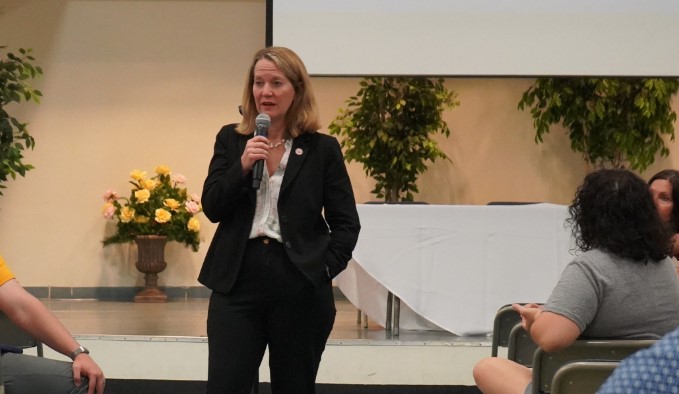
Another campaign finance violation complaint has been filed against Arizona Attorney General Kris Mayes.
This latest complaint concerned a $500 donation from District 14 Democrats in April. State law permits political party committees to contribute to party nominees, but not candidates. At the time of the April donation, well before the July primary, Mayes was a candidate but had not yet become the Democratic nominee.
Although Mayes ran unopposed in her primary, the complaint made the case that she could have faced a write-in candidate.
“A.R.S. § 16-645 permits qualified write-in candidates to compete in a primary election,” stated the complaint. “As a result, even an unopposed candidate has not definitively secured the nomination before the primary election because, at least in theory, a qualified write-in candidate could prevail.”
Timothy La Sota, a Phoenix attorney who filed the complaint, urged Secretary of State Adrian Fontes to respond more urgently to the allegations. La Sota stated that Fontes had taken nearly a month to provide acknowledgment of receipt of a prior complaint he filed against Gov. Katie Hobbs.
Concerning that complaint against Hobbs, filed in July, La Sota said nothing has come of it to his knowledge.
“Please take appropriate action, and in a timely fashion. On the last complaint I filed, against your political ally Katie Hobbs, you took twenty-five days simply to send an acknowledgement of receipt of the complaint,” said La Sota. “Since then I have heard nothing. I hope you act with more urgency here.”
That complaint against Hobbs accused her of illegally commingling millions in funds to subsidize her campaign.
In this recent complaint against Mayes, the attorney general was also characterized as displaying “a pattern of remarkable ignorance of basic campaign finance laws.” Supplementing this claim were two examples of refunds given to individual donors for excess contributions.
“[A]s the attorney for the State of Arizona, [she] clearly should know better,” stated the complaint. “Ms. Mayes was apparently unaware of campaign contribution limits applicable in state law to individual contributors, as she had to refund multiple excess contributions this last cycle[.]”
The complaint cited two instances of similar violations: one in the amount of $3,000, and the other in the amount of $500.
Mayes has raised more than $4.6 million this election cycle for her reelection campaign. Republican nominee Warren Petersen, her general election opponent, has raised more than $1.7 million. Petersen didn’t report receiving any contributions from political parties prior to the primary election.
Since state law requires the referral of substantiated campaign finance violations to the attorney general’s office, the complaint suggested any referral for enforcement actions be made elsewhere.
Another complaint filed against Mayes last month on a separate matter accused her, Hobbs, and Secretary of State Adrian Fontes of engaging in a straw donor scheme.
The campaigns for the three candidates enjoyed a sizable number of donations from donors who reported that they were not employed, tens of thousands of times greater in number than the unemployed donor donations received by their general election opponents across the aisle.
AZ Free News is your #1 source for Arizona news and politics. You can send us news tips using this link.
A new report examining corporate ownership of Phoenix-area housing calls for restrictions on institutional homebuyers, expanded financing for local builders, and changes to federal tax policy. The report also endorses an Arizona proposal from Republican state Rep. Nick Kupper (R-LD25).
The American Economic Liberties Project’s September case study, authored by Laurel Kilgour and Allie Gross, argues that consolidation in banking and homebuilding, purchases of foreclosed properties, and the expansion of build-to-rent communities have contributed to difficulties facing prospective homeowners.
For more on the investor takeover of housing in Phoenix, read the full brief Phoenix Case Study: Single-Family Rentals, Build-to-Rent, and Undoing the Corporate Capture of Housing here: https://t.co/bQtNUr6fLX
— American Economic Liberties Project (@econliberties) September 9, 2026
The nonprofit, which advocates against concentrated corporate power, acknowledges that institutional investors did not create the housing supply shortage. Its report contends that investors capitalized on that shortage while changes in financing weakened smaller builders’ ability to compete.
The report’s focus on construction shortfalls follows earlier research covered by AZ Free News in May. The Common Sense Institute identified prolonged underbuilding after the Great Recession as a principal driver of Arizona’s housing shortage, citing annual housing permits that fell from nearly 90,000 in 2005 to approximately 12,600 in 2010 and recovered to about 45,000 by 2019. That study examined short-term rentals such as Airbnb and found no consistent statistical relationship between their growth and home-price appreciation across Arizona communities.
Before the housing crash, Arizona was building at a rapid pace:
• ~400,000 homes built from 2003–2007 After the Great Recession, construction slowed significantly: • ~211,000 homes built from 2010–2019
— Common Sense Institute Arizona (@CSInstituteAZ) April 16, 2026
Phoenix has gained prominence in the institutional rental market in recent years, appearing in Urban Institute research published in 2023. Using 2022 property records, researchers identified 33,406 single-family rental properties held by “mega” rental operators in the Phoenix-Mesa-Chandler metropolitan area, second to Atlanta among the markets examined. The study defined those operators as investors owning more than 1,000 properties across multiple locations. However, the Urban Institute also cautioned that its data should be treated as a sample and that smaller institutional investors were incompletely captured.
A 2024 Government Accountability Office (GAO) review found that institutional investors may have contributed to increases in home prices and rents while helping stabilize neighborhoods after the financial crisis. The GAO said their effects on homeownership opportunities and tenants were less clear because of limited data and inconsistent definitions of institutional investors.
The new Phoenix report also examines build-to-rent developments, where homes are constructed for rental occupancy. Its recommendations include phased sales of institutional holdings, giving prospective owner-occupants and nonprofits an initial opportunity to purchase foreclosed homes, and reducing tax incentives for institutional rental ownership. The authors also recommend financing programs for local homebuilders and taxes intended to discourage holding undeveloped land.
In Arizona, the report endorses Kupper’s House Bill 2325, introduced in January as the “Own Something and Be Happy Act.”
I’m proud to introduce HB2325 the Own Something and Be Happy Act!
The introduced legislation would prohibit covered institutional investors from owning more than 50 single-family homes statewide, bidding during the first 60 days a home is publicly offered for sale, or making bulk purchases. Investors already exceeding the ownership limit would be barred from additional acquisitions and could voluntarily sell properties to comply.
The bill includes exemptions for affordable housing nonprofits, government housing agencies, community land trusts, qualifying homebuilders, and people or entities owning fewer than 50 single-family homes in Arizona. It would also require annual ownership disclosures to the Arizona Department of Housing. The proposed enforcement provisions would allow local prosecutors to act when the attorney general declines enforcement in a particular matter.
“When large investment firms buy up neighborhoods, families lose and prices climb,” Kupper said.
HB 2325 did not receive a hearing in the House Commerce Committee.
At the federal level, the 21st Century ROAD to Housing Act, enacted July 11, includes restrictions on additional single-family home purchases by large institutional investors. Its definition generally covers qualifying investment entities controlling at least 350 homes, subject to exclusions.
The federal purchase restrictions take effect 180 days after enactment. The law includes exceptions for qualifying build-to-rent purchases and other transactions, and it does not require investors to sell homes purchased before enactment.
Arizona’s House delegation split 5–3 on the final version in the June 23 vote. Reps. David Schweikert (R-AZ01), Eli Crane (R-AZ02), and Andy Biggs (R-AZ05) voted against it. Reps. Juan Ciscomani (R-AZ06) and Abraham Hamadeh (R-AZ08) joined Reps. Yassamin Ansari (D-AZ03), Greg Stanton (D-AZ04), and Adelita Grijalva (D-AZ07) in support. Rep. Paul Gosar (R-AZ09) did not vote. Sens. Mark Kelly (D-AZ) and Ruben Gallego (D-AZ) both supported the final Senate version in the June 22 vote.
President Donald Trump said that he would withhold his signature in protest over the Senate’s failure to pass the SAVE America Act, which would require documentary proof of citizenship for voter registration and photo identification for voting. The housing legislation became law July 11 without his signature, following the constitutional review period of 10 days, excluding Sundays, without a veto.
Arizona State Representative Walt Blackman (R-LD7) is calling on Americans to remember the courage, sacrifice, and national unity that followed the September 11 terrorist attacks.
Blackman, a retired U.S. Army combat veteran who served for 21 years, reflected on his own experience on September 11, 2001, when he was a young Army tank commander stationed at Fort Hood, Texas.
“Some dates are remembered. Others divide history into a before and after. September 11 did both,” said Blackman.
The September 11 attacks killed 2,977 people after 19 al-Qaeda terrorists hijacked four commercial airplanes.
Two were flown into the World Trade Center towers in New York City, while another struck the Pentagon. Passengers and crew members aboard United Airlines Flight 93 fought back against the hijackers before the plane crashed near Shanksville, Pennsylvania.
Blackman said that, like millions of Americans watching the attacks unfold, he could not have known at the time how dramatically the events of that morning would reshape the country or the lives of those serving in the military.
Rep. Walt Blackman Honors Victims, First Responders and Service Members on 25th Anniversary of September 11 Calls on Americans to remember the courage and unity that followed one of the darkest days in our nation’s history
In his statement, Blackman honored those killed in the attacks as well as the firefighters, police officers, and emergency personnel who responded to the scenes in New York and the Pentagon. He also recognized the passengers and crew aboard Flight 93 who resisted the hijackers.
“We remember the 2,977 innocent people whose lives were taken in New York City, at the Pentagon and near Shanksville, Pennsylvania,” Blackman said. “We honor the firefighters who climbed the stairs while others were trying to escape, the police officers and emergency personnel who ran toward danger, and the passengers and crew aboard Flight 93 who fought back and sacrificed themselves to save others.”
Blackman also directed attention toward the military personnel and their families who carried the burden of the wars that followed the attacks.
“We also remember the service members and military families who carried the weight of the wars that followed,” Blackman said. “Many never returned home. Others came home carrying wounds, some visible and others unseen.”
Blackman’s own military career included six overseas deployments, with combat deployments to Iraq and Afghanistan as well as service in Kosovo and Kuwait.
Twenty-five years after the attacks, Blackman said Americans should remember not only the lives lost but also the sense of unity that emerged across the country in the aftermath.
He noted that political divisions existed before September 11 and remain prevalent today, but argues that Americans put many of those differences aside following the attacks.
“America was politically divided before September 11, just as we are divided today,” said Blackman. “But when our nation was attacked, Americans came together. We did not ask whether the person standing beside us was a Republican or a Democrat. We stood together as Americans.”
Blackman said the anniversary should serve as an opportunity to remember the courage and compassion demonstrated under the aftermath of the attacks and to continue supporting first responders, veterans, and the families of those who died.
“We honor those we lost by remembering their names, supporting our first responders and veterans, standing with their families, and refusing to allow political division to outweigh our shared love of country,” said Blackman. “May God bless the families of the fallen, our first responders, our service members and the United States of America.”
Ethan Faverino is a reporter for AZ Free News. You can send him news tips using this link.
On a Friday in July 2022, the Department of Justice (DOJ), under President Joe Biden, arrested a man for a bomb threat he’d made a year and a half earlier to the Arizona secretary of state at the time, Katie Hobbs.
According to the DOJ’s public announcement of that arrest, that threat was sent online in mid-February 2021 through the secretary of state’s Elections Division contact form. Yet, it took law enforcement more than a year to nab the perpetrator: a Massachusetts man named James Clark.
Media outlets promptly picked up the news of Clark’s arrest, framing it as the latest in what was then an ongoing scourge of threats to election officials following the contentious 2020 election.
Hobbs was reaffirmed in the public eye as a face of resistance to former President Donald Trump’s purported election denialism. And she was deep into a contentious race of her own for the governor’s office against Trump-backed candidate Kari Lake.
“Election officials across the country are being threatened regularly for doing their jobs,’’ said Hobbs in a prepared statement at the time. “It’s unconscionable and undermines our democracy. This harassment won’t be tolerated and can’t be normalized. We thank the FBI for their persistence on further investigating this incident.”
The one detail that never received much attention was the timing of Clark’s arrest.
On the same day that the DOJ sparked a flurry of media coverage on their delayed arrest of a Trump-defying Democrat’s would-be assassin, a Hobbs campaign operative quietly registered Will of the People, a political action committee (PAC) that would go on to raise more than $5 million from dark money and labor union heavyweights across the nation.
The listed address for the PAC is a virtual office in downtown Phoenix. Its treasurer from day one was Dacey Montoya, founder and president of The Money Wheel, a well-known political and nonprofit compliance firm in Democratic circles. Montoya is currently the treasurer for both Gov. Katie Hobbs’ campaign and Hobbs’ alleged campaign finance fund-washing fund.
Montoya has offered her Money Wheel services to numerous Democratic candidates, party organizations, and progressive dark money operations both in Arizona and nationally over the years. Past clientele include Gov. Katie Hobbs, Secretary of State Adrian Fontes, Rep. Yassamin Ansari, Sen. Mark Kelly, Jevin D. Hodge, Kirsten Engel, Reginald Bolding, Arizona Democratic Party, Maricopa County Democratic Party, Progress Now Arizona/Progress Arizona, Our Voice Our Vote Arizona, Copper State Victory, and the Arizona Education Association.
The Money Wheel has received more than $5.2 million since 2017 at the federal level according to Federal Election Commission records, and more than $1.9 million since 2017 at the state level according to secretary of state campaign finance records. Since 2022, Montoya’s company has received more than $119,000 from the PAC.
Will of the People PAC
Most of Will of the People PAC’s millions came in 2022 and 2024.
$2.3 million from SEIU-UHW and SEIU-COPE, the nation’s largest labor union and a PAC
$1 million from Open Society Action Fund, an organization by the Soros family, who are top Democratic dark money donors
$680,000 from ProgressNow AZ
$600,000 from the National Education Association
$360,000 from the Fairness Project
$200,000 from the American Civil Liberties Union (ACLU) of Arizona
The PAC has not reported any income this year, and the only significant reported expenditures so far have been $8,000 from January through April given to The Money Wheel.
The PAC has spent an undisclosed amount of funding on lawfare to kill Republican-led ballot initiatives; in recent months, they filed two lawsuits to stop Propositions 142 (called the “Prohibit Mandatory Support for Discrimination or Preferential Treatment by Government Entities Amendment”) and 318 (called the “Require All Schools and Athletic Associations to Restrict Sports Participation and Access to Private Spaces Based on Sex Measure”).
Prop 142 would prohibit the state and government agencies from compelling, promoting, or implementing practices rooted in preferential treatment or discrimination based on race or ethnicity.
Prop 318 would restrict access to private spaces like restrooms and locker rooms based on biological sex, bar male students from participating in female sports, and establish a definition of sex rooted in biology.
In the case of Prop 318, the PAC also created a website called “Vote No on Prop 318.” However, per media coverage and the website itself, the PAC is now claiming to be a program under Progress Arizona, a progressive 501(c)(4) nonprofit. This website has not been disclosed under the PAC’s campaign finance reporting as of this report. The PAC’s logo is displayed on the website.
“Will of the People is a program of Progress Arizona,” states the website. “Email info@progressarizona.org. Paid for by Will of the People.”
Concerning the media — as previously reported, the PAC once identified The Arizona Republic as an endorser of their efforts.
It appears that the PAC may have failed to file some of its required expenditure disclosures. Four television advertisements urging Arizonans to vote “no” on Prop 132 (called the “60% Vote Requirement for Ballot Measures to Approve Taxes Amendment”) weren’t reflected in the PAC’s ballot measure expenditures for 2022, because none were issued.
Voters approved Prop 132 in 2022, which established a 60% vote threshold for ballot measures approving taxes.
Will of the People Is Also a Nonprofit
The PAC also has a similarly named nonprofit, “Will of the People Arizona.” The two share a launch year, an address, and leadership.
One of the first leaders of the nonprofit arm, Betsy Boggia, was not listed on PAC documentation. Boggia served as the director/secretary from 2022 through 2024, based on Arizona Corporation Commission records.
Boggia is a League of Women Voters board member and a recent former president of its Tucson chapter, according to her active and up-to-date LinkedIn profile. Notably missing from her work history and posts were any references to her leading a nonprofit that raised more than $5.5 million in three years.
Boggia’s silence on the matter may be explained by the nonprofit’s tax filings, which reported that Boggia spent an average of just one hour per week running the multi-million dollar operation.
Between the nonprofit and PAC, the two apparently affiliated entities have raised and spent approximately $11 million in four years.
The nonprofit didn’t disclose its revenue sources on its available tax filings from 2022, 2023, and 2024. Only four contributions totaling $2.1 million were publicly available through other organizations’ tax filings:
$1 million from Open Society Policy Center in 2024
Only the ACLU provided a detailed explanation for the purpose of their contribution: paid communications to defeat Propositions 128, 129, and 132.
Propositions Targeted by Will of the People PAC and Nonprofit
Based on various sources, the PAC and nonprofit together targeted at least 14 Republican-led propositions from 2022 through this year.
Nine were defeated and five passed. Five are to be determined this year.
The PAC and nonprofit also successfully advocated for the passage of Prop 139 in 2024, which made abortion a constitutional right in Arizona.
On publicly available archived versions of the PAC’s site from 2024 through 2025, the PAC clearly disclosed which propositions it opposed: Props 134, 136, 137, and 139.
Prop 134 would have set a signature distribution requirement in all 30 legislative districts for citizen-led initiatives: 10% for statewide initiatives, 15% for constitutional amendments, and 5% for statewide referenda.
Prop 136 would have allowed individuals to sue to stop voter-proposed initiatives from being put on the ballot if they believe them to be unconstitutional.
Prop 137 would have ended term limits for state supreme court justices and superior court judges.
Then, earlier this year, the PAC changed its website to offer a ballot proposal guide in exchange for donations. The linked donation button led to a donation page hosted by ActBlue Civics, which disclosed that the donated funds would be given to Progress Arizona, a 501(c)(4) nonprofit, not the Will of the People PAC.
In 2024, the PAC disclosed giving $8,000 to Progress Arizona’s policy and research director, Casey Clowes, in 2024 to run digital ads opposed to multiple propositions and in favor of one proposition, Prop 139, which created a constitutional right to abortion.
The PAC has also paid $55,000 to ProgressNow AZ and Progress Arizona PAC, and $706,000 to the Arizona Democratic Party.
The current version of the site as of this report no longer includes the promise of a ballot proposal guide in exchange for fundraising. Instead, the PAC website now urges individuals to endorse a “no” vote on Props 142, 144, 318, and 320.
“A group of power-hungry politicians have voted to put a set of highly deceptive propositions on your ballot this November,” states the present version of the site. “They are aiming to make voting more difficult for Arizonans, hollow out our schools with funding cuts, and institute blanket discrimination in youth sports. You can help stop these propositions by adding your name to the list of Arizonans endorsing a NO vote on these dangerous measures.”
Despite its grassroots-sounding name, Will of the People has been funded by millions of dollars from national labor unions, progressive organizations, and Democratic-aligned dark-money groups, while its leadership and vendors have extensive ties to Arizona’s Democratic political establishment.
The organization has opposed numerous Republican-led ballot measures. With five targeted measures still awaiting a vote, its influence over Arizona’s ballot initiatives remains active heading into November.
AZ Free News is your #1 source for Arizona news and politics. You can send us news tips using this link.
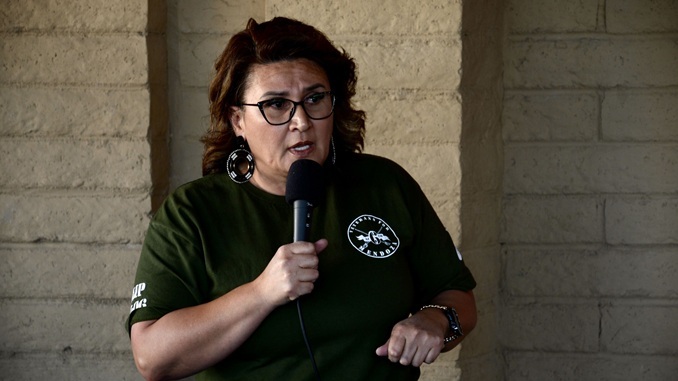
An event hosted by an anti-police group featuring 6th Congressional District candidate JoAnna Mendoza was canceled after a media outlet inquired about it.
The Washington Free Beacon had inquired about the virtual town hall event, which was scheduled to take place last Thursday night.
The canceled event was hosted by the program CareWins and paid for by its parent organization, MomsRising PAC. Mendoza was scheduled to appear virtually alongside Manny Rutinel, a Democratic candidate for a congressional seat in Colorado.
The organization has referred to law enforcement as rampant with “a deadly mix of white supremacy and violence.”
The epidemic of police violence must be stopped. We call on our elected leaders to immediately invest in communities and shift resources away from policing, where a deadly mix of white supremacy and violence remains unchecked. https://t.co/lTMIXsEO1tpic.twitter.com/87i6i2lusd
The Washington Free Beacon noted in its report that the MomsRising network has also advocated for the closure of immigration detention centers and prohibiting police from working with Immigration and Customs Enforcement.
In 2020, the first and strongest year of Black Lives Matter-led violence and advocacy, MomsRising called for defunding of the police.
"The idea of defunding the police is not new or naive, nor did it start with disconnected liberal elites." Black women, like @MonifaBandele, have meticulously organized and amplified this call for why police reform isn't a viable option. #BREATHEActhttps://t.co/GOdFO25yRnpic.twitter.com/p19IG3LKBa
That same year, Mendoza had expressed support for reducing police funding in favor of social welfare programs during her campaign for Arizona State Senate District 11.
“I support the reallocation of funding to programs that would allow people to live their best lives, such as the social service programs such as housing, public education, health care, ensuring that we’re addressing economic stability and environmental safety,” said Mendoza.
However, Mendoza opposed calls for total defunding of the police. She made that clear during a Clean Elections debate in September 2020.
“I do not support the defunding of police,” said Mendoza. “You know, police officers take an oath to protect and serve their communities much like military service members.”
Rather, Mendoza said she supported investing in other social welfare resources and additional funding into body cameras, deescalation training, and investigations into deadly force.
“Police officers are being asked to do too much, they’re being asked to address issues because of the lack of resources in our communities,” said Mendoza. “I support ensuring they have the resources but there also needs to be some accountability.”
Mendoza reiterated that position in a March 2026 opinion piece published by the Arizona Daily Star.
“The answer is not to defund law enforcement – it’s to fund law enforcement with intention. That includes ICE,” said Mendoza. “That means supporting the officers who serve honorably while insisting on training, body cameras, clear identification, lawful conduct, and meaningful oversight.”
Mendoza has raised more than $7.3 million according to Federal Election Commission data; no donations have come from MomsRising or Care in Action PAC, the political action committee affiliated with the CareWins program.
Approximately $665,000 of funds raised came from House Victory Project 2026, a joint Democratic fundraising committee. Most of the other funds have been reported as pooled donations from ActBlue, the main fundraising platform for Democratic candidates.
Rep. Juan Ciscomani, the incumbent and Mendoza’s opponent, has raised less. Ciscomani has raised just over $6.1 million this election cycle.
AZ Free News is your #1 source for Arizona news and politics. You can send us news tips using this link.