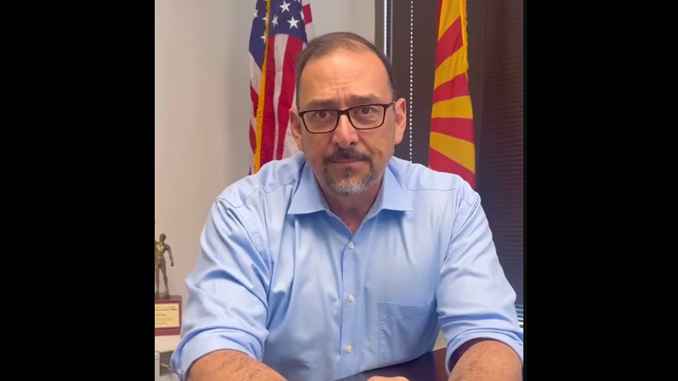
America First Legal (AFL) has filed a lawsuit in Maricopa County Superior Court challenging the official ballot language prepared by Arizona Secretary of State Adrian Fontes for Proposition 144. The lawsuit argues the description violates state law by failing to provide voters with a neutral and accurate summary of the election integrity measure.
The lawsuit asks the court to require the Secretary of State’s Office to revise the ballot language before early voting begins in October.
Proposition 144, referred to the ballot by the Arizona Legislature, would amend the Arizona Constitution to require proof of citizenship to register and vote, require voter identification for all forms of voting, prohibit foreign money from being used to influence Arizona elections, and affirm the authority of the people and the Legislature to enact election laws while clarifying the legal standard for court challenges involving those laws.
According to AFL’s complaint, Arizona law requires the Secretary of State to provide voters with an impartial, objective, and accurate description of ballot measures.
The organization alleges the current description fails to meet those standards by omitting major provisions of the measure, inserting political commentary, and making unsupported claims about its legal effect.
🚨BREAKING — AFL just filed an important election integrity lawsuit in Maricopa County, Arizona.
Adrian Fontes is trying to manipulate and sabotage ballot language to stop election integrity initiatives.
One of the lawsuit’s primary claims is that the official ballot language does not mention Proposition 144’s citizenship requirements, which AFL describes as the measure’s central purpose.
The complaint notes that while Arizona law allows for a 50-word descriptive title, Secretary Fontes allegedly used only about 28 words and did not reference the amendment’s provisions requiring citizenship to register to vote.
“Free and fair elections start with an honest ballot,” stated James Rogers, Senior Counsel at America First Legal. “Secretary Fontes had one job here: tell Arizona voters the truth about what’s on their ballot.”
The lawsuit also challenges language describing the measure’s prohibition on foreign election spending. The official “yes” vote explanation states that the provision is “similar to prohibitions that already exist in federal law.”
AFL argues that statement is misleading because federal law does not prohibit foreign money from being spent to influence ballot measures, and contends Proposition 144 would close that gap.
Additionally, AFL disputes the ballot language stating that the measure would “lower the legal standard for judicial review of election laws, making it harder to challenge election laws in state court.”
The organization argues that Proposition 144 contains no such language and that the statement represents a speculative legal conclusion rather than a neutral explanation of the amendment’s text.
“Arizona law requires official ballot language to be impartial, accurate, and free from advocacy,” added Rogers. “Secretary Fontes’s description of Proposition 144 fails all of these requirements. AFL will fight in court to ensure that every voter in Arizona gets the truth before they cast their ballot. That is what the law demands and what democracy requires.”
Ethan Faverino is a reporter for AZ Free News. You can send him news tips using this link.
House Speaker Mike Johnson said Wednesday that congressional Republicans must make temporary federal income-tax deductions for qualified tips and overtime permanent, tying their continuation to the outcome of the November midterm elections.
Johnson made the commitment during a press conference at PepsiCo’s Frito-Lay manufacturing facility in Casa Grande, where he joined Treasury Secretary Scott Bessent and Rep. Juan Ciscomani (R-AZ-06) for a factory tour and roundtable discussion with Arizona manufacturers and business leaders.
Responding to a question from AZ Free News about the provisions’ scheduled expiration after 2028, Johnson said Republicans intend to pursue an extension.
“We have to make these tax cuts permanent,” Johnson said during the press conference. “We have to ensure that the great benefit that people are feeling right now continues.”
The Working Families Tax Cuts established deductions for qualified tips and overtime compensation beginning with the 2025 tax year and continuing through 2028. The tips deduction is capped at $25,000 annually, while individuals may deduct up to $12,500 in qualified overtime compensation, or $25,000 for married couples filing jointly. The overtime deduction applies to compensation exceeding a worker’s regular rate of pay, such as the additional half-time portion of time-and-a-half wages, according to the Internal Revenue Service.
Johnson argued that continued Republican control of Congress would be necessary to extend the provisions.
“If the Republicans lose control of the Congress in this election cycle in 2026, you can kiss those tax cuts goodbye,” Johnson said.
He also said no Democratic members of the House or Senate supported the tax package and argued that the November election would determine whether Congress extends its temporary provisions.
The law, enacted as Public Law 119-21, permanently extended several provisions of the 2017 Tax Cuts and Jobs Act while establishing the temporary deductions for tips, overtime, qualifying vehicle-loan interest, and eligible seniors. The Congressional Budget Office (CBO) estimated that the law would increase primary federal deficits by approximately $3.4 trillion between 2025 and 2034 through a $4.5 trillion reduction in revenues, partially offset by $1.1 trillion in lower direct spending. A separate CBO estimate placed the total deficit effect at approximately $4.1 trillion when additional debt-service costs are included.
Arizona adopted corresponding state income-tax deductions for qualified tips and overtime through the budget agreement between Arizona Republicans and Gov. Hobbs in June.
Bessent, Johnson, and Ciscomani toured the Casa Grande facility before meeting with local business owners and managers to discuss manufacturing, taxation, and economic growth. The City of Casa Grande lists more than 300 associates at the Frito-Lay facility, which produces Lay’s, Fritos, Tostitos, Doritos, and Cheetos products.
Bessent said in a post on X that the visit focused on the administration’s “America First pro-growth economic agenda” and the effects of the Working Families Tax Cuts one year after President Donald Trump signed the legislation.
One year after President Trump signed the Working Families Tax Cuts into law, the promise of the American Dream is extending to every factory floor. It was great to join Speaker Johnson and Congressman Ciscomani at the Frito-Lay facility in Casa Grande, Arizona to discuss how the… pic.twitter.com/crTUUOySqx
— Treasury Secretary Scott Bessent (@SecScottBessent) August 6, 2026
The Treasury Department says 97 percent of filers received a tax cut compared with what they would have owed if the 2017 tax provisions had expired. The Treasury reported $325 billion in total refunds, $82 billion claimed through individual tax-relief provisions, and an average refund of approximately $3,300.
During the press conference, AZ Free News asked Ciscomani what specific economic developments in the Sixth Congressional District could help reverse the continuing financial pressure facing Arizona households and the state’s declining workforce participation.
The question cited a recent Common Sense Institute (CSI) analysis, which found that Phoenix-area prices remained 33.4 percent higher than in June 2019. CSI estimated that the higher price level is costing a typical Arizona household an additional $1,673 per month.
Arizona’s unemployment rate also increased to 4.9 percent in June, its highest level since the COVID-19 pandemic, while labor-force participation fell to 60.3 percent. The participation rate was near the state’s 10-year low after declining for five consecutive months.
Ciscomani responded by citing projected increases of between $7,400 and $10,600 in take-home pay for an average Arizona family and approximately $3,500 in lower taxes. He also pointed to accounts from parents on a youth football team he coaches who told him they had received the largest tax refunds of their lives.
“This is real money back in people’s real pockets,” Ciscomani said.
The $7,400-to-$10,600 figure has been promoted by Republican lawmakers as a projected increase in take-home pay. It is separate from the Treasury’s reported national average refund of approximately $3,300. Rep. David Schweikert (R-AZ-01) previously described the estimate as including lower taxes and projected wage growth.
“Our opponents on the Democrat side believe that just either freebies or more government programs are the ones that create that. And creating more government jobs is not. Creating jobs is what this company here is doing by expanding and hiring more people, improving the safety of the company, and also attracting more people to work here. That is what’s actually moving forward.”
Ciscomani said allowing families to retain more of their earnings would increase consumer spending and stimulate private-sector job creation. He cited the host facility’s expansion and hiring as an example of private-sector economic activity.
“From the numbers that we know as statistics and also testimonials that I hear about everywhere I go, we know that families are overall doing better,” Ciscomani said.
He acknowledged that Arizona families continue to face financial difficulties and attributed much of the remaining pressure to inflation experienced during former President Joe Biden’s administration.
“Are there hardships? Are there things that people are struggling with? Absolutely,” Ciscomani said. “And we don’t ignore that.”
Ciscomani said the country was “clawing” its way out of the earlier inflationary period and described the economy as moving in the right direction. “We have more work to do, but we’re definitely on the right track.”
Johnson concluded that maintaining Republican congressional majorities would be central to extending the tips and overtime provisions beyond their current expiration.
“Elections have consequences,” Johnson said. “They really do.”
The National Border Patrol Council (NBPC) has officially endorsed Republican Congressman Juan Ciscomani for re-election in Arizona’s Sixth Congressional District. The organization cited Ciscomani’s continued support for Border Patrol agents, commitment to border security, and record for delivering resources and legislative action to strengthen enforcement efforts.
The endorsement highlights Ciscomani’s work advocating for border security and comes as Arizona’s Sixth Congressional District remains one of the nation’s most closely watched House races, with immigration and border security continuing to be major issues for voters across Southern Arizona.
“We’ve had the pleasure of working with Congressman Ciscomani for years, dating back to his work with Governor Doug Ducey on southern Arizona border operations, long before he ever ran for Congress,” stated President of the National Border Patrol Council, Hector Andujo. “Over the years, Juan has proven that he’ll show up, listen, and deliver results.”
“During the government shutdown, he even withheld his own pay to stand with Border Patrol agents who weren’t getting paid through no fault of their own,” added Andujo. “That’s why we know we can count on Juan to stand with us when it matters most. We’re proud to endorse him for re-election to a third term.”
Honored to once again earn the endorsement of the National Border Patrol Council @BPUnion.
Today's event felt more like being surrounded by longtime friends than a campaign event. I've had the privilege of working with many of these agents for years, long before I came to… pic.twitter.com/qZJJyOxjbQ
Ciscomani, who immigrated to Tucson from Mexico at the age of five and later became the first naturalized U.S. citizen from Mexico elected to Congress from Arizona, has built his congressional record around working directly with law enforcement officials and border communities to address challenges facing the southern border.
As Vice Chair of the Homeland Security Appropriations Subcommittee and the only member of Arizona’s congressional delegation from either party or chamber serving on the Appropriations Committee, Ciscomani has played an important role in securing federal resources for Border Patrol agents operating throughout Arizona’s Sixth District.
During his time is Congress, Ciscomani led passage of the Pay Our Homeland Defenders Act, legislation designed to ensure Border Patrol agents and Department of Homeland Security employees continue receiving pay during government funding lapses.
He also helped secure additional resources for agents, retention bonuses, and equipment funding through the Working Families Tax Cuts Act.
Ciscomani has also introduced the FLASH Act, legislation aimed at improving public safety on federal lands along the southern border. It establishes Joint Operations Centers to improve coordination among federal, state, local, and tribal law enforcement agencies, and supported efforts to combat fentanyl trafficking and strengthen border interdiction operations.
“Maintaining a secure border is one of my highest responsibilities as the representative of a border district, and it’s something I work on every single day I’m in Congress,” said Congressman Juan Ciscomani. “I’m honored to once again earn the trust and support of the National Border Patrol Council. This is the third campaign they’ve had my back, and I don’t take that lightly.”
Ciscomani said his continued visits with Border Patrol agents in the field have shaped his approach to border policy and reinforced the need to provide agents with what they need to carry out their mission.
“I’ve spent countless hours with Border Patrol agents in the field, from the middle of the night to the hottest part of the day, listening to what they face and what they need to succeed,” added Ciscomani. “Every visit leaves me with an even greater appreciation for their service. I’ll continue fighting to ensure they have the resources, tools, and support they need to protect our communities and keep our nation secure.”
The National Border Patrol Council’s endorsement becomes the sixth organization to endorse Congressman Ciscomani for re-election and adds to the growing list of support from law enforcement, local leaders, and community advocates as he seeks a third term representing Arizona’s Sixth Congressional District.
Ethan Faverino is a reporter for AZ Free News. You can send him news tips using this link.
Gov. Katie Hobbs has campaigned on claims of success in negotiating protections for Arizona’s Colorado River water rights — but recent developments have indicated otherwise.
In late June, the governor promised Arizonans that she had successfully advocated for Arizona’s water rights. Hobbs characterized those negotiations as the “one problem” she solved in her four years as governor in an interview with 12 News.
One month later, the federal government announced that Arizona would face the largest Colorado River water cuts.
In her interview with 12 News, Hobbs indicated that the federal government had been persuaded by her contributions to the Lower Basin negotiations.
“We took on a lot of tough challenges that have been years in the making,” said Hobbs. “We have made huge progress in prioritizing Arizona’s Colorado River at the federal level to ensure that we can continue our economic position.”
Hobbs walked into negotiations with arguments no other state could make: Arizona uses Colorado River water to produce more fresh vegetables, advanced missile systems, advanced chip technologies, and critical minerals than other states. Yet, it appears Hobbs failed to make a compelling case for the federal government to divide water cuts more equally.
“All critical to America’s economic future, our national security, we do that with Colorado River water, and no other state can say that, and we’ve been making that case,” said Hobbs.
The Bureau of Reclamation announced last week that Arizonans would be required to cut water usage by up to 77% in 2027 and 2028.
Hobbs responded to the mandate with a plea to the federal government to adopt the proposal she and the other Lower Basin states put forward. The governor said she would continue to try to convince the federal government of Arizona’s importance to the nation with its agricultural and national security contributions.
“As the federal government finalizes their operating plans for 2027 and 2028, my administration will be working around the clock advocating for an approach that protects the stability of the system, distributes water reductions equitably, and ensures water security for all Colorado River water users,” said Hobbs. “I will continue making that case to the federal government and fighting relentlessly to protect Arizona’s fair share of the Colorado River so our families can feel confident we will have the water we need to turn on the taps, nourish our crops, and grow our economy well into the future.”
The Department of the Interior mentioned in its release of the new Colorado River operational guidelines that it had been unsuccessful in reaching a consensus with the basin states over the past six years.
Biggs described the federal mandate as an “Arizona last” measure, and said that the Upper Basin states — Colorado, New Mexico, Utah, and Wyoming — were behind the years-long lack of consensus.
Even with the release of the Final Environmental Impact Statement for the Colorado River Basin, I will continue to take action to bring relief to our state and ensure that we can protect our citizens, agriculture industries, and everyone else relying on this life-giving resource. pic.twitter.com/97mD6XUhhh
In that same June interview, Hobbs said in her view that her historic veto record — more than 500 — didn’t cause Arizonans to lose out on any legislation that provided solutions.
“I am proud of the fact that I have signed over 800 bipartisan bills into law. I didn’t come here to veto bills,” said Hobbs.
AZ Free News is your #1 source for Arizona news and politics. You can send us news tips using this link.
Gov. Katie Hobbs is rumored to have picked the leader of the Republicans for Harris movement to serve as her lieutenant governor should she win in November.
Unnamed sources toldThe New York Times that Hobbs picked John Giles as her running mate, a former Republican and the mayor of Mesa from 2014 to 2025. Giles co-chaired Republicans for Harris, a campaign advisory committee for 2024 Democratic presidential candidate Kamala Harris.
Multiple media outlets reported that Giles was a “moderate Republican,” but voter records reflect that Giles changed his voter registration to be an independent back in May and voted in this year’s Democratic primary.
Giles was initially reported to be among a handful of candidates that had allegedly rejected Hobbs’ request, according to sources cited in earlier reporting by The New York Times.
Giles has been a consistent supporter of Hobbs leading up to and throughout her governorship.
Giles served on Hobbs’ transition team; as our reporting noted, Giles was one of several on the team with connections to a fellow transition team member running a nonprofit under investigation for pandemic loan fraud. Giles had backed a proposition put forth by that nonprofit granting in-state college tuition to illegal aliens.
Giles also issued a statement commending the governor on her first 100 days in office.
During the 2024 election, Giles was promoted as leading a coalition of Arizona Republicans campaigning for Harris via their communications director at the time, Delaney Corcoran, who is currently Attorney General Kris Mayes’ campaign manager and until recently, Mayes’ deputy communications director. Giles described President Donald Trump as the “path of political extremism.”
HAPPENING NOW: Arizona Republicans endorse Vice President Harris and slam Trump for his attacks on democracy. GOP leaders will form a new advisory committee to help the Harris for Arizona campaign reach Republicans who will reject MAGA from now until November 🗳️ pic.twitter.com/UKySKxC0LG
Giles’ public commitment to the Harris campaign occurred following a widely circulated guest column in the Arizona Republic in which he criticized pro-life and pro-gun policies as “far-right” threats to constitutional rights.
“Trump poses a serious threat to our nation. We can’t have a felon representing us on the national stage, let alone one who would threaten to abandon NATO and ruin our standing abroad,” wrote Giles in the column. “Kamala Harris is the competent, just and fair leader our country deserves. This year too much is at stake to vote Republican at the top of the ticket.”
While mayor of Mesa, Giles implemented the Off the Streets program, which provides 90-day transitional housing to the homeless using roughly $14 million in pandemic relief funds. Under Giles’ tenure and following the program’s launch in 2021, the homeless population increased by 31%. Giles structured the program using the Built for Zero approach promoted by the nonprofit Community Solutions.
Giles also ensured Mesa was the first in the state to have a Google data center.
Following Harris’s loss and his departure from the mayor’s office, it appears Giles’ involvement with Arizona Republicans for Harris concluded.
Arizona campaign finance records reflect just one expenditure mentioning Giles’ Arizona Republicans for Harris group: a $600 cash payment from the Democrats of Rim County to the organization in September 2024 for signs. The address for Giles’ group was listed as “Unknown, Phoenix, AZ, 85001.”
It appears Arizona Republicans for Harris was absorbed or combined with a political action committee (PAC) that helped Joe Biden win the presidency in 2020, Arizona Republicans Who Believe In Treating Others With Respect.
Daniel Barker, retired Arizona Court of Appeals judge and leader within the Maricopa County Mormon community, co-founded the PAC with his wife, Nan, in 2020.
No campaign finance records for the PAC were available as of this report on the Arizona secretary of state website. Federal Election Commission (FEC) records report the entity to be an active super PAC which reported raising more than $470,000 in 2024. Nearly half of those funds — $200,000 — came from the revocable trust belonging to Democratic Illinois Gov. J.B. Pritzker. $125,000 came from Justin Durand, a Mesa guest ranch owner.
Most of the funds raised went to supporting the Harris campaign.
— AZRepublicansWhoBelieve (@AZ_Reps_Believe) October 1, 2024
At the national scale, Republicans for Harris has since rebranded as “Maverick,” a group of “bold centrists fighting for America.” It is maintained by Reed Howard, who formerly ran Young Republicans for Harris and currently serves as chief strategy officer for the Future Caucus.
Attorney General Kris Mayes wouldn’t confirm whether Gov. Katie Hobbs will be questioned as part of the investigation into the governor’s alleged pay-to-play scandal, which has been ongoing for more than two years.
Mayes was asked during a press conference announcing her lawsuit against the Trump administration’s tariffs on Monday whether it was possible that Hobbs would never sit for questioning.
“I’m going to decline to answer that question right now,” said Mayes.
Mayes’ office has asked Hobbs publicly to sit for questioning for months.
Despite needing a sit-down interview to proceed with the investigation, Mayes did promise to release the results of the investigation sometime before the general election in November. Left unsaid was the possibility that voters may not have those results until their ballots have already been cast in the highly competitive governor’s race between incumbent Hobbs and Republican Andy Biggs.
Mayes disagreed that Hobbs was shirking questioning and denied that the prolonged lack of communication between her and the governor on the matter had to do with Hobbs leaning on her power and status as the state’s chief executive, and their shared party affiliation.
“You cannot blow off the attorney general’s office. Full stop. No one can, regardless of who they are,” said Mayes. “When we have a result in this investigation, we will make an announcement. And we are near the end of the investigation.”
The investigation concerns an allegation that Hobbs directed a unique rate increase of 30% for Sunshine Residential Homes, a group home operator, as thanks for the company’s sizable 2024 election cycle donations totaling more than $400,000 to Hobbs and the Arizona Democratic Party. Hobbs was the only candidate to receive contributions from Simon Kottoor, founder and CEO of Sunshine Residential Homes.
While Sunshine Residential Homes received a rate increase, the Arizona Department of Child Safety (DCS) denied rate increases for other home operators and dropped more than a dozen providers. DCS has since stated that the rate increase occurred because Sunshine Residential Homes threatened to prioritize intake of migrant children over Arizona’s foster children.
Mayes began her investigation more than two years ago, in the summer of 2024, after others began investigating following reporting by the Arizona Republic that broke the pay-to-play scandal.
Certain officials had begun to investigate the allegations, but Mayes stepped in to stop them. Mayes sent letters to Maricopa County Attorney Rachel Mitchell and Auditor General Lindsey Perry, ordering both officials to stop seeking answers.
“It would not be appropriate or in the best interest of the state to conduct parallel investigations into the same matter,” said Mayes in the letter to Mitchell. “[A] separate process conducted by the MCAO could jeopardize the integrity of the criminal investigation that my office will now proceed with.”
Mitchell’s response urged Mayes to reconsider her position on being the sole investigator into the allegations.
“I want to be clear: This is not an accusation against you or the many fine employees in your office,” said Mitchell. “We are in a time when people are increasingly distrustful of government. Your insistence on being the sole investigator in this matter will greatly contribute to people’s […] belief that nothing can change.”
Leadership within the Republican-led legislature announced their own investigatory efforts earlier this year. The House advisory team obtained outside counsel to investigate the alleged pay-to-play scandal. No findings have been made public as a result of that effort to date.
Earlier this summer, the governor vetoed legislation establishing financial transparency requirements tied to the alleged pay-to-play scandal.
Hobbs has denied any wrongdoing throughout the years-long investigation.
AZ Free News is your #1 source for Arizona news and politics. You can send us news tips using this link.