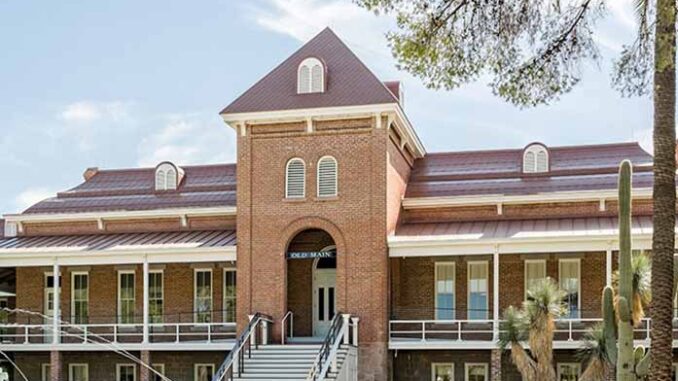
by Staff Reporter | Feb 14, 2026 | News
By Staff Reporter |
Karrin Taylor Robson announced the suspension of her gubernatorial campaign on Thursday.
Robson cited concerns about the possible effects of “a divisive Republican primary” as the November 2026 election approaches as her reason for stepping out of the race.
“It only weakens our conservative cause and gives the left exactly what they want: a fractured Republican Party heading into November,” said Robson. “With so much on the line in 2026, I am not willing to contribute to that outcome.”
Robson shared an endorsement from President Donald Trump with another primary opponent, Congressman Andy Biggs, this go around.
Trump handed Robson the endorsement first in December 2024 during Turning Point USA’s annual “AmericaFest” convention in Phoenix. When Biggs announced his run early last year, Trump made an unusual but not altogether unprecedented decision and put up a second endorsement for Biggs: the less moderate Republican and former Freedom Caucus chair.
When he announced his dual endorsement, Trump said he had endorsed Robson because there were no other candidates at the time.
“I like Karrin Taylor Robson of Arizona a lot, and when she asked me to Endorse her, with nobody else running, I Endorsed her, and was happy to do so,” said Trump. “When Andy Biggs decided to run for Governor, quite unexpectedly, I had a problem — Two fantastic candidates, two terrific people, two wonderful champions, and it is therefore my Great Honor TO GIVE MY COMPLETE AND TOTAL ENDORSEMENT TO BOTH. Either one will never let you down. MAKE AMERICA GREAT AGAIN!”
Trump split his endorsement in the 2024 congressional race between Blake Masters and now-Rep. Abe Hamadeh.
About a month after Trump split his endorsement between Robson and Biggs, three key allies from Trump’s circle split from Robson’s campaign. Two of those individuals served as Robson’s advisors after playing key roles in engineering Trump’s successful 2024 reelection. Sources said the allies left after Robson refused to run campaign ads with Trump’s endorsement immediately; instead, Robson waited until after Biggs got his endorsement to announce.
Robson, a former Arizona Boards of Regents member appointed by former Gov. Doug Ducey, made an unsuccessful primary run against failed Republican candidate Kari Lake in the 2022 gubernatorial election. That year, Lake was the sole Republican gubernatorial candidate to enjoy Trump’s endorsement.
With Robson out of the race, that leaves Biggs, Congressman David Schweikert, and local business owner Scott Neely gunning to win the primary in July.
Republican leaders responded to Robson’s campaign suspension with gratitude for her service to the state. Right-wing political and grassroots leaders also signaled Robson’s suspension as a unifying call to back Biggs in the race. Robson didn’t endorse another candidate.
State Senate President Pro Tempore T.J. Shope (R-LD16) told Robson he would continue to work with her on policy, and further expressed his endorsement of Biggs.
Likewise, Turning Point USA affiliates and leaders issued statements thanking Robson and encouraging voters to get behind Biggs.
A majority of the latest polls predicted Biggs would have double-digit leads in the upcoming primary election over Robson.
AZ Free News is your #1 source for Arizona news and politics. You can send us news tips using this link.
by Matthew Holloway | Feb 14, 2026 | News
By Matthew Holloway |
In a 5-4 party-line vote Tuesday, the Republican-led Arizona House Ways and Means Committee advanced legislation that would temporarily freeze most municipal and county tax, fee, and utility rate increases for four years.
House Bill 4030 and House Concurrent Resolution 2052, sponsored by Committee Chair Justin Olson (R-LD10), would limit local government charges to levels approved in fiscal year 2025–2026 budgets for a four-year period beginning July 1, 2026, and ending June 30, 2030.
Under the proposal, cities and counties would be prohibited from raising existing fees or tax rates, creating new tax classifications, or expanding tax bases during the moratorium period. The measures would preserve voters’ authority to approve increases at the ballot box. HB 4030 would enact the moratorium through statute. HCR 2052 would refer the policy to voters at the next general election.
The legislation includes enforcement provisions aimed at preventing local governments from restructuring or renaming charges, altering rate schedules, or modifying classifications in a way that would effectively increase revenues beyond fiscal year 2025–2026 levels.
In a statement, Olson said the measures are intended to provide cost certainty for residents amid ongoing inflationary pressures.
“These bills do exactly what families expect when the cost of living keeps climbing: they stop government from reaching deeper into their pockets,” Olson said. “While Arizona families are cutting back, local governments should not be hiking fees, raising taxes, or quietly inflating utility bills. HB 4030 and HCR 2052 put a hard check on that behavior and give taxpayers certainty and relief.”
“This comes down to discipline and fairness,” Olson explained. “Local governments already approved their budgets. This bill just requires them to live within the revenues generated by existing tax rates. If a city or county wants more money, they can make their case to voters and earn the support of a strong supermajority. What they cannot do is quietly raise costs on families whose budgets are already stretched thin.”
The proposal also follows recent disputes between state lawmakers and municipal governments over local authority, including 2025 legislation involving Axon’s planned headquarters development in Scottsdale that resulted in the Legislature preempting certain local actions.
Arizona’s Constitution grants charter cities broad authority over local affairs, including taxation and fee structures, under its home-rule provisions (Arizona Constitution, Article XIII, Section 2). Arizona courts have historically recognized broad municipal autonomy in matters deemed “purely local,” as the Arizona Supreme Court noted in State ex rel. Brnovich v. City of Tucson (2017).
In recent years, several Arizona municipalities have approved utility and service rate increases, citing infrastructure needs and inflationary pressures. For example, the City of Phoenix approved water and wastewater rate adjustments in 2023 and 2024 to address infrastructure and operational costs, according to the City of Phoenix Water Services Department. Tucson Water has also adopted phased rate increases in recent budget cycles, per city rate information.
If approved by both chambers and signed by the governor, HB 4030 would take effect as statute. As a concurrent resolution, HCR 2052 would bypass the governor and instead be placed on the ballot for voter consideration. Both measures now advance to the full House.
Supporters argue the measure would provide temporary cost certainty for residents, while opponents of similar proposals in past sessions have raised concerns about potential constraints on municipal budgeting and infrastructure funding.
Matthew Holloway is a senior reporter for AZ Free News. Follow him on X for his latest stories, or email tips to Matthew@azfreenews.com.
by Ethan Faverino | Feb 14, 2026 | Economy, News
By Ethan Faverino |
The latest survey from the National Federation of Independent Business (NFIB) reveals that small business optimism in the U.S. dipped slightly at the start of 2026. The Small Business Optimism Index declined by just 0.2 points in January to 99.3, yet it remains above the 52-year average of 98.
Among the index’s 10 key components, 7 declined, while only 3 improved. The positive standout shift came in expectations for real sales volumes, which jumped by 6 points, with a net 16% of owners now anticipating stronger sales in the coming quarter.
However, uncertainty notably climbed, as the Uncertainty Index increased by 7 points to 91. Much of this rise stemmed from more owners expressing doubt about whether the current environment favors business expansion.
“While GDP is rising, small businesses are still waiting for noticeable economic growth,” stated NFIB Chief Economist Bill Dunkelberg. “Despite this, more owners are reporting better business health and anticipating higher sales.”
In Arizona and similar regions, a cautious mood persists, with many business owners hesitant to pursue expansion. NFIB Arizona State Director Chad Heinrich noted that ongoing tax-related uncertainties are adding to these concerns, while NFIB data shows taxes are the leading problem for 18% of business owners.
“The optimism index remains stable, but small business owners remain cautious about the future and whether it’s a good time to expand their operations,” explained Heinrich. “The limbo Main Street Arizonans find themselves in this tax season only exacerbates their uncertainty. Small business owners need tax conformity from policymakers now.”
A new addition to this month’s report, the Small Business Employment Index, registered 101.6 in January—down nearly a point from December but still 1.5 points above its historical average of 100 and marginally higher than the 2025 average. This suggests the labor market for small businesses remains relatively balanced.
According to the NFIB Monthly Jobs Report, overall business conditions showed improvement in owners’ self-assessments, with 14% now rating their operations as excellent (up 5 points) and fewer classifying them as only fair (down 7 points to 27%).
Investment activity picked up as 60% of owners reported capital expenditures over the past six months—the highest share since late 2023—mostly directed toward new equipment.
On the labor front, challenges eased somewhat, with businesses citing labor quality as their top issue; the share fell for the third straight month to 16%, and unfilled job openings dropped to 31% (still above the long-run norm).
Inflationary pressures linger, however, as 26% of owners reported raising prices in January, and 32% plan increases in the next few months.
Ethan Faverino is a reporter for AZ Free News. You can send him news tips using this link.
by Staff Reporter | Feb 13, 2026 | Education, News
By Staff Reporter |
New email records reveal the University of Arizona (U of A) misled the public about a donation from Jeffrey Epstein.
Email records first reported on by FOIAzona proved Epstein’s donation was not “anonymous” as U of A’s vice president for communications at the time, Chris Sigurdson, claimed. U of A’s associate vice president of external communications at the time, Pam Scott, also claimed that the university had no knowledge because Epstein was not listed on the board of directors with the charity through which he donated, Gratitude America.
“At the time the donation was made by Gratitude America Ltd., Jeffrey Epstein was not listed on the board of directors and the university was unaware of his involvement,” she said. “We have no plans to repay this contribution.”
However, records reveal Epstein’s name was postmarked on the mailing documents containing the donation check bearing his charity’s name. The donation was made out to the University of Arizona Foundation.
Epstein’s $50,000 donation was made at the request of one U of A professor, Stuart Hameroff.
Hameroff’s team also helped Epstein’s team on where to send the donation. The university, through that professor’s program, gave Epstein’s charity public recognition for the donation.
In March 2017, Hameroff asked Epstein to fund an annual conference he put on through the interdisciplinary entity he founded over 30 years ago, the Center for Consciousness Studies. These conferences have occurred since 1994.
One of the center’s latest major donations was $2 million from a retired Google software developer. These funds align with the purpose of the funds put forth by Epstein: engineering consciousness. (The latest Epstein files release revealed Epstein sought, among his other endeavors into transhumanism, to create a behavioral engineering institute at Stanford University).
Hameroff is a leader with the U of A sciences: he cofounded and chairs the Center for Consciousness Studies, cochairs the Science of Consciousness, and serves as professor emeritus of the Departments of Anesthesiology and Psychology.
Hameroff didn’t need to provide Epstein with details before the financier pledged a minimum sponsorship of $50,000.
“Who are the speakers and what is the cost?” wrote Epstein. “I’m in for at least $50,000, before knowing anything.”
Epstein’s trust in Hameroff likely stemmed from the personal relationship the pair shared. The Epstein library presently returns multiple records mentioning Hameroff from 2016 through 2018.
Hameroff stayed at one of Epstein’s apartments in New York for multiple days leading up to Halloween in 2016, arranged by Gino Yu, associate professor and director of game development at Hong Kong Polytechnic Institute. Yu referred to Epstein as his “benefactor,” per Hameroff.
Hameroff called the night “memorable” in an email after the fact.
“We appreciate you staying up late with an early flight. We were tired too, but it was a memorable night,” wrote Hameroff.
Yu also wanted James Tagg, an inventor and engineer with Penrose Institute, to attend the October 2016 meeting with Epstein and Hameroff. It’s unclear if Tagg attended. However, Hameroff did later ask Epstein to provide seed money for another project, the Penrose Institute, in May 2017 during discussions of the Center for Consciousness Studies conference.
Other recently released Epstein records revealed that an investment banker and fellow Epstein affiliate, Robert Lawrence Kuhn, directed Epstein to review another consciousness program advised by Hameroff, the Shanghai Science of Consciousness Program. That email exchange took place in February 2017. It appears that program was a reference to a canceled attempt to hold the Center for Consciousness Studies conference in Shanghai, per emails.
“Attached is the Shanghai Science of Consciousness program (Stuart Hameroff put together; I advised),” said Kuhn.
Epstein, via his charity Gratitude America, was featured as a sponsor that “made the conference a reality” per program documents. Emails affirmed this promotion, as well as offers to pay for a hotel room for Epstein’s attendance at the conference.
Another U of A faculty member and famed political activist, Noam Chomsky, was a friend of Epstein as well. Chomsky was included in Epstein’s “little black book.”
AZ Free News is your #1 source for Arizona news and politics. You can send us news tips using this link.
by Staff Reporter | Feb 13, 2026 | News
By Staff Reporter |
Maricopa County’s former recorder, Stephen Richer, says Republican’s concerns over illegal alien voting are “bogus.”
The former elections leader for one of the nation’s biggest counties published that claim earlier this week in an opinion piece for The New York Times.
“Confirmed: non-citizens aren’t voting,” said Richer.
Richer cited state investigations into noncitizen voting in which voter rolls were cross-checked with citizenship status. The recorder said concerns over illegal alien voters were a myth jeopardizing democracy.
“People largely aren’t willing to risk their status in the United States — the land of economic opportunity — for the ability to cast one more vote out of hundreds of thousands or millions in a state and hundreds of millions in the country,” stated Richer. “Playing politics with the idea of fraudulent voters and stolen elections comes at a real cost to American confidence in our elections. It’s an affront to our democracy and to all those who work to deliver free and fair elections. It’s also an ominous sign for where things may be heading this year.”
However, the cross-check referenced by Richer doesn’t address the common practice of identity theft among illegal aliens. Voter rolls can only confirm the citizenship of the individual listed, not of an individual who may be usurping that identity.
According to some federal estimates, 75 percent of illegal aliens are using stolen identities. There’s about 11.5 million illegal aliens in the country per the latest federal estimate, which would mean over 8.6 million illegal aliens use stolen identities under those estimates. Around 7 million of those illegal aliens claim employment per the government.
Of the smaller number of illegal aliens whose employment is recorded on the books, the government’s low estimate for illegal alien identity theft totals over one million.
With that range of estimates, there may be anywhere from 20,000 to 170,000 illegal aliens living under stolen identities in each state, assuming equal population distribution.
A day after The New York Times published Richer’s opinion piece, the Department of Justice announced the case of another illegal alien convicted of voter fraud.
An illegal alien from Columbia voted in the 2024 presidential election under a stolen identity, which she’d been using for over 20 years. Lina Maria Orovio-Hernandez, 59, had obtained a Real ID and received over $400,000 in stolen federal benefits.
Those stolen benefits included over $250,000 in Housing and Urban Development rental assistance. Orovio-Hernandez also obtained eight other state IDs in addition to the Real ID she obtained in Massachusetts.
Since leaving the recorder’s office, Richer has taken up elections-related leadership positions that advance claims similar to the ones he made in his most recent opinion piece, to include senior practice fellow in American democracy with the Harvard Kennedy School and adjunct scholar with the Cato Institute.
Richer pulled away from the Republican Party during the 2024 election when he announced his intent to vote for Democratic candidate Kamala Harris.
Other illegal aliens have voted in elections without the use of identity theft.
Last month, an illegal alien pleaded guilty to voting in the 2020 election.
Last December, two illegal aliens were indicted for voting in the November 2020 general election.
Last November, an illegal alien from Mexico elected to be the local mayor was charged for having voted illegally numerous times over his decades spent in the U.S.
Last August, a Canadian citizen voted in two federal elections, once in 2022 and in 2024.
AZ Free News is your #1 source for Arizona news and politics. You can send us news tips using this link.
by Staff Reporter | Feb 13, 2026 | Education, News
By Staff Reporter |
Arizona Superintendent of Public Instruction Tom Horne believes the new federal guidance on prayer in schools serves as a pathway to further purge K-12 of diversity, equity, and inclusion (DEI).
Horne said the administration’s characterization of speech compulsion made it clear that DEI presented an impermissible threat to religious freedoms.
“The new guidance issued by the U.S. Department of Education states that ‘No public school, teacher, or school official should ever coerce or press a student to engage in speech or affirm a viewpoint that would violate the student’s sincere religious beliefs,’” said Horne. “Numerous DEI precepts violate widespread religious beliefs, such as urging students to change genders, age-inappropriate sexual lessons, and other elements that may demean a student’s religious beliefs.”
Horne clarified that the new guidance doesn’t permit schools to coerce religious expression, either. Both the superintendent and the guidance cited the 2025 Supreme Court decision, Mahmoud v. Taylor, which found that public schools mandating curriculums endorsing homosexuality and transgenderism were violating religious freedom.
“No public school, teacher, or school official should ever coerce or pressure a student to engage in speech or affirm a viewpoint that would violate the student’s sincere religious beliefs,” stated the guidance. “[A] public school cannot require a student group to adopt a particular viewpoint in order to be recognized by the school if the viewpoint violates the student members’ religious beliefs. School officials also cannot express hostility toward religious student groups by demeaning their beliefs.”
The guidance, issued last week, addresses the issue of DEI elements in the context of requirements under federal law to advise on constitutionally protected prayer in public elementary and secondary schools. This updated version replaces the last guidance issued under the Biden administration in 2023.
Horne offered a marked copy of the guidance highlighting key new provisions across the four parts of the nine-page guidance.
In order to receive federal funding, local education agencies (LEAs) must certify in writing to the Arizona Department of Education (AZED) by Oct. 1 every year that none of their policies prevent or otherwise deny participation in constitutionally protected prayer in public K-12 schools.
AZED will establish processes by which the LEAs provide that certification and by which complaints may be filed against noncompliant LEAs. AZED must also send a list of noncompliant LEAs to the Department of Education by Nov. 1.
Presently, AZED requires LEAs to answer on Critical Race Theory and DEI as part of public reporting of school grades to assist with parental choice in schools.
“We will add this question to our list and report answers not only on our website, but also, as required, to the federal government,” said Horne. “Those with unsatisfactory answers to this question will then be deprived of federal funds.”
The guidance further clarified that the Trump administration’s perspective on religious freedom within schools was unlike the “wall of separation” view undertaken by previous administrations. It cited the most recent Supreme Court decision on prayer by school officials, Kennedy v. Bremerton School District, which found that a high school football coach had a right to engage in prayer on the field after games.
“This is not the familiar but legally unsound metaphor of a ‘wall of separation’ between religious faith and public schools,” stated the guidance. “It is rather a stance of neutrality among and accommodation toward all faiths, and hostility toward none, deeply rooted in our nation’s history, traditions, and constitutional law — a stance that upholds our Constitution’s ‘recognition of the important role that religion plays in the lives of many Americans.’”
AZ Free News is your #1 source for Arizona news and politics. You can send us news tips using this link.