In 2020, illegal immigrants cost Arizona public schools over $748 million — an economic burden that will likely increase due to the ongoing border crisis. 99 percent of these funds come from Arizona taxpayers’ local and state taxes, not the federal government.
The cost estimate comes from a report released this month by the Federation for American Immigration Reform (FAIR). Despite the hundreds of millions poured into these limited English proficiency (LEP) programs, only 32 percent (about 23,900) of illegal immigrant students in Arizona graduate on time.
As of 2020, there were over 74,800 LEP students. That’s just over half of a percent of the total student population at most: 1.1 million. Nationwide, that number is 5.1 million students costing taxpayers over $78 billion.
American taxpayers spend nearly $80 billion a year to educate students with limited English proficiency.
More than one in ten U.S. public schoolchildren are enrolled in LEP programs.https://t.co/18CoV9YNlO
Under President Joe Biden, there have been over 277,300 accompanied minors and unaccompanied children that crossed the border illegally. That doesn’t account for those apprehended minors within family units, nor does it account for gotaways.
The Arizona Department of Education (ADE) handles LEP students, which they refer to as English Learners (EL), through their Office of English Language Acquisition Services (OELAS). Arizona schools’ LEP programs are known as Structured English Immersion (SEI) programs.
In May, the ADE invested $10 million of American Rescue Plan (ARP) funds to train teachers for SEI programs.
Today, @azedschools is proud to announce support for English Language Learners through a $10 million investment in @WestEd's Quality Teaching for English Learners program. The funding will assist #WestEd in preparing educators to meet the needs of Arizona's multilingual students. pic.twitter.com/Eb9hQ5Jlje
ADE Superintendent Kathy Hoffman opposes the SEI programs. Hoffman supported Arizona legislators’ efforts to repeal Proposition 203, which has required Arizona schools to educate EL students in English only since 2000, not their native language.
Repealing the English-only was a cornerstone of my campaign and remains critically important to my administration as we advocate for equity for all students to achieve their full potential. https://t.co/GeNEzVpv1L
American schools weren’t always required to provide taxpayer-funded public education to illegal immigrant children. That changed in 1982 when the Supreme Court (SCOTUS) ruled in Plyler v. Doethat illegal immigrant children were entitled to public schooling.
The taxpayer burden of illegal immigrant education may not end with K-12 schools. Come November, voters must decide whether to approve Proposition 308, which will grant in-state college tuition to illegal immigrants so long as they’ve graduated from an Arizona high school.
Arizona voters don’t just vote on people, we vote on policy too!
Prop 308 gives AZ Dreamers equal affordability if they attend a state school, has bipartisan support, and puts no additional costs on the taxpayer.
The state legislature approved the resolution last year through the combined efforts of Arizona House Democrats and several House Republicans: State Representatives Michelle Udall (R-Mesa), Joel John (R-Buckeye), David Cook (R-Globe), and Joanne Osborne (R-Goodyear).
Corinne Murdock is a reporter for AZ Free News. Follow her latest on Twitter, or email tips to corinne@azfreenews.com.
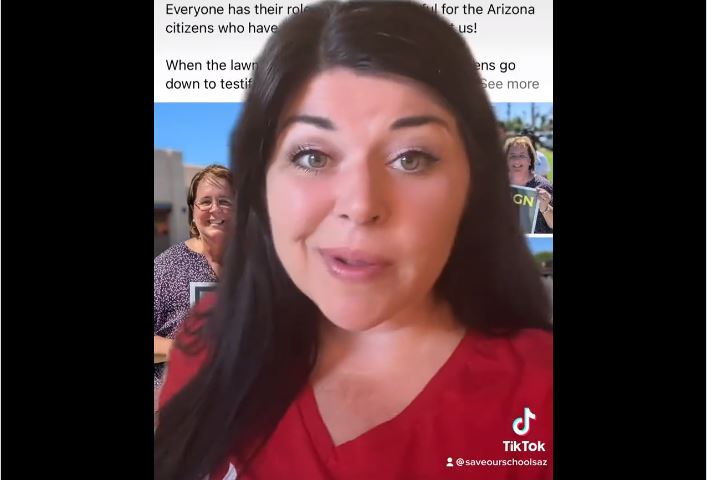
On Sunday, Save Our Schools Arizona (SOSAZ) Director Beth Lewis called four Arizona legislators “MAGA extremists,” accusing them of blocking their signature gathering efforts by protesting.
“They are all extremist lawmakers who are Trumpers and MAGA extremists,” said Lewis. “They are out here harassing our volunteers, surrounding 80-year-old women, calling businesses and lying, all to make sure that we don’t get to have signatures by this Friday to stop universal voucher expansion and keep public funding in public schools.”
These protesters are interfering with democracy. Yep, that’s Rep Ben Toma, Senators Warren Petersen, Michelle Ugenti Rita & Wendy Rogers— MAGA extremists trolling @arizona_sos events & harassing pro-public education volunteers 😡😡😡 Sign at https://t.co/M8Q0ZTkPD4pic.twitter.com/9wI07SBZBn
Lewis erroneously called Arizona’s school choice funds “vouchers.” Those types of funds may only be used at private schools. Arizona’s Empowerment Scholarship Account (ESA) Program funds may be used for other educational opportunities, such as tutoring, supplemental curriculum, online learning programs or courses, standardized testing fees, and community college.
One of the accused lawmakers, State Senator Michelle Ugenti-Rita (R-Scottsdale) retorted that peaceful protest doesn’t inhibit democratic signature-gathering.
“Expressing our beliefs is the foundation of democracy, not interfering with it,” said Ugenti-Rita. “Instead of name-calling, try using substantive and persuasive facts to sell your perspective. Otherwise, you simply come off as a simpleton.”
Hello, random person on Twitter, you have it all backwards. Expressing our beliefs is the foundation of democracy not interfering with it.
Instead of name calling try using substantive and persuasive facts to sell your perspective. Otherwise you simply come off as a simpleton. https://t.co/I0h3WGozBN
The three other legislators accused of being MAGA extremists were State Senators Warren Petersen (R-Gilbert) and Wendy Rogers (R-Flagstaff), as well as State Representative Ben Toma (R-Peoria).
SOSAZ is attempting to gather enough signatures for their 2024 ballot initiative to overturn Arizona’s universal school choice: “Stop Voucher Expansion.” As AZ Free News reported earlier this month, SOSAZ signature gatherers were giving false information to potential signers.
Lewis didn’t deny that false information was given to signature gatherers. Instead, she took issue that someone had recorded the SOSAZ activists secretly.
Cool flex. @grantbotma entrapped a grandma, lied about your identity, secretly recorded it, and then posted their photo online. You should be ashamed of yourself. When volunteers are pushed and pushed, they're bound to get slightly tripped up. But you know that. smh
Several days after the SOSAZ activists’ remarks were leaked, Lewis issued an opinion piece in the Arizona Mirror to denounce universal school choice. Lewis called school choice a “grift” and “massive cash grab” by private schools, pushing one of the contested claims of her organization’s signature gatherers that the ESA Program lacks oversight.
“Universal vouchers mean the end of public education as we know it in Arizona,” stated Lewis.
“AZ voters have to stop letting extremist Republicans in power continue to set the house on fire in order to claim their insurance money. We have one — and only one — opportunity to stop the privatization of public schools & that’s by signing the #StopVoucherExpansion petition” https://t.co/j5KCnbsgbO
If any lack of oversight exists, that would be because of Arizona Department of Education (ADE) Superintendent Kathy Hoffman. The superintendent is a vocal opponent of the ESA Program and supporter of the SOSAZ ballot initiative. Hoffman graduated from an Oregon private school.
When signing the SOSAZ ballot initiative, Hoffman claimed that the ESA Program she oversees has “zero accountability.”
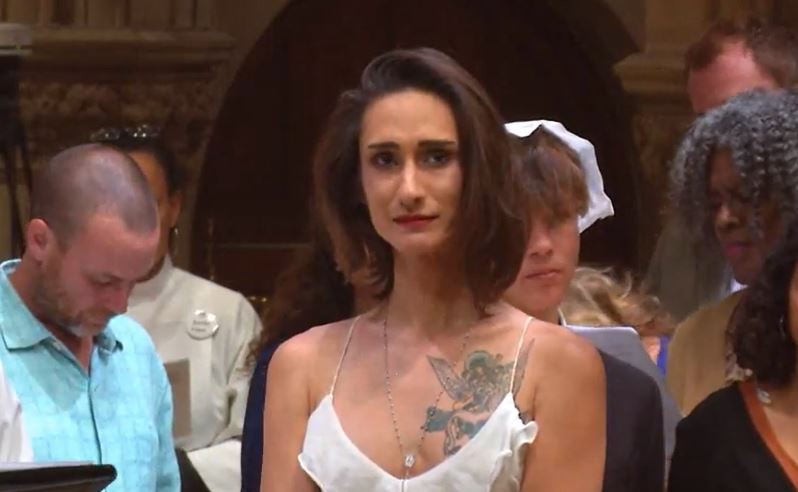
A Californian transgender woman on the board of an organization focused on normalizing child transgenderism plans to launch a private high school that grants college degrees in Phoenix next year.
Ella (née Daniel) Baker, the founder of Pathways Early College Academy (PECA) and board member of Gender Spectrum, also plans to have his students participate in “The Incubator”: academic and behavioral support through daily faculty check-ins that involve “tutoring, mentorship, and general guidance.” Over the past decade, there have been cases of children who grew distant from their parents and became suicidal after faculty challenged their gender identity or secretly aided in their social and physical gender transition.
Abigail Martinez: “I tried to get mental health for my daughter but I was told she didn't need that, she just needed hormone therapy and surgeries and THAT would save her life. I was told not to talk about God to my daughter.” https://t.co/c4lwUVphvVpic.twitter.com/WsCaOA9IcB
It appears that Baker is establishing a Phoenix campus primarily to capitalize on the newly-universalized Arizona’s Empowerment Scholarship Account (ESA) Program. PECA advertises that it accepts ESA funds, noting that its tuition is $7,000 even — the exact maximum a student may receive under the universal ESA Program. However, tuition increases to $9,800 for the 2023-2024 school year.
“[PECA] is set at the expected state-funded amount so that most families can attend for free,” stated Baker.
Baker’s Gender Spectrum bio includes career highlights not mentioned by his LinkedIn. His professional networking account portrays him as, primarily, an educator: he notes that he managed several educational programs, taught and directed several programs at Maranatha High School in Pasadena, California, and taught at his alma mater, Azusa Pacific University.
However, Baker’s Gender Spectrum bio portrayed his career in education as one focused on transgender activism. He noted that his research focuses on “how institutional climates and policies impact belonging and engagement for transgender communities.” Additionally, he revealed that his education program management duties included serving on a Diversity Equity and Inclusion (DEI) steering committee and overseeing initiatives to eliminate binary dress codes and establish gender neutral restrooms. The bio also disclosed that Baker leads transgender inclusion workshops for faith groups, schools, and businesses.
Baker also had brief stints working for mainstream media outlets: Huffington Post, PBS, and NPR.
During his time at Maranatha High School, a Christian school, Baker was “Daniel” and proclaimed to be a Christian. He founded the Oliver Honors Institute while there, a selective Bible-based classics program (though he omitted any mention of Christianity or the Bible on his LinkedIn description of the school and institute). Although the high school fired Baker once he chose to identify as a woman publicly, Baker still contends that he is a Christian.
An organization claiming to be a Christian church, All Saints Church in Pasadena, California, held a ceremony affirming Baker’s transgender identity on Easter Weekend in 2019.
Baker’s one other PECA colleague, Alden Kiertzner, will serve as the principal and senior director of operations at PECA.
PECA derives its college curriculum from Pathways College, whose Phoenix address is shared by Pathways in Education, a high school charter part of a network of public charter schools located in Idaho, Illinois, Louisiana, and Tennessee managed by Pathways Management Group (PMG). Pathways College has another address in Pasadena, California that’s the same as the PECA address.
What if you could graduate high school with a college degree? Now you can with Pathways Early College Academy! pic.twitter.com/2HULue1ru4
Last week, Arizona State University (ASU) launched a hate speech surveillance campaign with assistance from the federal government.
ASU’s McCain Institute received support from the Department of Homeland Security (DHS) Targeted Violence and Terrorism Prevention (TVTP) Grant Program to launch SCREEN Hate, an effort to monitor youths’ online activity. The institute told parents and caregivers that it was only a matter of time before the minors in their lives were discovered and corrupted by hate online.
“Trusting that your family’s values will protect them is not enough,” warned the campaign site.
The campaign resources came from DHS and leftist organizations like the Southern Poverty Law Center (SPLC), the Anti-Defamation League (ADL), UNESCO, Common Sense Media, and the National School Boards Association (NSBA).
The NSBA coordinated with the Biden administration to investigate parents and community members for domestic terrorism based on their school board activism. When reporters discovered this coordination between the DOJ and NSBA, the NSBA issued an apology letter that they later backdated on their website weeks after our reporting pointed out the letter’s absence online. It was only when the NSBA uploaded and backdated its apology letter that they deleted their celebratory press release about the Biden administration heeding their petition to investigate parents.
One of the SPLC resources insinuated that devout Christians constituted extremist beliefs.
“Extremist beliefs say that one group of people is in dire conflict with other groups who don’t share the same racial or ethnic, gender or sexual, religious, or political identity,” stated SPLC. “Extremists believe that this imagined conflict can only be through separation, domination, or violence between groups.”
One resource from UNESCO advises individuals on how to “stop the spread of conspiracy theories.” The organization asserts that the world can’t be divided into objective good or bad, and that no powerful forces with negative intent are secretly manipulating events.
Another resource, from the ADL, framed the 2020 George Floyd riots as peaceful protests, and those opposed to the rioters as white supremacists and extremists. The resource, “White Supremacy Search Trends in the United States,” also claimed that white supremacy was behind the January 6 protest at the Capitol.
Search trends that the ADL deemed “white supremacist” included any inquiries about the truth behind the Black Lives Matter (BLM) organization. The organization also declared that search trends reflecting concerns about the “great replacement theory” were rooted in conspiracy. ADL said that Arizona was the third in the top ten states it deemed to have the highest consumption of extremist content.
SCREEN Hate directs individuals to download the “Resilience Net” app in order to access a directory of practitioners who specialize in violence and terrorism prevention. It’s part of the One World Online Resilience Center (OWORC), a DHS-funded initiative from the Massachusetts-based organization founded by Boston Marathon survivors, One World Strong.
SCREEN Hate is the latest initiative of the McCain Institute’s Preventing Targeted Violence Program, which mainly focuses on combating right-wing extremists and white supremacy. The McCain Institute attributes the program’s focus to the DHS declaration that white supremacists were the biggest threat to the U.S., citing the 2020 Homeland Threat Assessment.
The Biden administration has labeled Americans supportive of former President Donald Trump as “MAGA Republicans” that present a “clear and present danger” to the country.
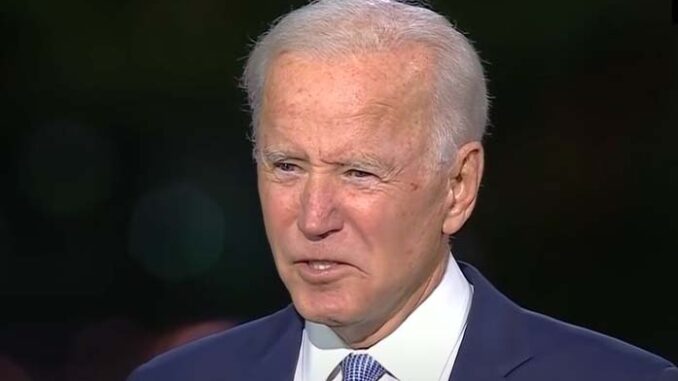
“Donald Trump and the MAGA Republicans represent an extremism that threatens the very foundations of our republic,” declared Biden. “MAGA Republicans do not respect the Constitution. They do not believe in the rule of law. They do not recognize the will of the people.”
Tonight was a classic example of how different things can look in person versus on TV. In person: Joe Biden at the patriotic cradle of America. On TV: Dark Brandon on his throne of human skulls. pic.twitter.com/uGldLywdVB
During Sunday’s speech commemorating the 21st anniversary of 9/11, Biden alluded to his administration’s focus on rooting out present domestic terror threats at home.
That same day, Vice President Kamala Harris clarified Biden’s intent in a subsequent interview with MSNBC. The pair discussed the Biden administration’s focus on combating the “threat from within,” which Harris concurred was comparable to 9/11.
“I think [that threat] is very dangerous and I think it is very harmful. And it makes us weaker,” said Harris.
Corinne Murdock is a reporter for AZ Free News. Follow her latest on Twitter, or email tips to corinne@azfreenews.com.
The latest Arizona Department of Education (ADE) report reveals that a majority of Arizona students continue to fail the statewide assessment.
This year, only 41 percent of students passed the English Language Arts (ELA) portion, while 33 percent passed the mathematics section.
The ADE revealed these declining results last Wednesday in a press release. However, ADE presented the results as overall gains, noting that students experienced increases of three percent in English Language Arts (ELA) and two percent in mathematics.
Despite the tumult of the Delta & Omicron variants, our students & teachers did something remarkable: increased academic scores. Thanks to historical federal funding, schools hired more staff, improved technology & invested in students. It's paying off. https://t.co/478ptrIAVk
Yet, last year’s results may not be weighed against these most recent results — the 2021 assessment report disclosed that “a significant number of students” weren’t tested, and therefore those results shouldn’t carry as much weight. Test results from Hoffman’s first year in office, 2019, were only slightly better than those this year: 42 percent of students passed both ELA and math.
It could be argued that those results were part of an upswing in testing that occurred under Hoffman’s predecessor, Diane Douglas. In 2016, 38 percent of students passed ELA and math. In 2017, 39 percent of students passed ELA and 40 percent passed math. In 2018, 41 percent of students passed both ELA and math.
Additionally, only a few percentage points were gained overall despite the ADE dedicating millions of COVID-19 relief funds to improve test scores.
Superintendent Kathy Hoffman said that she’s petitioning the state to increase funding by lifting the aggregate expenditure limit (AEL) to further improve test scores.
“If we want to continue increasing scores, defunding our public schools will have the opposite impact,” said Hoffman. “The infusion of federal dollars shows that increased funding can increase learning outcomes, not just on test scores but in our student’s abilities to thrive and contribute to our state.”
In an interview with “The Conservative Circus,” Hoffman’s opponent, former superintendent and attorney general Tom Horne, declared that the statewide assessment results constituted an emergency. He noted that student proficiency had fallen far from his 2003 to 2011 tenure, when Arizona students were over 60 percent proficient in math and over 70 percent proficient in English.
“It’s hard to imagine it could be worse,” said Horne.
Horne claimed that Hoffman was focused on implementing systems that distracted from proper education, citing social-emotional learning (SEL) as one problematic distraction.
“With social-emotional learning, the teachers are discouraged from imposing discipline because it might hurt some kids’ feelings,” said Horne.
Tom Horne, running for AZ Superintendent of Public Instruction, discusses Kathy Hoffman's LGBTQ chat portal plus th https://t.co/AiRJVJ6KTa
During the interview, Horne also opined that the ADE links to sexualized LGBTQ+ chat rooms for minors weren’t legal. As AZ Free News reported this week, Hoffman was sued last month for linking to these chat rooms on the ADE website.
Corinne Murdock is a reporter for AZ Free News. Follow her latest on Twitter, or email tips to corinne@azfreenews.com.
Democratic gubernatorial candidate Katie Hobbs, a product of private schools, revealed on Monday that she plans to reverse Arizona’s universal school choice if elected.
Hobbs appropriated pro-school choice phrasing to describe her 13-page anti-school choice plan. She omitted her private school attendance from the plan.
“Zip code shouldn’t determine the quality of public education our Arizona students receive,” wrote Hobbs. “As governor, I will always fight for students, teachers, and parents to have the resources they need to succeed.”
Zip code shouldn't determine the quality of public education our Arizona students receive. As governor, I will always fight for students, teachers, and parents to have the resources they need to succeed. Read more about my plan to do it here: https://t.co/bGY2Bn2oe3pic.twitter.com/REuHF3308W
In 1988, Hobbs graduated from Seton Catholic Preparatory High School, a private high school in Chandler. As one of the most expensive private schools in the state, SCP tuition sits around $17,700 currently, with a discounted rate for proven Catholic families of $13,300.
Arizona Democratic gubernatorial candidate Katie Hobbs just released her education plan opposing school choice.
In her education plan, Hobbs called the funds from Arizona’s Empowerment Scholarship Account (ESA) Program “vouchers.” However, the ESA Program funds are not “vouchers” — they are education scholarship accounts. Vouchers may only be used at private schools, whereas education scholarship account funds may be used for a greater variety of educational needs, such as tutoring.
“Vouchers should not have been expanded to provide an unaccountable means of enriching private schools and defunding our local public schools,” reads the plan.
In a 2019 interview celebrating her alma mater’s 65th anniversary, Hobbs toldGilbert Sun News that attending a small private school gave her the positive experience of a more intimate, tailored learning experience, such as her teachers encouraging her to discover timeless truths in classic literature.
“It really felt like a family,” said Hobbs. “You really had a chance to get to know the people that you went to school with.”
AZ Free News asked Hobbs’ campaign whether Hobbs’ children have attended any private schools. They didn’t respond by press time.
Both of Hobbs’ children attended Arizona School for the Arts, a charter school.
Hobbs’ plan also seeks to eliminate the aggregate expenditure limit (AEL). The AEL limits K-12 public schools’ expenditures every year based on the calculation of the aggregate expenditure of all districts, adjusted for student counts and inflation. The state legislature increased the AEL this past session so that schools could spend their budgets in full.
Early this morning, I joined teachers at Kenilworth Elementary to bring attention to the AEL and the school funding crisis. I continue to demand that all Arizona lawmakers get rid of an outdated rule so we can fully fund our schools and our kids can keep learning. pic.twitter.com/7bE4gnqxNR
The rest of Hobbs’ education plan pledges to establish free preschool and kindergarten, especially for low-income and minority families; reduce child care costs and increase options; increase teacher pay by up to $14,000 to match the national average; reduce teacher health care costs; increase fundings for school renovations; restore the special education cost study; increase funding for special needs care; and nearly-free, if not totally free, college education for students that live in state — whether they’re American residents or illegal immigrants protected by the Deferred Action for Childhood Arrivals (DACA) rule.
I’m a proud first-generation college graduate and can tell you firsthand just how many incredible opportunities arose due to access to a higher education.
As governor, I'll work to ensure every Arizonan has access to an affordable, world-class education.
Further, Hobbs’ pledged to increase funding to the Arizona Teachers Academy to grow enrollment; increase school funds to hire more mental health professionals and social workers; establish permanent funding for Northern Arizona University’s Teacher Residency Program; increase funding to the Arizona Department of Education (ADE) to establish new STEM grants and scholarships, particularly for women and “people of color”; expand Advanced Placement (AP) and dual enrollment programs to all schools; establish a refundable tax credit for career and technical education pursuits; fund start-up medical program costs; and establish health care training programs.
Additionally, Hobbs promised to increase oversight of charter schools through increased funding to the Arizona State Board for Charter Schools and the Auditor General. She also pledged to require charter schools to participate in the Auditor General’s annual classroom spending report, prohibit charter schools from making a profit from the sales of land and buildings, and publicize charter corporate boards through their inclusion in open meeting and public records laws.
Absent from Hobbs’ plan was any mention of additional funding for homeschooling families. Hobbs didn’t respond to our questions about that by press time, either.
Corinne Murdock is a reporter for AZ Free News. Follow her latest on Twitter, or email tips to corinne@azfreenews.com.