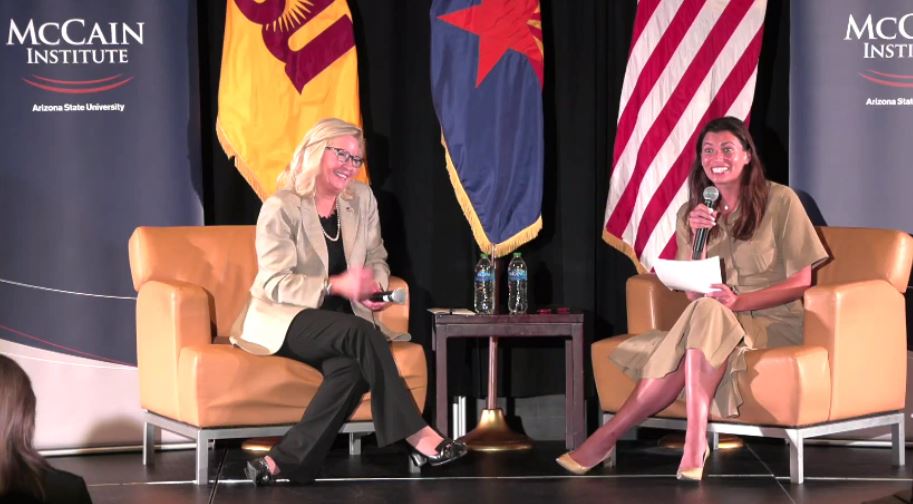
Ousted Congresswoman Liz Cheney (R-WY) told Arizona State University (ASU) students to fight back and stop Republican leaders from coming to Arizona to campaign for Trump-backed candidates. Cheney suggested punishments for those GOP officials, as part of her remarks during the fifth installment of the ASU McCain Institute’s series “Defending American Democracy.”
Cheney made an example of Senator Ted Cruz (R-TX), saying he should “know better” than coming to Arizona to campaign for Republican gubernatorial candidate Kari Lake. Cruz attended a fundraising event for Lake on Wednesday.
Yet shortly after giving that advice, Cheney lamented that “too often, conservative views are canceled.” Cheney also advised the students to vote for Democrats even if they’re Republicans.
Shortly after her loss in August, Cheney launched a $15 million initiative through her political action committee (PAC) to defeat Trump-backed candidates.
At the opening of the ASU event, McCain Institute Executive Director Evelyn Farkus explained that Cheney was their latest guest speaker because she’s the “epitome of American political courage,” having sacrificed her political career by standing up for her values.
The McCain Institute’s first-ever Democracy Fellow, Sophia Gross, interviewed Cheney. Gross said Cheney exemplified a courage and set of values that young men and women should look up to in order to better themselves and serve their country.
This is who @ASU@McCainInstitute had interview @Liz_Cheney tonight, a self-described "pretty big civic nerd": "[When] I showed up to vote for the first time, […] it turned out you voted for a lot more than just president. And, it was a very disenfranchising feeling…" 1/ pic.twitter.com/Iy8aa6R0Af
The McCain Institute stated that the goal of the series is to advance citizens “beyond politics” in order to make America a city on a hill. It’s partially funded by the Knight Foundation, a left-leaning organization.
The four prior events in the “Defending American Democracy” series focused on the dangers of the decline and disappearance of local journalism, implications of verbal threats to election officials, protections for election infrastructure against cyberattacks, and plans to counteract hate.
In this event, Cheney fixed her remarks on several general topics: former President Donald Trump, January 6, and the Russo-Ukrainian War.
Cheney said that the main lesson of the January 6 invasion of the Capitol was that institutions can’t defend themselves, it takes individuals. Cheney insinuated that government institutions were the victims — not citizens. Cheney also commended those who testified before her January 6 Committee: Maricopa County Recorder Stephen Richer, Maricopa County Board of Supervisors Chairman Bill Gates, and Speaker of the House Rusty Bowers. Richer and Gates were reportedly present at the ASU event.
“Arizona and our nation owes Rusty a debt of gratitude,” said Cheney.
Concerning the January 6 invasion of the Capitol, Cheney claimed that Trump didn’t take action to stop the trespassers. She quickly backtracked with a self-correction, noting that the former president did take action but complained that it took him “187 minutes.” Cheney stated repeatedly that Trump was attempting to destroy democracy.
“No nation can have a leader who is so derelict in his duty,” declared Cheney.
At one point, Cheney predicted that the nation was heading toward a future as similar and troublesome as the Holocaust. She issued that prediction as she relayed a recent conversation with a young woman from Wyoming whose grandparents escaped the Holocaust. That young woman reportedly expressed worry to Cheney that America would no longer be a place of refuge like it was when her grandparents escaped.
“I think that’s a very real and serious concern,” said Cheney.
Cheney also said that she’s proud of the January 6 Committee, assuring the audience that it was non-partisan. Cheney said she most respects her fellow select committee and other Democrats, especially those women on the armed service committee.
“I never imagined that I would find myself spending so much time with Democrats. I’m sure they’re surprised to be spending so much time with me as well,” said Cheney “Everybody should be represented by the people that they know are going to do the hard work.”
Cheney said that America needs to get involved in Ukraine’s war against Russia. She said that was a hallmark of patriotism. Cheney also indicated that anyone opposed to her beliefs belonged to the “Russian” wing of the Republican Party.
Toward the end of the event, Cheney opined that true patriotism meant an allegiance to a fundamental sense of human freedom, of inalienable rights from God and not the government.
“Being a patriot means first and foremost loving our country more. We can say to each other ‘we’re Democrats, we’re Republicans, but we love our country more,’ and we’ll act in accordance with that. That means you’ll put your country above politics, your political career,” said Cheney.
Watch the full event below:
Corinne Murdock is a reporter for AZ Free News. Follow her latest on Twitter, or email tips to corinne@azfreenews.com.
On Wednesday, the Department of Education (ED) announced the distribution of over $20.8 million to increase mental health oversight in Arizona schools.
The funds may be applied to a variety of mental, social, and emotional initiatives within schools. This includes school counseling, mentorships, and bullying and harassment prevention.
During a press call on Wednesday, the ED featured insight from Dr. Marty Pollio, the Jefferson County Public Schools superintendent in Louisville, Kentucky. Pollio said that the SCG funds allowed for three means of school improvement:
Identify students in need and in crisis who need mental health support like counseling;
Reduce the counselor-to-student ratio;
Train teachers on how to identify troubled students and support school personnel.
Pollio suggested that mental health professionals, such as board-certified behavioral analysts, should be deployed to classrooms to identify problematic students.
“Educators have to do more than ever,” said Pollio.
AZ Free News asked the Biden administration whether they would be providing guidelines for behavior analysis enabled by SCG funds, such as what students would be deemed problematic as Pollio suggested. The ED said they weren’t providing guidelines. Rather, the ED said that level of management would be up to the states and districts.
“[The SCG] allows states and districts to tailor their funds to each district and school,” said one of the officials.
The funds come from the Strong Connections Grant (SCG) within the Bipartisan Safer Communities Act (BSCA). Nationwide, grant funds totaled over $971 million.
Today, ED announced nearly $1 billion in Stronger Connections grants through the Bipartisan Safer Communities Act (BSCA) to support students’ physical, emotional, & mental well-being – real benefits for students across the country. https://t.co/WwxaZ4tQGZ
ED Secretary Miguel Cardona asserted that teachers have been handling student behaviors on limited funding and resources, and that students behaved better with reduced disciplinary action and increased promotion of positive behavior. Cardona noted that in all, investments to improve mental health in schools through SCG total $1 billion.
“We must broaden our focus beyond physically safe learning environments,” said Cardona. “If we’re serious about equity and opportunity, we must expand our definitions of learning and growth to include mental and emotional health.”
President Joe Biden’s special assistant for education policy, Maureen Tracey-Mooney, said that the SCG funds are designed for “high impact strategies” that would ultimately impact home life, such as counseling, tutoring, mentoring, and summer learning.
Earlier this month, Cardona sent a letter to the Arizona Department of Education (ADE) notifying them of this recent investment. Cardona’s letter provides educators with suggestions and guidelines on how to implement the SCG funding.
The ADE will decide which school districts will receive the SCG funds and oversee their expenditure. However, the ED retains the authority to audit and investigate schools’ use of the SCG funds.
Corinne Murdock is a reporter for AZ Free News. Follow her latest on Twitter, or email tips to corinne@azfreenews.com.
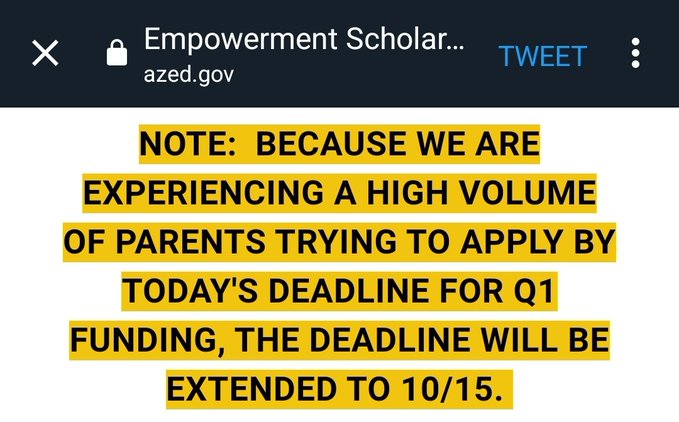
So many parents were trying to apply for Arizona’s expanded Empowerment Scholarship Accounts (ESAs) by Friday’s first quarter deadline that the department of education’s website was overwhelmed, leading to a decision to extend the application period.
“Because we are experiencing a high volume of parents trying to apply by today’s deadline for Q1 funding, @azedschools is extending the deadline to remain eligible for retroactive Q1 funding to 10/15/22,” the department announced midday Friday.
UPDATE: Because we are experiencing a high volume of parents trying to apply by today's deadline for Q1 funding, @azedschools is extending the deadline to remain eligible for retroactive Q1 funding to 10/15/22. https://t.co/NbiNjT8SnI
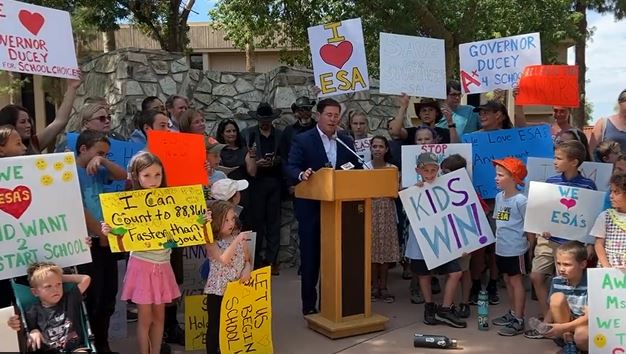
Gov. Doug Ducey helped spread word of the extension while commenting on the tremendous popularity of the new law which now makes all 1.1 million of Arizona’s K-12 students eligible to apply for an ESA which provides about $7,000 per student, per year to assist families in tailoring a student’s education experience to best meet their needs.
The funds can be used for a variety of purposes, including private school tuition, homeschooling expenses, educational therapies, tutoring, and other expenses in exchange for not attending a public school or receiving a tuition tax credit.
Arizona parents have shown time and time again they want options for their children’s education. https://t.co/Th3lqXXC2O
More than 12,000 applications have been received by the Arizona Department of Education since the governor signed ESA expansion legislation in June. That outpaces the number of students who were utilizing the ESA program under the old law.
The new expanded eligibility was to take effect Sept. 24 with a Sept. 30 deadline to qualify for first quarter funding. The rush by families to apply this week was bolstered by publicity involving a political action committee’s failed referendum effort to waylay the ESA expansion until voters could decide in 2024 whether it should go into effect or not.
Arizona Secretary of State Katie Hobbs put the law on hold Sept. 23 based on claims by Save Our Schools Arizona that more than 141,000 referendum petition signatures had been submitted to Hobbs’ office. Of those, at least 118,823 signatures needed to be validated to keep the ESA expansion sidelined.
But in a letter dated Thursday, Hobbs’ staff officially confirmed what has been known for days – that the referendum effort failed to come anywhere close to the constitutional minimum number of signatures.
We have informed the SOS committee that the referendum will not qualify for the 2024 General Election Ballot. While the statutorily required review continues, our office has inspected enough petitions & signatures to confirm that the 118,823 signature minimum will not be met. pic.twitter.com/UVydtBH5oi
One parent said Friday’s announcement by Hobbs’ office ensures parents are now “rightly in control of their children’s future.”
Christine Accurso of Gilbert is among pro-ESA parents who questioned whether the glaringly insufficient referendum filing was simply a calculated ploy by anti-school choice politicians to freeze funding for children right in the midst of the school year.
“As a longtime ESA parent, I could not be more thrilled to see thousands of new parents benefiting from this program,” Accurso said. “It is my hope that the rest of the country can follow our lead and bring this legislation to their state, so that we can one day see all American children in the school of their parent’s choice.”
Save Our Schools Arizona issued a statement Friday putting the blame for the group’s referendum effort failure on the governor, who is one of ESA’s staunchest supporters.
“We are confident we would have succeeded had Governor Ducey not waited 10 days to sign the bill, robbing Arizona voters of crucial time to sign the petition,” according to the statement.
The group even criticized pro-ESA organizations like the Goldwater Institute for using “sophisticated software” to review the petitions, resulting in Monday’s revelation that Save Our Schools Arizona submitted only about 90,000 signatures.
For school choice advocates like Accurso, the important fact is that the ESA expansion is now in effect. The priority now is to ensure families that still want to apply become aware of the extended Oct. 15 deadline.
BREAKING: So many families are applying for the new school choice program that the Arizona Department of Education extended the application deadline by two weeks pic.twitter.com/vrNKDisO5z
On Wednesday, Secretary of State Katie Hobbs chose to stall on the invalidation of a ballot initiative attempting to kill school choice, despite it not having the required number of signatures.
School choice advocates gathered outside of the State Capitol on Wednesday to protest Hobbs’ inaction. Hobbs told frustrated parents that her office would wait out the entire 20-day period offered by state law to verify the Save Our Schools Arizona (SOSAZ) ballot initiative signatures.
Governor Doug Ducey spoke at the rally, telling Hobbs to expedite her signature verification. He also directed Arizona Department of Education (ADE) Superintendent Kathy Hoffman to take charge and free the universal school choice funds.
“Arizona is going to be a state that funds students, not systems,” said Ducey.
We need to get Arizona’s universal Empowerment Scholarship Account program started for our kids. Joined families at the Arizona State Capitol to echo their call for Secretary Hobbs to expedite the verification process of signatures. pic.twitter.com/JI3VCXI7sB
One Empowerment Scholarship Account (ESA) Program mother, Christine Accurso, pleaded with the media to question Hobbs’ choice. Accurso led “Decline to Sign,” the countermovement to SOSAZ’s ballot initiative.
“Help us parents of Arizona. Ask Katie Hobbs why they won’t release this,” said Accurso.
Accurso added that if a group of four moms was able to verify the signature number total in a matter of days, it shouldn’t take the secretary of state’s office nearly a month to do the same.
According to earlier reporting from this week, pro-ESA Program parents, organizations such as the American Federation for Children, and various reporters reviewed the SOSAZ signature sheets and found them far short of the claimed totals. However, Hobbs and her office took SOSAZ’s signature total claim at their word.
Today a Citizen Referendum has filed with our office to refer part of HB2853 to the ballot! The committee is reporting 141,714 signatures which is above the min required: 118,823 signatures.
“Conservative Circus” radio host James Harris also spoke at the rally. He declared that Hobbs’ Republican gubernatorial opponent, Kari Lake, wouldn’t stand in the way of school choice funds for parents the way he said that Hobbs did this week.
“We don’t need more obstacles. We need liberty and we need freedom,” said Harris.
AZ Free News reached out to Hobbs’ office on Tuesday for clarification about whether their decision to accept SOSAZ’s word for their petition signature count without verification was protocol. They haven’t responded.
We also reached out to SOSAZ Director Beth Lewis; she didn’t respond to our questions, either.
Senate President Karen Fann (R-Prescott) sent a letter to Hobbs on Wednesday, informing the secretary of state that anything less than an immediate rejection of the SOSAZ ballot initiative would make Hobbs complicit in misreporting and interfering with the law.
“As our country enters into a recession, we know that every dollar is valuable to lives and livelihoods,” said Fann.
This morning, @FannKfann calls upon @SecretaryHobbs to end the uncertainty and confusion for families wanting to take part in Arizona's Universal ESA School Choice Program. The hold on this funding for students is unjustified and unnecessary. Read more… pic.twitter.com/lom1VsI1qb
While awaiting response from Hobbs’ office, AZ Free News posed the same question to former Secretary of State Ken Bennett. Though he said he was shocked by Hobbs’ handling of the ballot initiative, he said that Hobbs’ actions weren’t in violation of any laws. Bennett explained that Hobbs’ handling of this recent initiative didn’t align with the precedent of her predecessors, including his administration.
“We just felt the integrity of the whole process was worth at least a verification of the number of sheets and the purported number of signatures on those sheets when they first turned them in when I was there,” said Bennett. “Each secretary can decide how they want to do it, but my administration felt that we at least owed the public the fact that we checked the signatures per sheet. At least we would add the total sheets and total signatures up, so we weren’t getting somebody a false receipt of what we had received from them.”
Corinne Murdock is a reporter for AZ Free News. Follow her latest on Twitter, or email tips to corinne@azfreenews.com.
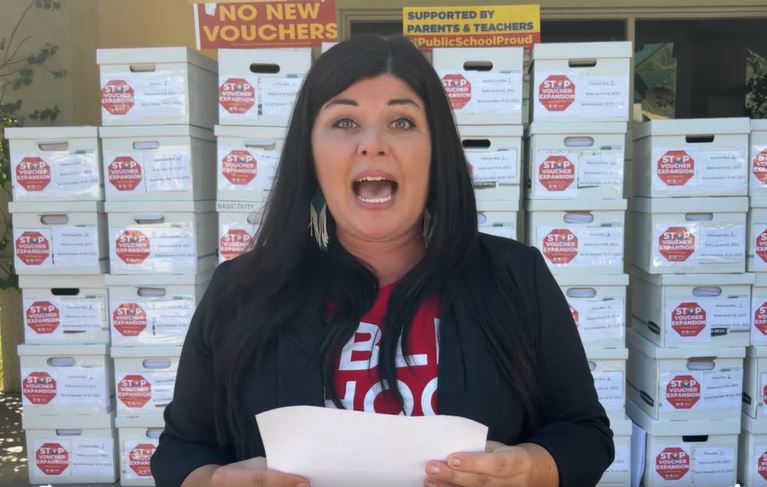
Save Our Schools Arizona (SOSAZ), the teachers union-backed group, claimed to have turned in more signatures than they did for a ballot initiative to end Arizona’s universal school choice.
SOSAZ claimed to have just over 141,700 signatures, above the minimum requirement of over 118,800.
However, an open records request by one pro-school choice mother, Christine Accurso, revealed that a sample of the petitions yielded about 10 signatures per page, not nearly 14 as SOSAZ claimed.
There’s been a pattern of lies coming straight from @azbethlewis over the past 3 months. Her claim of nearly 142,000 signatures was just the latest. After a weekend of hard work at the Secretary of State’s office, the petition count is final and it’s only 8175 total. 1/
Accurso leads AZ Decline to Sign, a countermovement to SOSAZ’s ballot initiative. She told AZ Free News in a statement that she wasn’t surprised by SOSAZ’s overestimation.
“I am not surprised at all that Save Our Schools lied again,” said Accurso. “Saying you are turning in 10,200 petitions when in reality it was only 8,175 is not a rounding error, it’s another way they are deceiving the public. To what end, I don’t know, but the public isn’t buying what they are selling, so I am not surprised.”
The 8,175 petitions that were submitted by Save Our Schools only appear to have 88,866 signatures on them. That is WELL below the minimum required.
It's not official yet until the Secretary of State announces it, but Arizona parents can claim the VICTORY! ESA's for all SOON! https://t.co/TrsiPOIQVs
Accurso credited SOSAZ’s shortcoming to AZ Decline to Sign and its supporters. She noted that even the overestimation by SOSAZ was a number able to be overcome by school choice supporters.
“Thousands of Arizonans pushed back against their tactics this summer,” recalled Accurso. “Without our efforts, they should have easily been able to get 250k – 300k signatures, so even when they reported 142k we were thrilled because challenging that number is very doable. With the new evidence of 8,175 petitions, we are confident more than ever on how this battle ends.”
On Friday, Secretary of State (SOS) Katie Hobbs, Democratic gubernatorial candidate, accepted SOSAZ’s claims without scrutiny. Within hours of SOSAZ turning in its signatures, Hobbs announced that implementation of universal school choice would be suspended while her office reviewed their petition signatures.
Today a Citizen Referendum has filed with our office to refer part of HB2853 to the ballot! The committee is reporting 141,714 signatures which is above the min required: 118,823 signatures.
Neither SOSAZ or Hobbs’ office have addressed the open records discovery. We reached out to both SOSAZ Director Beth Lewis and the secretary of state’s office for comment, but neither responded by press time.
Through a public records request I was given access to all of the 🆘 petitions. They uploaded 8,175 yesterday. When I inquired if more would be uploaded, they responded. ⬇️
It seems mathematically impossible to reach the required # of 118,832, but we will know very soon. pic.twitter.com/dcX0OowHTF
Kevin Gemeroy, a parent involved with AZ Decline to Sign, told AZ Free News that he and other school choice advocates witnessed SOSAZ signature gatherers providing false information to petition signers for weeks about universal school choice through the state’s Empowerment Scholarship Account (ESA) Program.
“Just last weekend, I heard an SOSAZ representative tell a woman that HB2853 would ‘steal $2 billion from public schools,’ which is over $182,000 per child that applied for the universal ESAs,” stated Gemeroy. “I’m unfortunately not surprised Save Our Schools lied to the media and Secretary of State’s office on Friday, and I hope the proper authorities are alerted and take action to protect our democratic process from these lies and attacks in the future.”
The Arizona Department of Education (ADE) hasn’t addressed the open records discovery, either. However, ADE Superintendent Kathy Hoffman has made it clear that she opposes school choice programs of any kind and fully supports the SOSAZ initiative.
As of last Tuesday, the Arizona Department of Education (ADE) received over 10,900 applications for the universal ESA Program.
As of September 19th, @azedschools has received 10,906 total ESA applications since opening the universal application on Aug 16th. 10,338 applied under universal eligibility, an addition of 1,087 in the last week. https://t.co/6UNzVySrz1
Next month, teams from all over the world will participate in the Arizona State University (ASU) “Hacks for Humanity,” a 3-day hackathon to develop socially beneficial technical solutions — but participants don’t have to have coding knowledge to win.
Hacks for Humanity encourages non-coder participants in order to expand the creation of social justice solutions.
The purpose of the annual hackathon is to problem-solve social justice issues locally and globally. This year, the hackathon theme challenges participants to answer whether or not people are losing their humanity, citing the contexts of social disparities, racial injustices, and the COVID-19 pandemic generally.
“An unforgiving global pandemic as the backdrop for ongoing social disparities and racial injustice nationally and globally once again draws attention to this critical question: ‘Are we losing our humanity?’” stated the page.
Hacks for Humanity encouraged any member of the public to participate. The event page specifically named activists, artists, entrepreneurs, educators, scientists, and social workers as desired participants.
“When these diverse perspectives come together, innovation is the exciting result,” stated Hacks for Humanity.
Participating teams must select one of three topics: aging and wellbeing, civic engagement, and environmental justice. The winning hackathon team will receive $10,000 in cash prizes and $1,000 per team member.
The annual hackathon began nearly a decade ago through Project Humanities, an ASU initiative founded in 2011 by Neal Lester focused on social justice theories such as diversity and intersectionality. Lester has defended controversial concepts like Critical Race Theory (CRT) and gender ideology.
This year’s sponsors are State Farm, ASU University Technology Office, ASU Entrepreneurship + Innovation Institute, JDT Family Foundation, and Jenny Norton & Bob Ramsey. Additional supporters are the Odysea Aquarium, ASU School of Social Transformation, Heard Museum, Arizona Cardinals, Desert Botanical Garden, Japanese Friendship Garden of Phoenix, the Nile, Tempe Boat Rentals of America, and the Phoenix Symphony.
The hackathon will take place from October 7-9, and is open to individuals aged 16 and older.
Corinne Murdock is a reporter for AZ Free News. Follow her latest on Twitter, or email tips to corinne@azfreenews.com.