The U.S. trade deficit widened to $88.58 billion in July, increasing $17.39 billion from June and ending the month 43 percent above its 12-month average, according to an analysis released Thursday by Republicans on the Joint Economic Committee (JEC).
The Bureau of Economic Analysis (BEA) and U.S. Census Bureau reported that the deficit increased 24.4 percent from a revised $71.2 billion in June. Total exports declined $6.6 billion to $310.7 billion, and imports increased $10.8 billion to $399.3 billion.
The monthly figures are seasonally adjusted and are not adjusted for changes in prices.
The July increase occurred within a year-to-date decline in the trade gap. Through the first seven months of 2026, the goods and services deficit was $188.4 billion, or 29.6 percent, lower than during the same period in 2025. Exports increased $237.2 billion, or 12 percent, and imports increased $48.8 billion, or 1.9 percent.
The latest figures were released as the Trump administration continues rebuilding its tariff framework following legal setbacks and imposing new duties on goods from dozens of countries.
The goods deficit increased $17.62 billion to $119.59 billion, placing it 31 percent above its 12-month average. The services surplus increased by $225 million to $31.02 billion, reaching 5 percent above its 12-month average.
Exports of goods declined $6.2 billion to $201 billion during July. The decrease included reductions of $4.5 billion in crude oil exports and $3.9 billion in nonmonetary gold exports. Imports of goods increased $11.4 billion to $320.6 billion, led by increases of $6.9 billion in computers, $6.6 billion in computer accessories, and $1.2 billion in semiconductors.
The Washington Times attributed much of the technology-related increase to demand associated with the expansion of artificial intelligence infrastructure. Computers, computer accessories, and semiconductors produced a combined monthly import increase of approximately $14.7 billion.
Total trade deficit in July was $88.58B, 43% above the 12-month average. In trade of goods, the US ran a trade deficit of $119.59B, 31% above the 12-month average. In trade of services, the US ran a trade surplus of $31.02B, 5% above the 12-month average. https://t.co/SWQZ1mDv7e
— Joint Economic Committee Republicans (@JECRepublicans) September 3, 2026
Over the 12 months ending in July, the United States recorded a total trade deficit of $743.58 billion. The country ran a $1.10 trillion deficit in goods and a $353.73 billion surplus in services. Total exports reached $3.67 trillion, and imports totaled $4.41 trillion during the period.
Vietnam accounted for the largest goods trade deficit over the 12-month period at $219.12 billion, representing 20.39 percent of the total goods deficit. Mexico followed at $213.35 billion, or 19.85 percent, and Taiwan ranked third at $203.67 billion, or 18.95 percent.
The largest goods trade surpluses were recorded with the Netherlands at $79.74 billion, the United Kingdom at $45.12 billion, and Hong Kong at $43.90 billion. The BEA’s July report also recorded monthly goods deficits of $27.5 billion with Mexico, $23.3 billion with Vietnam, $18.1 billion with Taiwan, and $15.2 billion with China.
Civilian aircraft, engines, equipment, and parts; nonmonetary gold; and crude oil were the country’s three largest goods exports by value during the 12 months ending in July. Together, the categories accounted for 17.94 percent of exported goods.
U.S. goods exports to Mexico totaled $370.39 billion, followed by Canada at $337.85 billion, and the United Kingdom at $109.39 billion. The three countries accounted for 34.62 percent of U.S. goods exports during the period.
Computers, computer accessories, and pharmaceutical preparations were the three largest imported-goods categories by value, accounting for 20.89 percent of all goods imports. The United States imported $583.73 billion in goods from Mexico, $385.96 billion from Canada, and $271.07 billion from China. Together, the three countries supplied 36.11 percent of U.S. goods imports over the 12-month period.
The Trump administration has presented tariffs as a mechanism for encouraging domestic manufacturing, protecting U.S. industries, and producing federal revenue. Commerce Secretary Howard Lutnick said the administration is pursuing a policy under which companies that manufacture products in the United States would avoid tariffs applied to imported goods.
In a Friday social media post, President Trump connected trade policy with his call for the Federal Reserve to lower interest rates.
“Lower the rate or I’ll stop trading with countries with which we have a deficit,” Trump said.
Trump: U.S. Has the Right to Stop Trading With Deficit Countries
President Donald Trump says the U.S. has leverage over countries running trade deficits, arguing America has the right to stop trading with them if necessary.
Trump wrote that the United States should have the lowest interest rate in the world and said ending trade with countries that maintain surpluses with the U.S. would be “better than tariffs.”
The BEA and Census Bureau are scheduled to release their August trade report on Oct. 6.
Arizona has not yet opted into a new tax credit to provide school choice funds for families, and the Trump administration is urging Gov. Katie Hobbs to join.
Linda McMahon, education secretary for the Department of Education (ED), chastised the governor during a touring event and press conference at the East Valley Institute of Technology on Tuesday.
Rep. Andy Biggs (AZ-05) — the Republican nominee for governor — and House Speaker Steve Montenegro (R-LD29) were present with McMahon.
The federal Education Freedom Tax Credit, signed into law through the One Big Beautiful Bill last year, enables individuals to receive a dollar-for-dollar federal tax credit up to $1,700 for contributing to approved K-12 scholarship-granting organizations.
ED defines qualifying scholarship granting organizations as those nonprofits that use contribution funds to provide scholarships for education-related services at both private and public schools. These nonprofits must use at least 90% of income on scholarships for educational choice options for K-12 students.
At the Tuesday event, McMahon accused Hobbs of denying Arizona students and their parents the access to “real” educational freedom.
“Governor Hobbs has vetoed three measures that would have allowed Arizona to participate in the Federal Education Freedom Tax Credit, holding Arizona families back from accessing these powerful opportunities expanding across the country,” said McMahon. “This is what real empowerment looks like, giving parents the freedom to choose the path that best serves their child, instead of forcing every student into a rigid, one-size-fits-all system.”
Hobbs must opt in and submit a certified list of scholarship granting organizations by Jan. 1, 2027, for Arizona to participate in the inaugural year of the program.
Even if Hobbs does not opt Arizona into the program, Arizona residents may still claim the tax credit. Instead of their credit going to Arizona students, however, those contributions will go to eligible students elsewhere in participating states.
Hobbs explained in her veto of SB 1142 that she wouldn’t opt Arizona into the program until the Trump administration issues regulatory guidance for it. She compared the tax credit program to the Empowerment Scholarship Account (ESA) program, the state’s universal school choice program.
A bipartisan coalition of 30 states have opted into the federal education tax credit program so far: Alabama, Alaska, Arkansas, Colorado, Florida, Georgia, Idaho, Indiana, Iowa, Kansas, Kentucky, Louisiana, Mississippi, Missouri, Montana, Nebraska, Nevada, New Hampshire, North Carolina, North Dakota, Ohio, Oklahoma, South Carolina, South Dakota, Tennessee, Texas, Utah, Virginia, West Virginia, and Wyoming.
New York announced in May it would opt into the program but has not finalized that opt-in.
Four states have declined to join: Hawaii, Minnesota, New Mexico, and Oregon. Similar to Hobbs, the governor of Wisconsin vetoed legislation to opt into the program.
13 states and Washington, D.C. have yet to announce a decision: California, Connecticut, Delaware, Illinois, Maine, Maryland, Massachusetts, Michigan, New Jersey, Pennsylvania, Rhode Island, Vermont, and Washington.
Rep. Biggs, who is looking to unseat Hobbs this November, published a press release criticizing Hobbs’ refusal to allow Arizona to join the program.
“Because of her failure, Arizona students will miss out on scholarship dollars that could help pay for tuition, tutoring, technology, special education services, and other educational needs,” said Biggs. “Arizonans should not have to watch their tax dollars create educational opportunities for students in other states simply because their governor refuses to participate.”
McMahon also addressed a Scottsdale audience in a “Great American Comeback Tour” event hosted by the America First Policy Institute. The Republican nominee for Congressional District 1, Jay Feely, also participated in the panel.
AZ Free News is your #1 source for Arizona news and politics. You can send us news tips using this link.
By U.S. Secretary of Agriculture Brooke L. Rollins |
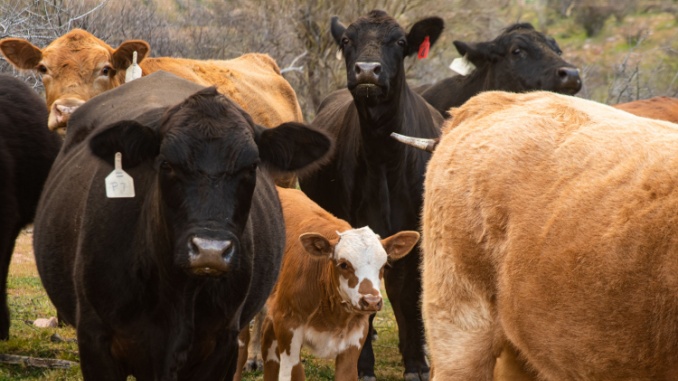
Recently, I visited the port of entry in Douglas, Arizona, which has been traversed by cattle nearly 150 years. Last year alone, over 57,000 live cattle were imported into the United States from Mexico through the port—that is, until we closed it in May 2025 to protect American livestock from the New World screwworm (NWS). Thanks to our round-the-clock efforts, in partnership with state and local animal health officials, it is now safe to begin a coordinated, phased reopening of southern cattle ports.
Every model showed NWS entering our country by late summer of 2025, but by increasing oversight of containment efforts in Mexico and strengthening border protections, we bought critical time to prepare. Since January 20, 2025, the Trump administration has invested a record $1.3 billion in emergency funding to combat the pest—one of the largest animal health responses in U.S. history.
Our defensive plan is robust. We have expanded the number of staff working on NWS by 1,000 percent, and over the past two months, we have conducted more than 1,000 drone flights observing over 21,000 wildlife in Texas. To prevent NWS from reproducing, we are also dropping 100 million sterile flies per week over Texas and Mexico. This spring at Moore Air Base in Texas, we opened a new sterile fly dispersal facility and broke ground on a sterile fly production facility. Last month, a production facility we helped upgrade in Metapa, Mexico, officially opened, and another facility we support in Panama is currently producing sterile flies at maximum capacity.
But we’re not stopping there. In Arizona, I announced a $25 million U.S. Department of Agriculture (USDA) investment to construct a brand-new sterile fly dispersal facility in the Grand Canyon state, which is coming into being thanks to the visionary leadership of Arizona’s own U.S. Representative Juan Ciscomani. Ranchers can rest assured that we are working with state officials to advance this project as soon as possible. Sterile flies were key to eliminating NWS from the U.S. in the 1960s, and they remain so today.
Just as important are surveillance and preparedness on the ground, which are led in Arizona by the Arizona Department of Agriculture, and in Texas by Governor Abbott, the Texas Animal Health Commission, and the Texas Parks and Wildlife Department. The Trump administration is reinforcing their efforts at every turn, including by ramping up outreach to producers and veterinarians and monitoring over 120 dedicated NWS traps and over 8,000 fruit fly traps along the border.
The results have been remarkable. Since the first confirmed case of NWS in the U.S. on June 3, the same month only saw 31 total cases within our borders, all of which are now inactive. Even better, July saw just 12 cases, and only 3 cases overall are active today. To put that in perspective, Mexico had over 30,000 cases last year alone. Clearly, our efforts are bearing fruit.
The fight is not over, but as the presence of NWS declines, so does the threat to our ranchers. That’s why it is now safe to reopen U.S. livestock ports of entry on our southern border, which have historically played a critical role in the American cattle trade—especially in recent years, as the U.S. cattle herd has reached a 75-year low. Live imports from Mexico make their way to U.S. feedlots and eventually end up on dinner tables across America.
The port in Douglas will be the first to reopen on August 24 due its low-risk profile and because the bordering Mexican state of Sonora remains the lowest-risk Mexican state for NWS and maintains some of the strongest livestock inspection and movement controls anywhere in Mexico. After evaluating the success of the initial reopening, we will then consider reopening the ports in Santa Teresa, New Mexico, and Columbus, New Mexico, to live cattle, bison, and horses.
Make no mistake, these reopenings are contingent on Mexico making continued forward progress and meeting all enhanced USDA requirements. Every animal entering the U.S. will fully comply with our comprehensive import protocol, which requires preventive treatment for NWS, multiple inspections before an animal approaches our border for import, and inspection by USDA for any trace of NWS.
If at any point we determine there is an imminent threat to our domestic herd, we will not hesitate to immediately pause the reopenings. Protecting American livestock will always come first, and we will continue using every tool at our disposal to support the ranchers who raise them and to eliminate NWS once and for all. Our nation’s food security—and, therefore, our freedom—depend on it.
Brooke Rollins serves as the U.S. Secretary of Agriculture
Treasury Secretary Scott Bessent is expected to visit Arizona on Wednesday and Thursday, with stops including a Casa Grande appearance alongside House Speaker Mike Johnson (R-LA) and Rep. Juan Ciscomani (R-AZ-06). The tentative itinerary, provided exclusively to AZ Free News by Treasury Department officials, also includes meetings with manufacturers, business leaders, and community bankers.
Bessent is scheduled to travel to the state on August 5 and 6 to discuss the Trump administration’s economic agenda and efforts to strengthen the integrity of the nation’s financial system, Treasury officials said.
The visit will include a tour of a manufacturing facility in Casa Grande with Johnson and Ciscomani. The three officials are also expected to participate in an economic roundtable with Arizona business leaders.
The Treasury Department had not yet publicly identified the manufacturing facility as of Monday night.
The administration plans to use the event to highlight the effects of the tax and business provisions it refers to as the Working Families Tax Cuts, including incentives for domestic manufacturing and capital investment.
The tax provisions were enacted as part of Public Law 119-21, which President Donald Trump signed on July 4, 2025. The law permanently extended several provisions of the 2017 Tax Cuts and Jobs Act and created temporary federal income-tax deductions for qualified tips and overtime compensation.
The law also allows businesses to immediately deduct qualifying research and development costs and the cost of certain equipment and machinery. It provides accelerated deductions for qualifying investments in new and expanded manufacturing facilities, according to a White House summary.
Arizona Republican lawmakers and Governor Hobbs reached a bipartisan budget agreement in June that eliminated state income taxes on qualified tips and overtime, increased the standard deduction, and added other tax provisions tied to the federal law. Republican legislative leaders described Arizona as the only state to fully adopt the federal tax package at the state level.
🚨FOR IMMEDIATE RELEASE: Arizona Becomes Only State in the Nation to Deliver Historic Trump Tax Cuts As Part of Bipartisan FY 2027 Budget Agreement
The White House, citing a National Association of Manufacturers analysis, said the law’s manufacturing provisions sustained an estimated 119,000 Arizona jobs, $22 billion in state economic output, and $11 billion in wages.
The Congressional Budget Office (CBO) estimated that the law would increase federal deficits by approximately $3.4 trillion from 2025 through 2034, excluding macroeconomic and debt-service effects. The CBO attributed the increase to an estimated $4.5 trillion reduction in revenues, partially offset by a $1.1 trillion reduction in direct spending.
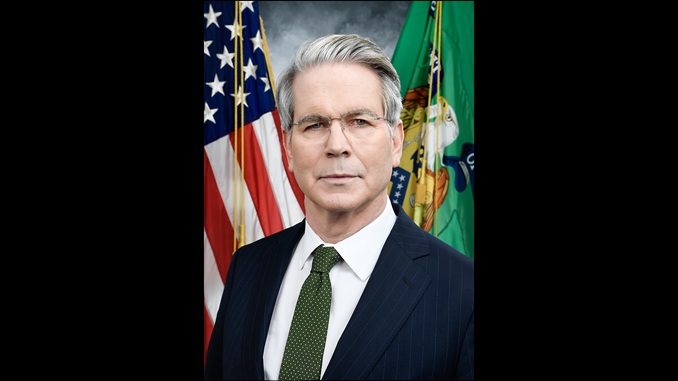
During a separate engagement, Bessent is expected to meet with community bankers from across Arizona alongside Comptroller of the Currency Jonathan Gould.
Bessent and Gould reportedly plan to discuss the administration’s efforts to reduce regulatory burdens on community banks and expand their ability to finance local businesses and economic development.
Reducing regulatory and supervisory burdens on community banks has been one of Gould’s stated priorities. The agency said in May that it had begun tailoring examinations according to a bank’s size, complexity, and risk profile, while giving smaller institutions greater flexibility to use a simplified capital framework.
The Office of the Comptroller of the Currency (OCC) has also revised its model-risk guidance and narrowed the scope of information-technology and cybersecurity examinations for community banks, according to an agency announcement.
“Community banks are anchors of local economies, providing essential banking services and small business lending that helps power job creation,” Gould said in the announcement.
The Arizona meeting is also expected to address the administration’s campaign against fraud, identity theft, money laundering, and other illicit activity involving the financial system.
Trump issued an executive order in May directing Treasury and federal banking regulators to strengthen customer-identification requirements and consider changes to regulations implementing the Bank Secrecy Act.
The order directed Treasury and federal financial regulators to propose stronger risk-based customer due-diligence requirements and consider changes to customer-identification rules. It instructed regulators to examine the use of foreign consular identification documents, invalid or mismatched Social Security and taxpayer-identification numbers, payroll-tax schemes, and accounts associated with workers who lack employment authorization.
It also directed financial regulators to consider whether banks should obtain additional information concerning immigration status and employment authorization when those details are relevant to fraud, identity misrepresentation, sanctions evasion, or another identified financial risk.
The Treasury’s Financial Crimes Enforcement Network (FinCEN ) subsequently issued a June 5 advisory urging banks and other financial institutions to identify and report suspicious activity associated with identity theft, payroll fraud, and the unlawful employment of people without work authorization.
FinCEN said some employers conceal unauthorized workers by using stolen identities, mismatched Social Security numbers, false payroll information, or off-the-books payment arrangements. The agency reported that financial institutions filed suspicious activity reports involving more than $2.5 billion in transactions associated with potential payroll-tax fraud during 2025.
The advisory was issued jointly with the Federal Deposit Insurance Corporation, OCC, and the National Credit Union Administration, and in coordination with the Internal Revenue Service.
The Treasury Department said Bessent and Gould will discuss how Arizona community banks can support the administration’s enforcement efforts while continuing to provide financing and banking services to local businesses.
Additional details regarding the facility, participating business leaders, event times, and press access are expected later on Tuesday.
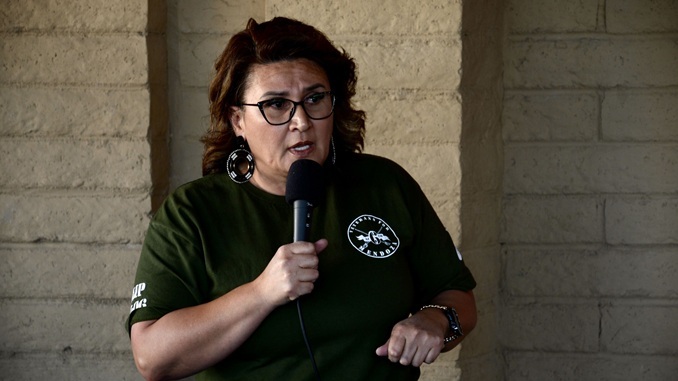
Two years after the attempted assassination of President Donald Trump in Butler, Pennsylvania, the Republican National Committee (RNC) is drawing attention to past remarks by Arizona Democratic congressional candidate JoAnna Mendoza in which she questioned the federal government and compared the United States to countries where democracy has collapsed.
Mendoza, a retired Marine running to represent Arizona’s Sixth Congressional District, made the statements during three separate political appearances released online between 2025 and 2026.
The RNC accused Mendoza of contributing to hostile political rhetoric surrounding Trump and connected her comments to the violence directed against him.
“JoAnna Mendoza continues to spew vile conspiracy theories and the extremely divisive rhetoric that have led to three assassination attempts against President Trump,” RNC spokesman Nick Poche said in a statement provided to AZ Free News. “Americans will never forget what happened in Butler, or the Democrats who refused to lower the temperature and tried to tear our nation apart.”
In the first video, released by LD18 Democrats, Mendoza questioned the reliability of federal intelligence while answering a question about the Middle East and Iran.
Mendoza criticized the Biden and Trump administrations’ handling of Israel, Gaza, and Iran before questioning whether the government possessed reliable intelligence about recent actions involving Iran.
“Can we even trust our intelligence agencies right now?” Mendoza asked. “Can we even trust our government to give us the correct information? And I think the answer to that is no.”
Mendoza said she was alarmed by what she described as the Trump administration’s actions in communities across the country and suggested that the nation’s democratic institutions were being eroded.
“It really scares me to think that, you know, what we’re seeing play out right now across our nation in communities, to see what this administration is doing, I never thought that I would see in the homeland,” Mendoza said.
“I never thought that I would see what has transpired happen here,” she continued. “You see it in countries like the ones I’ve been deployed to where democracy does not exist or has fallen.”
Mendoza did not identify a single policy or incident in that portion of the presentation. Rather, she broadly characterized the administration’s conduct as “unprecedented” and said she entered the race because she could no longer remain on the sidelines.
“What we’re seeing is unprecedented, and this is not the norm,” Mendoza said. “I just couldn’t stand by on the sidelines and watch this happen to our country or to its people, to us, to we the people.”
The third clip came from an interview with MeidasTouch host Ben Meiselas, who introduced Mendoza during a segment criticizing Trump and Republican Rep. Juan Ciscomani (R-AZ06).
During a discussion of border security and Immigration and Customs Enforcement (ICE), Mendoza questioned the training and conduct of ICE agents. Meiselas compared the administration’s practices to propaganda and tactics employed in other countries, and Mendoza agreed with the comparison.
“I know. It’s like we’re living in a third world country,” Mendoza said. “I mean, I’ve been deployed to countries who do not have democracy, who are in authoritarian regimes.”
“I never thought that I would see the government and its federal law enforcement agency turn against the American people,” she added, before alleging a pattern of misconduct involving ICE agents.
The RNC released the clips on July 13, two years after Thomas Matthew Crooks opened fire during Trump’s campaign rally near Butler.
Trump was wounded in the right ear. Former fire chief Corey Comperatore was killed while protecting his family, and rally attendees David Dutch and James Copenhaver were wounded, according to the Secret Service.
The FBI said in a 2024 statement that its investigation found no credible evidence that Crooks worked with co-conspirators. Investigators examined his electronic devices, searches, and online activity but did not determine a definitive motive.
The Associated Press reported that Crooks searched for campaign appearances involving both Trump and then-President Joe Biden and viewed the Butler rally as a “target of opportunity.” Reuters reported that his computer activity reflected a mixture of ideological interests without demonstrating a definitive left- or right-wing motivation.
Trump faced another assassination attempt on Sept. 15, 2024, when Ryan Wesley Routh positioned himself with a rifle near Trump International Golf Club in West Palm Beach, Florida. A federal jury convicted Routh in September 2025, and he was sentenced in February to life plus 84 months in federal prison. At trial, prosecutors presented a letter in which Routh described the incident as an assassination attempt and offered $150,000 to anyone who would “complete the job.”
Routh’s writings demonstrated explicit hostility toward Trump. The Associated Press previously reported that Routh had urged Iran to assassinate Trump in a self-published book and later wrote that “DEMOCRACY is on the ballot and we cannot lose.”
A federal grand jury has also indicted Cole Tomas Allen on charges including attempting to assassinate Trump during an April 25 shooting at the White House Correspondents’ Association Dinner. Prosecutors alleged that Allen ran through a security checkpoint carrying a shotgun and fired at a Secret Service officer, striking the officer’s ballistic vest, as he moved toward the ballroom where Trump was located.
Reuters reported that Allen sent relatives a manifesto describing Trump administration officials as prioritized targets. Prosecutors alleged that Allen disagreed politically with Trump and wanted to “fight back” against government policies he considered morally objectionable. Allen pleaded not guilty, and the case remains pending.
Mendoza is seeking the Democratic nomination to challenge Ciscomani in November.
Mendoza is also facing questions from the RNC about salary payments she has received from her own campaign.
The Mendoza campaign did not immediately respond to a request for comment.