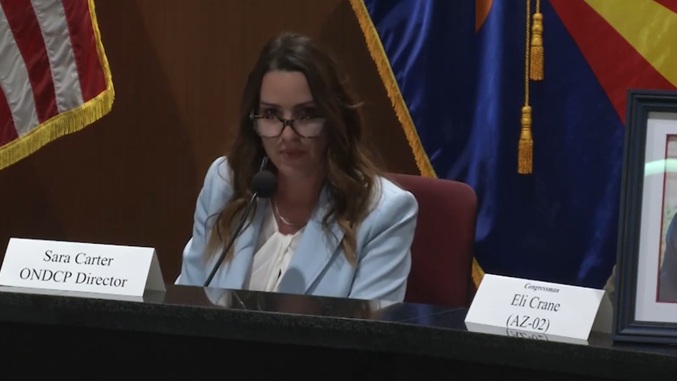
The White House Office of National Drug Control Policy (ONDCP) paid a visit to Arizona last week.
Sara Carter, director of the ONDCP, came to address Arizona’s unique situation with its ongoing drug crisis. Arizona was one of few states to experience an increase in drug overdose deaths rather than a decrease in 2025. Not only that: Arizona had the most drug overdose deaths last year.
While drug overdose deaths decreased 31% nationwide, Arizona experienced a 30% increase in drug overdose deaths.
Republican Rep. Andy Biggs (AZ-05) hosted Carter’s visit to Arizona, and Republican Rep. Eli Crane (AZ-02) joined the pair for meetings according to a press release from Biggs. These meetings were also attended by Drug Enforcement Administration officials, tribal partners, local law enforcement, and Angel Families.
Angel Families include all family members of individuals victimized or killed by criminal illegal aliens. Nearly all of the Angel Families in attendance last week were those whose loved ones fell victim to the crimes and violence resulting from drug cartel activity.
Eight of those families testified at a roundtable hosted at the Arizona State Capitol on Friday. These families claimed that the deaths of their loved ones were preventable through stricter immigration enforcement policies.
Among those to testify were Mary Ann Mendoza, who recounted how her son, Mesa police officer Brandon Mendoza, was killed in 2014 by an illegal alien drunk driver who had a criminal record dating back to 1994 and was living as a fugitive at the time of the crash.
Doug and Patricia Quets shared how their adult son Nicholas Quets, a Marine veteran, was murdered by Sinaloa cartel members in 2024.
Fernando Basurto explained that his grandson, Fernando Jose Basurto Jr., was about to graduate high school and had plans to enter the Air Force when he was murdered by a criminal illegal alien in 2016, who had been released shortly prior to the murder. Basurto said that former Sen. Martha McSally initially soured him on Congress because she refused to see their family to discuss Fernando Jose’s murder.
Patti Fox testified alongside her adult daughter, Carissa Aspnes, who was struck and severely disabled by an illegal alien running a stop sign in 2025. Carissa — a second-generation American on her grandmother’s side, a legal immigrant from Thailand — suffered a traumatic brain injury and now requires full-time care. Fox said local investigators initially covered up the fact that Carissa’s assailants were illegal aliens who entered the country under the Biden administration.
Karen Griffin explained that her teen son, Tyler Griffin, passed away in 2020 after taking a pill he believed to be Tylenol, but was actually laced with fentanyl.
Similarly, Anne Fundner shared that her 15-year-old son, Weston Fundner, passed away in 2022 after taking pills laced with fentanyl.
Carter promised to incorporate those suggestions from Friday’s roundtable into legislative proposals and policies put forth by the Trump administration.
Attendees included Reps. Quang Nguyen (R-LD-1), Nick Kupper (R-LD-25), and Lisa Fink (RLD-27); Sen. Carine Wrner (RLD-4); Maricopa County Supervisor Debbie Lesko; Queen Creek Mayor Julia Wheatley; and Art Del Cueto, formerly president of the National Border Patrol Council.
As part of its mission to address the drug crisis, ONDCP has taken a special focus on Arizona’s increase in drug overdose deaths, especially those involving fentanyl. It is the belief of the Trump administration, and Biggs and Crane, that the border policies of former President Joe Biden are to blame for Arizona’s ongoing drug crisis.
Carter commended Arizona as taking steps to fight back against the drug crisis.
“These communities know firsthand the devastating impact of illicit drugs,” said Carter. “President Trump and his administration will continue to fight for our citizens until every American is free to live a safe and healthy life, free from the scourge of illicit drugs.”
Earlier this month, ONDCP released a 200-page National Drug Control Strategy for 2026.
Under this administration, Trump has signed legislation classifying fentanyl-related compounds as Schedule I drugs; designated cartels as foreign terrorist organizations; designated illicit fentanyl and its core precursor chemicals as weapons of mass destruction; and signed legislation expanding the border wall and increasing deportations.
AZ Free News is your #1 source for Arizona news and politics. You can send us news tips using this link.
A viral story across the media accused the Trump administration of keeping parents from their adult son dying of terminal cancer.
The Department of Homeland Security (DHS) responded that was the furthest thing from the truth.
Although their son had been living and already returned to Mexico, his parents decided to reenter the country illegally.
DHS says the parents, Isidor Gonzales Aviles and Normal Anabel (also identified as Norma Anabel Ramirez Amaya), were not in Immigration and Customs Enforcement (ICE) custody and that their family misrepresented critical facts in their case to the media.
Per DHS, Aviles and Anabel had been deported years prior to this event and were illegal aliens. Neither individual had standing to enter the country regardless of the reason.
Aviles entered the country illegally in 2000; from that point to his removal in 2011, Aviles was arrested and charged multiple times with sexual abuse, retail theft, battery, trespassing, and disorderly conduct.
Anabel entered the country illegally in 2005. She was also deported back to Mexico in 2011. However, Anabel entered the country illegally again in 2024, where she was apprehended by Customs and Border Protection (CBP) and redeported within several days.
Their son Kevin Gonzalez — who is 18 and is identified as a U.S. citizen — was born during that time period while his parents were hiding out in the country illegally in Chicago, Illinois. That would mean Gonzalez was born to illegal immigrant parents, what some call an “anchor baby” in the heated debate over birthplace citizenship that has made its way to the Supreme Court.
Although Gonzalez was born in Chicago, he lived in Mexico with his parents leading up to December 2025. That’s around when Gonzalez received his cancer diagnosis and left his parents to seek out medical treatment in the U.S.
Gonzalez was diagnosed with metastatic Stage 4 colon cancer in January and was initially under the care of his brother, Jovany Ramirez, in Chicago. Aviles and Anabel reported petitioning for humanitarian parole into the country to be with Gonzalez, but their petitions were denied.
During this time, Gonzalez traveled back to Mexico to be with his family. He entered the care of his grandmother, Virginia Amaya.
DHS later responded to media reports on the claim of humanitarian parole; according to DHS, Aviles and Anabel applied for B1/B2 visas, which were denied, not humanitarian parole.
Although Gonzalez returned to Mexico, Aviles and Anabel then reentered the country illegally in April and were detained by CBP in Douglas, not ICE. The parents were taken to the Florence Correctional Center for processing.
On Thursday, a federal immigration judge authorized the expedited release of Aviles and Anabel.
Congressional Democrats who qualify illegal aliens as constitutents and have prioritized fighting against immigration enforcement efforts came to the family’s defense.
Rep. Adelita Grijalva (D-AZ-07) called the story “heartbreaking.”
“I’m asking ICE to accommodate this request so Kevin can see his parents one last time,” said Grijalva. “This isn’t about politics — it’s about human decency.”
This is absolutely heartbreaking.
I'm asking ICE to accommodate this request so Kevin can see his parents one last time.
A federal judge dismissed the Trump administration’s lawsuit against Secretary of State Adrian Fontes over his refusal to turn over voter registration records.
The Arizona District Court ruled in United States v. Fontes on Tuesday that the federal government didn’t have justification under federal law to force Fontes to turn over the records.
The court dismissed the claim with prejudice, calling the federal government’s claim on the law “[an] amendment [that] would be legally futile.”
District Judge Susan Brnovich, widow to former Arizona Attorney General Mark Brnovich, found “unconvincing” the DOJ’s argument that the Civil Rights Act of 1960 (52 U.S.C. § 20702) gave the federal government authority to request state voter records and documents. Brnovich said this interpretation conflicted with the National Voter Registration Act (NVRA) and Help America Vote Act (HAVA).
“[T]he Attorney General’s interpretation places § 20702 in conflict with multiple provisions of the NVRA and HAVA,” said Brnovich.
The Department of Justice (DOJ) filed the lawsuit against Fontes in January. Then-Attorney General Pam Bondi sought Arizona’s entire statewide voter registration list, which would include a registered voter’s full name, date of birth, residential address, and driver’s license number or last four Social Security Number digits.
At the time, Bondi said voter registration database transparency between the states and federal government fulfilled a “basic obligation of transparency.”
— Arizona Secretary of State (@AZSecretary) April 29, 2026
Fontes said the court ruling represented a victory for preserving the security of voter privacy.
“Looks like your personal data is safe yet again because the case against me and the Department of Justice’s illegal requests to grab that voter registration have been dismissed,” said Fontes. “I will continue to protect your personal identifying information from these illegal requests no matter what.”
BREAKING: A federal judge dismissed the DOJ’s case against my office.
Arizonans’ personal identifying information is safe and I will continue doing everything in my power to protect your privacy. pic.twitter.com/sPbqpkGiry
— Arizona Secretary of State (@AZSecretary) April 28, 2026
The DOJ requested records from Fontes twice last summer and once last winter. Fontes denied all requests. He has maintained that state and federal privacy laws preempt him from turning over voter records.
Attorney General Kris Mayes supported Fontes’ refusal from the start.
In a statement released on Wednesday, Mayes said the ruling was a rightful dismissal and a vindication of Fontes’ actions.
“That database contains the sensitive personal information of millions of Arizona voters — home addresses, dates of birth, and Social Security and driver’s license numbers. But the Court was clear: Title III of the Civil Rights Act does not authorize this demand,” said Mayes.
Today, Judge Susan Brnovich's dismissed the DOJ's lawsuit demanding our voter registration rolls. @AZSecretary and I will continue to defend the privacy of voters against federal overreach.
— AZ Attorney General Kris Mayes (@AZAGMayes) April 28, 2026
Five other federal courts in California, Oregon, Michigan, Massachusetts, and Rhode Island have rejected this Civil Rights Act argument by the Trump DOJ.
The DOJ has 25 lawsuits on their claim of Civil Rights Act authority pending in Colorado, Connecticut, Delaware, Georgia, Hawaii, Idaho, Illinois, Kentucky, Maine, Maryland, Minnesota, Nevada, New Hampshire, New Jersey, New Mexico, New York, Oklahoma, Oregon, Rhode Island, Vermont, Virginia, Utah, Washington, West Virginia, and Wisconsin.
Earlier this month, Arizona Senate leadership referred Fontes to the DOJ for allegedly obstructing justice and tampering with a witness concerning a federal probe into Arizona election records.
AZ Free News is your #1 source for Arizona news and politics. You can send us news tips using this link.
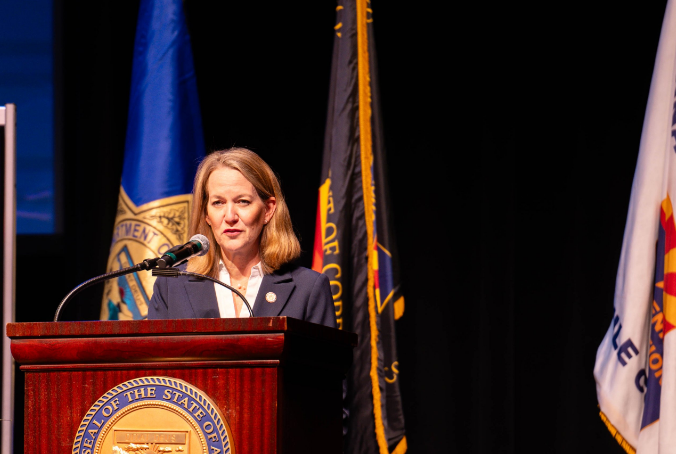
Attorney General Kris Mayes is suing to stop the construction of a new Immigration and Customs Enforcement (ICE) detention facility in Surprise.
Mayes announced the lawsuit on Friday. The Department of Homeland Security (DHS) plans to renovate a vacant warehouse it purchased in January for about $70 million into an immigration detention facility.
Mayes also hosted a press conference to announce the lawsuit. Present with her were Senate Assistant Minority Leader Catherine Miranda (D-LD11) and State Sen. Analise Ortiz (D-LD24).
Mayes claimed the federal government failed to hold public forums and conduct the proper environmental reviews.
The attorney general also argued the federal government needed permission prior to acting on this immigration enforcement initiative.
“The federal government did not ask the people of Surprise whether they wanted this,” said Mayes. “They did not ask the parents of the students that attend any of the schools near this site if they were okay with this. They did not ask the firefighters and paramedics, who would be the first to respond if something went wrong, if this was a good idea.”
Mayes accused the Trump administration of violating federal laws, to include the National Environmental Policy Act (NEPA) and the Administrative Procedures Act (APA).
“The Trump administration has run roughshod over federal law in its rush to expand detention capacity across the country,” said Mayes. “The federal government did not ask the people of Surprise whether they wanted this facility in their backyards. They simply bought a warehouse, handed a $300 million contract to a private company and told the City to deal with it.”
The city of Surprise issued a public statement saying the DHS purchase of the facility was news to them. The city also emphasized that it didn’t have the power to assist or interfere with federal immigration enforcement.
“The City was not aware that there were efforts underway to purchase the building, was not notified of the transaction by any of the parties involved and has not been contacted by DHS or any federal agency about the intended use of the building. It’s important to note, Federal projects are not subject to local regulations, such as zoning,” said the city. “When it comes to immigration enforcement, local law enforcement does not enforce federal immigration laws; Surprise Police Department enforces local and state laws. While we do not participate in ICE operations, we also cannot interrupt or prevent their operations.”
The lawsuit filed in the Arizona District Court alleges the facility is unsuitable for mass detainment based on claims that the location lacks the appropriate water and wastewater infrastructure, and the location exists across the street from a chemical storage facility as well as two public schools.
Several hundred followed up the attorney general’s lawsuit with a protest over the weekend. An ICE spokesperson said in a statement that they had evaluated the use of existing facilities to minimize potential impacts on the environment, including protected species, natural resources, and cultural resources.
“Let’s be honest about what is happening. This isn’t about the environment,” said the spokesperson. “It’s about trying to stop President Trump from making America safe.”
AZ Free News is your #1 source for Arizona news and politics. You can send us news tips using this link.
Arizona House Majority Whip Julie Wiloughby (R-LD13) praised a recent Trump administration decision recognizing the significant impact of internal emissions on Arizona’s ability to meet federal air quality standards.
The ruling grants the Phoenix metropolitan area relief from stricter federal requirements, opening the door for potential long-term reforms to the state’s expensive summer gasoline blend mandated in Maricopa and Pinal Counties.
The decision, issued last week by the U.S. Environmental Protection Agency (EPA), found that the Phoenix-Mesa nonattainment area would have met the 2015 ozone National Ambient Air Quality Standards (NAAQS) if not for emissions originating outside the United States. This finding, under Section 179B of the Clean Air Act, prevents reclassification to a more severe status. It acknowledges that a major share of emissions affecting Arizona is beyond the state’s control.
For months, Willoughby has collaborated with local and federal officials to pursue reforms addressing Arizona’s higher summer fuel costs. In January, she sent a letter to the EPA initiating discussions on permanent changes to lower costs for families while maintaining compliance with air quality standards.
“The main reason drivers in Maricopa and Pinal counties pay more for gas in the summer is that these areas are forced to use a special boutique blend made only for Arizona,” explained Willoughby. “It costs more to produce, limits supply, and leaves our state more vulnerable to price spikes. The question is whether this requirement is still doing anything meaningful to improve air quality. If it is not, then Arizona families are being forced to pay more for little to no benefit.”
Willoughby noted that industry operations are cleaner and national fuel standards have evolved since Arizona’s blend was last updated. “Industry is cleaner today than it was when Arizona’s blend was last updated, and fuel standards nationwide have changed significantly since then. There is a strong possibility that Arizona can move to a lower-cost fuel option without sacrificing air quality. If the evidence supports that conclusion, we should act immediately.”
To advance the issue, Willoughby introduced a package of five measures aimed at lowering fuel costs, evaluating compliant fuel options, and requiring the state to adopt a lower-cost fuel once federally approved.
“In order to change the blend, Arizona must submit a request to the EPA to revise our State Implementation Plan and show that we can still meet federal air quality standards with the new blend,” added Willoughby. “The modeling used to make that demonstration must take into account the fact that a major share of the emissions affecting our state comes from outside our borders and is beyond Arizona’s control. The Trump Administration’s recent decision recognizing international transport acknowledges this impact and gives Arizona more room to reevaluate whether our current fuel requirements are still justified. With the federal government signaling openness, this may be our best and only opportunity to get this done.”
In February, Willoughby requested that the Maricopa Association of Governments (MAG) model the impacts of switching from Arizona’s current boutique gasoline blend (Reid Vapor Pressure of 7.0 psi) to a more widely available, lower-cost blend with an RVP of 7.4 psi.
Preliminary modeling completed in March showed that the switch would increase the maximum ozone concentration in the Phoenix metropolitan area by between zero and 0.01 parts per billion.
“That is a negligible impact and more than enough reason to move this conversation forward,” continued Willoughby. “Just as important, Governor Hobbs’ administration already has these results. MAG provided the modeling to her Department of Environmental Quality, which means the Governor could begin acting on this now if she wanted to. She does not need to wait. She does not need more excuses. If Governor Hobbs is serious about lowering fuel costs, she should direct her agency to act immediately.”
In a follow-up letter to MAG Director of Environmental Planning, Matt Poppen, Willoughby highlighted the positive results from the Comprehensive Air Quality Model with Extensions (CAMx v7.32) and Community Multiscale Air Quality (CMAQ v5.5) analyses. The CAMx results showed no changes in the 2023 design value attainment at any monitoring site, while CMAQ predicted a maximum impact of just 0.01 ppb at three sites.
Willoughby also requested additional modeling for a Federal Reformed Gasoline blend with an RVP of 7.8 psi, used in some other western states, and discussions on next steps for a State Implementation Plan revision.
“The modeling is favorable. The facts are lining up in Arizona’s favor. We should seize this opportunity and make the case for lasting gas affordability now,” concluded Willoughby.
Ethan Faverino is a reporter for AZ Free News. You can send him news tips using this link.