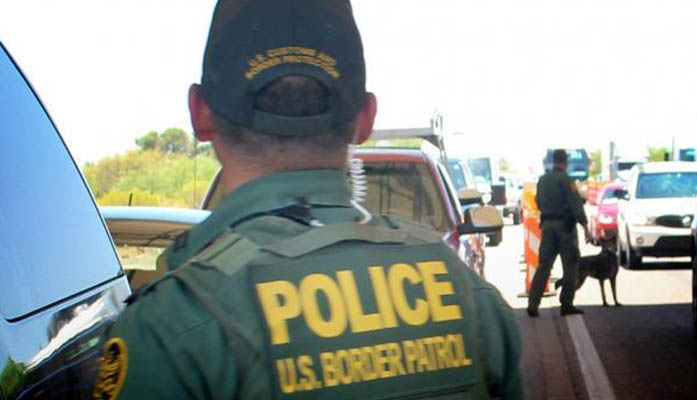
The U.S. Department of Homeland Security (DHS) and U.S. Customs and Border Protection (CBP) announced preliminary fiscal year 2026 data showing a 95% decline in southwest border apprehensions compared with annual levels under the Biden administration. The data also showed the lowest annual nationwide encounters in CBP history.
According to the CBP, fiscal year 2026 marked the first time in agency history that the U.S. Border Patrol completed an entire fiscal year without releasing migrants into the United States.
September also marked the 17th consecutive month with zero Border Patrol releases.
The preliminary figures show that Border Patrol agents recorded 98,708 apprehensions along the southwest border during FY26, compared to an annual average exceeding 1.8 million under former President Joe Biden.
The total was also approximately 60% lower than the 249,740 apprehensions recorded during the highest single month under the Biden administration, according to DHS.
That’s right. ZERO releases for an entire fiscal year. Lowest nationwide encounters in CBP history. Our agents have worked hard for these results, and we are keeping our foot on the gas. pic.twitter.com/nVmR8WLwK5
“President Trump promised the American people a secure border, and the data proves he delivered,” stated DHS Secretary Markwayne Mullin. “Over the past year, CBP recorded its lowest numbers in American history. A stark contrast to Biden, where CBP recorded its highest illegal immigration numbers ever.”
Nationwide encounters also fell to a reported 379,243 during FY26, compared to an annual average of approximately 2.7 million under the previous administration.
The latest figures represent an 88% decline from FY23, when encounters reached their highest annual level.
CBP Commissioner Rodney Scott attributed the decline to increased enforcement efforts and cooperation among federal agencies.
“FY 2026 demonstrated what focused enforcement, strong partnerships, and the commitment of our frontline personnel can achieve,” said Scott. “DHS and CBP are securing the border, stopping dangerous drugs and criminals, protecting communities, and ensuring our personnel have the resources necessary for this critical mission.”
The agency also reported a nearly 80% decline in migrant deaths identified by Border Patrol during FY26 and since President Donald Trump returned to office in January 2025, compared to levels under the Biden administration.
Despite the reduction in crossings, CBP personnel continued conducting search-and-rescue operations and providing emergency medical assistance.
During FY26, CBP’s Office of Field Operations responded to more than 3,000 medical emergencies, performed CPR on more than 50 individuals experiencing cardiac arrest, and administered naloxone to individuals experiencing suspected opioid overdoses.
In addition to declining border crossings, CBP reported completing 250 miles of new border barriers along the southwest border since January 2025. The construction includes primary and secondary barriers, waterborne barriers, and supporting surveillance technology.
The agency also obligated approximately $34.3 billion between September 2025 and September 2026 toward Smart Wall projects across the southwest border states, using funding provided through the Working Families Tax Cut Act.
CBP also reported higher drug seizure totals during the fiscal year.
Preliminary figures show the agency seized nearly 1 million pounds of illegal drugs nationwide, approximately 63% above the annual average of 600,000 pounds recorded during the previous four years.
“The results could not be clearer: strong enforcement works,” added Mullin. “Thanks to President Trump’s leadership and the hard work of CBP and DHS law enforcement personnel, we have restored control of the border and made America safer than ever.”
Beyond border enforcement, CBP reported stopping more than 4,000 shipments valued at over $325 million due to suspected forced labor violations. The agency also seized approximately 55.5 million counterfeit items with an estimated value exceeding $12.6 billion.
Among those seizures were 476,903 counterfeit items associated with FIFA World Cup intellectual property valued at more than $33 million.
DHS officials attributed the reduction in unlawful border crossings to the administration’s immigration enforcement policies and investments in border infrastructure, while highlighting increased drug seizures and trade enforcement efforts during FY26.
Ethan Faverino is a reporter for AZ Free News. You can send him news tips using this link.
The city of Phoenix is operating a program to investigate federal agencies under President Donald Trump, according to public records.
The city publicly promotes its Community Transparency Initiative (CTI) as a complaint intake system and informational resource for the public on immigration matters.
However, records obtained by Judicial Watch reflect that the city of Phoenix tasks its employees and law enforcement with documenting, reporting, and investigating more than just federal immigration officials.
CTI, developed through the Office of Transparency and Accountability (OAT), was initially developed to take in reports and complaints concerning Immigration and Customs Enforcement (ICE) personnel.
The city’s employee training materials reveal that CTI has a much larger scope of oversight beyond ICE to include more federal agencies. City employees are trained to document and report all encounters involving federal law enforcement personnel. They are also trained to maintain records of time and resources devoted to work done concerning CTI.
Agencies under city of Phoenix employees’ purview were indicated to include the Federal Bureau of Investigation; United States Secret Service; Alcohol, Tobacco, Firearms, and Explosives; United States Postal Inspection Service; Border Patrol; Drug Enforcement Agency; United States Marshals Service; Federal Air Marshal Service; Federal Protective Service; Capitol Police; and the Transportation Security Administration.
Under CTI, the Phoenix Police Department uses its Special Investigations Division to review CTI complaints, investigate for criminal or civil rights violations, and pass along findings to Arizona Attorney General Kris Mayes. Both the police and fire departments have been involved in implementing CTI.
The initiative also connects residents with multiple progressive nonprofit organizations: the national and Arizona chapter of the ACLU, Immigrant Legal Resource Center, National Immigration Law Center, Informed Immigrant, Florence Project, International Rescue Committee, Phoenix Legal Action Network, and the Immigrant Advocacy Network.
CTI also refers residents to its Office of Refugee and Immigrant Support, established in March 2023 amid the height of the illegal immigration crisis under former President Joe Biden. The office provides refugees and asylum seekers with integration services, including access to healthcare, housing, childcare, education, and employment.
Around the same time in 2023, Gov. Katie Hobbs’ administration allocated $60 million to house, feed, and provide other resources to the homeless and illegal immigrants. $13 million went to the city of Phoenix.
In recent years, the city spent around $8 million of its $396 million in American Rescue Plan Act funds on refugee and immigrant services.
In early March of this year, the city authorized spending up to $500,000 through June 2028 for legal counsel through Coppersmith Brockelman PLC, a favorite law firm among top Democrats such as Gov. Katie Hobbs, though the CTI website and later reporting stated that the city spent $1 million to hire the firm. Sam Coppersmith, a managing partner to the firm, was formerly a Democratic congressman for the 1st Congressional District and a chairman of the Arizona Democratic Party.
Judicial Watch didn’t receive any records confirming that the city formally considered any other law firms to provide outside legal counsel for CTI.
Following this authorization for outside legal counsel, the city passed a policy banning ICE enforcement operations from city-owned property. Mayes later issued a defense of the city’s action.
AZ Free News is your #1 source for Arizona news and politics. You can send us news tips using this link.
The Trump administration greenlit another one of Maricopa County’s plans to incentivize clean air improvements.
The county plans to encourage the railroad and construction industries to voluntarily upgrade or replace their nonroad vehicles with cleaner emissions technologies through Maricopa County Rule 204.
The rule represents another effort to bring the county closer to compliance with the 2015 ozone standard of 70 parts per billion outlined by the federal Clean Air Act.
Maricopa County reported that it is currently designated as a moderate non-attainment area under the standard. Under the Biden administration in 2024, the Environmental Protection Agency (EPA) began to consider whether the Phoenix area warranted reclassification as a serious non-attainment area.
However, the EPA determined earlier this year that the county would have attained standards had it not been for international emissions, namely from Asia and Mexico.
The Maricopa Association of Governments reported that it found through modeling with the EPA that approximately 80% of regional ozone originates from natural sources or outside Arizona.
The EPA determination from this year spared the county from the burden of additional air quality regulations, which would have slowed and potentially reversed industry growth in the region.
The region has reported reduced local emissions of air pollutants by 50% since 2000. The county also reported on Tuesday that total emissions statewide have fallen by more than 70% since 1990, despite the population more than doubling.
On Tuesday, EPA Administrator Lee Zeldin participated in a press conference to announce the incentives alongside Maricopa County officials, including Board of Supervisors Chair Kate Brophy McGee and Republican attorney general nominee Warren Petersen.
Zeldin remarked that Maricopa County’s approach to emissions reduction has been successful.
“They aren’t increasing emissions,” repeated Zeldin. “They are not breaking federal requirements. They are finding new, innovative ways to work within their circumstances.”
NEW: @MaricopaCounty & @EPA announce innovative plan to improve air quality and protect jobs. We appreciate this chance to work together to prove that a healthy environment and growing economy can go hand-in-hand. 1/3 pic.twitter.com/QigWcvgheM
Brophy McGee pledged that the new county rule would maintain county residents’ quality of life and would not hinder economic development.
“This plan demonstrates how a healthy environment and growing economy can work together,” said Brophy McGee. “By incentivizing rather than punishing job creators, implementing Maricopa County’s Rule 204 will improve the quality of the air we breathe while enabling key industries to continue investing in our community. I thank Administrator Zeldin and the EPA for working with Maricopa County and our business community on this innovative approach.”
Danny Seiden, president and CEO of the Arizona Chamber of Commerce, called the rule “smart policy” that ensured a win-win for the economy and air quality.
“For more than a decade, Arizona’s business community has worked to expand the tools available to reduce emissions while giving companies a workable path to invest, expand and create jobs,” said Seiden. “Rule 204 does exactly that: when businesses voluntarily replace older equipment with cleaner technology and achieve real, measurable emissions reductions, those reductions can help make continued economic growth possible.”
In April, the EPA approved Maricopa County Rule 205, another incentive which provides emission reduction credits to fleet owners and operators who upgrade or replace on-road vehicles with cleaner technologies.
AZ Free News is your #1 source for Arizona news and politics. You can send us news tips using this link.
A national survey of Democratic voters found that 59% would react positively to a hypothetical military takeover removing President Donald Trump from power, while 31% would react positively to news of his assassination, according to published results from the Center for Strategic Politics.
The survey, commissioned by Liberal Currents, examined Democratic voters’ presidential preferences, policy positions, and reactions to five hypothetical scenarios involving Trump leaving office. The publication released its analysis Sept. 21.
The military takeover scenario described military leaders removing Trump and assuming control of the United States under a stated rationale of safeguarding the Constitution. Respondents were asked how they would feel upon seeing such a news headline.
The accompanying graphic showed 43% responding very positively and 16% somewhat positively. Another 13% were neutral, while 10% responded somewhat negatively and 18% very negatively.
We polled five routes for Trump to leave office before the end of his term. A plurality of Dems support four of them, including a military coup and death by natural causes. The only one underwater, an assassination, is still supported by 29%. pic.twitter.com/C3qb2H0R8j
For the assassination scenario, the published crosstabs reported 23% very positive and 8% somewhat positive responses. Negative reactions totaled 43%, with 25% neutral. The hypothetical headline described Trump being assassinated while speaking at a rally.
The center’s social media caption cited 29%, while its published crosstabs reported 31%.
Positive reactions also totaled 56% for Trump dying in his sleep, 86% for impeachment and removal, and 84% for the scenario invoking the 25th Amendment.
The questions measured respondents’ anticipated emotional reactions to hypothetical headlines. They did not directly ask whether respondents would participate in or authorize violence.
The same survey also found majority support for a future Democratic administration pursuing criminal prosecutions of Trump administration officials, with one question extending to officials who served under former President Joe Biden.
Criminal prosecutions of Trump officials are generally favored by Dems, with clear majorities indicating support in all cases. Voters also support prosecution of officials from both the Trump and Biden admins over US support for Israel's genocide in Gaza. pic.twitter.com/OF6tRVasF8
Seventy-seven percent favored pursuing prosecutions of Trump administration members over actions taken by Immigration and Customs Enforcement and Customs and Border Protection. A separate question naming Stephen Miller drew support from 73%.
On military actions, 72% favored prosecuting administration members over lethal strikes on boats in South America, while 66% favored prosecutions over actions taken during the war in Iran.
Another 69% favored prosecuting Pete Hegseth in response to a question that described him as directing the military “to violate national and international law.” That characterization appeared in the question itself.
The question encompassing both administrations drew 57% support for pursuing prosecutions over actions related to what the questionnaire called “Israel’s genocide in Gaza.” Twenty-two percent opposed pursuing those prosecutions, and 22% were unsure.
Although the graphic’s headline described Democrats as wanting officials jailed, the questions asked whether the next Democratic administration should pursue criminal prosecution. They did not ask respondents to determine guilt or select a punishment.
In his analysis accompanying the poll, Liberal Currents writer Chance Phillips noted that assassination was the only one of the five scenarios in which negative reactions exceeded positive reactions.
“Thankfully, on net Democrats are not pro political violence,” Phillips wrote, referring to the assassination responses.
That conclusion did not account for the majority’s positive response to a military seizure of government. The scenario explicitly described military leaders removing Trump from power and assuming control of the United States, with 59% responding positively and 28% negatively.
The Center for Strategic Politics describes itself as part of the progressive community and says its work is funded through grassroots contributions.
The English-language survey included 683 Democratic voters nationwide, contacted Sept. 3 and Sept. 8–10 through SMS-to-web and online panels. Researchers weighted responses by age, ethnicity, and gender and reported a margin of error of plus or minus 3.75 percentage points.
Congressmen Andy Biggs (R-AZ-05) and Eli Crane (R-AZ-02) are urging the Trump administration to select Arizona State University (ASU) as the home of a new national advanced manufacturing center aimed at strengthening military readiness and the U.S defense industrial base.
Biggs led a letter this month alongside Crane to Secretary of War Pete Hegseth supporting an ASU Research Enterprise proposal to establish the Applied Research for Manufacturing Operational Readiness Center or ARMOR Center, at ASU’s Polytechnic campus.
The U.S. Army is seeking to establish the center to help move advanced manufacturing technologies from research and development into practical military applications.
Under ASU’s proposal, the ARMOR Center would create a pipeline for developing, testing, qualifying, and scaling new manufacturing technologies before transitioning them into the Army’s Organic Industrial Base, defense contractors, and other manufacturing partners.
The center would focus on areas including additive manufacturing, artificial intelligence-enabled manufacturing, advanced composites and point-of-need production.
“Led by institutions and companies like Arizona State University, our state continues to position itself at the forefront of America’s defense industrial base,” stated Congressman Biggs. “Throughout my time in Congress, I have been pleased to support projects and initiatives that strengthen our national defense and help safeguard our citizens, freedoms, and interests.”
I recently led a letter to Secretary of War Pete Hegseth supporting Arizona State University’s application to establish the Applied Research for Manufacturing Operational Readiness Center at ASU’s Polytechnic campus in #AZ05.
Biggs said ASU is well positioned to lead the effort and expressed hope that the administration will select the university’s proposal.
In their letter to Hegseth, Biggs and Crane argued that Arizona’s existing defense industry, military installations, semiconductor investments, and research capabilities make the state a strong candidate for the center.
Arizona is home to major defense and aerospace companies including Raytheon, Honeywell Aerospace, Northrop Grumman, General Dynamics, and Boeing, along with hundreds of suppliers involved in the production of missiles, aircraft, avionics, and electronics.
Biggs and Crane also pointed to more than $210 billion in semiconductor and microelectronics investments announced in Arizona since 2020, arguing that the expanding industry could provide the Army with an established network for developing and scaling advanced manufacturing technologies.
Arizona’s military presence was also highlighted in the letter.
Fort Huachuca and Yuma Proving Ground support Army missions and testing, while Luke Air Force Base, Davis-Monthan Air Force Base, and Marine Corps Air Station Yuma provide additional military infrastructure within the state.
“Few states combine manufacturing, research, testing, and military operations in one place,” wrote Biggs and Crane.
ASU has also invested heavily in manufacturing research at its Polytechnic campus. It’s $200 million interdisciplinary Science and Technology Building 12 contains approximately $6 million in advanced manufacturing equipment, according to the letter.
The university offers bachelor’s, master’s, and doctoral degrees in manufacturing engineering and graduates more than 1,000 students annually across manufacturing, mechanical, and industrial engineering programs.
ASU has also conducted nearly $300 million in Department of War research during the past three fiscal years and leads one of the nation’s eight Microelectronics Commons hubs.
Beyond establishing the ARMOR Center, ASU’s proposal could position Arizona to host a University Affiliated Research Center (UARC) supporting the Army’s modernization and readiness efforts.
Such a center would provide the Army with a long-term research partner focused on developing and transitioning technologies needed for national defense.
Supporters contend that bringing the ARMOR Center to Arizona could strengthen domestic manufacturing capacity, expand the military’s ability to adopt emerging technologies, and reduce vulnerabilities within defense supply chains.
“A UARC in Arizona would deepen the Army’s partnership with a state that already delivers defense manufacturing, semiconductor production, federally funded research, and a skilled engineering workforce,” Biggs and Crane wrote.
Biggs and Crane asked Hegseth to give ASU’s proposal “full and fair consideration,” arguing that Arizona’s combination of defense manufacturing, military infrastructure, research capabilities and engineering workforce makes the state a natural location for the new national center.
Ethan Faverino is a reporter for AZ Free News. You can send him news tips using this link.