by Corinne Murdock | Dec 15, 2022 | News
By Corinne Murdock |
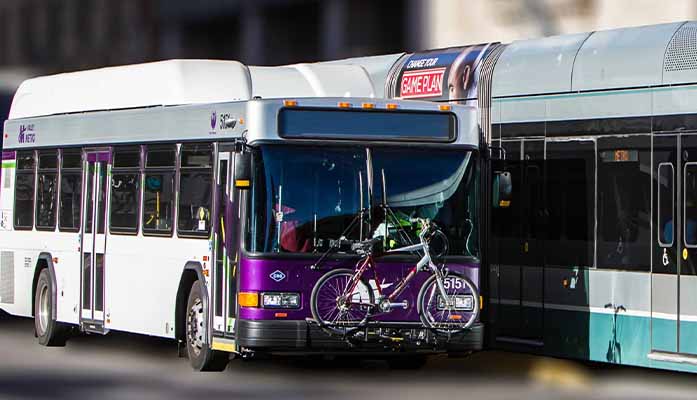
The Phoenix City Council unanimously approved a plan to spend $102 million to replace its bus fleet with electric vehicles. Outgoing councilmember Sal DiCiccio wasn’t present.
Over $86.7 million (85 percent) comes from federal funding; over $15.3 million (15 percent) comes from regional funding. The initiative is part of the council’s goal of achieving a total zero-emissions bus fleet by 2040. The current fleet consists of 500 buses.
The city will procure a variety of electric buses: battery, hybrid, and hydrogen fuel cell. The council waived standard competition in its procurement process to award the five-year contract due to supply chain issues; reportedly, the city learned it couldn’t acquire its first round of zero-emissions buses until after 2025, well after its planned timeline. The city selected a supplier who could meet their timeline: the Washington State Transit Bus Cooperative.
Mayor Kate Gallego indicated that their goal of true zero-emissions would come from future negotiations with power companies. Gallego noted that the plans to create an electric charging grid launched by the Biden administration and state would facilitate their efforts.
“It cannot be zero-emission if the power going in is not zero-emission,” stated Gallego.
READ THE COUNCIL’S BUS FLEET PLAN
Councilwoman Yassamin Ansari noted that this plan put the city on the same timeline to zero-emissions as New York City and California. Ansari promised that the council would accelerate their plan even further once the supply chain stabilizes and inflation costs reduce.
Ansari credited the Sierra Club, Arizona Public Interest Research Group (PIRG), Southwest Energy Efficiency Project (SWEEP), American Lung Association (ALA), and CHISPA AZ for allowing their plan to come to fruition.
“We will only be ordering hybrid and zero-emission buses after 2024, which will completely then end our dependence on fossil fuel transit in terms of new purchases,” stated Ansari. “This is a public health win, a quality of life win, a climate win, and a very big win for Phoenix.”
Public comment came from two organizations that advocated heavily for the $102 million expenditure:
Joanna Struther, ALA senior director of advocacy, cited ALA data ranking Phoenix as the fifth-most polluted city in the nation. Struther stated that the city’s air pollution presented a severe harm to circulatory systems.
The ALA claimed that electrification of city fleets would result in 38,000 less asthma attacks and $15.1 billion in public health benefits. ALA asserted that its polling revealed 70 to 80 percent support among Arizonans for electric vehicles.
PIRG’s executive director, Diane Brown, noted that not only would residents benefit from improved air quality from bus electrification, but the city would increase its access to federal funding.
The city rejected a plan last year to renew their current fleet powered by fossil fuels for another five years.
Corinne Murdock is a reporter for AZ Free News. Follow her latest on Twitter, or email tips to corinne@azfreenews.com.
by Corinne Murdock | Nov 30, 2022 | News
By Corinne Murdock |
Phoenix City Councilman Sal DiCiccio has been posting daily updates on police reporting since September. It’s part of the outgoing councilman’s efforts to apprise citizens of their local law enforcement’s work on a daily basis.
These daily police reports offer details on crimes happening in the community. DiCiccio’s posts offer a small glimpse into their daily work — he doesn’t include the entire report.
DiCiccio’s latest report detailed an aggravated assault on an officer, two robberies, arson, several assaults, a school shooting threat, several misconduct weapons incidents, and several accident investigations.
DiCiccio has also informed constituents of the monthly district crime reports.
Last year, DiCiccio would share these reports as well as updates on police staffing to advise citizens of the rising crime rates combined with staffing shortages.
DiCiccio also informs the community about breaking crime issues, such as a homicide that occurred Monday.
In addition to crime and police-related content, DiCiccio posts about community events like park openings and lifeguard certification classes, dog adoptions, and school board updates.
DiCiccio posts constituent-focused content far more frequently than his fellow council members. The others tend to rely on their monthly district newsletter to inform constituents, with the exception of Councilwoman Yassamin Ansari, who posts more frequently at the rate of several times per week about community events pertaining to her office.
As of this report, Mayor Laura Pastor informed constituents last week about a toy and clothing drive last week, Councilman Jim Waring last tweeted thanks to his voters for reelecting him two weeks ago, Councilwoman Betty Guardado advised constituents to read her district newsletter two weeks ago, Councilwoman Ann O’Brien last retweeted a fire escape plan notice in mid-October, Councilwoman Debra Stark last retweeted in April about her appearance at the Phoenix Fire Department, and Councilman Carlos Garcia last tweeted last November about Phoenix Sky Harbor International Airport hiring.
Several council members are more active on Facebook. Their posts mainly reflect community events rather than major updates.
O’Brien encouraged constituents to vote, wished constituents a happy Thanksgiving, and updated constituents on the council’s approval of Metrocenter Mall’s redevelopment.
Waring last posted in October to encourage constituents to vote.
Stark shared her appearances with different groups, recent toy drive involvement, and a call to action for upcoming Habitat For Humanity home repair projects.
Pastor posted about several events: the toy and clothing drive, and an Alzheimer’s benefit.
Guardado posted videos of her attendance at a festival, and involvement in a tree donation event at a park.
Garcia posted an update about their quarterly Laveen Community meeting last week.
Corinne Murdock is a reporter for AZ Free News. Follow her latest on Twitter, or email tips to corinne@azfreenews.com.
by Corinne Murdock | Nov 25, 2022 | News
By Corinne Murdock |
Last Wednesday, the Phoenix City Council declared that COVID-19 no longer constitutes an emergency. The council passed the resolution quietly and without discussion, lumping it in with dozens of other agenda items.
It has been two years and eight months since the city first declared COVID-19 as an emergency. Yet, the issue that instigated controversy and struggle for so long was passed over with little notice.
The resolution rescinding the emergency declaration for COVID-19 cited the CDC data from late last month listing transmission levels for Maricopa County as “low.” This means that all declarations related to the COVID-19 emergency are rescinded.
Although the city rescinded the emergency declaration, they continue to offer COVID-19 mitigation resources like testing kits and masks.
The city lagged behind the state in determining that COVID-19 no longer constituted an emergency.
Governor Doug Ducey ended the state’s COVID-19 emergency in March. The city last updated its face mask policy in February, requiring mask-wearing if risk levels were considered high. Phoenix went through periods of rescinding then reimposing its mask mandate.
It wasn’t until April that the Phoenix Sky Harbor International Airport dropped its mask mandate in accordance with the Transportation Security Administration no longer enforcing the federal mask mandate.
Like most other cities, Phoenix capitalized on its $396 million in COVID-19 relief funds to subsidize community needs and other projects.
This included allocations like $75.5 million for homeless shelters, housing, treatments, and resources; $31 million for affordable housing and financial assistance; $16.7 million for a “Resilient Food System” to increase agriculture in the city with a focus on equity and inclusion; $10.5 million for planting trees and making homes energy efficient; $8.3 for refugees; $5 million went to community college tuition assistance.
As for COVID-19 mitigation efforts and expenses: $28.9 million went to city testing and vaccination efforts, $28 million funded current and projected COVID-19 health care expenses for the city, and $22 million funded premium pay for essential city workers.
Corinne Murdock is a reporter for AZ Free News. Follow her latest on Twitter, or email tips to corinne@azfreenews.com.
by Corinne Murdock | Nov 19, 2022 | News
By Corinne Murdock |
The city of Phoenix plans to spend over 25 percent of its $396 million in COVID-19 relief funds on homelessness and affordable housing initiatives. It is the city’s second-highest expenditure of relief funds after city operations.
According to the city’s American Rescue Plan Act (ARPA) plan for this year, over $99.5 million will be spent on homelessness and affordable housing. The majority of this, around $75.5 million, is slated to address the homelessness crisis.
Even with tens of millions allocated to mitigate the homeless crisis, notorious encampments like “The Zone” continue to worsen. City spokespersons informed reporters in September that the city is working to approve contracts and allocate the funds, which expire in 2024.
Earlier this week, the state’s largest homeless shelter told 12 News that they lacked enough resources to meet community needs, though they receive city funding. The city announced on Wednesday that it allocated $8 million to expand shelters for homeless families.
Comparatively, the city’s allocation of relief funds for other initiatives amounted to far less.
Financial, utility, and rent assistance for low-income families totaled $26 million altogether — about one-fourth of what’s slated for homelessness and affordable housing. Funds to advance the city’s workforce training facility and program, as well as establish workforce tuition and apprenticeship programs, totaled $28.5 million.
Concerning COVID-19 mitigation, the city allocated $28.9 million for testing and vaccines. From last July until the end of June, the city provided nearly 120,000 tests and 15,700 vaccines.
The city also allocated $28 million for COVID-19 health care expenses for its workers, and another $22 million to give premium pay for its essential workers. The city’s revenue replacement totaled $20 million. It set aside $23 million to rehabilitate a recycling facility and manage stormwater projects with the county’s flood control district.
$6 million went to tuition assistance and college prep for high school students, with another $3 million to update the Mesquite Library. $5.9 million went toward public Wi-Fi, with a small portion of that allocated for laptops and hotspots for the community, and $22 million to improve internet connectivity in certain neighborhoods.
$8.3 million went to refugees. $10.5 million went to climate-related initiatives: $6 million to plant trees, and $4.5 million to make 200 homes energy efficient.
Child care-related initiatives received $14.8 million, with the majority slated for airport employee child care and establishing an early childhood education program for 300 children.
Corinne Murdock is a reporter for AZ Free News. Follow her latest on Twitter, or email tips to corinne@azfreenews.com.
by Corinne Murdock | Oct 17, 2022 | News
By Corinne Murdock |
Earlier this month, a lawsuit against the city of Phoenix for facilitating a crime-riddled homeless encampment in the downtown area dubbed “the Zone” received a legal boost. The Zone has over 1,000 individuals, making it the largest homeless encampment in the state and one of the largest homeless encampments in the country.
The Goldwater Institute, a Phoenix-based public policy think tank and litigation organization, submitted an amicus brief in support of the lawsuit in early October. They petitioned the court to require the city to clean up The Zone.
The brief summarized that the city’s dereliction of duty violated multiple laws, including a 1985 Arizona Supreme Court decision constituting the invitation of vagrants into an area as an illegal nuisance as well as state law forbidding cities from maintaining activities that pollute public waterways.
READ: GOLDWATER INSTITUTE AMICUS BRIEF
In a press release, the Goldwater Institute’s vice president for legal affairs, Timothy Sandefur, contested that it was “outrageous” that the city would withhold police protection from the property and business owners within The Zone.
“It’s not compassion to let people live on the streets, in an atmosphere riddled with unpoliced gang violence,” wrote Sandefur. “Hardworking Phoenicians should be able to rely on the public services their tax dollars pay for — and their elected officials owe them a duty to enforce the laws.”
Sandefur highlighted one of the businesses harmed by the city’s facilitation of The Zone: Arizona Rock Products Association (ARPA), a trade organization for the mining and rock industry. Sandefur relayed how the homeless started fires, left used needles and condoms, defecated and urinated, broke into cars, trespassed, and stole food from a refrigerator on ARPA property.
“ARPA is one of the many crucial contributors to Arizona’s economy, all of whom deserve to have their public officials enforce the law and protect their rights,” wrote Sandefur. “Yet thanks to this nuisance the city has created, ARPA is finding it increasingly difficult to do business at all in Arizona.”
The case, Brown v. City of Phoenix (CV2022-010439), was filed in August in the Maricopa County Superior Court and will be heard by Judge Alison Bachus.
The 19 plaintiffs represent property and business owners located within The Zone: Freddy Brown, Joel and Jo-Ann Coplin, Joseph and Deborah Faillace, Karl Freund, Gallery 119, Michael Godbehere, Jordan Evan Greeman, Rozella Hector, Daniel and Dianne Langmade, Ian Likwarz, Matthew and Michael Lysiak, Old Station Sub Shop, PBF Manufacturing Company, Phoenix Kitchens Spe, and Don Stockman.
In their lawsuit, the plaintiffs accused the city of Phoenix of concentrating the homeless population within The Zone. The plaintiffs noted that city officials had full authority to adopt “irrational” policies, but asserted that those policies couldn’t cause nuisance and damage to civilians.
“In short, instead of seeking to solve the homelessness crisis, the City has effectively invited this population to construct semi-permanent tent dwellings on the public sidewalks and rights of way in Plaintiffs’ neighborhood, and to make the Zone their home,” stated the lawsuit. “The City has not only permitted this illegal conduct and maintained it on public lands within its control, but it has also encouraged it through a policy of directing other homeless persons from around the city to the Zone.”
The plaintiffs noted that a “substantial portion” of the homeless residents within The Zone were mentally ill or addicted to drugs, and consistently in violation of quality-of-life ordinances prohibiting loitering, disturbing the peace, drunken and disorderly conduct, drug use, domestic violence, and obstruction of streets, sidewalks, and other public grounds.
“In the Zone and its environs, laws are violated with impunity; residents are subject to violence, property damage, and other criminal and civil violations of laws designed to protect the quality of life of residents; property values have been erased; trash and human waste litter streets and yards; and, most tragically, a great humanitarian crisis unfolds as homeless residents of the Zone die on daily basis,” read the lawsuit.
Corinne Murdock is a reporter for AZ Free News. Follow her latest on Twitter, or email tips to corinne@azfreenews.com.