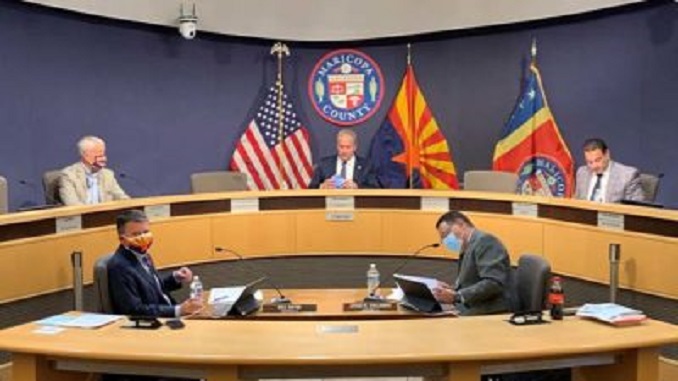
The Arizona House Government and Elections Committee approved State Representative Jake Hoffman’s (R-Queen Creek) bill to split Maricopa County into four separate counties. The four new counties would be Maricopa, encompassing central Phoenix, Tempe, and Tolleson; Mogollon, encompassing north Phoenix, Scottsdale, and Cave Creek; O’odham, encompassing Buckeye, Peoria, and Surprise; and Hohokam, encompassing Gilbert, Mesa, and Chandler. If signed into law, the current Maricopa County officials would continue jurisdictional operations until boards of supervisors could be established in those three counties. The committee approved the bill along party lines, meaning it barely passed with a 7-6 majority.
Hoffman stated during committee that this would be a fairer representation of current Maricopa County residents, and that any attempts to characterize this bill as a response to a dispute over the 2020 election results was a conspiracy theory. Arizona House Democrats insisted otherwise.
Rep. Jake Hoffman's big-government punishment for Maricopa County not going along with overturning the 2020 election for Trump is up in Gov. and Elex committee. #HB2787 would split Maricopa County 4 ways. Includes his personal gerrymander, so 1 big Dem county, three smaller GOP.
Gubernatorial candidate Steve Gaynor testified during committee that Maricopa County threatened to overtake Arizona the way that similarly-dominant counties in other states have, such as Los Angeles County, California.
“The two largest counties by population in the country, Los Angeles and Cook, are examples of what Maricopa will likely become if action is not taken,” Gaynor testified. “Their governments are wasteful and unresponsive to citizen needs, and they are unpleasant places to live.”
Today I told the Legislature to BREAK UP MARICOPA COUNTY.
We don't want a liberal, terribly-run megacounty like Los Angeles or Cook County here in AZ, so we need to act now on Rep. Jake Hoffman's HB 2787. #AZGovpic.twitter.com/Qje84R5CSB
— Steve Gaynor for Arizona Governor (@gaynorforgov) February 16, 2022
Los Angeles County has a population of over 10 million, while the second-largest county, San Diego County, has over 3.3 million. Similarly, Maricopa County is by far the largest county in Arizona at around 4.5 million residents. The next-largest county, Pima County, doesn’t come close in terms of population count: a little over 1 million. The federal government estimated Arizona’s total population last summer to be around 7.3 million citizens, meaning Maricopa County contains around 62 percent of the state’s population.
Considering the size of its constituency, Maricopa County has only five supervisors, and one of other county officials like sheriff, secretary, and recorder. By comparison, Greenlee County, the least-populous county at under 10,000 residents, has just two less supervisors and the same number of other county-wide officials.
President Joe Biden eked out a victory in Arizona thanks to Maricopa County, earning over 10,400 more votes in the state than former President Donald Trump. Biden won just over 50 percent of the vote in Maricopa County, or over 1.04 million votes, while Trump won over 48 percent of the vote, or 995,000.
Corinne Murdock is a reporter for AZ Free News. Follow her latest on Twitter, or email tips to corinne@azfreenews.com.
Individuals may receive $100 grocery gift cards if they get vaccinated fully through the city of Phoenix’s mobile COVID-19 vans. Those interested must register with either Vincere Cancer Center or Premier Lab Solutions, the two health care companies operating the vans. Vaccination will be free, as will be testing.
The city didn’t disclose how many gift cards they would give out in their initial announcement, only saying that the number of gift cards given would continue while supplies lasted. AZ Free News asked the city how many gift cards they were distributing. They didn’t respond by press time.
Phoenix’s move appears to fall in line with the suggestion from President Joe Biden this summer to offer $100 to incentivize vaccinations.
$100 grocery gift cards for adults who get fully vaccinated using our #PHX mobile #COVID19 vans. We are still offering no out-of-pocket testing, too!
Phoenix will have one to two vaccination vans eligible for the $100 gift card offer at various locations around the Valley. A list of vaccination dates, times, and locations is available on the city’s website.
Like many other cities across the country, Phoenix has relied on monetary incentives or rewards for compliance with encouraged or mandated vaccination. Last December, the city council voted to give its employees bonuses of up to $2,000 for getting vaccinated, costing the city anywhere from $25 to $29 million in federal relief funds.
Other governmental authorities have opted to offer financial incentives for vaccination as well. In December, the Tucson Unified School District (TUSD) Governing Board voted to give employees $500 for being vaccinated fully, with $100 for each booster shot. The board reported that these vaccination payments would total approximately $3 to $5.8 million of their federal Elementary and Secondary School Emergency Relief (ESSER) funds.
According to one of the latest special reports from the Arizona Auditor General, school districts and charter schools spent less than 25 percent of their federal relief monies by the end of June. The Arizona Department of Education (ADE) spent far less: they had 95.5 percent of federal relief funds left to spend by the end of June.
Corinne Murdock is a reporter for AZ Free News. Follow her latest on Twitter, or email tips to corinne@azfreenews.com.
The United States Hispanic Chamber of Commerce (USHCC) announced this week it will hold its 2022 national convention in Phoenix in October.
The USHCC promotes the economic growth, development and interests of more than 4.7 million Hispanic-owned businesses which employ 62 millions Americans while contributing over $800 billion annually to the American economy.
The 43rd annual national convention, described by USHCC as “the largest gathering of Latino business leaders,” serves as the meeting ground for thousands of community leaders and advocates; elected and appointed officials; a national network of more than 260 affiliated Hispanic Chambers of Commerce; members of the corporate, philanthropic, and academic communities; entrepreneurs; college students and more.
“The United States Hispanic Chamber of Commerce is excited to host our 2022 National Conference in Phoenix, a city fueled by the economic power, tenacity, and resilience of Hispanic-owned businesses,” said Ramiro A. Cavazos, USHCC President & CEO. “We are proud and honored to host our largest event of the year in one of the largest Latino communities in America.”
The three-day national convention will include more than 25 workshops, exciting keynote speakers, engagement from local, state, and federal government officials, informative plenary sessions, and inspiring remarks from leading business experts across several fields are at the center of a Conference experience that seeks to inform and empower our community and spotlight the integral role of Latinos politically, economically and socially.
The conference will also feature the participation of the nation’s leading elected officials and presidential appointees who will connect with an audience of more than 1,000 national stakeholders representing the fastest growing demographic in America—Latinos.
For Monica Villalobos, the CEO of Arizona Hispanic Chamber of Commerce, being selected the host chamber for the 2022 convention is an honor.
“It is an opportunity to not only showcase the success of small businesses in Arizona but also to bring valuable resources from around the country to our state,” Villalobos said. “This is a BIG win for us and the collaborative environment between community partners, other chambers plus business and corporate leaders will contribute to a very successful experience for all attendees.”
According to USHCC, the U.S. Latino community represents an annual economic impact of $2.7 trillion. And in Arizona, Hispanics in Phoenix comprised 42 percent of the population. In 2020.
Phoenix Police Department (PPD) leadership informed city council that they may have to stop responding to certain 911 calls due to their shortage of police officers. PPD Chief Jeri Williams shared with the Public Safety and Justice Subcommittee at the start of this month that they haven’t made such a policy official yet, but may have to in order to offset the workload created by 370 vacancies.
They had 27 recruits going through academy and 31 officers-in-training. PPD has 2,755 total officers. The fifth-largest city in the nation had over 1.6 million people according to the 2020 census — approximately 17 officers per 10,000 residents.
The proposal was based on a study from Arizona State University (ASU). The university identified eleven call types: intrusion alarms, assisting fire departments with unruly patients, drug overdoses, loose animals, public marijuana smoking, civil matter stand-bys, abandoned vehicles, found property, minor vehicle crashes without injuries, illegal parking, and noise complaints. Williams suggested that the last six call types could be mitigated by civilian members or assistants and not PPD, and that public marijuna smoking calls were nullified with the legalization of marijuana.
Williams suggested that eliminating police response to intrusion or false alarms, fire department assistance and/or check welfare calls, drug overdoses, and loose animals wouldn’t be good for public safety. PPD recorded 60,000 welfare calls and 552 drug overdose calls.
Civil matter stand-by calls have to do with incidents like exchanges of children, roommate relationships, and merchant or customer relations. Williams reported that PPD received about 14,000 of civil matter stand-by calls annually, 10,000 abandoned vehicle calls, 3,200 found property calls, 26,000 minor vehicle accidents without injury calls, 10,000 minor vehicle hit-and-run, 6,200 illegal parking calls, and 14,000 noise complaint calls.
Overall, Williams reported that PPD received 2 million calls in 2020 with 660,000 of those dispatched, and 1.8 million calls in 2021 with about 614,000 of those dispatched.
“This is just preliminary information that we’re going through. We didn’t want you all or members of the public to be surprised by the types of calls we’re looking at. We’ve made no decisions on these whatsoever, we’re really just trying to introduce the topic and idea,” explained Williams.
The second adjustment was PPD’s new “deferred patrol response” program where officers come into the station and work overtime by assisting with calls, taking reports, and handling paperwork.
The third adjustment was changes to PPD’s dispatch protocol concerned changes to dispatch protocols.
In all, Williams touched on six different improvement efforts: in addition to call type reduction, deferred patrol response, and dispatch protocol changes, PPD has undertaken programs implementing civilianization, body worn cameras for all officers, and specialty back to patrol. PPD also introduced efforts to increase officer retention and morale, such as raises.
Corinne Murdock is a reporter for AZ Free News. Follow her latest on Twitter, or email tips to corinne@azfreenews.com.
COVID-19 exhaustion is not a medical term, although what it represents can be as emotionally fatiguing as the virus can be physically draining. It describes the sense of frustration and weariness that comes from reacting 24/7 to a pandemic for the last 20 months.
AZ Free News looks at some of the events which occurred last week in federal courthouses, corporate offices, and the Arizona statehouse which illustrate the confusing regulations, legal rulings, and political posturing commonly found with COVID-19 exhaustion.
Private vs. Public Employees
On Dec. 15, Gov. Doug Ducey issued yet another executive order concerning COVID-19. Among the nine-page order are 19 words which seemingly ensure municipal, county, and state officials cannot impose any COVID-19 vaccination on citizens, businesses, or public employees:
“No person shall be required by this state, or any city, town or county to obtain a COVID-19 vaccine…”
Yet just two days later, Tucson Mayor Regina Romero issued a dismissive response to Ducey’s order as she doubled down on enforcing a city ordinance passed in November that allows for termination of any city employee who did not provide prove of vaccination or had not gone through an exemption process.
Meanwhile, the illnesses and deaths of several public safety workers across Arizona who contracted COVID-19 are being classified as work-related, which allows for various financial benefits for the employee or family. At the same time, a growing number of private companies have discontinued assistance for unvaccinated frontline employees who contact COVID-19.
The latest employer to do so is Kroger Co., which owns 2,700 supermarkets and multi-department stores across the country under several names. In Arizona, Kroger operates the Fry’s Food Stores.
According to Kroger’s announcement, any of the company’s 465,000 employees who are not vaccinated will no longer be eligible for two weeks of paid emergency leave if they fall ill. In addition, a $50 monthly health insurance surcharge will soon be imposed onunvaccinated nonunion employees.
A similar COVID-19 health plan surcharge was implemented by Pima County against several hundred of its employees who have not been vaccinated. The county’s action, which is expected to cost employees $100 a month, is the subject of a federal lawsuit filed last week by the Arizona Conference of Police and Sheriffs (AZCOPS).
Another problem that has developed as a result of various vaccination mandates is the uneven -and potentially discriminatory- decisions by companies and government entities in response to applications for religious and medical exemptions. There are also concerns over employee privacy.
The City of Phoenix issued its own COVID-19 vaccination mandate back in November, citing the city’s status as a federal contractor. The city’s 14,000 or so employees were given a Jan. 18 deadline, along with the option of applying for a medical or religious exemption.
Many employees balked at the exemption process after learning they would have to reveal deeply personal medical and religious information to fellow city employees with the Human Resources, Equal Opportunity, and Law departments.
The Phoenix mandate is on hold while the federal court address challenges to the Biden Administration’s federal contractor vaccination mandate. If reactivated, the city’s mandate allows for termination.
Federal Court Decisions
While a legal challenge or two have been threatened against Ducey’s latest executive order, Arizonans who work for the federal government have not had success challenging President Joe Biden’s executive order that requires federal employees to get the shot.
But for workers of private companies with 100 or more employees, for those who work for a federal contractor, or whose employer receives Medicare & Medicaid funds, things get a whole lot murkier.
A federal appeals court recently put on hold the Centers for Medicare & Medicaid Services rules which require staff at any facility which participates in the Medicare and Medicaid programs to get the COVID-19 vaccination, regardless of whether that staff member has patient contact.
But even if that rule never goes into effect, healthcare workers in Arizona may not have recourse to challenge any employer mandated vaccination policy, thanks to Ducey’s Dec. 15 executive order. The governor specifically allows “a health care institution licensed pursuant to A.R.S. Title 36, Chapter 4” to require its employees to be vaccinated, although a medical and religious exemption must be offered.
There is also a Biden executive order which requires federal contractors and subcontractors to implement a mandatory employee vaccination policy. A federal court order put that mandate on hold earlier this month, but the U.S. Department of Justice continues to argue the President has authority to impose such a requirement on America’s private businesses.
The Biden Administration mandate with the biggest reach is one issued by OSHA that affects more than 80 million workers. An emergency OSHA rule requires companies with 100 or more employees to implement COVID-19 vaccination protocols or face financial penalties. The OSHA rule also requires unvaccinated workers to undergo frequent testing, and only provides for a medical exemption.
A federal court had put the OSHA rule on hold due to legal challenges from multiple states and employers. However, last Friday a federal appellate court allowed the mandate to go into effect pending any possible action by the U.S. Supreme Court which was asked on Saturday by several parties to get involved sooner than later.
It did not take long for OSHA to react to last week’s lifting of the hold. The agency issued a statement Saturday warning those companies with more than 100 employees to comply by Jan. 10 or face citations and penalties.
The Trauma Surgeon
Mental COVID-19 exhaustion can also be caused by the frustration brought on by inane vaccination mandate protocols. A glaring head-scratcher of such a mandate comes from Phoenix-based Banner Health, Arizona’s largest private employer.
Until recently, Dr. Devin L. Gray held medical privileges at several Banner hospitals, just as he does at many other Maricopa County hospitals. But Gray, a surgeon with 30 years of experience, is no longer allowed to use his specialty skills as a life-saving trauma surgeon at Banner’s facilities.
The reason? A Banner Health administrator did not find Gray’s request for a religious exemption to the company’s vaccination mandate to be sincere. The other hospitals -Arizona General Hospitals, Chandler Regional Medical Center, Mercy Gilbert Medical Center, and Mountain View Medical Center- did.
Gray has asked the Arizona Attorney General’s Office to look into the exemption inconsistencies, as well as the amount of deeply personal information some companies are demanding from employees who apply for a medical or religious exemption.
In the meantime, Gray has been told by a Banner Health executive that he can be treated as a patient at their facilities. He is also free to visit patients at a Banner facility. But he can’t treat those patients’ medical emergencies.