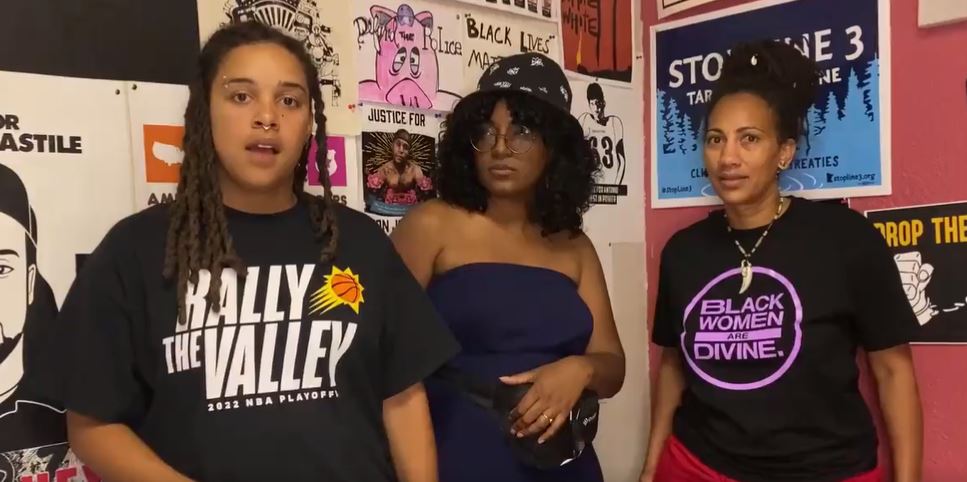
The valley’s first annual Juneteenth celebration from Black Lives Matter (BLM) Phoenix Metro, a fundraiser, ended before it started due to a low level of community interest.
“Hey BLM family! Deepest regrets but our Juneteenth event is postponed. We’ll keep you all updated on the new date. Juneteenth is a very important holiday that should be taken seriously and celebrated,” wrote the organization. “We unfortunately did not have the capacity or momentum behind this event to put it on this year. We were hoping for this to be an awesome event. Stay tuned for our next big celebration.”
Hey BLM family! Deepest regrets but our Juneteenth event is postponed we’ll keep you all updated on the new date. Juneteenth is a very important holiday that should be taken seriously and celebrated. We unfortunately did not have the capacity or momentum behind this event to put- pic.twitter.com/jYC1lEV1Pj
— Black Lives Matter Phoenix Metro (@blmphxmetro) June 15, 2022
Those wishing to attend were asked to pay a minimum of $50 for general admission, which came with a swag bag, limited edition BLM shirt, and one green raffle ticket which could win designer sunglasses or other luxury items with a $500 to $1,000 value.
There were other, higher-priced tickets: $100 for a “supporter”-level ticket, which came with the general admission items plus an additional green raffle ticket, and a “trailblazer”-level ticket, which came with the general admission items plus an additional red raffle ticket for winning luxury items over $1,000 in value. A limited, undisclosed number of “solidarity” tickets for low-income and BIPOC-only individuals (Black, Indigenous, People of Color) were available for $25.
The organization, which has over 10,000 followers on Twitter and over 33,400 followers on Instagram, first announced the event in early May.
Juneteenth is coming and we’d like to invite you to our upcoming Juneteenth Concert Fundraiser! Mark your calendars now for June 21st, 2022. The event will be from 6 pm to 10 pm and will include performances from artists as well as local vendors! Stay tuned for more details! pic.twitter.com/AeRNBsMnT2
— Black Lives Matter Phoenix Metro (@blmphxmetro) May 9, 2022
BLM Phoenix Metro explains that part of its mission is dismantling white supremacy, abolishing police and prisons, and prompting community healing from generational trauma. As part of their “Who We Are” page, the organization quotes Assata Shaukur, the infamous cop killer and FBI Most Wanted Terrorist.
Some of the organization’s most recent work included protesting outside Phoenix City Hall against increased funds for the police force.
Corinne Murdock is a reporter for AZ Free News. Follow her latest on Twitter, or email tips to corinne@azfreenews.com.
President Joe Biden’s skyrocketing, 40-year-high inflation levels have resonated with a historic worst for Arizona. Arizona households are spending an average of nearly $6,000 more on household necessities since the 2020 election.
According to the most recent report from the Common Sense Institute, a Phoenix-based research nonprofit, Phoenix inflation prices rose over eight percent in one year. The metropolitan area reached 11 percent price inflation, nearly three points higher than the nation’s average.
The institute noted that the current rate of increasing inflation would cause the cost of living in Phoenix to be higher than San Francisco’s cost of living by 2034.
Additionally, the cost of rent and housing grew by nearly 15 percent over the last year. The pandemic marked a record-high for the number of those moving to Arizona.
Yet, Biden declared that the last year marked positive changes lending to a “historically strong” economic foundation that would result in a decline in inflation.
We’ve laid an economic foundation that is historically strong.
Now we are moving forward to a new moment where we can build a future of stable, steady growth. So we can bring down inflation without sacrificing all of the historic gains we’ve made.
Governor Doug Ducey blasted Biden’s handling of inflation as a “disaster,” noting that Arizona families were paying an average of over $500 a month more in household costs.
President Biden’s inflation disaster is costing AZ families $500+ more per month in added household costs. Curbing the damage of Biden’s policies is a top priority. Cutting taxes is an answer. We’ve done so by adopting the lowest flat tax in the nation. https://t.co/Pq3AQfkahw
In a Wall Street Journal opinion piece succeeding Memorial Day, Biden blamed inflation on Russia President Vladimir Putin. Biden said that Putin’s warring impacted the energy market and supply chain. The president alluded to heavier intervention in the Russia-Ukraine war, with more aggression toward Russia, to uplift the flagging economy.
“We can’t let up on our global effort to punish Mr. Putin for what he’s done, and we must mitigate these effects for American consumers,” said Biden.
The president explained that the federal government would build a million more affordable housing units, and proposed using Medicare to negotiate with pharmaceutical companies. He also proposed recouping lost tax revenue from companies established overseas who benefit from international tax policies, and claimed that billionaires pay lower tax rates than working-class individuals like teachers or firefighters.
Biden also claimed that the job market was the strongest since World War II, though he didn’t distinguish between new jobs and those restored after the pandemic layoffs.
The most important thing we can do now to transition from rapid recovery to stable, steady growth is to bring inflation down. That is why I have made tackling inflation my top economic priority. My plan has three parts — read more about them here: https://t.co/5IUu0qbCaa
The president relied on the “kitchen table” illustration again to empathize with Americans’ struggles. (For context: there are over 40 speeches from Biden on the White House’s website in which he’s used the “kitchen table” illustration; it is unclear whether his speech writer has a penchant for kitchen tables or whether the term is meant to serve as a touchstone concept, but former first lady Hillary Clinton is credited for popularizing the term within the Democratic Party in the 1990s).
Secretary of State and gubernatorial candidate Katie Hobbs has picked up on the “kitchen table” illustration, though she hasn’t denounced the Biden administration’s handling of inflation.
From groceries to gas prices to child care to inflation, these are just a few of the kitchen table issues I hear about from Arizonans.
As Governor, I will tackle these—and more—to ensure our state is the best place to live, work, and raise a family.
Instead, Hobbs blamed Ducey and the Republican-controlled state legislature for not doing more to curb inflation. She insisted that her plan — Affordable Arizona — would mitigate inflation.
Once again, I’m calling on Gov. Ducey & our Legislature to put partisan politics aside, alleviate the burden of inflation & put money back in pockets by passing my Affordable Arizona plan.
Biden has denounced one specific plan from across the aisle by Senator Rick Scott (R-FL): a “12 Point Plan to Rescue America.”
Earlier this month, the president reiterated that the plan to bring down inflation consisted of taking a hands-off approach with the Federal Reserve. He then listed two end goals — lowering the cost of living and reducing the deficit — as part of the plan, without elaborating further.
My plan to tackle inflation is simple:
– Let the Fed do its job – Lower everyday costs for Americans – Keep reducing the deficit
By taking these steps — and with Congress taking action — we can build a sustained recovery that benefits all Americans.
On Sunday afternoon, the city of Phoenix rolled out its draft roadmap to ready the city for widespread electric vehicle use. The city projected that there would be up to 280,000 electric vehicles in the area by 2030, and noted that total adoption of electric vehicles would align with their climate action plan. In order to accommodate that quantity of electric vehicles, the roadmap cited U.S. Department of Energy projections that the city would require around 3,500 charging ports.
The city presented a five-step plan. First, prioritize equity by maximizing restorative investments in underserved communities, achieving transformational change with bottom-up decision-making, and helping institutionalize equity and justice from the inside. Second, educate and outreach by engaging in qualitative and quantitative information gathering, designing and launching an education and awareness campaign, and monitoring and tracking consumer attitudes and behaviors. Third, leading by example by growing the city’s electric vehicle fleets and installing electric vehicle charging for the city fleet and employees. Fourth, growing public charging by identifying locations for electric vehicle charging networks and installing base amounts of electric vehicle charging annually. Fifth, standardizing electric vehicle charging access by streamlining permits and updating the zoning ordinance and building codes by 2025.
One of the core principles for forming the roadmap was equity — affordability and accessibility for the underserved and disadvantaged communities. One of their first proposed actions for achieving equity was to either hire or assign a current staff member to focus on equity throughout the electric vehicle rollout. Then, the city would adopt an “Environmental Justice” screening tool.
The plan projected that the cost of electric vehicles would reduce at some point in the future.
The City's Electric Vehicle Roadmap is out, and we want to hear what you think!
— City of Phoenix, AZ (@CityofPhoenixAZ) May 15, 2022
The city also asked Arizonans to take a survey on electric vehicles. The survey asked individuals about their knowledge, attitude towards, and current use of electric vehicles. It also asked individuals whether they supported new homes and buildings to be required to have electric vehicle charging stations.
The roadmap is the latest effort of the Ad Hoc Committee on Electric Vehicles, formed by Phoenix Mayor Kate Gallego last June.
The infrastructure bill gives Phoenix/Arizona a mighty push forward, and matches my priorities for Phoenix: EVs/climate, transit, roads, and JOBS! Congrats @POTUS and deep gratitude to AZ Congressional delegation that backed this important work. #BuildBackBetter. pic.twitter.com/EjyzrzZ4bg
Members of the committee are Councilwoman Yassamin Ansari; Autumn Johnson, Tierra Strategy Public Interest Policy Advocate; Caryn Potter, Southwest Energy Efficiency Project Utility Program Manager; Catherine O’Brien, Salt River Project Electric Vehicle Lead; Clark Miller, Arizona State University (ASU) professor; Court Rich, Rose Law Group Renewable Energy and Regulatory Law Department; Delbert Hawk, International Brotherhood of Electrical Workers Local Union 640 President; Jason Smith, Arizona Public Service (APS) Energy Innovation Program Consultant; Katherine Stainken, Electrification Coalition (EC) Senior Director of Electric Vehicle Policy; Kathy Knoop, General Motors Vehicle Grid Integration Solutions Manager; Lisa Perez, Public Affairs Consultant; Omar Gonzales, Nikola Corporation State and Local Government Affairs Manager; Tim Sprague, Habitat Metro Owner; and Vianey Olivarria, CHISPA Arizona State Co-Director.
Corinne Murdock is a reporter for AZ Free News. Follow her latest on Twitter, or email tips to corinne@azfreenews.com.
Earlier this week, Sam Stone accused City of Phoenix officials of letting the vagrancy and homeless problem get out of control. And the former chief of staff for Councilman Sal DiCiccio suggested a drastic change is needed in how the community addresses the issue.
During an interview Monday with KFYI’s James T. Harris, Stone said Phoenix is “headed down the same path” as Seattle, Portland, and large cities in California, in part because officials here are following the same failed policies. “And when you do the same thing you’re going to get the same results,” he said.
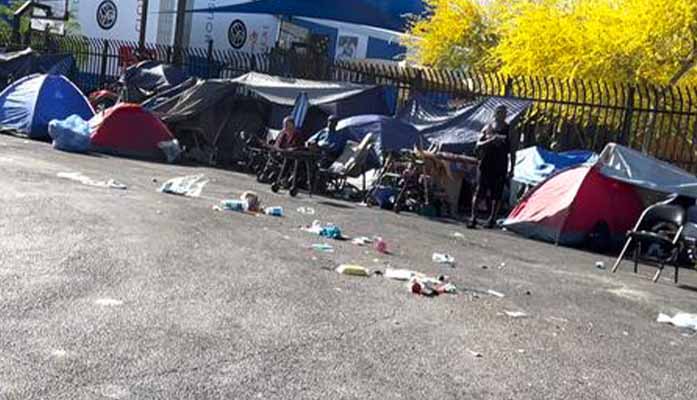
The topic of homelessness came up after Harris recently took an informal tour of a massive downtown homeless camp. He later posted a video of what he witnessed along a several block area of downtown.
Harris told listeners Monday he was shocked by what he saw, and that it appears the homeless crisis will get worse without some major change.
“Unless you’ve been to downtown Phoenix lately you might not be aware of the growing homeless population in the Valley,” Harris said during his show. “There are so many of them…so many people – if you wanted to help them where would you put them?” he asked Stone.
The issue of homelessness is complex, Stone told Harris, and there are many unseen homeless people who are “sofa surfing” with friends and family or who live in their vehicle. Many of those are utilizing social services and other support networks to address their situation.
But Stone’s comments during the interview focused on a large percentage of Phoenix’s homeless population made up of citizens who cannot -or will not- take advantage of social services due to mental health issues or an addiction. As a result, they live on the streets, sometimes in makeshift homeless camps on large vacant lots but often on public parks and sideways, even residential alleys and private property.
The city, according to Stone, is failing to do anything about the problem of chronic street homelessness.
“What we’re doing – the same approach that has been done across the country – is enabling chronic street homelessness instead of treating it,” Stone said to Harris. “We’re making it easier and easier to live on the streets.”
Part of the problem, Stone said, is that an entrenched industry has built up around street homelessness, resulting in advocate who no longer push services as the number one priority. To change how chronic street homelessness is addressed would require an investment by the city, Stone acknowledged, including a temporary large facility -perhaps a tent city- and many more shelters than are available now.
“You’ve got to make it services first, you’ve got to push people, you’ve got to do some tough love,” Stone said. “People don’t want to talk about this but you’ve got to make it harder to live on the street than it is to go to treatment, period.”
Stone also contends liberals don’t see chronic homelessness as a problem and that advocates consider forcing homeless persons into a decision of whether “they want to pack up and move on” or get into treatment to be a negative.
“And it’s true, that’s a tough thing to say, but all of these policies they have from coast to coast are the same,” he explained. “Where we’ve seen success with this is in other countries where they say pure and simple ‘no you can’t live here on the street’ – we have a place for you and we’re going to give you treatment when you’re there.”
Stone added that the person is not given an option about the treatment “because someone who is drug addicted or has a mental health issue is not in a frame of mind to be able to make good decisions for themselves, period. So you make the decision for them.”
As to concerns about the rights of homeless persons suffering with addiction or mental health issues, Stone noted in many instances those same people would be declared by a court as incompetent to handle major financial decisions. In such situations, a judge would appoint a guardian ad litem to protect the person’s best interests.
But when it comes to leaving those same people to fend for themselves on the streets, Stone said homeless advocates often argue, ‘oh they’re qualified and mentally competent to say that they should remain on the street’ and not get treatment.
“It is absolutely wrong to me, it is immoral and inhumane, and it is total misplaced compassion from the Left,” he added.
A Phoenix-area Antifa member, Arizona State University (ASU) graduate, and certified nursing assistant (CNA), Marysa Leyva, made death threats against prominent investigative journalist Andy Ngo, who rehashed details about Leyva’s Antifa involvement and criminal history.
Leyva’s comments were associated with claims that Ngo was behind the shooting that took place at an Antifa meeting in Portland, Oregon earlier this month. Ngo reported that Leyva resides in the Portland area, consistent with the location listed in one of her Twitter account bios.
Disinfo #antifa accounts are spreading false claims about the shooting in Portland. They falsely claim I posted a flyer about their event & that I was involved in the shooting.
Marysa Leyva says it is time for me to die. Felony suspect Alissa Azar says I have blood on my hands. pic.twitter.com/6RrBm1iZ5G
Marysa Leyva, a Phoenix-area militant #antifa member & a traveling nurse who is now in Portland, is calling for me to be killed. She used to run @antifash_m but was so extreme that she was permanently suspended. Now she's evading that ban with a new account calling for violence. pic.twitter.com/s4KAXP9Y18
As Ngo reported, Leyva’s original account, @antifash_m, was suspended for violating Twitter rules. Leyva then made her backup account, @BirdAppFugitive, private after Ngo discovered it; sometime that same week, that secondary account was also suspended. Leyva’s bio describes the account as a slander account for Maricopa County Attorney Allister Adel, who is under investigation by the Maricopa County Board of Supervisors and the State Bar of Arizona for her sobriety and absence at work.
Leyva was one of 15 individuals who received controversial and later dropped street gang charges for her involvement in the August 2020 Black Lives Matter (BLM) protest, which included assisting a criminal street gang, aggravated assault on an officer, rioting, unlawful assembly, resisting arrest, and obstructing a public thoroughfare. As AZ Free News reported, ASU graduate student Sarra Tekola was among those charged. Leyva toldABC15 Arizona that although the felony charges against her were dropped, the ordeal caused her to lose her patient care technician job with Tempe St. Luke’s emergency room.
“We were like, this is just so outrageous,” said Leyva. “How are they ever going to prove this in a court of law? We know Phoenix Police Department is bad, but man, they, like, really were just seeing how much they could get away with.”
Leyva also tweeted that the survival of the five officers who were ambushed by a shooter earlier this month while trying to rescue an infant was a “missed opportunity.”
According to the Arizona State Board of Nursing, Leyva’s nursing license was issued December of last year, and won’t expire until March 2024.
Corinne Murdock is a reporter for AZ Free News. Follow her latest on Twitter, or email tips to corinne@azfreenews.com.