by Matthew Holloway | Jan 22, 2026 | News
By Matthew Holloway |
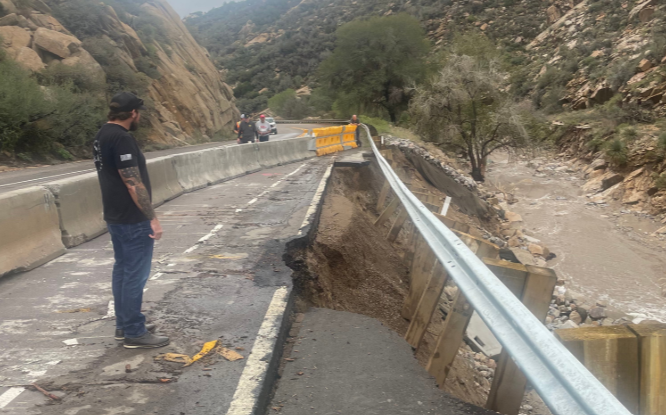
In the aftermath of historic flooding across Gila County in September 2025, Arizona communities are still wrestling with the long road toward recovery, and the federal government’s initial refusal to provide disaster relief has only added to the frustration.
On Thursday, U.S. Rep. Eli Crane (R-AZ02) took action, sending a letter to President Donald Trump and FEMA Region IX Administrator Robert Fenton uring them to intervene in Arizona’s appeal of FEMA’s denial of a Major Disaster Declaration. He was joined by Reps. Andy Biggs (R-AZ05), Juan Ciscomani (R-AZ06), and David Schweikert (R-AZ01).
The disaster declaration, would unlock vital federal funds and resources under the Robert T. Stafford Disaster Relief and Emergency Assistance Act to help communities like Globe, Miami, and other rural areas rebuild infrastructure, support residents, and mitigate future flood risks.
The appeal follows FEMA’s December 20, 2025, denial, a decision that came despite the state and local officials’ reassessment estimating damages well above $100 million.
“The new figures reflect substantial and unanticipated financial burdens placed on local jurisdictions, which were required to undertake immediate emergency protective measures, restore essential services, and address damage to roads, utilities, and public facilities,” Crane wrote in the letter.
He added, “When viewed in the aggregate, these impacts demonstrate a level of strain that exceeds the reasonable capacity of affected communities to manage without federal support.” Crane has engaged directly with FEMA officials in Washington, D.C., and invited them to visit Gila County to see conditions firsthand.
“With this more accurate assessment,” Crane said, “FEMA will now have a better sense of the damage to these storied communities. While many democrat elected officials were quick to point fingers and score cheap points, we worked behind the scenes to strengthen our efforts and believe the State of Arizona’s updated figures present a far stronger case for federal assistance. We applaud President Trump’s ongoing commitment to Arizona and look forward to continuing our work with his team at FEMA as they consider this appeal, which would deliver much-needed assistance to residents in rural Arizona.”
The original denial has drawn bipartisan criticism, including from Democrat Gov. Katie Hobbs, who argued the decision left families and local governments to shoulder rebuilding without critical federal support.
As federal officials weigh the appeal, residents and local leaders in Gila County continue working to recover from floods that overwhelmed watersheds, washed out infrastructure, and left lasting damage to homes and businesses.
Matthew Holloway is a senior reporter for AZ Free News. Follow him on X for his latest stories, or email tips to Matthew@azfreenews.com.
by Matthew Holloway | Jan 20, 2026 | News
By Matthew Holloway |
U.S. Representative Eli Crane (R-AZ-02) has introduced H.R. 6931, the Yavapai-Apache Nation Water Rights Settlement Act. The bill would ratify and authorize the Yavapai-Apache Nation Water Rights Settlement Agreement reached in 2024 between the Tribal Nation, the State of Arizona, the Salt River Project, the U.S. Department of the Interior, and local stakeholders.
The agreement, approved by the Yavapai-Apache Nation Tribal Council on June 26, 2024, resolves water rights claims that have been pending in Arizona courts for over four decades.
A central component of the settlement is the Cragin-Verde Pipeline, a roughly 60-mile-long pipeline that will deliver surface water from the C.C. Cragin Reservoir on the Mogollon Rim to the Verde Valley. The pipeline will provide reliable drinking water to the Nation, reduce groundwater pumping, support housing and economic development on the reservation, and contribute to the sustained health of the Verde River, as explained by the ASU Arizona Water Innovation Initiative.
H.R. 6931 would codify the Nation’s water rights, authorize federal funding for construction of the Cragin-Verde Pipeline and the Yavapai-Apache Drinking Water System, and establish dedicated trust funds for water, wastewater, watershed restoration, operations, and maintenance.
Under the legislation, the U.S. Department of the Interior would oversee planning, design, and construction of the Cragin-Verde Pipeline as part of the Salt River Federal Reclamation Project. The bill also authorizes the Nation’s use of Central Arizona Project (CAP) water, establishes a permanent CAP delivery contract, and allows the Nation to store, lease, or exchange CAP water within Arizona.
The settlement would provide water reliability for the Nation’s more than 2,500 enrolled members across five tribal communities and enhance long-term water security throughout the Verde Valley, according to a press release from Crane’s office.
Yavapai-Apache Nation Chairman Buddy Rocha Jr. stated, “The passage of the Yavapai-Apache Nation Water Rights Settlement Act will finally resolve our water rights claims that have been pending in Arizona’s courts for over four decades, providing water certainty for the Nation and our neighbors throughout the watershed. On behalf of the Yavapai-Apache Nation, I want to thank Congressman Crane for his commitment to the Settlement and to his constituents here in the Verde Valley. We are also truly grateful to Congressman Crane for his recent visit to the Nation, where he, and Assistant Secretary of Indian Affairs Kirkland, saw first-hand how the Settlement will help support critically needed housing and economic development on our Reservation for years to come.”
Rep. Crane said in the press release, “I’m honored to introduce this legislation to help secure long-term water security for the Yavapai-Apache Nation, develop critical infrastructure, and finally move toward a permanent solution. After visiting and meeting with tribal leaders and surrounding communities, it was clear how much certainty and stability this bill would provide. I’m proud to fight for rural Arizona.”
Matthew Holloway is a senior reporter for AZ Free News. Follow him on X for his latest stories, or email tips to Matthew@azfreenews.com.
by Staff Reporter | Jan 16, 2026 | News
By Staff Reporter |
The divide among Republicans in Congress became apparent on Wednesday during key budget votes.
Two key Republican-led amendments to the appropriations bill failed for lack of lockstep party voting: one to end funding to the National Endowment for Democracy (NED), the other to slash funding to the D.C. District and Appeals court and its chief judge.
Rep. Eli Crane (R-AZ02) introduced the failed amendment to defund NED, alleging the nonprofit has acted in hostility to U.S. interests for years.
NED issues thousands of grants annually to foreign nongovernmental groups. For the 2025 fiscal year, NED received $315 million in new appropriations and had spending power of $316 million from a balance carried over. The Trump administration failed to defund NED earlier this year.
“We’ve learned that this organization has engaged in global censorship, domestic propaganda, and regime-change politics. It has worked to crush populist movements, fuel color revolutions, and run off-the-books operations with plausible deniability,” said Crane.
Rep. Andy Biggs (R-AZ05) accused NED of Democratic “ideological capture” undermining elected leadership, citing the 2022 incident in which NED demanded the removal of Rep. Elise Stefanik from their board for defending President Donald Trump following the 2020 election.
“If this was such a doggone great program, then why has it been unauthorized by this body for more than 20 years?” asked Biggs. “The reason is, it’s lost its moorings, it’s wandering around, it hasn’t complied with transparency requirements, it more closely resembles covert political operations designed to entangle the United States in foreign disputes and undermine diplomatic efforts than support them.”
Republican representatives on behalf of Missouri, Florida, and Pennsylvania also spoke in favor of Crane’s amendment to defund NED.
Crane challenged the Republicanism of his fellow Republicans who voted to continue NED funding.
“81 ‘Republicans’ voted with Democrats to fund this rogue organization that fuels global censorship and domestic propaganda,” said Crane.
He pledged to “keep fighting” to end funding to NED.
“The swamp is real,” said Crane. “But we did pass the Shower Act this week. I could use one after spending so much time in this awful place.”
Rep. Juan Ciscomani (R-AZ06) was the sole Arizona Republican to join Arizona’s Democratic representatives and the majority of the House in voting down Crane’s amendment.
The Republican-led effort to end funding to the D.C. court and its chief judge, James Boasberg, were the latest attempt to exact punishment over rulings that have undermined Trump administration policies. Texas Rep. Chip Roy led on that amendment.
Crane called his fellow representatives “weak” for voting to continue funds for Boasberg.
The amendment would have slashed the court’s funding by 20 percent and struck the salary and expense funding for Boasberg and his staff.
Last week, the Senate Subcommittee on Federal Courts, Oversight, Agency Action & Federal Rights convened a hearing on accountability for “rogue judges” through impeachment. Boasberg and another judge with the Maryland District Court, Deborah Boardman were named.
Last summer, the Department of Justice (DOJ) filed a misconduct complaint against Boasberg which accused him of “undermin[ing] the integrity and impartiality of the judiciary” by attempting to influence Supreme Court Chief Justice John Roberts and about two dozen other federal judges against President Donald Trump.
Ciscomani did join his fellow Arizona Republicans in supporting Roy’s amendment.
AZ Free News is your #1 source for Arizona news and politics. You can send us news tips using this link.
by Matthew Holloway | Jan 15, 2026 | News
By Matthew Holloway |
Rep. Eli Crane (R-AZ-02) introduced legislation Jan. 7 to award citizen journalist Nick Shirley the Congressional Gold Medal for his reporting on fraud and misuse of public funds in Minnesota.
Crane’s office said the bill would recognize Shirley’s work documenting alleged waste, fraud, and abuse involving more than $110 million in federal and state funds in Minnesota’s Somali community, in a statement released Wednesday.
In a December 26 video cited by Crane’s announcement, Shirley detailed his investigation into social services programs in Minnesota. Following the release of the report, the Trump administration halted federal funding to businesses accused of fraud, and Minnesota Gov. Tim Walz (D) ended his reelection campaign.
In a statement accompanying the bill’s introduction, Crane wrote that Shirley’s reporting “shed light on this historic scandal” and “resulted in seismic shifts to our political landscape virtually overnight.” Crane added that Shirley “stood up to a corrupt system and exposed waste, fraud, and abuse being perpetrated against the American people.”
He described Shirley as “a fearless citizen journalist,” and called his work “a testament to the power of the average American over the legacy media, and a vindication of the mission that DOGE has sought to implement.”
The Congressional Gold Medal is the highest civilian honor awarded by Congress. Recipients have historically included figures recognized for distinguished achievements and contributions to the United States.
Shirley, who is widely known as a YouTuber and content creator, responded to Crane’s announcement on X, writing that the potential award “would be cool, thank you!”
Congress has honored journalists in many ways over the last century through resolutions, Congressional Record tributes, and naming/designation actions. However, there is no official, comprehensive count of journalists honored because congressional recognition isn’t cataloged by profession, unlike the Presidential Medal of Freedom. If so honored, Shirley would join the ranks of the late Bryan Johnson, sports journalist Grant Wahl, and renowned broadcaster Edward R. Murrow.
Crane’s bill is now pending in the House. No additional legislative action, committee referral, or cosponsor information was included in the office summary.
Matthew Holloway is a senior reporter for AZ Free News. Follow him on X for his latest stories, or email tips to Matthew@azfreenews.com.
by Ethan Faverino | Jan 4, 2026 | News
By Ethan Faverino |
U.S. Representatives Paul Gosar (R-AZ-09) and Eli Crane (R-AZ-02) have reintroduced H.R. 6374, landmark legislation that would impose a complete 10-year moratorium on all immigration into the United States.
The bill, titled simply as a measure “to prohibit the admission of aliens to the United States for 10 years, and for other purposes,” would halt all new admissions of foreign nationals beginning on the date of enactment and continuing for a full decade.
In a joint announcement, the Arizona lawmakers cited the ongoing border crisis, overwhelming immigration systems, national-security vulnerabilities, and recent deadly incidents involving individuals who entered the country under prior policies as urgent reasons for the drastic pause.
Rep. Gosar issued the following statement:
“[The] tragic shooting of two National Guard members in Washington, D.C., within a few feet of the White House on Thanksgiving eve by Afghan national Rahmanullah Lakanwal is a sad reminder of Joe Biden’s reckless and unchecked open-border policies. Our immigration system is overwhelmed and unmanageable, thanks in large part to the previous administration’s open border policies, poorly vetted asylum claims, and visa overstays. We cannot maintain a lawful immigration process when we cannot control our borders or account for who is entering our country.
Fraudulent asylum claims, illicit trafficking, and insufficient vetting present real threats to our national security, our economy, and our citizens. Adversaries are exploiting these failures. Americans are being murdered. Meanwhile, schools, hospitals, law enforcement, and local governments—especially in border states like Arizona—are stretched to their limits.
Immigration must be legal, orderly, and in the national interest. Every nation has the right and responsibility to secure its borders and protect its people. I’m proud to join my friend and colleague Representative Eli Crane in reintroducing this legislation, which imposes a 10-year moratorium on all immigration until our system is restored, our borders are secured, and future immigration can occur safely and in a way that strengthens our country.”
Rep. Crane added:
“One of our most important responsibilities as representatives is to protect the citizens of our great nation. Due to the premeditated border invasion under the Biden administration, Americans have faced devastating consequences. I’m proud to join Rep. Paul Gosar in introducing this sensible legislation to restore stability and help reestablish security within our borders.”
The legislation is straightforward: for ten years following enactment, no alien may be admitted to the United States under any category or program. Supporters argue the pause is necessary to allow Congress and federal agencies to fix vetting procedures, close legal loopholes, deport criminal aliens, and restore operational control of the southern and northern borders.
Ethan Faverino is a reporter for AZ Free News. You can send him news tips using this link.