by AZ Free Enterprise Club | Oct 17, 2022 | Opinion
By the Arizona Free Enterprise Club |
In just a few short months, Arizona will officially have the lowest flat income tax rate in the country. Governor Ducey announced last week that the Department of Revenue will be implementing the final stage of individual income tax rate and bracket reductions to a single 2.5% flat rate in 2023, a year sooner than originally planned. This is great news for Arizona taxpayers and job creators as well as the overall economic outlook of the state for years to come.
Given what is coming out of Washington, D.C. these days, this news couldn’t have come at a better time…
>>> CONTINUE READING >>>
by Corinne Murdock | Oct 12, 2022 | News
By Corinne Murdock |
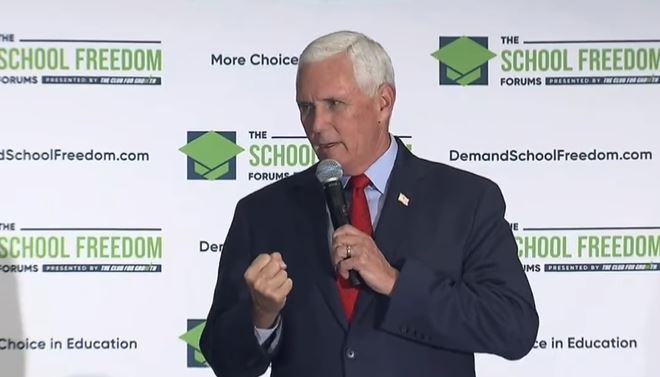
On Tuesday, former Vice President Mike Pence came to Phoenix to celebrate Arizona’s universal school choice.
Pence attended a forum hosted by the Club for Growth, a conservative nonprofit based out of Washington, D.C. The forum was the third in their “National Campaign for School Freedom” series. Pence praised Ducey for making universal school choice possible. He predicted that universal school choice would be the standard for all states.
“I don’t think you can overstate or over-commend the leadership of Governor Doug Ducey in creating universal school choice in America for the first time,” said Pence.
Ducey also spoke at the event, explaining that the experiences of parents and students throughout the pandemic accelerated the growth in support for school choice. Ducey stated that it took 8 years to achieve universal school choice. He thanked activists who pushed for school choice expansion, including the Black Mothers Forum and Love Your School founder Jenny Clark.
Ducey compared the refusal of school choice opponents’ refusal to empower families with educational freedom to the refusal of the anti-segregationists in the 1950s.
“50 years ago, politicians stood in the schoolhouse door, and wouldn’t let minorities in. Today, union-backed politicians stand in the schoolhouse door and won’t let minorities out,” said Ducey. “These children are trapped in failing schools.”
That explanation by Ducey was backed by data presented by Chris Wilson, CEO of an Oklahoma-based market research agency called WPA Intelligence. Wilson explained that a poll of over 4,000 voters from last July to last August determined that COVID-19 shutdowns changed attitudes on public schools and teachers’ unions.
Wilson explained further that voters had a negative perspective of the phrase “school choice” on its own, but adopted a positive view once a definition of the phrase was provided. He explained that those activists and unions opposed to school choice successfully branded the word “choice” as a negative. Wilson suggested that politicians adjust their presentation and terminology concerning school choice, though cautioned that there was no single “silver bullet” for phrasing.
Wilson pointed out that terms like “school freedom,” “school choice scholarships,” and “education freedom” had positive feedback, whereas “parental choice” and “school choice” had negative feedback.
Wilson added that advancing school choice requires identifying the right opponents and avoiding rhetoric around the wrong ones.
READ THE FULL SCHOOL CHOICE POLLING REPORT
Republican Senate candidate Blake Masters also came to the event. Masters discussed how he and his wife chose homeschooling for their children. Masters derided modern education for prioritizing equity-based curricula like the 1619 Project and Critical Race Theory (CRT).
“That feeling of being in charge of your child’s education, that is a feeling that I wish for every parent in this state and every parent in this country,” stated Masters. “When parents are left free to choose — surprise, surprise — parents will choose reading, and writing, and arithmetic, and history. Guess what they won’t choose? Critical race theory, are you kidding me?”
The forum also featured several testimonies from young adults and their families who benefited from school choice.
Saturday is the deadline to apply for universal school choice through the Empowerment Scholarship Account (ESA) Program.
Corinne Murdock is a reporter for AZ Free News. Follow her latest on Twitter, or email tips to corinne@azfreenews.com.
by Terri Jo Neff | Oct 1, 2022 | Education, News
By Terri Jo Neff |
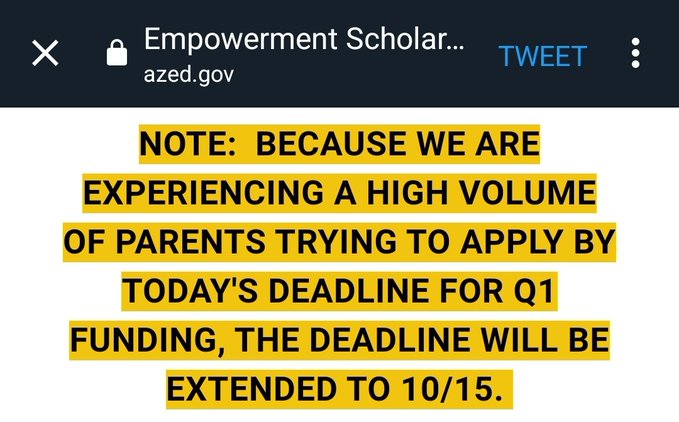
So many parents were trying to apply for Arizona’s expanded Empowerment Scholarship Accounts (ESAs) by Friday’s first quarter deadline that the department of education’s website was overwhelmed, leading to a decision to extend the application period.
“Because we are experiencing a high volume of parents trying to apply by today’s deadline for Q1 funding, @azedschools is extending the deadline to remain eligible for retroactive Q1 funding to 10/15/22,” the department announced midday Friday.
Gov. Doug Ducey helped spread word of the extension while commenting on the tremendous popularity of the new law which now makes all 1.1 million of Arizona’s K-12 students eligible to apply for an ESA which provides about $7,000 per student, per year to assist families in tailoring a student’s education experience to best meet their needs.
The funds can be used for a variety of purposes, including private school tuition, homeschooling expenses, educational therapies, tutoring, and other expenses in exchange for not attending a public school or receiving a tuition tax credit.
More than 12,000 applications have been received by the Arizona Department of Education since the governor signed ESA expansion legislation in June. That outpaces the number of students who were utilizing the ESA program under the old law.
The new expanded eligibility was to take effect Sept. 24 with a Sept. 30 deadline to qualify for first quarter funding. The rush by families to apply this week was bolstered by publicity involving a political action committee’s failed referendum effort to waylay the ESA expansion until voters could decide in 2024 whether it should go into effect or not.
Arizona Secretary of State Katie Hobbs put the law on hold Sept. 23 based on claims by Save Our Schools Arizona that more than 141,000 referendum petition signatures had been submitted to Hobbs’ office. Of those, at least 118,823 signatures needed to be validated to keep the ESA expansion sidelined.
But in a letter dated Thursday, Hobbs’ staff officially confirmed what has been known for days – that the referendum effort failed to come anywhere close to the constitutional minimum number of signatures.
One parent said Friday’s announcement by Hobbs’ office ensures parents are now “rightly in control of their children’s future.”
Christine Accurso of Gilbert is among pro-ESA parents who questioned whether the glaringly insufficient referendum filing was simply a calculated ploy by anti-school choice politicians to freeze funding for children right in the midst of the school year.
“As a longtime ESA parent, I could not be more thrilled to see thousands of new parents benefiting from this program,” Accurso said. “It is my hope that the rest of the country can follow our lead and bring this legislation to their state, so that we can one day see all American children in the school of their parent’s choice.”
Save Our Schools Arizona issued a statement Friday putting the blame for the group’s referendum effort failure on the governor, who is one of ESA’s staunchest supporters.
“We are confident we would have succeeded had Governor Ducey not waited 10 days to sign the bill, robbing Arizona voters of crucial time to sign the petition,” according to the statement.
The group even criticized pro-ESA organizations like the Goldwater Institute for using “sophisticated software” to review the petitions, resulting in Monday’s revelation that Save Our Schools Arizona submitted only about 90,000 signatures.
For school choice advocates like Accurso, the important fact is that the ESA expansion is now in effect. The priority now is to ensure families that still want to apply become aware of the extended Oct. 15 deadline.
by Terri Jo Neff | Sep 23, 2022 | News
By Terri Jo Neff |
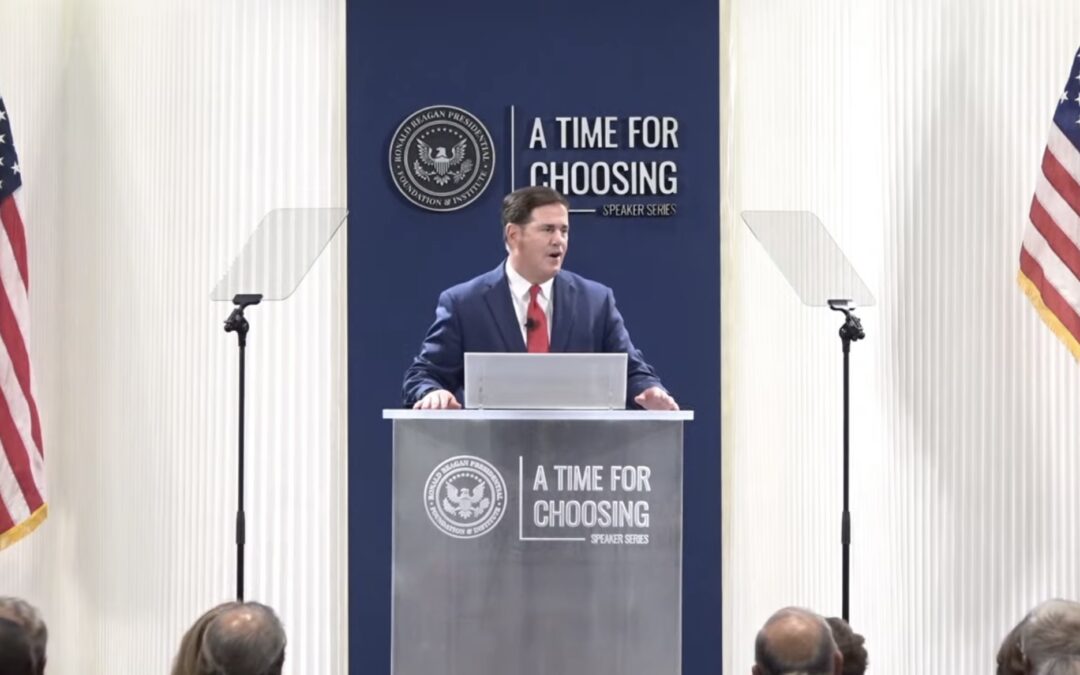
Tuesday night, Gov. Doug Ducey was joined by his family in Simi Valley for his featured appearance as part of the Ronald Reagan Presidential Foundation & Institute’s “A Time For Choosing” speakers series.
The emphasis of the series is to hear from the leading voices in the conservative movement. And Ducey’s social media comments before and after the event show he was honored to be invited to speak.
At the beginning of his speech, the governor described the Ronald Reagan Presidential Library as “a monument to not only a great president, but a great man who built the modern conservative movement” and who inspired many, including Ducey.
“Ronald Reagan’s sentiment remains today,” Ducey said. “Most of us can say unflinchingly – while far from perfect – we remain the single greatest country in the history of the world.”
The governor also used his speech to address the importance of federalism.
And he used the appearance at the Ronald Reagan Library to express his concerns with the direction of the Republican Party at the federal level, calling out what he sees as the “dangerous strain of big government activism.”
Ducey also spoke of the many achievements under his eight years in office.
by Terri Jo Neff | Sep 17, 2022 | News
By Terri Jo Neff |
Gov. Doug Ducey’s recent decision to use state-owned shipping containers to close five gaps along the U.S. / Mexico border in Yuma County has helped better identify other vulnerable areas, including a stretch of unsecured border on land belonging to the Cocopah Indian Tribe.
“It is a known vulnerability, I think it’s pretty obvious to everyone down there,” Tim Roemer, director of the Arizona Department of Homeland Security, said Thursday about dozens of people who cross into the U.S. via tribal lands each week, some without presenting themselves to federal authorities.
Roemer told KFYI’s James T. Harris that the temporary shipping container project was “a good step in the right direction because it’s going to highlight where the weaknesses are at other points.” One of the most exploited weak points is at the end of one segment of the state’s border barrier next to Cocopah tribal land.
Tribal officials have complained about the state’s construction of the barrier, which they contend encroaches several feet on the tribe’s property. Roemer did not openly criticize Cocopah tribal officials, but said knowing where vulnerabilities exist is “going to put more pressure on other people to do more about it, to stem that flow, to better protect their land as well.”
Roemer added that it is his hope the Tribe will work more with state officials.
As to complaints about the poor aesthetics of the shipping containers, border security “is not meant to be pretty; it’s meant to be effective,” Roemer told Harris.
It is also “extremely frustrating” to hear people who want to secure special events, such as political gatherings, “but they don’t want to secure the southwest border into the nation,” Roemer said.
Yuma County was not the only border area Roemer discussed with Harris during the interview. According to the Director, efforts are underway to make state funding available to help better secure Cochise County where some stretches of border have no effective barrier or wall.
The geography in most of those areas is mountainous, making it not a good match for the type of shipping-container temporary border barrier installed in Yuma County. Instead, Roemer says state funding will be made available to the Cochise County Sheriff’s Office for virtual technology instead of physical barriers.
Those funds are part of a $335 million appropriation signed into law by Ducey earlier this year. Cochise County Sheriff Mark Dannels can access some of that money for technologies such as drones, cameras, mobile units, and infrared night vision.
“We work really well with Sheriff Dannels and his team,” Roemer told Harris. “They utilize technology there about as well, probably better than anybody in the country. It’s really impressive.”
LISTEN TO THE ROEMER INTERVIEW HERE