by Matthew Holloway | Dec 3, 2025 | News
By Matthew Holloway |
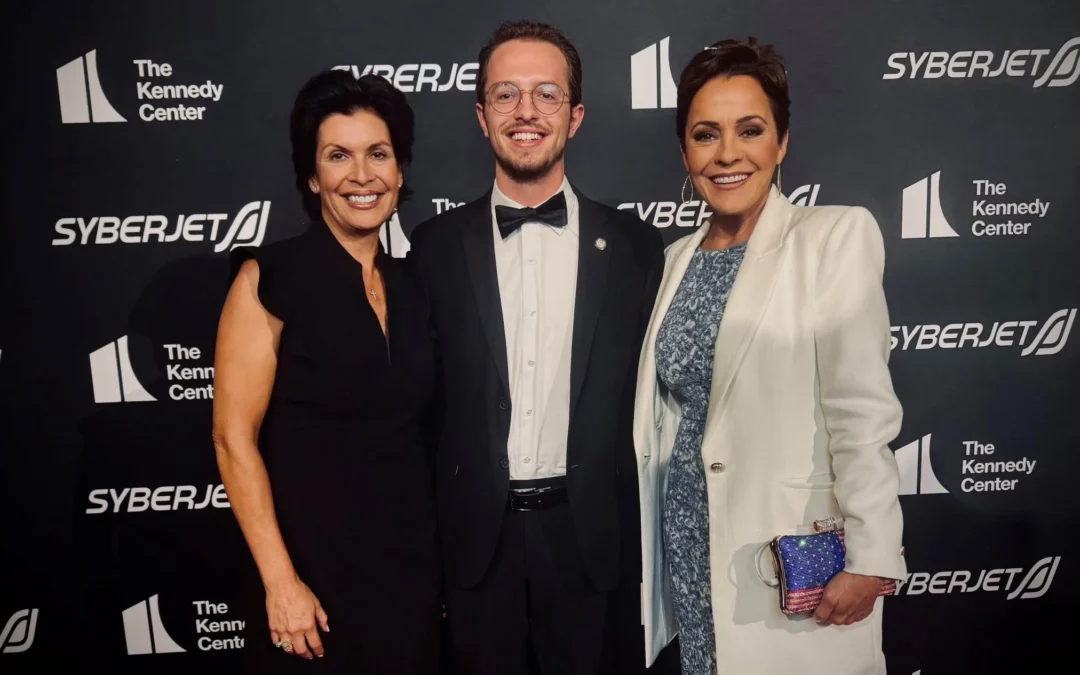
Fresh off his 2025 graduation from Grand Canyon University, Caleb Foss is now helping senior leadership at the John F. Kennedy Center for the Performing Arts in Washington, D.C., where his team has brought in $58 million in secured funds over the last 30 days.
Foss serves as executive assistant to Lisa Dale, the center’s Senior Vice President and Head of Development. He graduated summa cum laude from GCU this year with a bachelor’s degree in government, with an emphasis on public administration, according to GCU News. During his time at the Phoenix-based university, Foss participated in the Canyon Civic Institute, a student organization focused on preparing members for careers in civic engagement and public service.
GCU News revealed that Foss traces his path to the Kennedy Center back to high school, when he first got involved in political media. At GCU, that interest turned into hands-on work as a finance assistant and fundraising consultant for Kari Lake’s U.S. Senate campaign.
In his senior year, he joined the university’s Canyon Civic Institute, and a CCI trip to Washington, D.C., opened the door to job interviews and networking that ultimately led to his current role. At the Kennedy Center, Foss supports operations, scheduling, and fundraising efforts under the leadership of Kennedy Center Chairman President Donald Trump, Kennedy Center President and Ambassador Richard Grenell, and the board of trustees.
In June, he helped raise more than $10 million at the red-carpet premiere of “Les Misérables,” an event attended by the president, vice president, and Cabinet members. Foss also attended a Stuttgart Ballet performance in October alongside Dale and Lake, now acting CEO for the U.S. Agency for Global Media.
“It’s truly an honor. Especially with the President of the United States being chairman of the center, it’s a great privilege to be involved and help make the Kennedy Center better than ever.”
Foss attributes his drive to public service to his faith. “My true passion for going into that originally stems from my faith, my passion to serve and to lead in different areas, especially within government,” he stated. “My Christian foundation in life has been essential for pointing me in the direction where I believe I can make a difference.”
In reflecting on the recent fundraising success, Foss noted, “In the past 30 days, we brought $58 million in secured funds for the Kennedy Center.” He explained, “It’s a big operation, and it’s really exciting to be a part of it. With the leadership of Chairman President (Donald) Trump, Kennedy Center President and Ambassador Richard Grenell, Lisa Dale, the board of trustees, and our entire leadership team, the Kennedy Center has accomplished so much in this past year, and we have many great things in store for the future.”
Foss described the “Les Misérables” event as pivotal: “The president and the vice president were there, along with many members of the Cabinet. We brought in a lot of new donors for the Kennedy Center and raised over $10 million that one night. It was an incredible experience.”
Offering advice to current GCU students pursuing similar paths, Foss said, “Communication and connection are essential. But most importantly, stick to your morals, values, and faith, especially. No matter what the goal is at that moment, stay true to what you believe in.”
He emphasized starting locally: “The best place you can get involved is in your local community first. Whether that’s in your church, your neighborhood, or something like the Canyon Civic Institute or other clubs or organizations at GCU, from there, the opportunities are endless.”
The Kennedy Center is a national cultural hub undergoing major renovation under President Trump, who provided $257 million in funding, and continues to host live performances and national events such as the Memorial Service for Charlie Kirk, amid these improvement efforts.
Matthew Holloway is a senior reporter for AZ Free News. Follow him on X for his latest stories, or email tips to Matthew@azfreenews.com.
by Staff Reporter | Dec 2, 2025 | News
By Staff Reporter |
Congressman Abe Hamadeh warned that Senator Mark Kelly’s advice to military members to refuse “unlawful” orders amounted to blackmail.
Hamadeh added in a statement on X that Kelly had jeopardized military readiness with this vague, alleged threat.
“By suggesting there ‘could’ be severe consequences for carrying out undefined ‘unlawful’ orders, the ‘Seditious Six’ are emotionally blackmailing our active-duty personnel,” said Hamadeh. “They want them to hesitate before protecting the American people. Reprehensible.”
Last month, Kelly and five other Democratic members of Congress with military and intelligence community backgrounds issued a call to action to the military to stand down on “illegal” orders from President Donald Trump.
This group — dubbed the “Seditious Six” by Hamadeh and other Republicans — indicated that some orders from Trump and his administration violated the laws or the Constitution and were therefore illegal.
“We want to speak directly to members of the military and the intelligence community who take risks each day to keep Americans safe. We know you are under enormous stress and pressure right now. Americans trust their military. But that trust is at risk,” said the elected officials. “This administration is pitting our uniformed military and intelligence community professionals against American citizens. Like us, you all swore an oath to protect and defend this Constitution. Right now, the threats to our Constitution aren’t just coming from abroad but from right here at home. Our laws are clear: you can refuse illegal orders. You must refuse illegal orders.”
The others in the “Seditious Six” are Senators Elissa Slotkin (MI) and Representatives Chris Deluzio and Chrissy Houlahan (PA), Maggie Goodlander (NH), and Jason Crow (CO). Slotkin posted the video.
Hamadeh claimed Kelly and the other elected officials were intentionally ambiguous about which orders from Trump were allegedly illegal.
“The reason Democrats refuse to name what they consider to be illegal orders by President Trump is that they want our military and intelligence community to question every order they receive from this administration,” said Hamadeh. “They want to make our active-duty personnel hesitate to execute the agenda voted for by the American people, paralyzing these men and women with the threat of future punishment.”
After the release of the video, Slotkin admitted she couldn’t name any military orders by Trump which were illegal.
“To my knowledge, I’m not aware of things that are illegal but certainly there are some legal gymnastics going on with these Caribbean strikes and everything going on with Venezuela,” said Slotkin in an interview with ABC’s “This Week” segment.
Slotkin clarified later in the interview that the video was primarily meant for addressing the use of the military within American cities.
“So, it was basically a warning to say, like, if you’re asked to do something particularly against American citizens, you have the ability to go to your JAG officer and push back,” said Slotkin.
President Trump said Kelly and the Democratic members within the video had committed “seditious behavior.” He called for the six to be arrested and put on trial, and reposted another user’s commentary (since deleted) that called for hangings.
AZ Free News is your #1 source for Arizona news and politics. You can send us news tips using this link.
by Ethan Faverino | Nov 29, 2025 | Economy, News
By Ethan Faverino |
As families across the nation prepared for Thanksgiving travel, gas prices provided relief at the pump, holding steady around $3 per gallon and marking the lowest levels in years.
According to data from fuel savings tracker GasBuddy and the American Automobile Association (AAA), the national average for regular unleaded gasoline has fallen significantly in 2025, with some stations even offering prices under $2 per gallon for the first time since 2021.
This year’s average price stands at $3.12 per gallon so far, down from $3.31 in 2024 and $3.52 in 2023. The decline follows a peak above $5 per gallon in June 2022, reflecting a steady downward trend that has eased the financial burdens on drivers around the country.
One year ago, the average was $3.06, matching the price of October 2025, with only minor fluctuations of a few cents this pre-Thanksgiving week.
The Trump administration has highlighted these reductions as a direct result of its energy policies since President Donald Trump’s return to the White House.
In October, the White House issued a statement celebrating GasBuddy’s report that national averages had slipped below $3 per gallon – the lowest in four years.
Head of petroleum analysis at GasBuddy, Patrick De Haan, said, “It’s pretty compelling to see gas prices this low, falling ahead of Thanksgiving, and it signals what more Americans could experience in the coming months. Lower seasonal demand, falling oil prices, and rising OPEC output are all pushing prices down. While a few stations have recently dipped below $2 through temporary offers and promotions, this marks the first time we’ve seen a regular sub-$2 price.”
The lowest gas price in the country is now $1.99, available at four stations in Midwest City, Oklahoma, part of the Oklahoma City metro area. Reported on Monday, November 24, these are the first prices below $2 nationwide without discounts or promotions, marking the lowest U.S. prices since 2021.
In Arizona, gas prices have remained remarkably stable in recent weeks, with the current average for regular unleaded at $3.336 per gallon – just 4 cents below what it was a week ago ($3.380). Compared to October ($3.339), regular prices have essentially held flat, while showing a modest year-over-year increase of 12.2 cents from $3.214.
Ethan Faverino is a reporter for AZ Free News. You can send him news tips using this link.
by Matthew Holloway | Nov 24, 2025 | News
By Matthew Holloway |
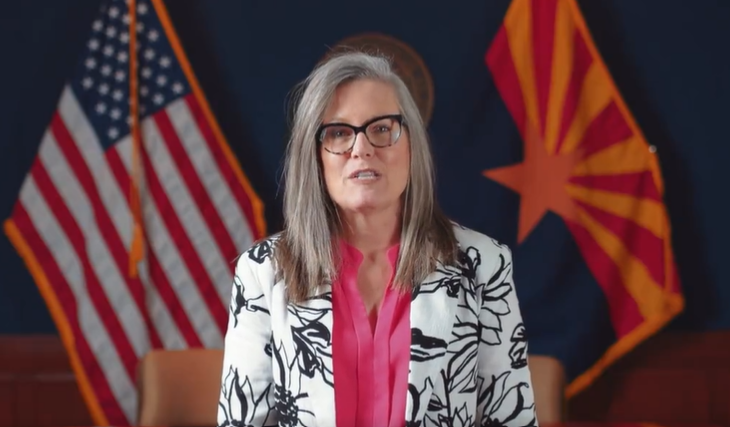
Congressman Andy Biggs has called out Arizona Gov. Katie Hobbs for “blatant hypocrisy” after she publicly pitched the benefits of the federal Working Families Tax Cut, a policy she previously denounced as a “betrayal.”
In a statement released Thursday, Biggs said Hobbs is “shamelessly” attempting to attach herself to a Republican-driven tax package that she vocally opposed earlier this year.
“After calling the Working Families Tax Cut a ‘betrayal,’ Katie Hobbs now shamelessly wants to take credit for the tax cuts passed by President Trump and Congressional Republicans,” Biggs said. The congressman provided links to her July comments to Fox10 in which the Governor stated:
“This bill is a betrayal of working families, children, and seniors in Arizona who will lose their healthcare, their ability to put food on the table, and good-paying jobs, all to give tax cuts to the people who are already billionaires while ballooning our national debt by $3.4 trillion.”
Biggs argued that despite Hobbs’ prior opposition, Republicans “successfully delivered tax relief to working-class Arizonans and seniors who are being hurt by the rising energy costs of Hobbs’ progressive, green energy agenda.”
On X, Biggs highlighted Hobbs’ recent promotion of her own “Middle Class Tax Cuts Package,” which includes bigger deductions, tax relief for seniors, and exemptions on taxes for tips, overtime, and new car loan interest.
Hobbs, who recently launched her 2026 reelection bid, has highlighted the tax cut in campaign messaging and controversially billed her events as “Arizona First” rallies, as noted by Capitol Media. Biggs asserted that the move reflects political weakness within her own party.
“Even her fellow Democrats are calling her ‘weak’ because they know the truth just like Arizonans do: Katie Hobbs has failed our state, and now she’s trying to cover it up by taking credit for Republican victories,” he said citing an op-ed from AZ Mirror.
The Working Families Tax Cut, a component of the “One Big Beautiful Bill” championed by President Donald Trump, Biggs, and other House Republicans, expanded credits for lower- and middle-income households and included relief provisions for seniors. Hobbs criticized the measure during negotiations, calling it fiscally irresponsible and siding with Democrats who argued it favored Republican priorities.
Matthew Holloway is a senior reporter for AZ Free News. Follow him on X for his latest stories, or email tips to Matthew@azfreenews.com.
by Ethan Faverino | Nov 24, 2025 | Economy, News
By Ethan Faverino |
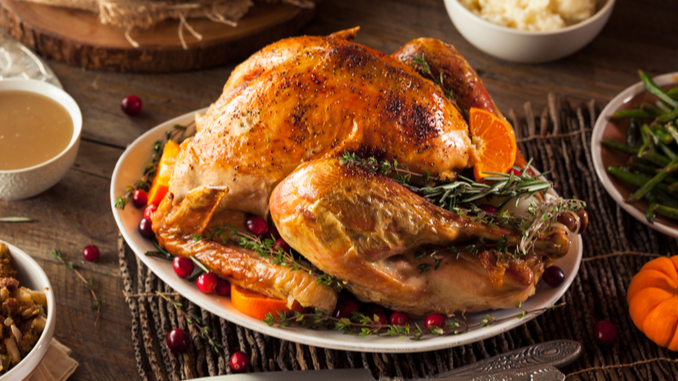
The American Farm Bureau Federation (AFBF) released its 40th annual Thanksgiving Dinner Cost Survey, revealing welcoming news for American families. The average cost of a classic Thanksgiving meal for 10 people has fallen to $55.18, or $5.52 per person—a decrease of more than 5% from 2024 and the third straight year of declines.
While the drop provides some relief at the checkout, AFBF cautions that prices remain well above pre-2022 levels, following a record-high average of $64.05.
AFBF Economist Faith Parum, Ph.D., said, “It’s encouraging to see some relief in the price of turkeys, as it is typically the most expensive part of the meal. Farmers are still working to rebuild turkey flocks that were devastated by avian influenza, but overall demand has also fallen. The combination will help ensure turkey will remain an affordable option for families celebrating Thanksgiving.”
2025 Classic Thanksgiving Menu Price Changes (for 10 people)
- 16-lb turkey: $21.50 (−16.3%)
- Stuffing (14 oz): $3.71 (−9%)
- Dinner rolls (1 dozen): $3.56 (−14.6%)
- Sweet potatoes (3 lbs): $4.00 (+37%)
- Veggie tray (1 lb carrots & celery): $1.36 (+61.3%)
- Fresh cranberries (12 oz): $2.28 (−2.8%)
- Pumpkin pie mix (30 oz): $4.16 (+0.1%)
- Whipping cream (½ pint): $1.87 (+3.2%)
- Frozen peas (1 lb): $2.03 (+17.2%)
- Pie crusts (2): $3.37 (−0.8%)
- Milk (1 gal): $3.73 (+16.3%)
- Misc. ingredients: $3.61 (−4.7%)
Thanksgiving dinner costs vary significantly across different regions. Families in the South enjoy the nation’s lowest average price for a classic meal for 10 at $50.01, followed by the Midwest at $54.38, the Northeast at $60.82, and the West at $61.75.
When adding ham, russet potatoes, and green beans to create an expanded menu, the South remains the most affordable at $71.20, while the West is the priciest at $84.97.
“We are blessed to live in a country capable of producing such an abundant food supply, and for that we should be thankful,” said AFBF President Zippy Duvall. “Despite modest declines this Thanksgiving, food prices remain a real concern for many families — including farm families. We lost 15,000 farms last year due to low crop prices, high input costs, and trade uncertainty. Every farm lost moves us closer to greater consolidation and reliance on foreign food sources. We urge Congress to address these challenges so America’s farm families can continue growing the safe, affordable food we all depend on every day of the year.”
The White House also celebrated the lower cost of Thanksgiving this year, noting President Trump’s promise to lower prices and cut inflation. Retailers are stepping up with their cheapest Thanksgiving meals in years:
- Walmart’s feast for 10 is down 25% from last year, with its lowest turkey price since 2019 at under $4 per person.
- Lidl’s Thanksgiving meal is $10 less, clocking in at $3.60 per person for 10.
- Aldi’s Thanksgiving meal is $7 cheaper and at 2019 lows, $4 per person for 10.
- Target’s meal for four is at its lowest price ever, at $5 per person.
- Schnucks, one of the nation’s largest privately held supermarket chains, is selling turkeys at prices not seen in over 15 years.
Ethan Faverino is a reporter for AZ Free News. You can send him news tips using this link.