by Matthew Holloway | Sep 26, 2025 | News
By Matthew Holloway |
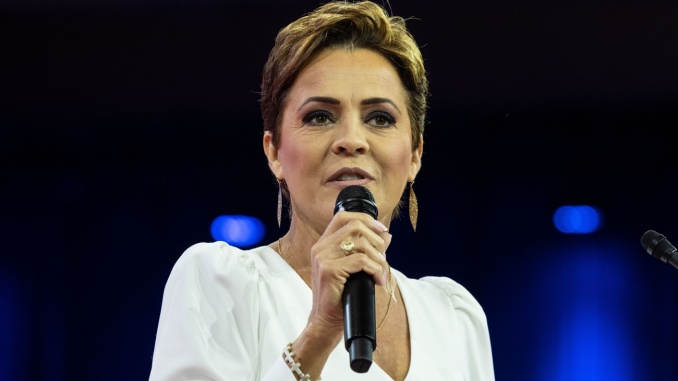
The full deposition of Kari Lake, acting CEO of the U.S. Agency for Global Media (USAGM), was unsealed and filed publicly on Monday in the U.S. District Court for the District of Columbia. In the September 9th questioning from plaintiffs’ lawyers in lawsuits challenging layoffs at Voice of America (VOA) and its parent agency, Lake dismantled the narratives woven by the terminated staffers in outlets like the Washington Post and NPR.
Lake has been accused of “gutting” VOA through alleged illegal firings and union-busting. The headlines painted a scene of “fearful journalists” and “dismantling” America’s global voice, framing the cuts as a political purge in defiance of court orders. However, Lake’s sworn testimony tells a different story.
In the 549-page transcript, Lake coolly describes a deliberate, team-driven effort to comply with President Trump’s March 14, 2025, Executive Order “Continuing the Reduction of the Federal Bureaucracy,” which mandated slashing agencies like USAGM to their “statutory minimum” within seven days, as previously reported by AZ Free News.
“I effectuated — I got busy working to effectuate the President’s executive order,” Lake stated plainly during the deposition, responding to questions about her rapid response to the EO. Far from the “unaware” operative depicted in the Post’s coverage—which claimed she learned of the order “the day of” and blindsided staff—Lake described proactive preparations based on “rumblings” and immediate collaboration with career officials.
“We made the decision to determine what (the) statutory minimum was, and in the process of doing that, we worked with the senior leadership at the agency to come up with what our plan would be. We placed everybody on paid leave and worked with senior leadership, career leadership, and they came up with the plan.”
This new information decisively counters the union-led narrative of a “union-busting attack on workers’ First Amendment rights,” as put forth by the American Federation of Government Employees (AFGE) and amplified by Politico. Lake emphasized that reductions in force (RIFs) affecting hundreds were “the same process that went into the first one,” guided by non-partisan experts, such as Victor Morales, a 36-year agency veteran.
“This was an agency decision based on everything that’s led up to [it],” she added, rejecting any indications of personal retaliation. These firings also included a subsequent round after an August 28 executive order excluded the USAGM from the Federal Labor-Management Relations Program.
The deposition also highlighted Lake’s repeated warnings about foreign infiltration plaguing USAGM, which were emphasized during her congressional testimony with Congressman Abe Hamadeh in June. “This place is rotten. It’s rotten to the core,” she told the House Committee on Foreign Affairs. “President Trump has asked me to go in and help clean it up, and he’s also issued an executive order to reduce this agency down to its mandate, to what is mandated, statutorily required. That’s exactly what I’m doing. I don’t care if they attack me.”
Media critics have dismissed her findings as fearmongering to justify cuts, but under oath, Lake was firm, identifying “massive national security violations, including spies and terrorist sympathizers and/or supporters infiltrating the agency, eye-popping self-dealing involving contracts, grants, and high-value settlement agreements…”
Pressed on her posts to social media stating that “the CCP has infiltrated VOA and you are paying for it,” Lake confirmed her statement without hesitation, saying simply, “Yes.” When asked about Chinese Communist Party (CCP) meetings with VOA managers to shape coverage, she replied, “In the past, they have.”
These revelations appear to fly in the face of NPR’s portrayal of Lake’s reforms as baseless paranoia endangering journalists abroad, with reporters “fearful” over visa revocations amid supposed “lax security” excuses.
Instead, Lake clearly laid out the overhaul as a mission to restore integrity: “I think it’s important to effectuate the President’s executive order and make sure that what we’re putting out is honest, truthful reporting.”
She highlighted fiscal wins, like canceling an “obscenely expensive 15-year lease that burdened the taxpayers,” and anticipated operating “above the originally proposed statutory minimum” while adhering to the law.
The lawsuits, Widakuswara et al. v. Lake and Abramowitz et al. v. Lake, both stem from the firing of VOA staff and former VOA Director Michael Abramowitz, whom Lake attempted to reassign before a judge intervened to block it. But Lake invoked executive privilege on White House chats and stressed the EO’s clarity: “In the executive order, it says right here in Section 2(a), ‘such entities shall reduce the performance of their statutory functions and associated personnel to the minimum presence and function required by law.'”
Along that same line of reasoning, Solicitor General of the United States D. John Sauer announced in late August that the Department of Justice is prepared to defend the removal of Abramowitz from his position writing, “Under Article II, inferior executive officers must be removable at will by the President or by a department head acting on the President’s behalf.”
As Lake navigates the legal hurdles raised before her, her deposition emerges as a counter to the media narrative. While outlets like the Washington Post describe “contentious court battles” and “radical cuts,” Lake’s testimony underscores a lawful cleanup of a bloated, fatally infiltrated bureaucracy. She summarized the situation best, saying, “The President put out an executive order calling for the reduction to the statutory minimum,” and “it was the decision of the team, the senior leadership team, that we needed to follow the President’s executive order.”
Matthew Holloway is a senior reporter for AZ Free News. Follow him on X for his latest stories, or email tips to Matthew@azfreenews.com.
by Ethan Faverino | Sep 21, 2025 | News
By Ethan Faverino |
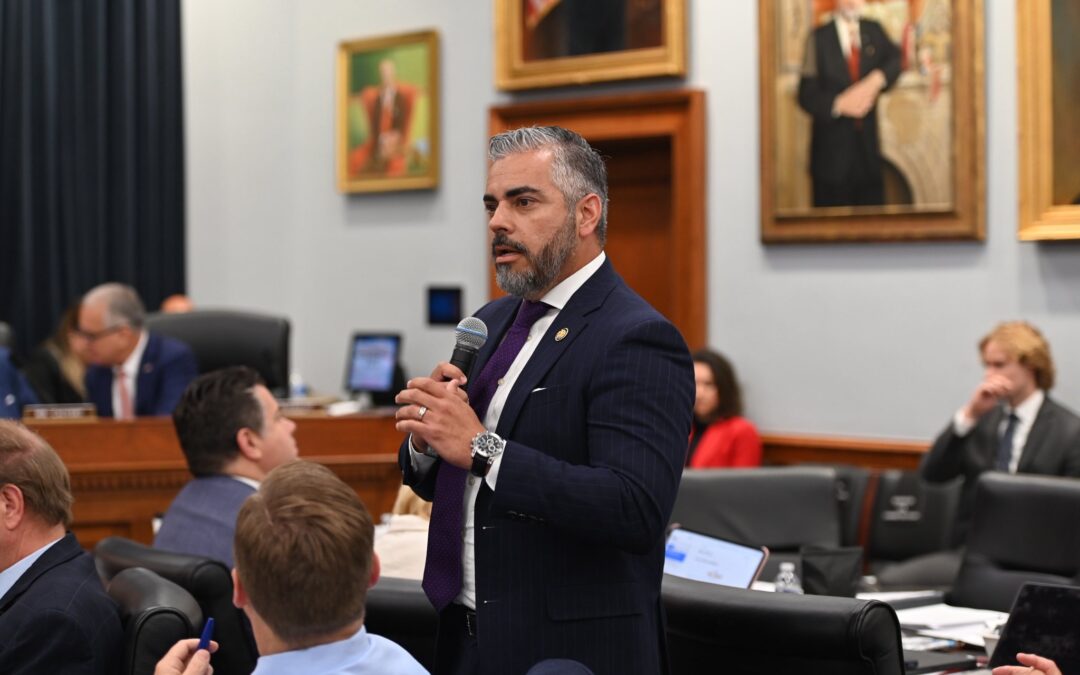
Congressman Juan Ciscomani (AZ-06) marked a personal milestone on September 18, 2025, commemorating 19 years since he became a U.S. citizen and reflecting on his remarkable journey from a congressional intern to a member of the United States Congress.
In a heartfelt post on X, Ciscomani shared a touching moment of his parents visiting him on Capitol Hill, 18 years apart, highlighting the opportunities afforded by the American Dream.
“Same place and same people, 18 years apart,” Ciscomani wrote. “In 2006, my parents visited me on Capitol Hill. I was a Congressional intern with a Green Card. Now they’re back visiting me again. And I’m a member of Congress with a Green Pin. Grateful for the opportunities our great nation offers!”
Ciscomani, who represents the Arizona 6th Congressional District, also celebrated the 19th anniversary of his U.S citizenship, recalling the moment he raised his right hand and became a citizen.
“From the son of a bus driver to serving in the United States Congress—my story and millions of other stories are only possible in the greatest country on earth. Grateful for the blessings of citizenship and the American Dream!” said Ciscomani on X.
Before his election to Congress in 2022, Ciscomani served as the senior advisor to Arizona Governor Doug Ducey and held leadership roles in the Tucson Hispanic Chamber of Commerce, where he advocated for economic growth and community development.
As a member of Congress, Ciscomani has focused on issues critical to his constituents, including border security, economic development, and veterans affairs. He serves on the House Committee on Veterans Affairs and House Committee on Appropriations, where he advocates for policies to strengthen Arizona’s communities and support the nation’s veterans.
Ethan Faverino is a reporter for AZ Free News. You can send him news tips using this link.
by Staff Reporter | Sep 19, 2025 | News
By Staff Reporter |
A Pima County Sheriff’s office deputy was placed on leave with pay after making threats to President Donald Trump on social media.
Deputy Ramon Hernandez made the threats following the assassination of conservative leader Charlie Kirk last week.
Hernandez called for Trump’s assassination, celebrated Kirk’s assassination, and called for revolution in multiple posts.
“Death to pedophile rapist Trump,” posted Hernandez, sharing a video depicting news coverage of pro-Palestinian protesters interrupting a Trump dinner in Washington, D.C.
“Death to Israel, death to pedo-Trump,” said Hernandez, sharing a post describing Israel’s recent bombing of Doha, Qatar.
“[Trump is a] piece of shit human. REVOLUTION,” posted Hernandez, in response to news of a court allowing Trump to defund Planned Parenthood pending case review of Medicaid funding.
“Feel bad for his kids, then again, they’re probably better off,” said Hernandez, sharing posts from Kirk that criticized Islam and Gaza.
“For the past 2 years I’ve been watching children’s bodies snipped and shredded to bits by U.S. bombs and Israel pushing the button….. And here we are feeling empathy for Charlie who only promoted hate, racism and was all for the annihilation of the Palestinians. Ironically Charlie didn’t believe in ‘empathy.’ We are well past the red line in this country. A pedophile rapist for a president, the military initiated for no real reason against its own citizens, ICE abducting anyone of color….. We are long overdue for a revolution. As for poor Charlie, that’s his own karma that got him where he now lays. Stand on the right side of history, especially if you’re a cop. Cops for Palestine.”
Hernandez called for the “tak[ing] out” of Israel Prime Minister Benjamin Netanyahu.
The Secret Service launched a criminal investigation into Hernandez.
Sheriff Chris Nanos said in a video statement that they were concerned about Hernandez’s posts, which he said were “alleged to be inappropriate.” Nanos said they would open their own investigation pending the outcome of the federal investigation.
“We have been notified by several citizens, as well as the Secret Service. The Secret Service is conducting a criminal investigation as we speak, and we are cooperating fully. To that point, we have protocols that are governed by law and by policy,” said Nanos. “To be clear, this sheriff and this department does not and will never condone violence of any kind. We hold our team to a higher standard: a level of professionalism that’s above all. We expect the best out of our team at all times, 24/7, not just during their eight-hour day.”
A Secret Service spokesperson told KJZZ that they couldn’t comment on active investigations.
“We take all threats against our protectees seriously,” stated the spokesperson. “As a matter of practice, we do not comment on matters involving protective intelligence.”
Earlier this summer, Hernandez was featured in the news as a protester against Trump’s immigration policies. Hernandez carried a Palestinian flag.
“Standing up for Indigenous people, decolonization is the main thing,” said Hernandez. “If we’re able to liberate Palestine, we’re able to liberate the world.”
AZ Free News is your #1 source for Arizona news and politics. You can send us news tips using this link.
by Staff Reporter | Sep 18, 2025 | Education, News
By Staff Reporter |
The Department of Education (ED) announced a significant new investment in school choice.
On Monday, ED pledged “historic” investments into charter schools, American history and civics programs, Historically Black Colleges and Universities (HBCUs), and Tribally Controlled Colleges and Universities (TCCUs).
The department repurposed funding from Diversity, Equity, and Inclusion programs to fund these investments.
ED Secretary Linda McMahon said the funds were reserved for programs “which support student success.”
“The Department has carefully scrutinized our federal grants, ensuring that taxpayers are not funding racially discriminatory programs but those programs which promote merit and excellence in education,” said McMahon. “The Trump Administration will use every available tool to meaningfully advance educational outcomes and ensure every American has the opportunity to succeed in life.”
ED also pledged over $160 million to the American History and Civics Education National Activities — Seminars for America’s Semiquincentennial program. 2026 will mark the 250th anniversary of the founding of the United States of America.
ED will award American history and civics grants for seminars that “directly commemorate the 250th anniversary of the Founding of the United States.” Eligible seminar programming must make a feature study of American political tradition: the ideas, institutions, and texts instrumental to this nation’s constitutional government and history. The seminars must also be based on “the first principles of American founding.” Eligible seminars must include the Declaration of Independence, Constitution, and Bill of Rights.
$500 million in grants will be distributed to charter schools for the 2025 fiscal year. Another total of nearly $500 million collectively will be sent as one-time investments to HBCUs and TCCUs.
As justification for the reallocation of millions in government grants, ED cited the poor student outcomes exhibited by the 2024 National Assessment of Educational Progress (NAEP) scores released earlier this month. Student NAEP scores reached “historic lows” throughout K-12.
Nationally, average NAEP scores were lower across all three assessments: science at grade 8, mathematics at grade 12, and reading at grade 12.
Arizona students scored lower across the various subjects than the average national scores for both fourth and eighth graders. Fourth grade math scores averaged 232, compared to the national average of 237; fourth grade reading scores averaged 208, compared to the national average of 214; and fourth grade science scores averaged 149, compared to the national average of 153.
Eighth grade math scores averaged 270, compared to the national average of 272; eighth grade reading scores averaged 254, compared to the national average of 257; and eighth grade science scores averaged 148, compared to the national average of 153.
McMahon called the NAEP results “devastating,” and indicative of a trend of generations unprepared for adult life. McMahon questioned the spending of billions annually with such dismal results, and pledged to claw back some of those funds to invest in individual states and educational choice.
“At a critical juncture when students are about to graduate and enter the workforce, military, or higher education, nearly half of America’s high school seniors are testing at below basic levels in math and reading. Despite spending billions annually on numerous K-12 programs, the achievement gap is widening, and more high school seniors are performing below the basic benchmark in math and reading than ever before,” said McMahon. “If America is going to remain globally competitive, students must be able to read proficiently, think critically, and graduate equipped to solve complex problems. We owe it to them to do better.”
In May, ED pledged to increase charter school funding by $60 million for a program budget total of $500 million.
AZ Free News is your #1 source for Arizona news and politics. You can send us news tips using this link.
by Ethan Faverino | Sep 15, 2025 | News
By Ethan Faverino |
The McCain Institute’s Freedom for Political Prisoners Initiative (FPPI) praised President Donald Trump’s newly signed Executive Order on Strengthening Efforts to Protect U.S. Nationals from Wrongful Detention Abroad.
The order establishes a groundbreaking “State Sponsors of Wrongful Detention” designation, empowering the U.S. Department of State to impose sanctions, visa restrictions, export controls, foreign assistance cuts, and travel bans on nations that systemically detain Americans and other foreign nationals for political leverage.
By codifying tools long advocated by advocates like the FPPI, the order transforms wrongful detention into a strategic liability for offending states, potentially aiding negotiation for the release of detainees and preventing future abductions.
Ambassador Roger D. Carstens, inaugural Senior Distinguished Fellow of the John McCain Freedom for Political Prisoners Initiative and former Special Presidential Envoy for Hostage Affairs (SPEHA) said, “I am grateful to see the Trump Administration’s new executive order creating a ‘state sponsor of wrongful detention’ designation that can be levied against those who would take our citizens unjustly. This executive order starts to codify the very tools we have long advocated for—tools that, for the first time, make wrongful detention a strategic liability for any state. We’ve moved from response to prevention; now, with sanctions and designations in place, deterrence is real—and it’s backed by the full force of U.S. policy. We need to keep doing more to impose even harsher deterrence on countries who dare to wrongfully take Americans and hold them hostage.”
The executive order authorizes the Secretary of State to label a foreign government as a “State Sponsor of Wrongful Detention” if it engages in or supports such practices, including detentions on its soil or failures to release confirmed wrongful detainees after U.S. notification.
Designations can be lifted only if the government releases detainees, enacts policy changes, and offers credible assurances against recurrence.
Secretary of State Marco Rubio addressed the measure in a press statement, declaring, “Anyone who uses an American as a bargaining chip will pay the price. This administration is not only putting America first but also putting Americans first.”
The initiative comes amidst a global crisis, where at least 30 American citizens are currently wrongfully detained in countries such as Iran, Venezuela, Eritrea, Syria, and Afghanistan.
Sarah Moriaty, a member of the FPPI Advisory Board and the daughter of a former FBI agent who was wrongfully detained by Iran in 2007, later dying in custody, said, “We have watched in horror as the practice of taking American citizens hostage as political leverage has not only escalated but run rampant by the acts of many rogue nations.”
Ethan Faverino is a reporter for AZ Free News. You can send him news tips using this link.