by AZ Free Enterprise Club | Feb 11, 2023 | Opinion
By the Arizona Free Enterprise Club |
Katie Hobbs certainly seems to like power. That’s probably why she was so giddy with laughter and excitement during her swearing-in ceremony last month. Now, she’s gotten to work. And despite her claims that Republicans and Democrats will have an open door to her office to get to work on bipartisan compromise, her preferred method appears to be executive action.
In just over a month since beginning her reign as governor, Hobbs has already signed seven executive orders. And there’s no sign that she’ll stop there. Her first executive order, prohibiting gender identity discrimination in state employment and contracts, was particularly eye-opening. Consider it a small taste of the woke agenda Hobbs is looking to implement over the next four years. And while it’s good to see that groups like the Arizona Freedom Caucus are planning to file a lawsuit challenging the constitutionality of such an order, it will take more than that to stop Hobbs from overstepping her authority…
>>> CONTINUE READING >>>
by Corinne Murdock | Feb 2, 2023 | News
By Corinne Murdock |
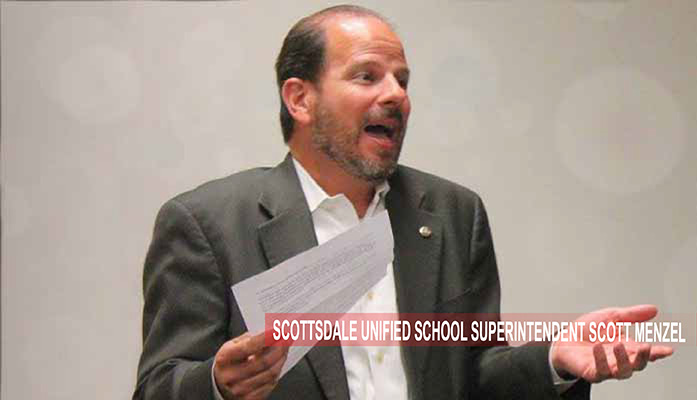
Republican state legislators representing Scottsdale condemned a local superintendent for racist remarks that recently made national headlines. Scott Menzel, the Scottsdale Unified School District (SUSD) superintendent, called the white race “problematic.”
Republicans representing District 3 — State Reps. Joseph Chaplik and Alex Kolodin, along with State Sen. John Kavanagh — urged Menzel to issue an apology and resign.
“The racist words and sentiments Menzel publicly expressed have no place in Scottsdale schools,” stated the trio. “Menzel’s racist views not only compromise his ability to lead, but he has made himself the center of a controversial spotlight that will only distract from learning.”
The three legislators also asked the SUSD Governing Board to remove Menzel. They noted that SUSD has faced mounting criticism in recent years over its incorporation of various progressive ideologies, such as on gender and race.
Menzel issued the remarks in a 2019 interview while working as a superintendent in Michigan. He said that white people, including children, needed to feel uncomfortable about themselves due to their race. Menzel further claimed that meritocracy was a myth.
“[W]hite people have racial identity as well, and in fact problematic racial identity that we typically avoid,” said Menzel. “[White people] should feel really, really uncomfortable, because we perpetuate a system by ignoring the realities in front of us, and living in a mythological reality.”
Menzel went on to celebrate public chaos as an opportunity for social reform.
“[White supremacy is] in the very fabric of the way this country was established, and we’ve never righted the wrongs of the genocide of the indigenous population, and the enslavement of a population from Africa on which the wealth of this country was built,” said Menzel.
At the time of the 2019 interview, Menzel had received numerous awards, honors, and recognitions for his leadership, and was a frequent featured panelist and guest speaker for local and state events. During the Obama administration, the White House named Menzel a YMCA Champion of Change in 2013. The next year, the Michigan Department of Education named Menzel to their advisory council on early childhood education.
SUSD hasn’t addressed this latest controversy from Menzel.
Under Menzel’s leadership the divide between parents and the district has only grown. Last year, the district adopted a controversial policy in which they posted the names of individuals submitting records requests, yet they would redact staff members’ names in response to those requests.
Menzel has also defended staff members that discussed gender ideology with kindergarten and elementary students without parental knowledge. He claimed those parents opposed to these discussions were in violation of Civil Rights law, insisting that the staff member in question was attacked because of her identity. Menzel further informed parents that the district wouldn’t punish employees over such behavior.
“To target an individual publicly for their personal identity — in this case the individual against whom this complaint was filed does not identify as either male or female — is overt discrimination and inconsistent with state and federal law as well as school district policy,” said Menzel.
In a separate incident in 2021, Menzel admonished parents and community members opposed to clubs focusing on children’s gender and sexuality. Menzel called them bullies.
Last April, SUSD’s social justice professionals promoted a drag queen storytime.
As the Arizona Daily Independent reported recently, the district falsely denied the existence of an official transgender support plan for nearly a year. The support plan, labeled “Confidential” by the district, noted that caregivers should be included in the completion of the document — not “must.” The district also considered ways to implement a gender support plan if the student’s parents or guardians weren’t supportive of such a plan.
In a 2015 equity panel hosted by Menzel’s former employer, Menzel proposed a “cradle to career education continuum” that resembled the controversial “cradle to grave” approach proposed by former President Barack Obama for lifelong government involvement.
The district only went so far as to remove the former board president, Jann-Michael Greenburg, from presidency after the 2021 discovery of his involvement in a dossier on parents and alleged political enemies within the district. Court cases concerning this dossier are ongoing.
Corinne Murdock is a reporter for AZ Free News. Follow her latest on Twitter, or email tips to corinne@azfreenews.com.
by Corinne Murdock | Jan 20, 2023 | News
By Corinne Murdock |
Scottsdale Mayor David Ortega has refused to allow Rio Verde citizens to use canal space to transport their water, effectively forcing them to go without, pay thousands in water bills, or leave their homes.
The Scottsdale canal route would be the short-term solution to save Rio Verde residents time and money until a proposed long-term solution, a stump pipe, can be worked out. In the meantime, Rio Verde residents must be frugal with what water they can obtain. Some have come to rely upon rainwater — a nonviable solution come summer. The trucks that reliably delivered affordable water for years are now expensive: per their 2021 drought plan, Scottsdale prohibited water haulers from taking water from its tanks, forcing truckers to trek through the Valley in search of water. Rio Verde residents face water bills of around $1,000.
During a House Natural Resources, Energy, & Water Committee meeting last week, Rio Verde’s representative, State Rep. Alex Kolodin (R-LD03), questioned Arizona Department of Water Resources (ADWR) Director Tom Buschatzke about Rio Verde residents’ predicament. Kolodin shared that EPCOR, a utility company, had offered to route water to the residents via a stump pipe, but in the meantime must transport it by truck.
Buschatzke said that, to his understanding, Scottsdale cut Rio Verdes’ water access off for preservation efforts. He said ADWR was willing to help as much as they could in obtaining groundwater for those residents via a stump pipe.
“[The city of Scottsdale] thought because of what’s happening on the river with those supplies, they needed to take that action to protect their customers and their own city,” said Buschatzke. “[Rio Verde residents] don’t have groundwater of their own to access, and that’s a big part of the problem.”
Kolodin asked why water purchased and transported from the Harquahala Valley wasn’t a viable idea. Buschatzke responded that EPCOR wasn’t eligible to use that water since they’re a private company, and because that water was considered a “non-groundwater source” under the law.
Kolodin told AZ Free News that EPCOR has had to undertake the costly endeavor of transporting the water by truck because the city of Scottsdale refused to allow access to their canal. Kolodin remarked that he doesn’t understand Ortega’s resistance to helping these communities, which he said was well within Ortega’s ability.
“I get why the city of Scottsdale doesn’t want to give them their water. I don’t understand why the city won’t let them transport other water through their canal until EPCOR can build the stump pipe,” said Kolodin. “I get it. You’re the mayor of Scottsdale, you want to circle the wagons. Why not let them move their water through your canal? That’s pure twisting their arm.”
Kolodin also questioned why Ortega wouldn’t opt to rent canal space for two years. He claimed that Ortega wasn’t happy that Rio Verde residents haven’t set up a water regulation structure yet continue to develop land, chalking it up to a “liberal agenda” of Ortega’s. Ortega was a longtime Democrat before becoming an independent.
“To me, that’s a sign of Mayor Ortega’s liberal agenda. He cares so much about forcing these people into groundwater regulation that he’s willing to hurt thousands of people just to teach them a lesson,” said Kolodin. “He wants to impose his liberal agenda on water regulation on them. He doesn’t like that they don’t live with a governmental structure. In his mind everyone should be regulated.”
Scottsdale has pushed its own citizens to reduce water usage due to the worsening drought over the past few years. The Bureau of Reclamation reclassified the Colorado River’s drought status worsened from Tier 1 last January to Tier 2a. While this would normally mean the city remains in Stage One of its Drought Management Plan issued 2021, the city warned residents that it was anticipating cuts from the federal government. In this first stage, the city issues recommendations and potentially restrictions, as well as shutting down or restricting commercial and residential fill stations.
Time is running out for these Rio Verde residents. In the meantime, Kolodin has busied himself arranging meetings between Rio Verde residents, EPCOR, Scottsdale City Council, the Arizona Corporation Commission, and even Freeport-McMoran for potential solutions.
Few others who speak publicly on the issue seem to empathize with the Rio Verde citizens’ plight. The Arizona State University (ASU) director of the Kyl Center for Water Policy, Sarah Porter, indicated to The New York Times that the homeowners bore some burden for their struggles since they bought an unincorporated area.
“It’s a cautionary tale for home buyers,” said Porter. “We can’t just protect every single person who buys a parcel and builds a home. There isn’t enough money or water.”
Corinne Murdock is a reporter for AZ Free News. Follow her latest on Twitter, or email tips to corinne@azfreenews.com.
by Corinne Murdock | Jan 18, 2023 | News
By Corinne Murdock |
Maricopa County might become four counties, per a new resolution seeking to break up the fourth-largest county in the nation.
HCR2018 wants to shrink Maricopa County, then divide the remaining land into three counties named after Native American tribes that once populated the Valley and southern area of the state: Hohokam, Mogollon, and O’odham. The bill sponsor is State Rep. Alex Kolodin, cosponsored by State Reps. Joseph Chaplik, David Marshall, and Barbara Parker.
Kolodin told AZ Free News that the initiative is a continuation of a bill run last year; however, since this year’s version is a resolution it will ultimately be up to the voters to decide Maricopa County’s fate. Kolodin shared that voters discussed breaking up Maricopa County with him often on the campaign trail last year. The dissent to the proposal that he did hear concerned an increase in costs, but Kolodin said he thinks the opposite would be true.
“It’s never been my experience in government that having it smaller and more conservative increases costs,” said Kolodin. “There’s an optimal size for counties, and that’s not having a county board of supervisors that oversees over three-quarters of a million people. That’s more than a congressman.”
Kolodin noted that Maricopa County residents’ grievances with their current administration aren’t a shared experience by residents of other counties. In fact, he observed other counties having a positive relationship with their board of supervisors during his travels as a lawyer.
Kolodin argued that county officials should be able to pick up the phone and talk to constituents — a far-fetched concept for Maricopa County residents. The county has a population of about 4.5 million; Arizona has a population of around 7.4 million.
“Besides the problems of unaccountable government, people joke about the ‘great state of Maricopa.’ I think there’s lots of Democrats in Pima County that would agree that Maricopa County has an outsized presence. Counties should be relatively coequal entities,” observed Kolodin.
Kolodin said that the restructuring would also improve elections administration. Maricopa County experienced massive Election Day failures stemming from their printers.
“One thing we’ve learned from this last cycle is that Maricopa County is too big to effectively run itself anymore,” said Kolodin. “It completely screwed up the 2022 election. It’s too hard for them to run it.”
We also asked Kolodin to weigh in on community feedback regarding Maricopa County’s rebranding unveiled last week. Some noted that the new logo intended to depict an orange cactus looked like a middle finger.
“All I can say is these guys have spent the past several years demonstrating utter contempt for their constituents,” said Kolodin. “I’ve been involved in politics for a while, and the constant feeling is [that Maricopa County residents] don’t feel like they’re heard. You never hear that about the State House, ‘Oh these guys are so distant, they’re so inaccessible.’ You might disagree with us, but you would never feel that we don’t care about our constituents. People feel like members of the board of supervisors don’t care about their constituents, and they just feel like they’re not heard.”
Maricopa County has struggled to fulfill basic functions like public record requests or, most recently, complying in a timely manner with an Arizona Senate subpoena.
“They’re trying to run a state with a county’s infrastructure. It just doesn’t make any sense,” said Kolodin. “It gives rise to both arrogance and incompetence. The arrogance is they think they can thumb their nose at the state legislature. It upsets the constituents.”
Corinne Murdock is a reporter for AZ Free News. Follow her latest on Twitter, or email tips to corinne@azfreenews.com.
by Corinne Murdock | Nov 30, 2022 | News
By Corinne Murdock |
Freshman lawmaker Alex Kolodin has eight election integrity bills ready to introduce in the upcoming legislative session.
Kolodin publicized these draft bills this week for constituent review.
Several of the bills would establish an election integrity commission; a tiebreak system for when the attorney general and secretary of state can’t agree on the Election Procedures Manual (EPM); further rights for political party and public observers to oversee processing of drop box ballots; a requirement for drop box ballot processing to be recorded on a live feed; the option for any county to forgo the use of electronic tabulation machines; and clarifications for minimum signature disqualification and observer rights to challenging signatures.
One bill would prohibit the secretary of state, county recorders, county board of supervisor members, and any elected or unelected officer in charge of elections from serving as a chairperson, treasurer, or any other member of a political action committee (PAC). That bill would prevent controversies such as ongoing public scrutiny over Maricopa County Recorder Stephen Richer’s PAC. A similar bill was introduced last session by State Representative Shawnna Bolick (R-Phoenix), but never made it to any committee.
Richer’s PAC, Pro-Democracy Republicans, submitted $45,000 to Defending Arizona Values for polling and mailers, $10,000 to Awareness Analytics for polling, just over $7,000 to Richer for event and operating expenses, over $3,700 to Connect Strategic for consulting, and over $2,200 to Summit Consulting Group for consulting.
The PAC’s $88,000 in donations came from thousands contributed by various business leaders across different sectors, like investing and insurance.
Another bill would further clarify legislative intent concerning Title 16, “Elections and Electors,” Chapter 4, “Conduct of Elections.” The proposed legislation clarifies that courts, election officials, and others in power have interpreted these statutes to “an undesirably restrictive degree of public transparency.” Kolodin’s bill establishes a rule of construction that requires the interpretation of statute that affords more transparency to prevail.
A final bill, the “Voters Right to Know Act,” would establish a system enabling voters to see an image of their cast ballot online. These ballots would be digitally organized in a searchable manner by precinct, not vote center, and would include a report informing voters how each vote for the particular candidate or ballot measure was tabulated. Each ballot would also have a unique identifier like a serial number. However, the identifier wouldn’t be linked to individual voters in any government database. Exempt from this ballot image database would be Uniformed and Overseas Citizens Absentee Voting Act (UOCAVA) votes. Violations of this legislation would constitute a class 2 misdemeanor.
Though they share the same name, Kolodin’s bill is unrelated to Proposition 211. That separate act approved by voters during this election claims to purge dark money from elections, though it includes carve outs for leftist dark money: corporate media, Big Tech, most labor unions, and certain PACs.
Prior to joining the state legislature, Kolodin served as a prominent constitutional attorney. Over the last few years, he’s represented the Arizona GOP in several election integrity cases. Kolodin attempted to extend Maricopa County’s polling hours on Election Day following mass voting machine failures, which the county explained during its cavass on Monday were due, in part, to incompatible heat settings on a series of retrofitted ballot-on-demand (BOD) printers. Senator Mark Kelly (D-AZ) intervened in that petition to ensure its demise.
Corinne Murdock is a reporter for AZ Free News. Follow her latest on Twitter, or email tips to corinne@azfreenews.com.
Page 9 of 10«12345678910»