This November, voters will decide on a resolution amending the Arizona Constitution to further prevent noncitizen voting and foreign influence in elections.
House Concurrent Resolution 2001 passed the legislature along party lines last week. The Arizona Secure Elections Act, also known as the FAST Election Results Act, will appear on the general election ballot.
The resolution would amend the state constitution to repeat an existent declaration that only U.S. citizens may register and vote in Arizona elections. The resolution would also ban foreign nationals from contributing or expending money or anything of value to influence an Arizona election, and would require voters to show valid government-issued proof of identity for all voting methods prior to casting their ballot — including mail voting.
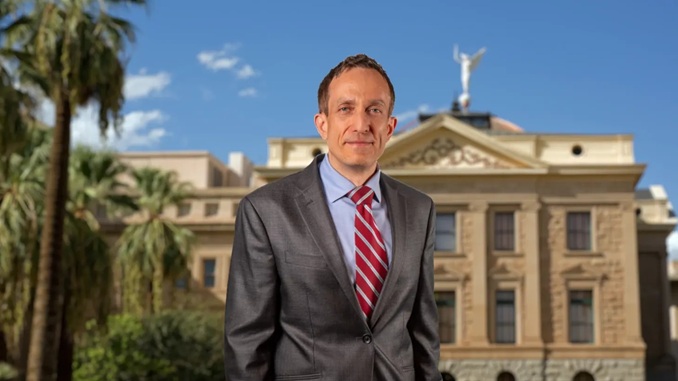
Republican State Sen. Alexander Kolodin (LD3), the resolution sponsor and secretary of state candidate, issued a press release describing the legislation as an opportunity for voters to establish better safeguards for elections by enshrining these proposed rules in the state constitution.
“For years, Arizonans have watched the same election problems repeat while trust in the system has eroded,” said Kolodin. “Election laws should be written by Arizonans, not dictated by bureaucrats, activists, or outside interests.”
Democrats and Republicans argued over the impact of the resolution during the Senate vote last Friday.
Senate Democrats criticized the legislation as redundant at best and a fatal threat to voting by mail at worst.
State Sen. Lauren Kuby (D-LD8) claimed the resolution was a “backdoor attempt” to end mail-in voting. Kuby accused Republicans of being stooges for President Donald Trump’s election policy preferences at the expense of Arizona voters.
“It’s disturbing to see the legislature put the desires of a sad, desperate man above their very own constituents,” said Kuby.
State Sen. Priya Sundareshan (D-LD18) called the bill “unnecessary” and filled with “vague” language, saying the state constitution’s present voter ID and citizenship proof requirements were enough.
State Sen. Analise Ortiz (D-LD24) said the bill was “voter suppression” and “a state-level SAVE Act.” Ortiz argued the resolution would enable lawmakers to repeal mail-in voting in the future. Ortiz claimed Trump was “plotting to meddle in the 2026 midterms.”
“The real goal of this is to make it harder for eligible voters to vote,” said Ortiz. “Our democracy is being systemically dismantled across the country.”
State Sen. Mitzi Epstein (D-LD12) said the legislation’s declaration that only citizens were eligible to vote was not only redundant and unnecessary, but that the other provisions would create an undue burden on mail-in voters.
“This bill opens the door to no more mail-in ballots,” said Epstein.
State Sen. Theresa Hatathlie (D-LD6) claimed the resolution was a template to “lay the groundwork for Project 2025.”
Republicans countered that existing voter registration requirements already require proof of citizenship, and that voters already anticipate security measures when casting ballots.
Majority Leader John Kavanagh (R-LD3) accused Democrats of “confusing the issue” and misleading voters.
“You’re only scaring people and creating a false argument,” said Kavanagh.
State Sen. David Farnsworth (R-LD10) said an increasing number of Arizonans have lost faith in their elections, and that this resolution was the means of remedying that sentiment.
“Our motive is not to make it more difficult to vote, but to make our elections more secure so that all of us can have confidence that those who vote their votes will be counted properly, and that those who win the most votes will be elected,” said Farnsworth.
State Sen. Jake Hoffman (R-LD15) argued that the “overwhelming majority” of Arizonans support these proposed provisions within the resolution.
AZ Free News is your #1 source for Arizona news and politics. You can send us news tips using this link.
An attorney with America First Legal (AFL), the nonprofit created by President Donald Trump’s policy chief Stephen Miller, is running for a seat in the Arizona House.
AFL senior counsel James Rogers is gunning to represent LD10. For the past five years he has been in court challenging faulty election processes and other red-meat Republican issues. With that history heavily promoted, Rogers campaigns as one with the potential to be the foremost election integrity expert in the legislature.
Rogers’ platform also focuses on what he calls “straightforward” conservative issues: affordability to encourage family growth, election integrity, purging gender ideology from schools, protecting the unborn, stopping illegal immigration, and defending gun ownership rights.
Since Republican State Rep. Ralph Heap won’t be returning to represent LD10 — he’s running for the Arizona Corporation Commission — Rogers and State Rep. Justin Olson are running together as a slate.
There’s a third Republican candidate in the mix: Ciara Anderson, who moved to Arizona in 2021 from Washington state. Anderson has served as a Republican precinct committeeman and LD10 executive board member, and founded a mothers-focused coalition through Turning Point Action.
Two are running on the Democratic side: Brian Calaway and Helen Hunter. The No Labels party has one candidate: David Scott.
Rogers, a sixth-generation Arizonan, takes credit for drafting key Republican-led legislation like Proposition 314, the Secure the Border Act approved by voters in the 2024 election. The law criminalized illegal migration into the state and gave the state authority to act on immigration matters: state and local law enforcement may arrest illegal aliens, and state judges may order deportations.
A similar law in Texas, Senate Bill 4, has been challenged in federal court and would determine the fate of Arizona’s law. So far, Texas’s law has withstood legal challenges.
Rogers was senior litigation counsel at the solicitor general’s office for former Attorney General Mark Brnovich during the COVID-19 pandemic, 2021 to 2022. In that time, Rogers led on lawsuits against former President Joe Biden’s COVID-19 vaccine mandates and border policies.
Prior to serving under Brnovich, Rogers was a foreign service officer with the State Department from 2015 to 2021. According to his April 2025 testimony before the House Foreign Affairs Committee Subcommittee on Oversight and Intelligence, Rogers endured retaliation for whistleblowing.
Rogers alleged that State Department leadership ignored Trump on policy to more thoroughly vet visa applicants during his first term, but that he complied and was punished for it through a denial of tenure. Rogers also reported that his rate of problematic visa issuances, such as overstays, was more than 50% lower than his colleagues’ while following the directive of Trump rather than his supervisors.
Rogers estimated that the number of visa overstays was two to four times higher than it would have been had State Department leadership complied with Trump’s orders.
“[T]he malfeasance of State Department consular managers during that time likely caused 900,000 to 1.4 million extra overstays that were easily avoidable. Most foreigners who overstay their visas do so with the intent of illegally immigrating and remaining in the United States long-term,” said Rogers. “To put that in perspective, ten U.S. states have populations of 1.4 million or less. In other words, consular managers working to subvert President Trump’s policies managed to add an entire state population’s worth of illegal aliens in just four years.”
Since joining AFL in 2022, Rogers has led on cases challenging the Biden administration, such as the alleged diversity, equity, inclusion, and accessibility (DEIA) discrimination that occurred within the federal government.
Rogers also testified before the House Judiciary Committee last March to discuss court-ordered immigration policy made through the landmark Supreme Court case Plyler v. Doe (1982), which determined that states must permit children of illegal aliens to attend public school. Rogers argued that the decision was wrong, and that the legal framework used by the Supreme Court to overrule Roe v. Wade through Dobbs v. Jackson could be applied to overrule Plyler v. Doe.
“The Court’s role is to interpret the Constitution, not to serve as a policymaking body filling in the gaps left by legislative inaction,” said Rogers. “Where the Constitution’s text, history, and precedent all point in the same direction — and where the Court’s own analytical concessions compel application of a standard under which the challenged law would clearly survive — the Court must follow the law, not its own policy preferences.”
AZ Free News is your #1 source for Arizona news and politics. You can send us news tips using this link.
Congressman Abe Hamadeh (R-AZ-08) has introduced two new pieces of legislation aimed at strengthening America’s commitment to recovering U.S. citizens abroad and ensuring military equipment is properly secured during overseas withdrawals.
The measures, the No American Left Behind Act and the No Equipment Left Behind Act of 2026, were recently approved as amendments to the Fiscal Year 2027 National Defense Authorization Act (NDAA) by unanimous voice vote in the House Armed Services Committee.
The legislation is expected to be considered by the full House in late June.
The No American Left Behind Act seeks to establish a formal “No American Left Behind Doctrine” to guide future U.S. policy and planning regarding Americans detained or stranded overseas.
The legislation was inspired in part by the release of American citizen Dennis Coyle from Taliban custody earlier this year and Congressman Hamadeh’s ongoing efforts to recover the remains of Arizona humanitarian worker Kayla Mueller from Syria.
Congressman Hamadeh said the legislation is designed to improve coordination among federal agencies involved in hostage recovery and citizen repatriation efforts. The bill calls for reviews of collaboration between the Department of War, the Hostage Recovery Fusion Cell, and other government partners to strengthen whole-of-government response.
Hamadeh has made the recovery of Kayla Mueller a central focus of his congressional service. Mueller, a humanitarian aide worker from Prescott, Arizona, was abducted by terrorists in Syria in 2013 after leaving Doctors Without Borders hospital in Aleppo.
Before taking office, Hamadeh pledged to work toward returning Mueller’s remains to her family. When he was sworn into Congress in January 2025, he honored Mueller’s memory by using her family’s Bible during his oath-of-office ceremony, attended by her parents.
That effort continued in August 2025 when Hamadeh made a trip from Jerusalem to Damascus to meet with Syrian President Ahmed al-Sharaa and Syrian Foreign Minister Asaad Hassan al-Shaibani. According to the congressman’s office, the discussions focused on ongoing efforts to bring Americans home and advance “Peace Through Strength” foreign policy agenda.
The legislation also draws from Hamadeh’s efforts to secure the release of Dennis Coyle. Coyle was detained by the Taliban in Afganistan in January 2025 and held in solitary confinement without charge or due process. Hamadeh publicly called for Coyle’s immediate release in February and Coyle was freed the following month.
“The bottom line is clear: the United States is finally making real progress in bringing Americans home,” stated Congressman Hamadeh. “This bill locks in those efforts — strong, coordinated, and enduring. Every American abroad must know that their country will never stop fighting for them. No exceptions. America First means no American left behind.”
The second proposal, the No Equipment Left Behind Act of 2026, addresses concerns stemming from the U.S. withdrawal from Afghanistan in 2021 and previous incidents in Iraq where American-funded military equipment was captured by hostile forces following the collapse of partner governments and security forces.
According to the Department of War findings cited in the legislation, at least $7.1 billion worth of U.S.-funded military equipment was left behind following the Afghanistan withdrawal. The report also found that the Taliban gained access to approximately $57.6 million in U.S. government funds and captured thousand of U.S.-provided vehicles and military assets after Afghan security forces collapsed.
The legislation further references similar events in Iraq in 2014 when ISIS seized large quantities of U.S.-provided military equipment, including hundreds of armored vehicles that were later weaponized against coalition and partner forces.
Hamadeh’s bill would establish enhanced reporting requirements, risk assessments, and accountability measures intended to ensure military assets are properly tracked, secured, transferred, or destroyed during future military withdrawals.
“The American people should never again be forced to watch billions of dollars in military equipment fall into the hands of our enemies,” added Hamadeh. “We’re still haunted by the shameful images of the Biden Administration’s disastrous withdrawal from Afghanistan — weapons scattered across the battlefield, abandoned to terrorists and our adversaries. Those failures exposed dangerous gaps in leadership, accountability, and planning. Our service members and taxpayers deserve far better — and with this bill, we’re ensuring it never happens again.”
Ethan Faverino is a reporter for AZ Free News. You can send him news tips using this link.
The proposed ballot initiative would have required the Arizona Department of Education (ADE) to establish an online marketplace payment system next year for all ESA purchases with approved vendors, and would have eliminated the current reimbursement and debit card system.
The initiative would also have further restricted allowable expenditures, and required valid fingerprint clearance cards for qualified tutors and school personnel. Any parents who intentionally misuse funds would have been disqualified permanently from the ESA program.
Under the canceled initiative, the ESA program would have had to submit quarterly reports addressing vendor payments, disqualifications, and recovered funds to the attorney general as well.
Fortify AZ was supported in its signature-gathering efforts with millions from the American Federation for Children (AFC). Arizona campaign finance records reflected $1.2 million to their political action committee, but AFC said they invested over $5.3 million into the ballot initiative.
AFC said the proposed reforms were aligned with best policy practices implemented in other states: Texas, Arkansas, Florida, Iowa, Indiana, Ohio, Utah, Tennessee, New Hampshire, and West Virginia.
In a press release issued on Tuesday, AFC CEO Tommy Schultz said their organization backed the ballot initiative as the “best opportunity to save school choice in Arizona,” which they say is under threat by school choice opponents behind the other proposed ballot initiative which would end universal school choice, the Protect Education Act.
“After a small number of individuals acted to sabotage this chance for the school choice-gutting petition to be pulled and commonsense reforms enacted, we are evaluating our best next steps to ensure the union-backed petition does not rip school choice away from thousands of Arizona students overnight and fundamentally break the program for the rest,” said Schultz.
As the Arizona Agendareported, Republican lawmakers and the Arizona Education Association, the state’s largest teachers union, nearly reached a secretive school choice reform deal to end both the Arizona Empowerment Scholarship Accounts Reform and Accountability Act as well as the Protect Education Act.
However, the Arizona Free Enterprise Club raised concerns over the impact of the secretive deal on the ESA program.
Don't Cut a Deal that Kills ESAs — Lawmakers are negotiating a secret bargain with teacher unions tonight. Over 100,000 Arizona students hang in the balance. https://t.co/dToo9ac4uQ
— AZ Women of Action (@AZWomenofAction) June 12, 2026
Ultimately, lawmakers voted against the proposed deal.
Matthew Nielsen, founder of the Educational Freedom Institute, called the Arizona Empowerment Scholarship Accounts Reform and Accountability Act an “ill-conceived, and now ill-fated […] waste.”
The other ballot initiative to end the universality of the ESA program will continue. The Protect Education Act would place a $150,000 income cap for ESA program enrollees.
Additionally, this initiative would not only require qualified tutors and schools to have valid fingerprint clearance, it would subject them to Arizona State Board of Education discipline and require them to pay a fee and register annually with ADE.
Protect Education, Accountability Now, the political action committee behind the still-active ballot initiative, has spent about $2.7 million of the nearly $4.6 million it has raised.
98% of those funds (more than $4.4 million) came from the National Education Association, a national teachers’ union and the largest labor union in the nation.
As of this report, the ESA program has over 100,700 students enrolled.
AZ Free News is your #1 source for Arizona news and politics. You can send us news tips using this link.
The federal government says delays are bound to occur with impending construction on Arizona’s second-busiest border entry point.
The 16-acre San Luis I Land Port of Entry, established in 1984, will undergo another series of renovations beginning June 20 to improve its operations and infrastructure. Construction on this leg of the project will last approximately four to five months per Customs and Border Protection (CBP).
The forthcoming construction is part of a greater $356 million expansion and modernization project which pledges to make San Luis I Land Port of Entry an “eco-friendly gateway” as the “first fully electric, net-zero energy land port of entry” in the country. Construction work on the port of entry began in 2023 and is scheduled to conclude in the spring of 2029.
The port expansion and modernization project was announced in 2024 under former President Joe Biden as a major “green expansion” initiative for his Investing in America agenda. Nearly $100 million of the total project funding came from the Inflation Reduction Act (IRA) subsidies for “low-embodied carbon construction materials and emerging and sustainable technologies.”
IRA funds also went to 37 other land port of entry projects. Sen. Mark Kelly (D-AZ) and former Sen. Kyrsten Sinema (I-AZ) both endorsed the project and its net-zero approach.
The IRA appropriated $3.4 billion for GSA to institute net-zero emissions infrastructure reforms in federal facilities across America by 2045.
The General Services Administration (GSA) has stated in its public project summary for the port of entry that the current infrastructure has proven inadequate to handle traffic volumes and CBP mission requirements.
“The modernization and expansion project will improve efficiencies and traffic flows, reduce wait times, increase CBP processing capacity and operational security by effectively deploying the latest technology to identify high risk activity and shipments and combat drug trafficking,” stated the GSA.
In March, the GSA announced the San Luis I Land Port of Entry opened 16 new northbound vehicle lanes, doubling the previous capacity, covered with two shade canopies spanning 16,000 square feet.
The expansion and modernization project also includes a secondary vehicle processing area, additional pedestrian inspection lanes, and a new administrative facility. It further expands southbound privately owned vehicle operations with upgraded primary and secondary inspection and processing buildings, as well as expanded employee parking.
Last July, the Office of the Inspector General notified the GSA that contractors who hadn’t undergone the required security screening had worked on the port of entry expansion and modernization project.
Travelers seeking passage through the San Luis I Land Port of Entry should review border wait times on the CBP website or the mobile app, Border Wait Times.
The San Luis I Land Port of Entry encounters three million drivers and 2.5 million pedestrians annually, per GSA data.
The GSA awarded the design-build contract for the expansion and modernization effort to Hensel Phelps Construction Company in 2022, which is based out of Colorado and one of the biggest general contractors and construction managers nationwide.
Community stakeholder and civic leader briefings on the port of entry occurred in the spring of 2024.
AZ Free News is your #1 source for Arizona news and politics. You can send us news tips using this link.
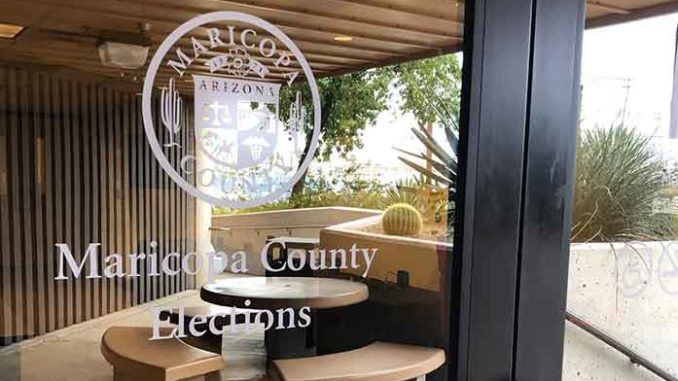
A court has ordered Maricopa County officials to participate in a settlement conference next week to determine election powers.
Maricopa County Superior Court Judge Scott Blaney issued the order in response to Recorder Justin Heap’s request for contempt sanctions against the board.
The settlement conference is scheduled for Monday, June 22. The contempt hearing will remain scheduled for Tuesday, June 30 unless the board of supervisors and recorder resolve their dispute.
In the order issued last week announcing the contempt hearing, Blaney stated that the supervisors would be required to explain their “willful, continuing, and escalating noncompliance” with his order to restore certain election responsibilities, personnel, and technology to Heap.
Heap says the board has failed to return resources to include IT personnel, servers, databases, and websites, as well as refused to authorize the use of state and federal funds.
The superior court ordered the board of supervisors to restore those resources to Heap back in April.
The board has refused to comply. They say the ruling would cause problems with the administration of the upcoming primary and general elections.
“[T]he ruling creates more confusion than clarity,” said the board. “The Board of Supervisors has purchased equipment and planned to provide tabulation of early ballots in the 2026 Primary and General Elections. However, the ruling calls into question who is responsible for overseeing and executing this option for voters.”
Instead, the board has established an independent resource page to provide “just the facts” about the ongoing lawsuit and the Shared Services Agreement (SSA) negotiations that determine the distribution of election authority between the recorder and board.
SSAs distinguish election responsibilities between the board and recorder. Heap’s predecessor, Stephen Richer, coordinated with the prior board of supervisors to reduce the recorder’s scope of responsibilities in his final months in office in 2024.
The board appealed the superior court ruling with the Arizona Court of Appeals last month.
The board maintains that it has “consistently negotiated in good faith” with Heap. Several efforts to settle on a new SSA have failed. The board claims that Heap has made inconsistent demands and “at least twice” rejected their proposed new SSAs.
Also last week, a months-old incident involving employees within the recorder’s office resurfaced following a public announcement by Heap. Heap accused the board of retaliation over a criminal investigation into two of his employees for alleged theft of election equipment. Board Chair Kate Brophy McGee accused Heap of perpetuating “a parade of falsehoods, misrepresentations and strawmen.”
The board responded that Heap’s employees had no right to remove and later return an envelope scanner from the Maricopa County Election and Tabulation Center during the Tempe Jurisdictional Election. According to the board, that equipment was replaced due to the alleged security compromise.
Heap countered that the equipment belonged to his office and was therefore under the purview of his employees. Heap claimed the board ignored the alleged incident for months and dismissed their narrative as “baseless allegations.”
🚨 UPDATE: RECORD CORRECTS THE BOARD'S MANUFACTURED SCANDAL AND MALACIOUS SLANDER.
The Board spent 3 months sitting on these baseless allegations. Then, after losing in court again and facing contempt proceedings, it launched a smear campaign against career election employees… https://t.co/FRSwQb27ml
— Maricopa County Recorder Justin Heap (@azjustinheap) June 12, 2026
AZ Free News is your #1 source for Arizona news and politics. You can send us news tips using this link.